



Few men of the 20th century truly earned that “polymath” label as convincingly as Ludwig von Mises. His expertise stretched from economics to politics, to philosophy, to history, giving his work unmatched breadth and depth. But eventually, great thinkers have to answer to time, to contemporary evidence they never lived to see.
In Human Action, Ludwig von Mises provides an account of Rome’s civilizational collapse from an Austrian perspective. Mises argues that currency debasement & price controls paralyzed food merchants and crushed the division of labor, turning Rome into a sort of autarkic (non-cooperative) production process with little urban commerce. Mises seems to be trying to explain the crumbling of Rome more broadly, rather than just the capital, but this account also supposedly explains the internal struggles that made invasions possible.
Mises writes:
“What brought about the decline of the empire and the decay of its civilization was the disintegration of this economic interconnectedness, not the barbarian invasions.” [...] “(price controls & debasement) completely paralyzed both the production and the marketing of the vital foodstuffs” (Human Action, page 762)
The two distinct parts of this are:
Currency debasement hollowed out the Western Empire over two centuries
The 301 price edict did enough damage to outweigh competing explanations
These are very strong claims that require more than theoretical mechanisms. The analysis is certainly elegant, intuitive, and interesting, but it is far too reductive and convenient. And to be clear, I oppose price controls. I have no doubt that price ceilings discouraged production to some degree, and debasement certainly made entrepreneurial planning difficult, but it seems like an incomplete view of history. In Mises’ analysis, several notable factors go unmentioned or are subordinated to economic discussion, meaning the politics of the invasion are left undiscussed.
For starters, the actual Diocletian price edict occurred in 301 AD, whereas the Gothic (barbarian) sack of Rome occurred over a century later in 410 AD. If price controls were so damaging, it seems strange that it would have taken over a century to fester into a disaster. Furthermore, it’s not so clear to me that the price control was all that enforceable, meaning it was a price control on paper only. As for debasement, over the span of 2 and a half centuries, silver content dropped from 90% under Augustus to 5% by the 3rd century. It seems also unexpected here that such enormous debasement would produce no immediate economic rupture, but a catastrophe only in the 4th century AD.
There’s also a messy natural experiment we use as weak abductive evidence between the East & West. The Eastern Empire (Constantinople) inherited all the bureaucratic and statist baggage that the West did, yet it survived ~a millennium past the sack of Rome. This would certainly be highly unexpected under the Misesean hypothesis, where statist baggage is an enormous driver of imperial collapse.
Not to sound too ‘empirically-minded’, but I think the obvious issue in all this is a lack of an identification strategy. A century-long gap between the price edict and the sack of Rome doesn’t disprove Mises’s conclusion, but it seems to be evidence that lowers the probability of his view being true. And remember, the burden is on him (or other Austrians) to show that price controls were the reason for the persistent decline in commerce and the weakened military capacity.
Keep in mind, Mises’ empirical scaffolding leans on Michael Rostovtzeff’s book, “The Social and Economic History of the Roman Empire” (see page 762 footnote), published in 1926. Because Mises wrote Human Action in the 1940s, his pool of resources is far less comprehensive than the work we have in 2026; thus, given how contemporary scholarship has focused on archaeology, regional comparisons, and ceramics, the evidentiary standard seems to have grown far past what Mises could have even possibly provided in his nearly century-old book.
The irony here is that Mises is correct that long stretches of food networks made Rome vulnerable, but the economic collapse in 410 AD was not from merchants refusing to sell grain under Diocletian’s price ceiling; it was the army that controlled rivers, harbors, and other trade routes. So skipping over the military land control while elevating price controls as a factor seems mistaken.
The more plausible story seems to be that prior to Diocletian, there was massive political instability. Emperors would get shuffled in and out in mere months. The implication here is that virtually every policy gets slashed before it bears fruit. Thus, Diocletian, who served for decades (284-305), stabilized government volatility through the Tetrarchy, designing a four-emperor autocracy. As you can imagine, as is the case with most autocratic regimes, dissent is inevitable.
So in essence, Diocletian’s authoritarian ‘Tetrarchy’ temporarily stabilized political regime continuity, only to violently collapse into self-sabotage. After a wave of mass paranoia swept the elites, Honorius (the Western emperor) ordered Stilicho’s (a general) execution. Roman soldiers subsequently slaughtered the wives & children of barbarian federates living inside Italian cities, which caused the surviving relatives to defect to the Barbarian army outside the city walls. Not the smartest move to say the least.
It certainly seems incomprehensible that a century of price controls would have set the stage for the invasion of Rome; after all, the defensive infrastructure was incredible. The walls were mixed with volcanic ash and lime, standing at 8 meters high and 3.5 meters thick, reaching ~12 meters high by 403 AD. The Gothic barbarians could surround the city, cut off food supply lines, or wait for an unlucky famine, but actually vaulting past thick slabs of limestone is an entirely different matter.
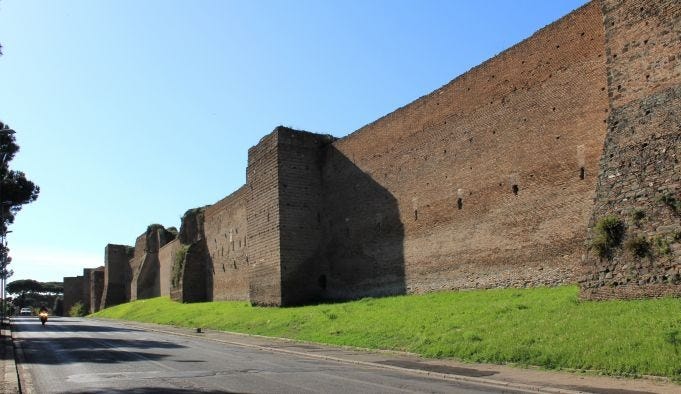
The story that I most believe is Procopius’ account, who claimed that 300 Gothic youths entered as enslaved ‘gifts’, only to kill the guards and open the Salarian Gate. Sounds like a plausible Trojan horse story. Another plausible explanation that I’ve suggested is that Goths already living inside the city secretly worked with outside forces to open the gate. In any case, the historical consensus seems to be a mix of siege and internal fracture, which cuts against Mises’ anti-statist account.
While I think Mises is correct in observing the pain caused by price controls, he falls extremely short by blindly assigning causes without considering other non-economic factors such as a lack of Gothic assimilation and political fault lines. Even if he’s correct that debasement strained commerce, the invasion in 410 seems to be explained better by failed Gothic assimilation, military fractures, and a government that slaughtered the militant coalitions that it needed to ward off invaders. We can imagine a counterfactual in which prices were liberalized, leading to more prosperity, but this seems unlikely to have prevented inter-coalition slaughters and mass defections to the barbarians.
This is a frequent problem I’ve stumbled on in heterodox economics. Because these schools badly want a paradigm shift, they constantly market themselves as deeper alternatives to the empty world of Neoclassical economics. So it’s no surprise that heterodox thought leaders feel so obligated to not only explain more, but to explain everything with their theory. Where Austrians find price controls behind every empire’s collapse, Marxists find ‘internal contradictions’. So in short, Mises may be right in pointing out that Diocletian’s price edict made the empire poorer. In fact, the economic story might just be causally upstream of the political explanation, but economic intervention didn’t cut the city’s militia or create political dissent; thus, Mises is smuggling in a strong causal thesis with a very thin layer of outdated evidence.


Theory is ultimately inescapable.
You too, after all, have presented your own competing theories to explain the historical causes. We can call them, for convenience here, "a theory of assimilatory tension," "a theory of anticipating proportional retaliation to brutal aggression," and maybe a theory of "consequences of incorrect political maneuvers," if you may. Mises is not rejecting all these causes in my opinion; he simply thinks the economic cause is larger than any of these, as evident from the following where he writes, "From a military point of view the tribes which invaded the empire in the fourth and fifth centuries were not more formidable than the armies which the legions had easily defeated [p. 768] in earlier times. But the empire had changed. Its economic and social structure was already medieval."
When multiple causes seem valid in bringing about a historical event, historians ultimately decide what they think is the correct order of importance among these causes, and one historian can differ from another in this regard.
For example, say John loves ice-cream, and he had bought himself some on Tuesday afternoon, but he was also very hungry at the time. So did he buy the ice-cream because he loves ice-cream or because he was hungry? Which factor was more important than the other? Were they both equally important? What was the ultimate deciding factor of the two? There is always some room for differences of interpretation in the ordering of causes, and historians can differ from each other even when they follow similar theoretical systems. Incidentally, this question of difference in historical interpretation too is something Mises discusses in his section on "Ideal Types" and "Conception and Understanding" in Human Action, and also in his other works.
But anyway, besides the events that caused political upturning at the seat of power in Rome, I think Mises is ultimately more concerned with the entire economy of Rome receding in structure and becoming less sophisticated in its division of labour across greater territory. It is what he means by it turning into a "medieval" economy. This was a matter of concern for him as he saw this as evidence that economic advancement is not a given and can reverse and recede due to interventionism, and it was in Rome he thought this happened, and he believed some version of it happened in other ancient civilizations as well.