

Another Movie Pre-Review
The untold story of Reagan at Reykjavik

As mentioned yesterday, I’m scratching my head about the new film from Angel Studios out in the last few days, The Brink of War. It presents itself (see the trailer below) as the inside story of the climactic summit meeting between President Reagan and Gorbachev in Reykjavik in October 1986, which came tantalizingly close to an agreement to abolish all strategic nuclear weapons over a ten-year period. The prospective deal collapsed at the end because Reagan refused to limit the development of his missile defense program (the “Strategic Defense Initiative,” or “Star Wars” to his critics in an epic PR blunder, because who didn’t love Star Wars in the 1980s before Lucas began wrecking it with his revisions).
First, Angel Studios (formally just rebranded as “Angel”) is a somewhat right-leaning, faith-friendly, family-friendly outfit. They acquired and released The Sound of Freedom a few years back when none of the usual pedo-friendly Hollywood studios (isn’t that all of them?) would release it, where it became smash hit. More recently Angel released Young Washington to much acclaim, and also has produced a biopic of Dietrich Bonhoeffer (based partly on the Eric Metaxis biography I think), which was controversial with the left—a point in its favor of course.
On the other hand, Angel also released the recent animated adaptation of Orwell’s Animal Farm, and it was a complete botch job.
And from just the title and other advance details of the Reagan-Gorbachev film I highly suspect it is offering a completely inaccurate story, too. I have not heard of the young writer-director, Michael Russell Gunn, who has some decent productions to his name. He is said to have worked from original documents (more on this in a moment) and interviews with surviving participants in the summit.

First—Jeff Daniels as Ronald Reagan? Right away you can move your status to DefCon1. Daniels is a very left actor, who revels in left-wing roles on screen to match his personal politics. It is hard to imagine him taking the role unless he approved of the spin of the script. Could the script actually portray Reagan favorably? Maybe Daniels accepted the role as a bank shot of sorts. He is a certified Trump Hater (is it necessary to point this out?), and perhaps by celebrating Ronald Reagan he intends it as an implicit criticism of Trump.
Keep in mind that after the summit collapsed in such dramatic fashion, Reagan received huge criticism from Democrats and the media for refusing to trade his “pipe dream” of missile defense for a sweeping arms deal that would surely have won him a Nobel Peace Prize. It is possible the film will continue to portray Reagan as the stubborn old man and make Gorbachev the hero.
Second, judging by the trailer to the film (not to mention the title), the premise is entirely wrong. The trailer says that in the fall of 1986, the world was on “the brink of war.” The trailer has J.K. Simmons, playing Secretary of State George Schulz (I love Simmons, but this seems an odd casting choice) saying to Reagan, “You got the Russians to the table. . . But if we fail here, there will be war.”
This is completely, absolutely false and ahistorical. First, the Reykjavik summit was Gorbachev’s idea. And it wasn’t intended as a full-scale “summit,” but as a quick meeting for Reagan and Gorbachev to break the logjam of the two nations’ arms control teams that were not making any progress in their follow-up negotiations after the promising summit in Geneva the year before. In fact it is well known now to historians that Gorbachev had already decided that the arms race needed to end—because it was in the interests of the Soviet Union to do so. His own military establishment, which was terrified of Reagan’s missile defense program, demanded that Gorbachev gain some concessions about it before it would sign off on an arms treaty. (Reagan’s joint chiefs of staff, who were not brought to Reykjavik, were also wary of an arms deal—more on this in a moment.) The point is, warlike tensions were receding rapidly by 1986—the real war scare was actually the fall of 1983, but that wouldn’t make for a feature film.
Gorbachev’s message to Reagan suggesting the meeting was simple: we’re the only people who can propel a reduction of tensions. Reagan and his team were actually wary of the meeting, correctly fearing an ambush about SDI. And hence the climactic moment when Reagan said “No deal!”
But there is a more interesting subtext to the whole scene that was unknown at the time and generally overlooked in the years after because of the central arms control drama. It concerns the startling philosophical debate between Reagan and Gorbachev in their several private meetings. Years ago I came across the translated Soviet transcripts of these meetings, which were much more detailed than our State Department “memcons” of the dialogue, which are always terse.
Start with this exchange, from their third and climactic face-to-face meeting on the last day:
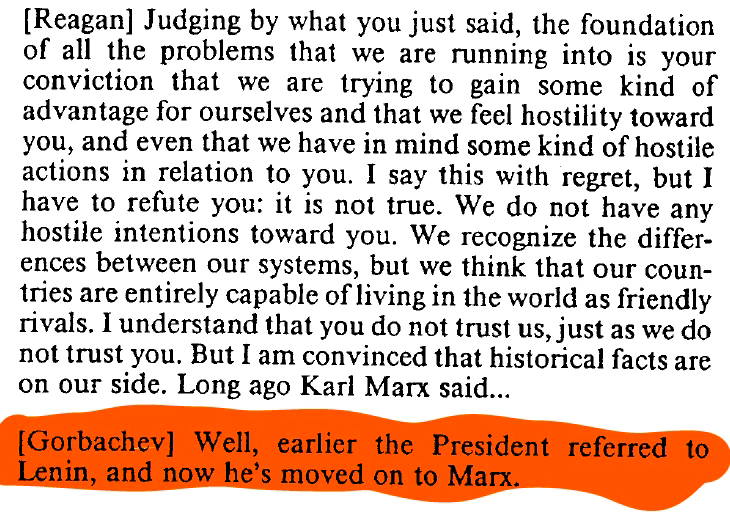
Here Gorbachev was gesturing to George Schulz with his interruption, hoping Schulz would bail him out of having to listen to Reagan lecture him tediously about Marx and Lenin, but Schulz knew better. But that’s why the odd third-person reference here, with Reagan sitting just five feet away. The immediate sequel is quite stunning:
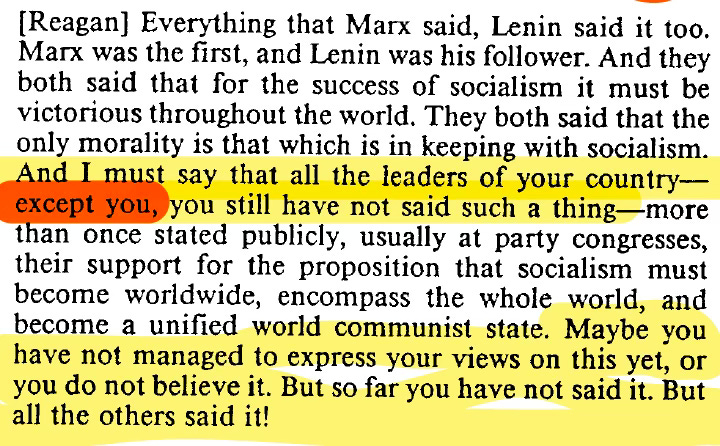
Reagan believed that we should take seriously the long-time Soviet declarations in favor of world revolution, which “sophisticated” Westerners always discounted or waived away. But why shouldn’t we think they were serious about this? In any case, Reagan had paid close attention to Gorbachev’s first major speeches to the Soviet Presidium, and noticed the omission of the old revolutionary boilerplate.
Here, I suggest, is the moment the Cold War ended, or would have if Gorbachev had recognized it. He had invited Gorbachev to clarify and repudiate the old doctrine. But he missed the moment. (He did implicitly repudiate the old doctrine at the UN in December, 1988, when he disavowed the old Brezhnev doctrine.) Let’s continue:


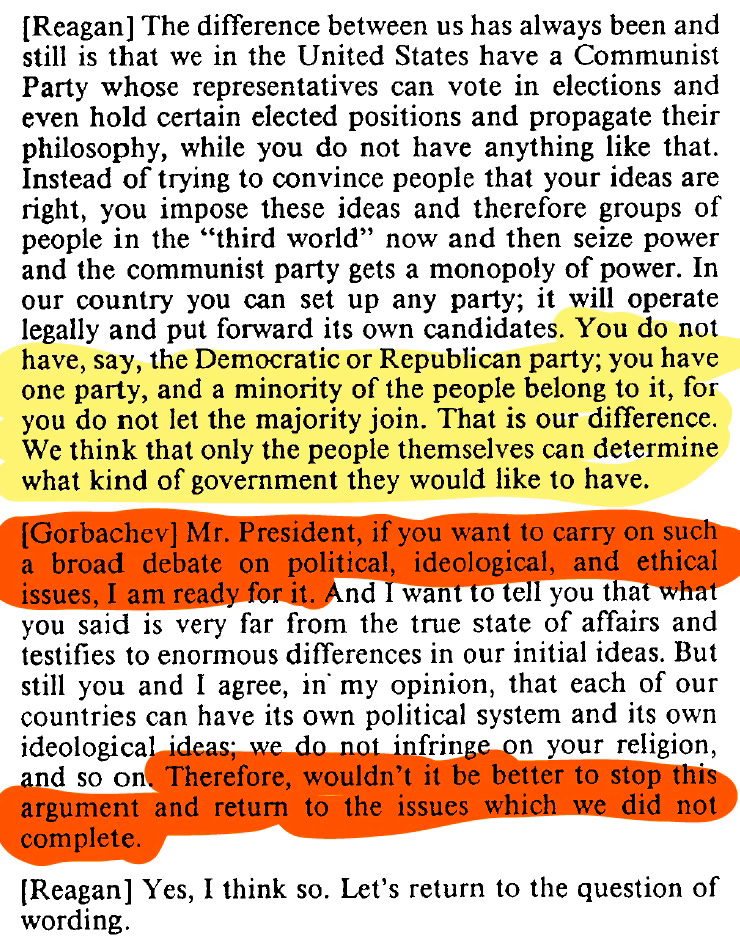
Gorbachev says that he is “ready” for a philosophical debate, but in fact he wasn’t, as he made clear when instead of pivoting back to nuclear details, he doubles down:
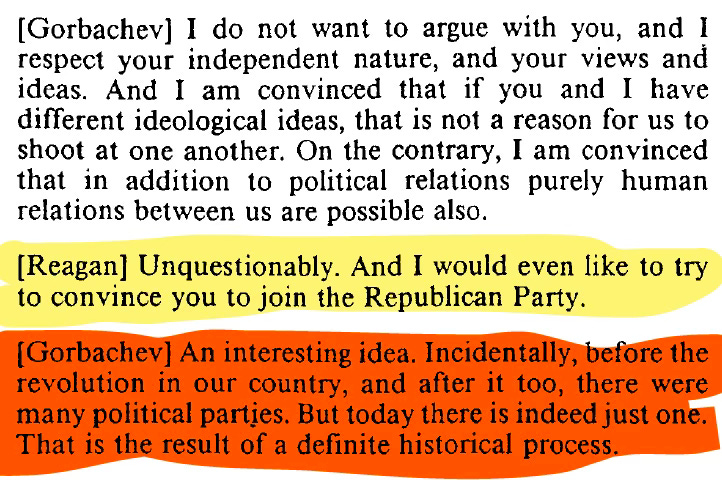
I’m pretty sure Reagan was partly joking about Gorbachev becoming a Republican, but Gorbachev’s reply (“a definite historical process”) demonstrates that despite his liberal reformist inclinations—which were genuine—at the end of the day he could not shed his orthodox Hegelian-derived Marxism.
I doubt any of this extraordinary colloquy will make the film, but if anyone sees it before I do, let me know. Love to be wrong. Gorbachev later described the meetings as having had “Shakespearean passions.”
There is one other exchange that both humorous and revealing of Gorbachev’s stubborn residual Marxism, and it concerned showing Soviet movies in America:
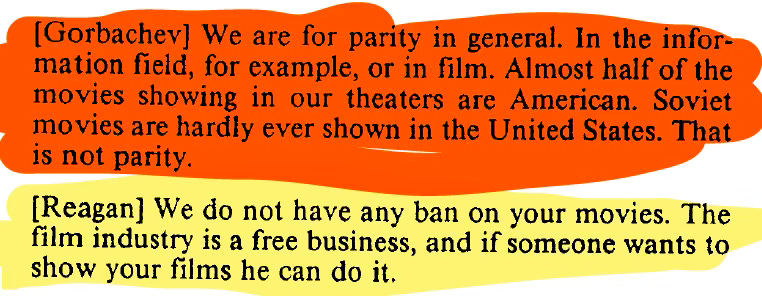
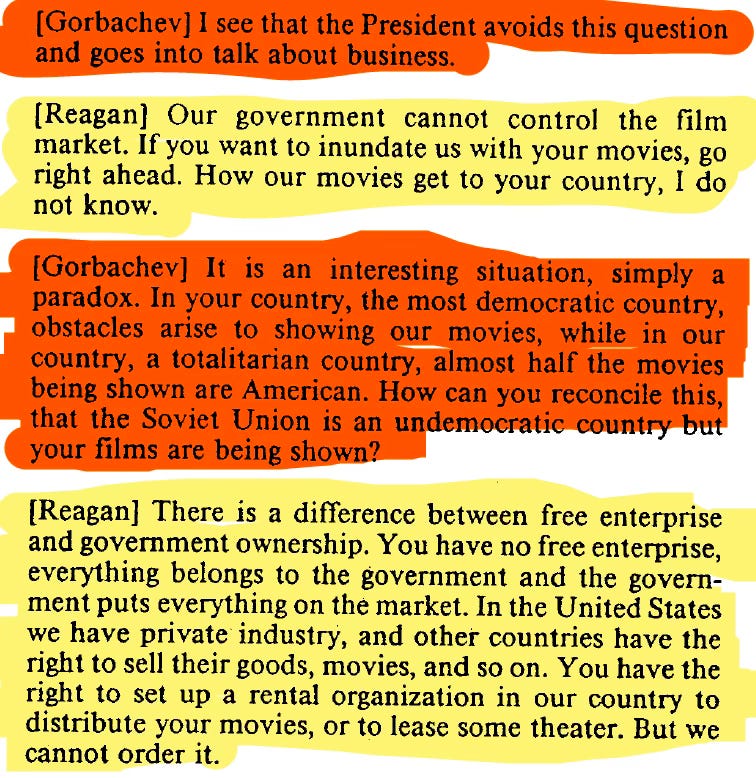
As a former Hollywood actor, it had to take all of Reagan’s restraint and politeness not to burst out laughing at Gorbachev’s complaint, and say something like: “If your film industry made anything worth seeing, believe me our theaters would rush to show them!” Instead, Reagan bears down again on the fundamental differences between the two systems. What was Gorbachev thinking? In any case, he abruptly changed the subject.
There was one more interesting exchange that most everyone has ignored:
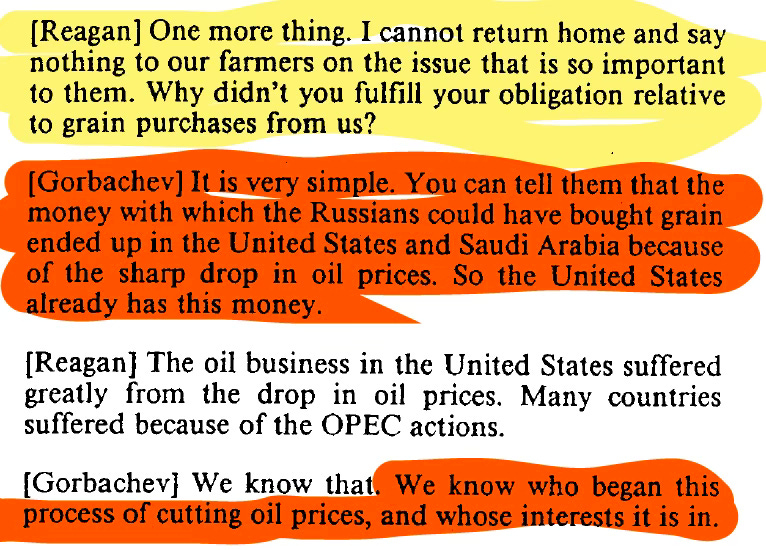
Here is Reagan at his passive-aggressive best—ascribing the question as something important to someone else—and Gorbachev at his prickly best: he is saying in the last sentence here that he resents the fact that Reagan was collaborating in pushing oil prices down as a means of waging economic warfare against the Soviet Union.
In any case, while the mood in America after the meeting was gloomy and highly critical of Reagan, Gorbachev said to his own team in the flight home to Moscow that he thought an arms breakthrough and peace were closer than ever. The “brink of war” theme of this film’s title was completely wrong. And in fact the Soviets folded in their demands in the following year.
By the way, if Reagan and Gorbachev had struck the deal, it would have become unstuck very quickly. But that’s a story for another day.
For what it’s worth, here’s my 10-second summary of the matter from the scene in Reykjavik on my visit last year:
P.S. I neglected to include these fabulous memes in yesterday’s item about The Odyssey:
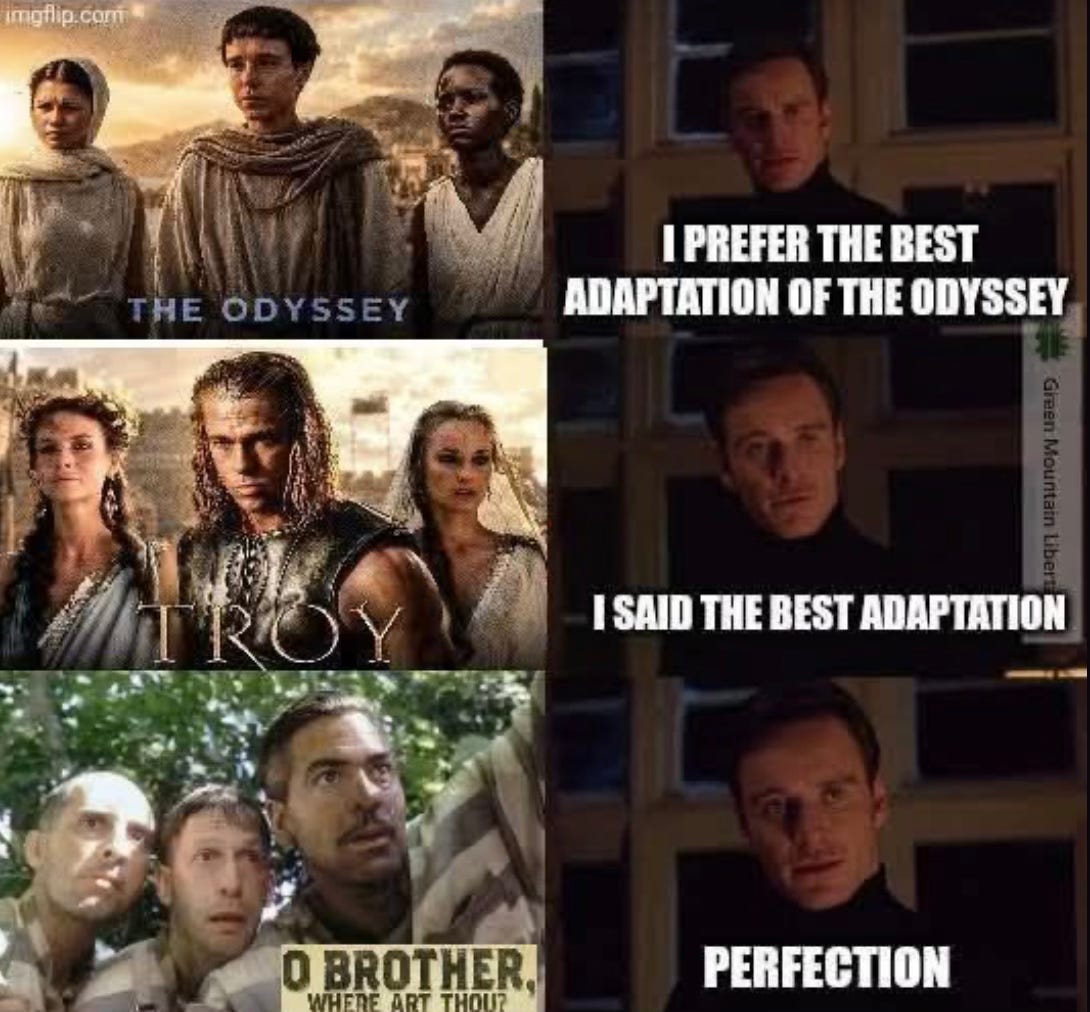
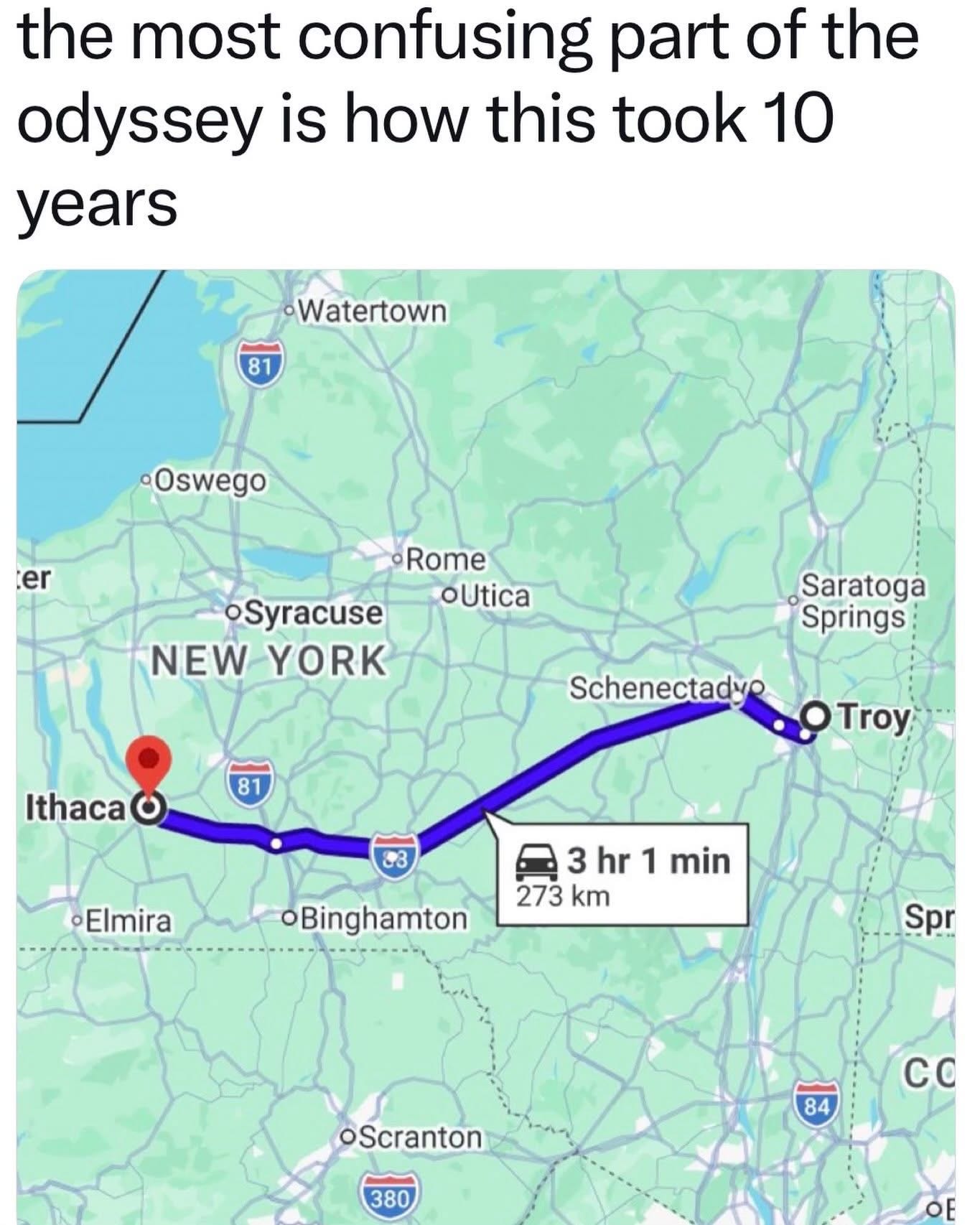


Steve is too pessimistic.
I have no doubt that this film will be as faithful to historical events as was "Truth", starring the late Roy Hobbs.
For those unfamiliar with that 2015 box office smash, it is a rigorously fact-checked documentary about Dan Rather's heroic efforts to preserve journalistic integrity and honor -- in the face of incredible danger (read about the Kenneth Frequency Assassination Plot) -- by reporting on Dubya Chimpy McHitler's dereliction of duty while he was in the Air National Guard.
The scene where Bush, soused, is caught reading "My Pet Goat" at a dive bar while his squadron was preparing for a top secret mission to fly their F18's upside down into a steep canyon to precision bomb a nuclear enrichment facility, remains seared in my memory.
Thus, even though 97 percent of ABA-approved historians agree that Glasnost Gorby deserves all the credit, Reagan -- an amiable dunce who was frequently observed double-fisting jellybeans while the world careened towards mutual assured destruction -- should garner a measure of respect for sitting quietly in the room while Nancy signed the INF treaty.
1. Come for a "pre-review" of a movie, and get a great history lesson. This lesson includes a reminder that socialism can only work if the entire world suffers. (Actually, a socialist state can thrive if it is surrounded by a bunch of very successful , larger capitalist countries.)
2. Wow! The DETAILED story of the Gorbachev-Reagan October 1986 Reykjavik meeting is EXCITING. Every high school kid should be taught it. It even includes laugh-out-loud humor.
3. Who'd have thought the SOVIET transcripts would be so thorough and CANDID ?
4. Criticizing Reagan's Strategic Defense Initiative by calling it "Star Wars"? I remember that, and I remember describing it as the Star Wars Defense when arguing for it with my liberal friends. To Steve's point about everybody loving the Star Wars movies back then (i.e., when there was only the original trilogy), my liberal friends considered that a favorable description.
5. The Soviet transcript illuminates why Ronaldus Magnus (ahh, memories of the late, great Rush Limbaugh) was correctly known as "The Great Communicator."
6. Thanks, Steve.