Phantom Frequencies: Kiyoshi Kurosawa on Serpent’s Path, Chime and listening to inner darkness

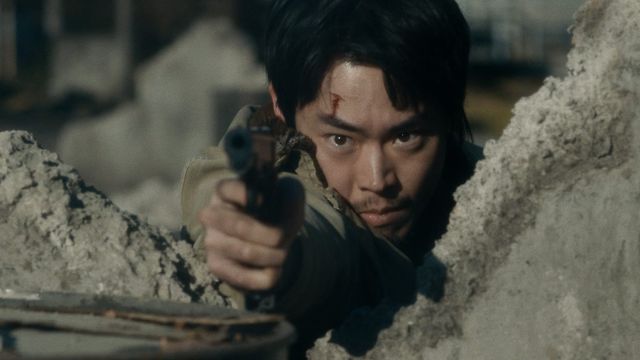
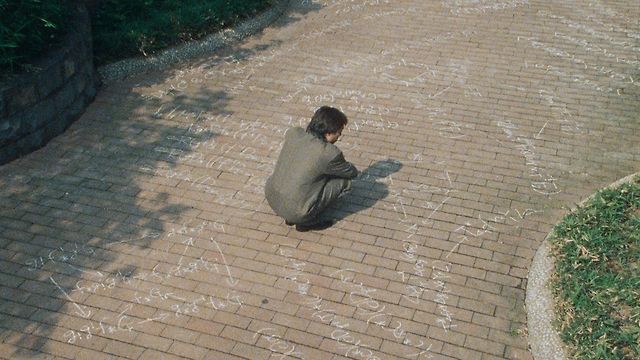
Figuring out the equations in Serpent’s Path (1998).

With his deeply unsettling short film Chime playing in theaters alongside a new 4K restoration of his 1998 revenge thriller Serpent’s Path, visionary filmmaker Kiyoshi Kurosawa tells Isaac Feldberg about experimenting within genre constraints and believing in ambiguity.

To continuously have the audience watch and be locked into the screen to see what action comes next, through one action after another, and then to suddenly have the film be over, I feel that this is an ideal shape of film.

—⁠Kiyoshi Kurosawa

Widely regarded as one of Japan’s most influential living filmmakers, Kiyoshi Kurosawa is best known for masterful psychological thrillers in which the threat of sudden violence thrums almost imperceptibly beneath the surface of everyday life.

Creating an atmosphere of existential dread and isolation as he peers into the abyss of human impulse, Kurosawa’s greatest films—from his hypnotically disquieting detective procedural Cure, in which the hunt for a serial killer accrues darkly philosophical overtones, to his supernaturally charged horror Pulse, where technology serves as a conduit to the ghost realm—confidently blend and bend genres while exploring themes of identity loss, metaphysical decay and spiritual emptiness.

Furthering Kurosawa’s international exposure following a banner year that included a stateside theatrical run for Cloud, his suspenseful gig-economy thriller, Janus Films is now bringing two of the director’s underseen masterworks to US theaters as a double feature. First is Serpent’s Path, a gangster thriller that the filmmaker made as his follow-up to Cure, following two men—low-level ex-yakuza Miyashita (Teruyuki Kagawa) and his friend Nijima (Sho Aikawa), an enigmatic math teacher—who seek revenge for the death of Miyashita’s daughter by abducting the person they believe responsible, only to spiral into confusion after he points to another possible culprit.

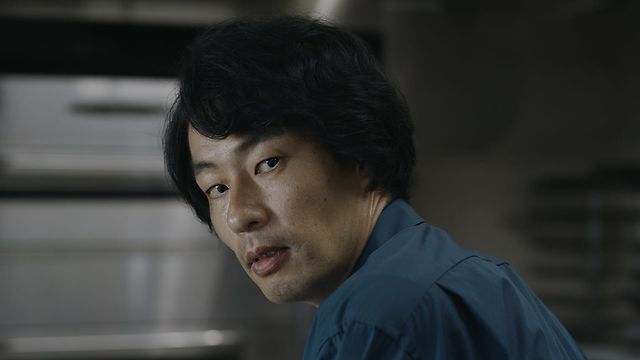
Along with it comes Chime, which originated as an NFT and clocks in at a ruthlessly economical 45 minutes, centering culinary instructor Matsuoka (Mutsuo Yoshioka), who—after witnessing the suicide of a young student (Seiichi Kohinata), who’d claimed a mysterious chiming sound was controlling his actions—begins his own descent into madness. Both films are being released theatrically for the first time in the US, with Serpent’s Path playing from a new 4K restoration; Chime will reportedly only play in theaters and never be released on streaming platforms.

Though Kurosawa operates at a highly prolific pace, often directing multiple pictures in a single year, he’s recently had reason to revisit this earlier work. At the behest of a film studio in France, Kurosawa remade Serpent’s Path in 2024 from a new screenplay co-written with journalist Aurélien Ferenczi; shifting across borders to shoot entirely on location in France, Kurosawa also changed the gender of Nijima from the original screenplay by Hiroshi Takahashi (Ring), casting actress Ko Shibasaki in the role.

Outside of promoting Chime and Serpent’s Path, Kurosawa is also preparing for the premiere of his ambitious new feature, The Samurai and the Prisoner, which he has described as a cross between a samurai film and a locked-room mystery, debuting at next month’s Cannes Film Festival. Set in sixteenth-century Japan, the feature—recently acquired by Janus Films for US release—centers on a general of the warlord Oda Nobunaga who rebels against his master’s tyrannical methods; besieged within his castle and struggling to protect its people, he’s confronted with a series of mysterious crimes, ultimately entering into an uneasy alliance with a brilliant, dangerous military strategist he’d previously imprisoned in the castle dungeon.

News of the upcoming Cannes premiere serves as a well-timed reminder that Kurosawa’s range extends far beyond the metaphysical horror for which he’s best known; in conversation with Journal about Chime and Serpent’s Path, the filmmaker, speaking alongside interpreter Aiko Masubuchi, reflected on how working extensively throughout the ’90s on Japanese genre films (including action, gangster and horror movies) made directly for the VHS market—known collectively as V-cinema—allowed him to experiment freely with mood and narrative in a way that prepared him for the extraordinary oeuvre he’d subsequently produce.


Many of your films, from Serpent’s Path to Cloud, feature characters wandering through these decaying industrial warehouses, and I’m curious about the inspiration behind this choice of setting. Are these locations commonplace around the borders of cities near Tokyo and its suburbs, and what do they represent to you thematically?

Kiyoshi Kurosawa: You’re right. I do often shoot in locations like this. There are two reasons for this, broadly speaking, that I can talk about. The first one is that they both have a lot of shootout scenes, or scenes of people falling; there’s a lot of action going on in a lot of the scenes that I’m shooting in these locations. This is something I can’t shoot in the middle of Tokyo, because Tokyo is, in fact, a very difficult city to shoot in. When I consider where I can do these kinds of scenes, we end up picking these decaying places, as you see in the films.

The second reason is that, when we’re shooting, we do shoot in these dilapidated factories and buildings, but what I have realized is that—when we find these kinds of locations—what often happens, especially near and around Tokyo, is that they will get demolished very quickly. When these places are razed, they suddenly become very clean, and that happens very quickly. So even if I shoot in one location and I want to use that location again the next year, it’s often the case that this location is no longer there by the time I want to shoot my next film.

Even when I’m driving around in a car, unrelated to shooting, I will sometimes notice a factory or a building that’s dilapidated, and I go, “Oh, there’s one here.” In some ways, because I know this place could be there only fleetingly, my instinct is to go, “We must go shoot somewhere around here while this place actually exists.” In some ways, I’m being compelled by this feeling of needing to document or record the fact that this building is there while it still exists.

Serpent’s Path arrived amid an extremely productive period of your career, in which you were making TV dramas and V-cinema, primarily in the horror and gangster genres. Cure, your international breakthrough, came in 1997—just one year before. Serpent’s Path, with Eyes of the Spider, formed this duo of yakuza pictures about the desire for revenge. What do you remember about making these two films, and were you more satisfied with one than the other? 

As you noted, both of these films were made towards the end of the ’90s, and I was very much making a lot of V-cinema at the time. The way that those films tended to be shot is that we would make two films at the same time. As you mentioned, I was making Eyes of the Spider at the same time that I was making Serpent’s Path. What this meant is that I was shooting both of them basically at the same time, because I was shooting two films in the span of four weeks, so we were basically allocated two weeks each for shooting.

What those films have in common is the actor, Sho Aikawa, who’s in both, but everything else, including the story, is very different. The cast is different. But, again, I was making them at the same time, over the course of a month. I would take on these kinds of jobs at that time, and I would do that maybe two or three times a year, so as a result I would end up making about five to six films in the course of a year.

Looking back at this time, I feel that it was a very fulfilling and happy period of my filmmaking life. Of course, we were making films on a very tightly controlled schedule and in a particular way, but I was continuously making films in that way. With V-cinema, the films were being made for VHS rental stores; in that sense, the films that were made through V-cinema were lower-ranked than what people consider films to be. After they were made, there was no real consideration about whether the film needed to be a hit or whether it needed to make it big at the box office. We also didn’t have to think about sending the works that were made into international film festivals, or about how the critics would receive it; those things were irrelevant. Once we made the film, our work was done.

Also, we were working with Sho Aikawa, who was very much the star of V-cinema, so whatever he was in would always do very well. He was also a free-spirited person, and he was always open to experimentation; he would be on board with doing something because he thought it could be interesting, or that it could be fun, and so I was able to use other people’s money in a way to continuously be able to experiment and actually just do, and work and be in process. I could experiment by shooting a certain way and realize that it resulted in a certain kind of film, or I might ask the actor to act a certain way and then be able to understand the results of that. Within this construct of genre filmmaking, I was given great freedom to experiment; in that sense, it was truly a very happy, fulfilling period for me.

Even though the genre is that of gangster film, I wanted to shoot it in a way that was horror, in such a way that a ghost or a dead body could appear at any moment.

—⁠Kiyoshi Kurosawa

In Serpent’s Path, when schoolteacher Nijima is asked why he’s helping the increasingly unstable Miyashita, he casually replies, “I always wanted to try something like this.” This type of protagonist abounds in your films, testing their limitations and transgressing past moral, emotional or psychological boundaries, but doing so with a certain detachment or apathy. What is it that appeals to you about this type of character, and about continually exploring human psychology in this sense?

That’s a very astute question, regarding that line of dialogue, which was actually written by the author of the screenplay, Hiroshi Takahashi. At the time when we were making the film, I didn’t quite understand what this line meant, because, after all, the character is very calculating in how he is laying out all these plans, and yet he also just comes out and says that this was something that he just wanted to try. [Laughs] I had this question in me, and I was not quite understanding it, but I was also just thinking, “Well, it’s V-cinema after all, so let’s just shoot the scene, even though I don’t quite understand it.”

I remember, now that I think back on it, being on set with Sho Aikawa, saying to him that I didn’t quite understand this line but [asking] did he feel he could still say it in a compelling way. He said to me, “Yes, of course. No problem. This type of line of dialogue exists in all your films, anyway.” That was surprising to me, and I remember feeling that surprise on that set.

Personally, I don’t ever feel like I’m depicting any characters that can commit all these extreme, violent acts without having a reason, who’d ever say “I just felt like doing it.” Usually, I feel that I am depicting characters who very much have a reason for doing what they’re doing, or whose motivations or intentions are within the realm of all of us to understand. Those characters are the ones I feel that I am depicting, but people will sometimes comment to me that I’m depicting characters whose motivations are not quite possible to grasp, even though I don’t feel that I am depicting characters who are over the top in this way. It’s a mystery to me. I’m not entirely sure what I should do about that. [Laughs]

Mutsuo Yoshioka stars in Chime (2024).

Perhaps I could ask, also in terms of Chime, about how deliberately you pace your films, in terms of following characters and carefully building toward the violence they enact. It’s this hypnotic, slow-burn atmosphere that makes your films so potent in their sense of dread; it can often feel like your characters’ behavior is somehow escalating out of their relationship to their environment.

As you know, Chime is a shorter film. It’s about half the length of what a regular feature film is. When making this film, I was very intentional about showing somebody who’s doing these things, about showing that they exist, and I was very intentional that we don’t ever reveal why this person is doing what they are doing. With my other, longer feature films, this is not how I think that I’m operating or how I think I’m working. But, regarding Chime, I was very intentional in this respect of not revealing why.

In talking about why I did this, I think it’s because a part of me believes that explaining the reason for somebody’s actions is not very interesting filmmaking. To continuously have the audience watch and be locked into the screen to see what action comes next, through one action after another, and then to suddenly have the film be over, I feel that this is an ideal shape of film and way of filmmaking.

That all said, it’s not so easy to do this on the script level, and also to tell an actor to perform something like this, because, without revealing their motivation, it’s very difficult for an actor to be able to act and do what they have to do. So, especially with more commercial or bigger-budget filmmaking, I do believe that—in some ways—you need to show the reason behind why certain protagonists are doing what they do. With Chime, I decided not to do that, that I was not going to reveal the reason, and I think it’s because, for a long time, I have felt this is more what an ideal film should be.

Perhaps it is a little irresponsible for me to say this, but I do feel that there is no need for a film to have a very clear conclusion. In fact, I find it strange for a film to have that.

—⁠Kiyoshi Kurosawa

For the Belfort Entrevues Film Festival, you once played a game of “double features”. With each of your films screened there, you associated a film from your personal pantheon. Which films might you associate with Serpent’s Path and Chime?

Regarding Serpent’s Path, it was a film that I made such a long time ago, so I am having a difficult time remembering what headspace I was in back then. This answer is not necessarily limited to Serpent’s Path but, back then, I was making genre films. These V-cinema films were basically yakuza or gangster movies, but I remember I wanted to shoot them as if they were horror films. Even though the genre is that of gangster film, I wanted to shoot it in a way that was horror, in such a way that a ghost or a dead body could appear at any moment.

The reason why I was interested in doing so was actually The Silence of the Lambs—which is a very famous film that many people have seen. I remember being taken by this film, because it was ultimately a crime or detective story, and yet it felt like a horror film. It was shot as if it was a horror film. Of course, there are no ghosts that appear in it, but it still felt like horror.

When I watched this, I felt this was something that perhaps I could replicate while making films in Japan. This is a very specific memory that I have from watching that film. I started to think about how I can shoot non-horror stories to feel like horror stories. Out of that came my film Cure, which was the film I made before Serpent’s Path. Both of these films ultimately are not horror narratives, yet they feel like horror films.

For Serpent’s Path, [I’d also mention] Dirty Harry, directed by Don Siegel. This might seem like an unexpected choice, but they might have in common protagonists who are bent on carrying out what they feel they must do, despite knowing that there is no happiness that awaits them in the path ahead. Regarding Chime, of course, I made this much more recently. [I’d associate it with] Videodrome, directed by David Cronenberg. They both depict the process of people straying further away from the realm of common sense.

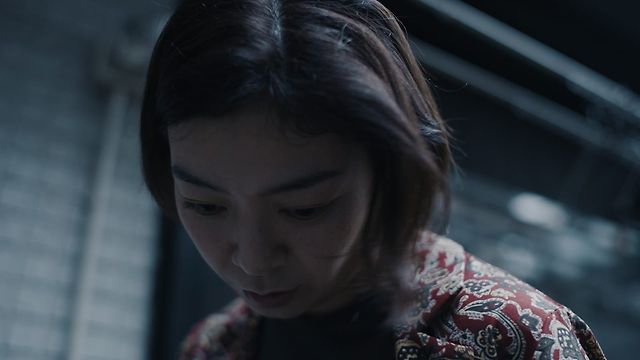
Tomoko Tabata in Chime.

The horror that holds your films together comes from the outside world intruding on the daily lives of your characters, in a way that causes them to see their lives differently and ultimately reevaluate their realities. That foreign element causes your films to move “a half-step from reality,” you once told the Criterion Collection. In Chime, it’s a sound that serves as this ominous, unsettling presence.

This is not only related to the horror genre but rather is the case in any film. This is stating the obvious, but an audience is only able to see what exists within a rectangular screen, and they can’t see what’s happening beyond that frame, what’s outside.

Yet, in watching the film, the audience believes that there is a world on the other side of the screen. We can’t actually see that world, but what’s interesting about film in general is that, while we’re watching, we feel like that outside world exists. Of course, there is a world existent other than what’s in front of the camera when we’re making it. But when I’m making a film, I’m very conscious of the fact that I’m constantly cutting away and cutting out certain elements of that world.

Regarding the use of sound, I always find sound to be particularly interesting, because even if you can’t see the source of a sound or where it’s coming from, sound can exist [independently of that]. Working in sound is a very creative process for me, because—after I’ve shot the film—I am able to imagine what kind of world exists outside of what we can see on the screen.

I really like to build what sound exists there; in a way, that’s me imagining a world that’s slightly different from the actual world, right? Because I’m able to build something else through sound. This work of sound design doesn’t require as much money to be able to do, either, so I do really like this process of thinking about how all of the sound in my films should feel. It’s a very creatively fulfilling process that I always try to approach in this way.

The sound that’s very representative of this within Chime is actually that sound they hear: the chime. At one point, I thought this sound would be one the characters could only hear inside of themselves [and that the audience wouldn’t hear], but I felt that it would be interesting if this gong-like sound of the chime sounded as if it could be from a different world, another place. I wanted the sound to feel like it was slightly different from our reality, like something between reality and unreality.

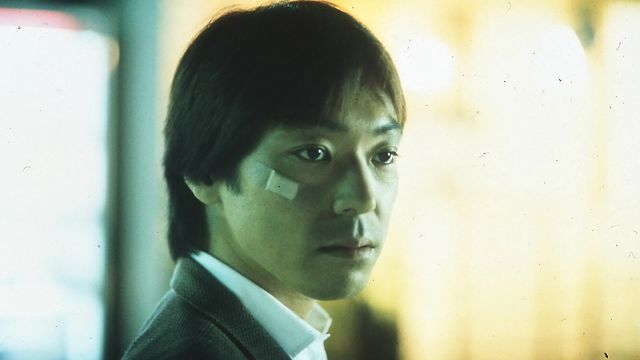
Teruyuki Kagawa stars in Serpent’s Path.  

To bring us back to Serpent’s Path, those characters search for the man responsible for the death of Miyashita’s daughter, and their efforts to methodically uncover the identity of the true culprit only lead us into deeper uncertainty. Generally speaking, in this prolific period, a lot of your stories had unclear endings, or were left unresolved, and that’s what allowed them to leave such a deep mark within the viewer. This has been true of many of the films you’ve made since. What can you say about the continued importance of preserving ambiguity within your filmmaking?

Perhaps it is a little irresponsible for me to say this, but I do feel that there is no need for a film to have a very clear conclusion. In fact, I find it strange for a film to have that. Of course, what I am creating is fiction, but I think what a film is able to do is to say to an audience, “This kind of person exists, and this kind of person did these kinds of things. What do you think?”

That is the limit of what a film can actually present and achieve, and the conclusion is really up to whoever receives the film, or perhaps even for critics to find and discuss. But I don’t think it’s the filmmaker’s responsibility to show what you’re supposed to take away from it, or reach any kind of conclusion. In fact, I find that sort of attitude to be very full of yourself, to feel that you must do that, as a filmmaker.

When I consider why I feel this way, it might be a result of the films that I saw when I was young. In the early ’70s, at the beginning of my film-watching experience, a lot of the films that I was watching back then—whether they were American entertainment or not—did not have real conclusions. A lot of the films would just suddenly end. I think that this resulted in me thinking that films are meant to be this way, because that was a fundamental experience of my youth.

As filmmakers, at the end of the day, we’re creating stories. We’re creating narratives. It’s not like I’m writing a thesis or working in politics. I don’t think a story actually needs to find a conclusion or to force an answer. Any filmmaker who thinks that needs to happen is full of themselves, to even think that they can present an answer.

I was very much moved by watching films that did not present a conclusion, that did not present answers. I found those films to be wonderful. We already discussed The Silence of the Lambs but—to be very specific—all of the films by David Cronenberg, who is one of my favorite filmmakers, [demonstrate] this. Very specifically, I’d mention his film A History of Violence. Once you watch that film, you realize there is no need for a conclusion. There’s no need to answer anything. Whenever I watch it, I feel that—in that sense—this film is a masterwork.


Chime’ and ‘Serpent’s Path’ are now playing together in US theaters, courtesy of Janus Films.

Further Reading

Tags

Share This Article