How online disinformation fuelled Ceuta migrant surge
Online false claims that the Ceuta border was open drove tens of thousands of migrants to cross from Morocco into Spain.

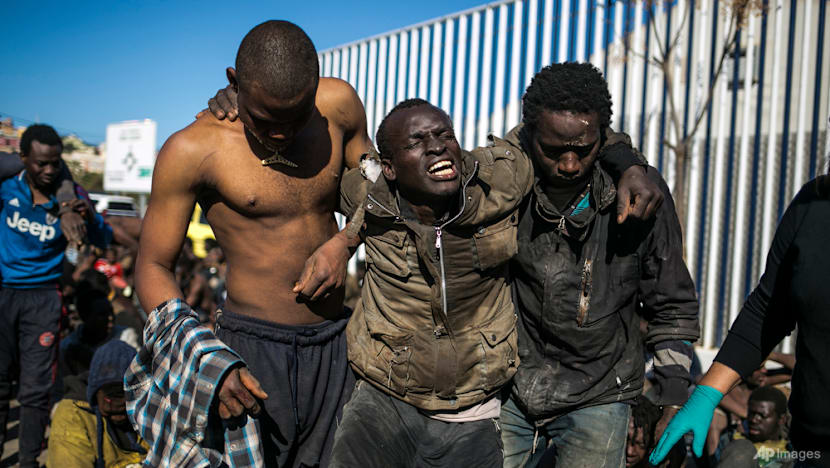
Migrants from Morocco cross into Ceuta by sea and gather near the border fence between the Spanish enclave of Ceuta and Morocco, as seen from Ceuta, Spain, Jul 30, 2026. (Photo: REUTERS/Fabian Bimmer)
MADRID: A wave of disinformation on social media drove the deadly rush of tens of thousands of migrants into Spain's north African territory of Ceuta last week, analysts told AFP.
An unprecedented 72,000 people poured into Ceuta from Morocco from July 30, mostly by swimming around a barrier in the Mediterranean Sea, according to official Spanish figures.
Spanish authorities have recovered the bodies of 78 migrants who drowned in the attempt, while Morocco says 11 people died on its side of the border.
A rumour that "the Ceuta border is open" spread like wildfire on social media as men, women and children risked their lives trying to reach Spain.
An online campaign that generated 11 million views from early July fuelled the surge, according to a report published by Chema Gil, a security and intelligence analyst at the University of Murcia.
An open-source investigation by technology company Golden Owl concluded "with a high degree of confidence" that the migrant rush "was a deliberately organised operation".
Marcelino Madrigal, an expert in social media and security, told AFP "there was evidence that this was going to happen".
"Rumours, messages and groups that caused this crisis" mainly appeared on Facebook and WhatsApp, said Madrigal, although it was impossible to determine "who or what ignited the flame".
Spanish Prime Minister Pedro Sanchez promptly blamed the migrant rush on human trafficking gangs. His government avoided criticising Morocco, with whom it has delicate diplomatic relations.
An unprecedented 72,000 people poured into Ceuta from Morocco from July 30, mostly by swimming around a barrier in the Mediterranean Sea, according to official Spanish figures.
Spanish authorities have recovered the bodies of 78 migrants who drowned in the attempt, while Morocco says 11 people died on its side of the border.
A rumour that "the Ceuta border is open" spread like wildfire on social media as men, women and children risked their lives trying to reach Spain.
An online campaign that generated 11 million views from early July fuelled the surge, according to a report published by Chema Gil, a security and intelligence analyst at the University of Murcia.
An open-source investigation by technology company Golden Owl concluded "with a high degree of confidence" that the migrant rush "was a deliberately organised operation".
Marcelino Madrigal, an expert in social media and security, told AFP "there was evidence that this was going to happen".
"Rumours, messages and groups that caused this crisis" mainly appeared on Facebook and WhatsApp, said Madrigal, although it was impossible to determine "who or what ignited the flame".
Spanish Prime Minister Pedro Sanchez promptly blamed the migrant rush on human trafficking gangs. His government avoided criticising Morocco, with whom it has delicate diplomatic relations.
"THIS ISN'T OVER"
The Spanish government has singled out a deliberate misinterpretation of a July Supreme Court ruling that said irregular migrants would not be immediately returned if they arrived by sea.
An Instagram post appeared a day after the court ruling making that very claim.
Messages to that effect were "spread by accounts that were unidentifiable and had practically no interactions, which raises questions about the possible use of mass-diffusion algorithms," said Mohamed Benaissa, president of the Northern Observatory for Human Rights.
But Antonio Benitez Ostos and Antonio Jesus Perez, of the Administrativando law firm, told AFP the court decision did not mean the border was "open" for irregular arrivals by sea.
The text specifies that a procedure different to immediate returns at the border applies to those "intercepted on the high seas" because those migrants do not breach physical infrastructure.
"The person may be returned all the same, it's just that this procedure requires basic guarantees", said human rights lawyer Laura Maria Medina Ferreras, adding that in her view these must "always" be respected.
An Instagram post appeared a day after the court ruling making that very claim.
Messages to that effect were "spread by accounts that were unidentifiable and had practically no interactions, which raises questions about the possible use of mass-diffusion algorithms," said Mohamed Benaissa, president of the Northern Observatory for Human Rights.
But Antonio Benitez Ostos and Antonio Jesus Perez, of the Administrativando law firm, told AFP the court decision did not mean the border was "open" for irregular arrivals by sea.
The text specifies that a procedure different to immediate returns at the border applies to those "intercepted on the high seas" because those migrants do not breach physical infrastructure.
"The person may be returned all the same, it's just that this procedure requires basic guarantees", said human rights lawyer Laura Maria Medina Ferreras, adding that in her view these must "always" be respected.


After last week's scenes, Spain has installed floating barriers between Ceuta and Morocco, which could "legally enable" returns at the border if they are deemed elements of containment, said the lawyers Benitez and Perez.
It is not the first time that social media has encouraged irregular crossings into Ceuta. A similar case in 2024 led to more than 150 people being prosecuted in Morocco.
Social media expert Madrigal predicted that "this isn't over", pointing to fresh online posts that are calling for mass arrivals in August.
He said social media platforms bore responsibility for not rebutting in time the content that encouraged last week's rush, warning it was "very likely" a similar event would happen "in any part of the world".
It is not the first time that social media has encouraged irregular crossings into Ceuta. A similar case in 2024 led to more than 150 people being prosecuted in Morocco.
Social media expert Madrigal predicted that "this isn't over", pointing to fresh online posts that are calling for mass arrivals in August.
He said social media platforms bore responsibility for not rebutting in time the content that encouraged last week's rush, warning it was "very likely" a similar event would happen "in any part of the world".
Source: AFP/fs


Also worth reading