
BING-JHEN HONG/iStock Editorial via Getty Images
Introduction
Usually, I’m not covering huge tech earnings straight after the event happens because my colleagues here, on SA, are doing an amazing job covering everything there is to cover hours after the numbers are announced. Today, though, I have an interesting perspective, something I found a few days ago, and I genuinely thought I had to share this information about Nvidia (NVDA).
I suggest we make a short trip down memory lane for Nvidia, get a little nostalgic feeling, return to the projections of a few years ago, and see how wrong our predictions sometimes are. It really puts investing decisions and strategies into perspective, so I recommend it to everyone, investor in Nvidia or not.
But first, a few words about the beat and why the market isn’t happy about it.
The numbers this quarter are indeed incredible, but it was also very predictable. Heading into earnings, there were 34 upward EPS revisions, with only 1 downgrade, and 36 revenue upward revisions, with 0 downward. I usually break down Nvidia before the earnings and always suggest waiting for after the numbers are out to buy, because the expectations are so high, the market doesn’t know by how much Nvidia should beat for investors to be satisfied. The stock usually rallies a few weeks before, pricing in a better-than-expected quarter prior to earnings, just for the stock price to correct on the day of the news.

Estimate Revisions
But honestly, I’m not even sure who this analyst is who revised Nvidia down, because by this point, it is statistically unlikely that Nvidia would miss on any of those headline numbers. The last time this company missed on EPS was in Q3 2023, which was 15 quarters ago (NVDA is in Q1 2027 already), and it hasn't missed on revenue in over 16 quarters. Adding to the fact that CapEx spending from hyperscalers had once again exceeded all of the expectations, it is unlikely that Nvidia’s growth would slow down, at least in 2026.
In this article, I’ll take a close look at the results, break them down in all detail, and talk about the valuation. Besides, as I already promised, I want to do that by comparing where Nvidia is today to what the expectations and predictions of the market showed a few years back.
Q1 2027
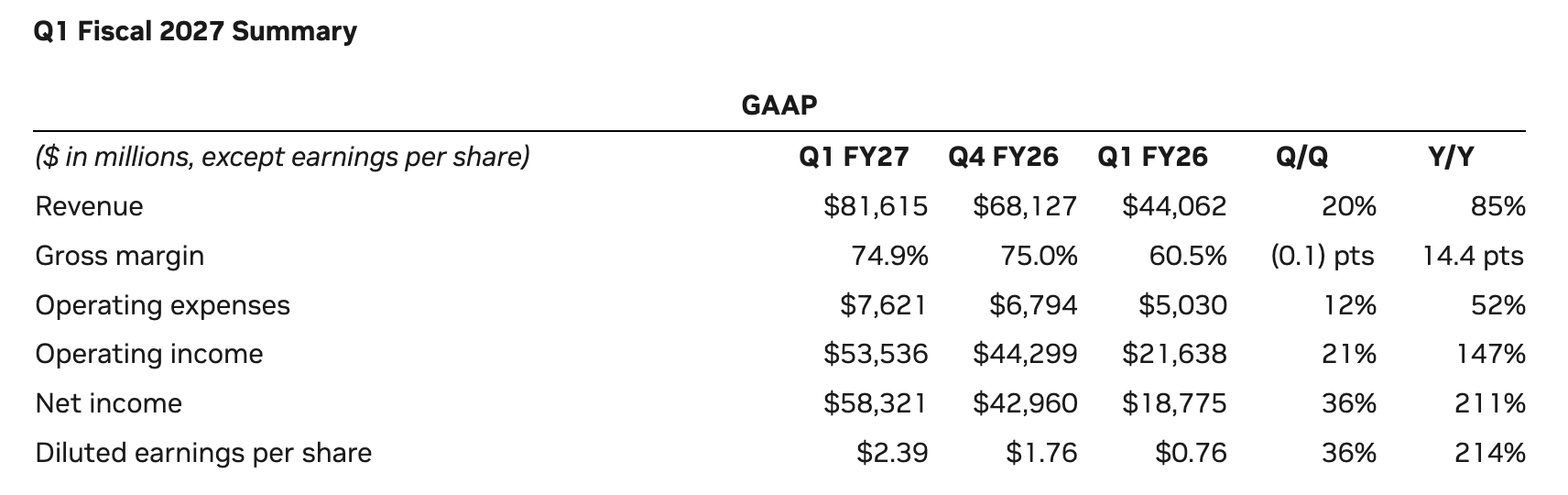
Nvidia once again beat all of the revenue records, bringing in $81.6 billion for the first quarter ended April 26, 2026. It was an incredible growth of 85% from a year ago, but what is even more shocking, it represents 20% revenue growth quarter-over-quarter.
In my latest YouTube video about Nvidia, which I filmed based on the earnings preview I wrote earlier this month here on Seeking Alpha, I randomly threw in that a few years ago, the company was expected to grow annually by about 15% by 2026. I said that to make a point of how insane it is that the company guides for 15% growth quarter-over-quarter now. I am honestly not sure why I threw in that 15% before verifying it was, in fact, the estimation, but I thought I remembered something like that back when I first noticed Nvidia, in 2022. I wanted to cut off that part, since it wasn’t confirmed, but just for fun, I went back to the beginning of 2022 here on SA to see what analysts and investors were saying about Nvidia back then.
First of all, of course, not everyone was bullish, with the feeling towards this stock fairly mixed. In the screenshot below, you can see that there were plenty of fears and caution, but also a bullish sentiment. I deleted the identifications of the analysts because looking at the rating without reading an article makes little sense. Even though since August 2022 the stock is up by over 1,100%, while the S&P returned 76%, some of these sell ratings might have been a genius decision in the short term. And this is not what I wanted to discuss.

NVDA Ratings in 2022
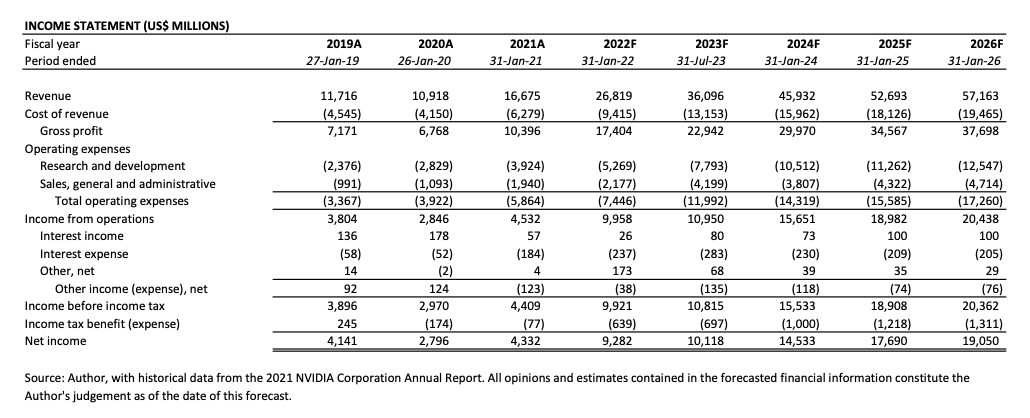
Imagine my surprise when, in the first bullish article I randomly clicked, I found an estimation of about 16% growth by 2026 by Summit Research, which confirmed I remembered the predictions correctly. The author did a great job breaking down the company (you can see the screenshot below and find more in the article I tagged), and with the information that was available back then, it seems an absolutely reasonable and correct conclusion. These estimations don’t happen in a vacuum, and usually, analysts' predictions don't fall too far off from one another because they use the same numbers and what the company itself is guiding for.
Authors' Estimations
According to that 16% CAGR, for the fiscal year of 2026, which just ended last quarter, the company was supposed to make $57 billion in revenue. This was a bold, bullish outlook, and there were many analysts disagreeing with this prospect. Nvidia made almost $216 billion in fiscal 2026, a number that, if someone were there to estimate it, would raise a highly negative response even from the bulls. Today, the company is guiding for $91.0 billion in the next quarter, plus or minus 2%, vs. the consensus of $86.95B. It seems that if Nvidia continues growing this fast, it will soon be making double the revenue in one quarter than what we expected could happen in a year a few years back.
I’m curious how that makes you feel, but for me, it really humbles my expectations of our abilities to predict where the businesses are headed. We indeed have many metrics, both relative and absolute, and we are doing our best to model where the company is headed, but this example with Nvidia shows how important it is to stay open to the quickly changing environment and to adjust.
Unfortunately, making real-life decisions is very different from developing models and theories, and there are always so many moving pieces that your estimations and predictions will most likely differ from what happens in reality, especially a few years down the road. The problem is, of course, that most of our decisions are based on those forward expectations. This is why it’s very important to see where the company stands right now and to analyze the numbers quarter after quarter, paying less attention to what the management says, and of course, to diversify our portfolios.
Back to earnings, not only is the company showing incredible growth, especially relative to its size, but the demand looks completely organic. Even with the ramping up of Blackwell production to offset Rubin delays, the gross margin stays flat at an incredible 75% level, although they were supposed to decrease. Total operating expenses for the quarter were between $7.4 billion and $7.6 billion, which is lower as a % of revenue than the usual 10%-11%. This high efficiency allowed NVIDIA to convert its massive revenue into an extraordinary GAAP net income of $58.3 billion, which translates to $2.39 per diluted share.
Q1 2027
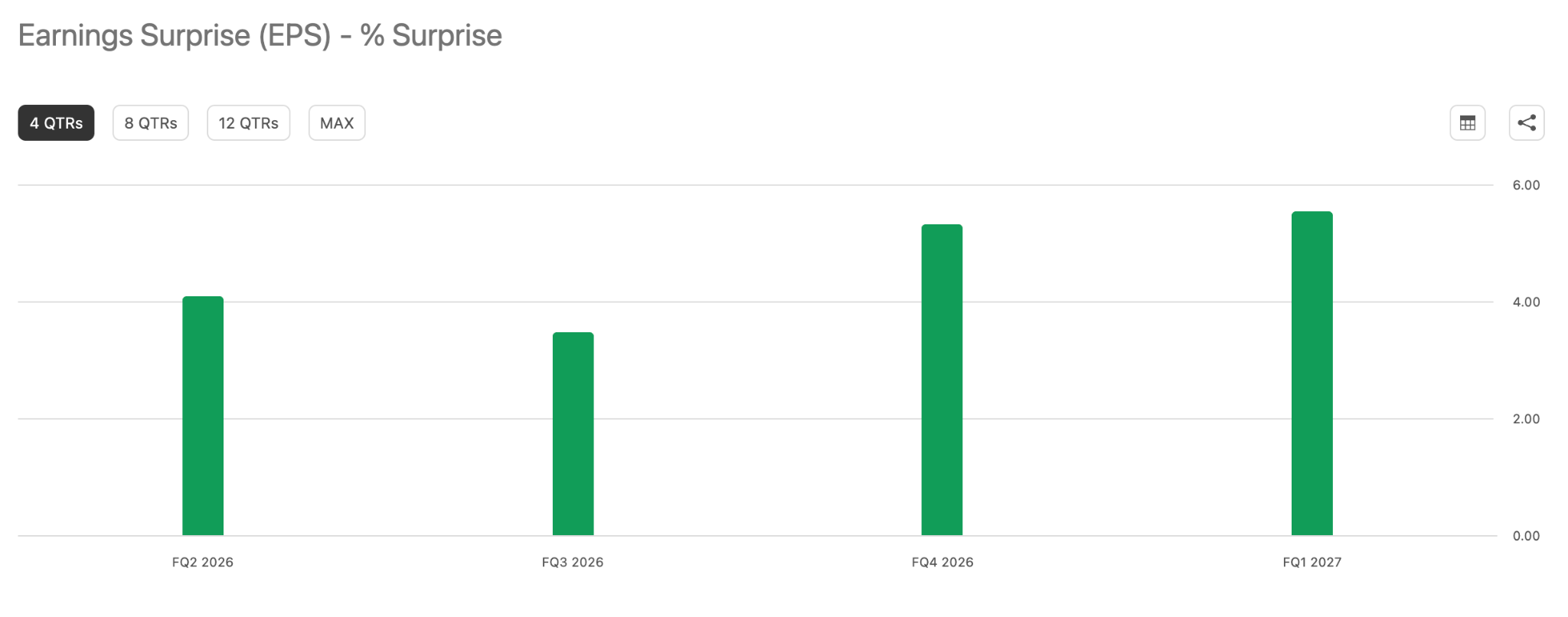
Investors should note that the non-GAAP net income was lower, sitting at $45.5 billion, or $1.87 per share. This difference is a result of a large $15.9 billion paper gain from NVIDIA's equity investments, which boosted the official GAAP figures but is excluded from non-GAAP metrics to show the true core earning power of the standard business operations. Additionally, NVIDIA updated its financial reporting methods this quarter to include employee stock-based compensation within its non-GAAP calculations, which, in general, is a great piece of news because it provides a more realistic ongoing picture of standard company expenses than how it was before. I was curious whether, with this change, the company would still be able to beat the expectations, but the company surprised the market by even more than it did in the last 4 quarters.
Earnings Surprise
There is another change in how the company is going to present the results from now on. The business now consists of Data Center (with Hyperscale and ACIE) and Edge Computing (data processing devices):
NVIDIA is transitioning to a new reporting framework that better reflects its current and future growth drivers. NVIDIA will have two market platforms — Data Center and Edge Computing. Within Data Center, NVIDIA will report two sub-markets, Hyperscale and ACIE, which incorporates AI Clouds, Industrial and Enterprise. Hyperscale will include revenue from the public clouds and the world’s largest consumer internet companies, while ACIE addresses NVIDIA’s growth opportunity in diverse AI purpose-built data centers and AI factories across industries and countries. Edge Computing highlights data processing devices for agentic and physical AI including PCs, game consoles, workstations, AI-RAN base stations, robotics and automotive.
The Data Center segment is the star of Nvidia, and it grew by 92% from a year ago and by 21% sequentially, bringing in $75.2 billion in revenue, which was a record. Under the old sub-market tracking metrics, the company said that data center compute chips accounted for $60.4 billion of this total, while high-performance networking equipment brought in $14.8 billion. It is not surprising, as all of the small infrastructure suppliers had seen major rallies this year in revenue and in stock prices as a result. Nvidia is not an exception, and it also benefits not only from chip demand but also from cables, switches, and whatever else is needed to get these chips working as fast as they were planned to.
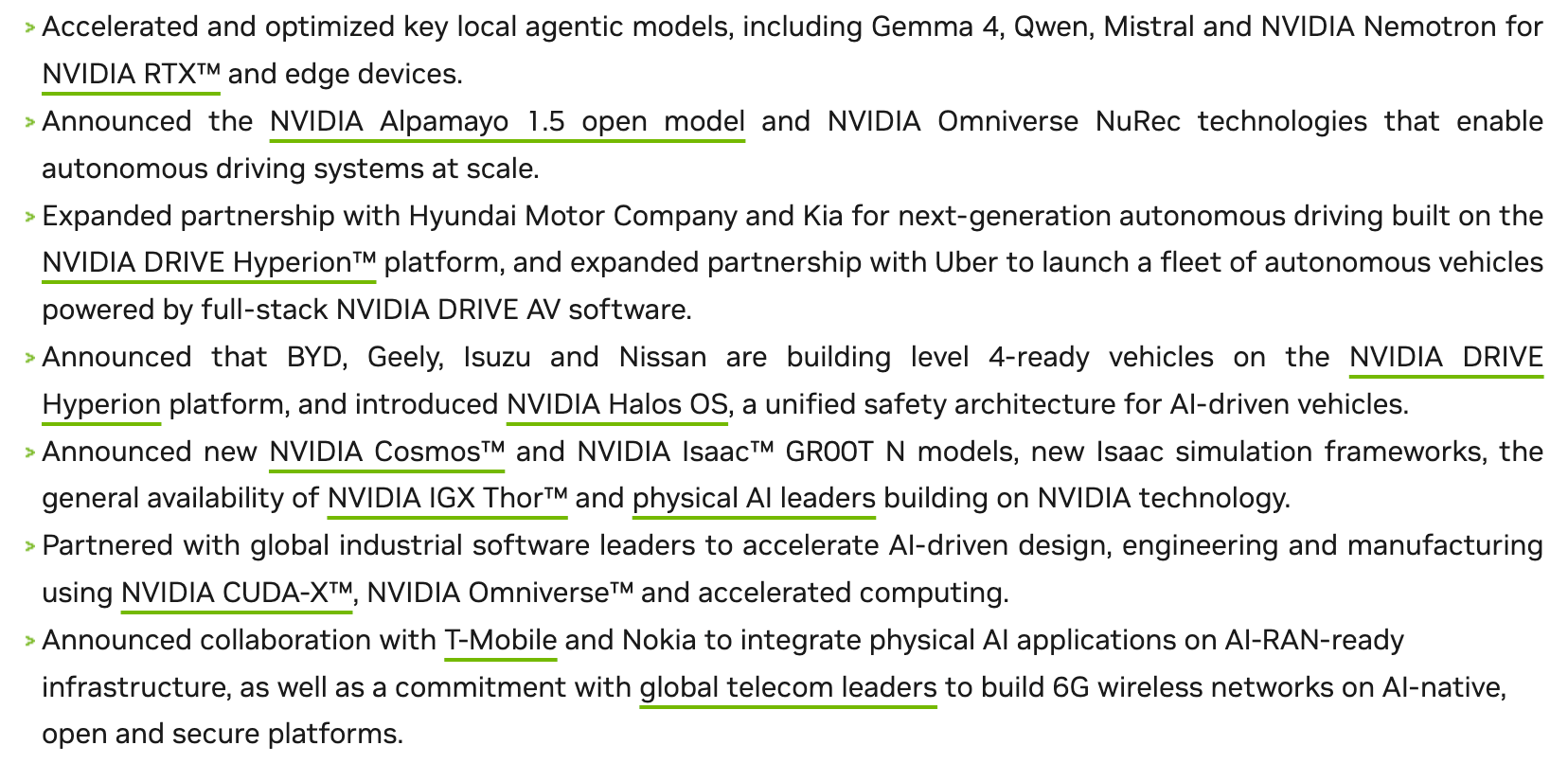
The Edge Computing segment will include data processing devices of various types, including personal computers, gaming consoles, robotics, automotive technologies, etc. This segment made $6.4 billion for the quarter, which is a growth of 29% year-over-year and 10% from the previous quarter. This division is heavily focused on what the company refers to as physical AI and localized processing. Some of the news here included the graphics rendering models like Deep Learning Super Sampling version 5, partnerships in automotive with companies like Hyundai, Kia, Uber (UBER), and BYD (BYDDF) using NVIDIA DRIVE architecture, and partnerships with telecom leaders like T-Mobile and Nokia to run physical AI applications on cellular infrastructure.
Q1 2027
I think the real surprise was how aggressively Nvidia increases the shareholder value and plans on continuing to do so in the future. This quarter alone, investors got back $20 billion in stock buybacks and dividends. Going even further, the board of directors approved a massive new expansion to its capital return program, authorizing an additional $80 billion specifically for future share repurchases, which comes on top of $38.5 billion that remained from previous allocations. Besides, the company announced a massive 25-fold increase to its quarterly cash dividend. The dividend is jumping from just one cent per share to 25 cents per share.
During the first quarter of fiscal 2027, NVIDIA returned a record level of approximately $20.0 billion to shareholders in the form of shares repurchased and cash dividends. As of the end of the first quarter, the company had $38.5 billion remaining under its share repurchase authorization. On May 18, 2026, the Board of Directors approved an additional $80.0 billion to the Company’s share repurchase authorization, without expiration. NVIDIA is increasing its quarterly cash dividend from $0.01 per share to $0.25 per share of common stock, which will be paid on June 26, 2026, to all shareholders of record on June 4, 2026.
Looking forward, the company expects to grow by about 11% quarter over quarter, lower than the 15% expected going into these earnings, but still an impressive level to be at. This forward-looking projection assumes absolutely zero data center compute revenue coming out of China, but as far as I’m aware, the market thinks that some changes here are possible after the recent visit of the U.S. president to China. I won’t speculate further, but it remains to be seen. Operating expenses will experience a slight sequential increase to roughly $8.5 billion on a GAAP basis as the company continues to invest in its Vera Rubin platform, but it is still at a regular “as a % of revenue” level. Margins are projected to stay the same.
Conclusion
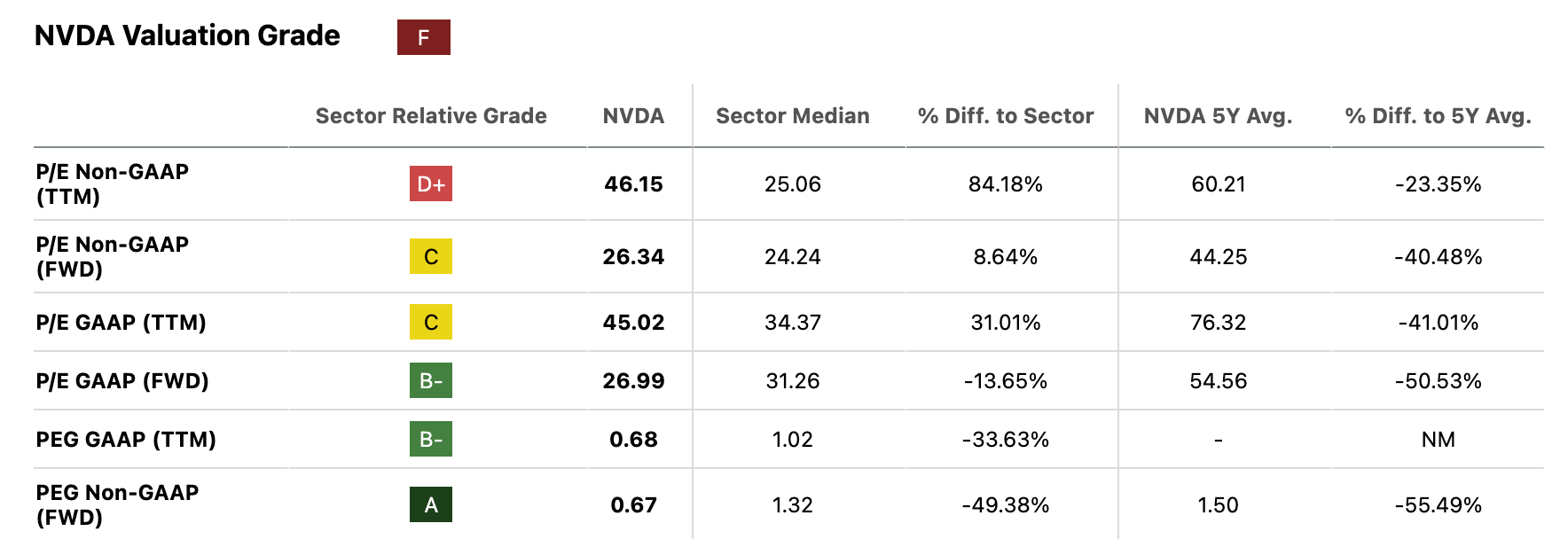
There are no major changes to the valuation multiple from where the company has been before the earnings. It now stands at 26x FWD P/E, which is cheaper than the sector, at an elevated P/E on the TTM basis of 46x, and an incredibly cheap PEG ratio, which normalizes the sector for growth.
Valuation
If you’ll allow, I’ll just quote myself, as this really explains the valuation well:
While it doesn’t scream a value opportunity, it is clearly not high valuation multiples for the exceptional performance of this company. It has best-in-class margins, revenue growth, operational metrics, cash flow, return on invested capital, etc. Just think of the metric, and I can assure you, Nvidia will be way better than all of the competitors and all of the Mag 7 peers in this metric.
It seems the market is very cautious about Nvidia because it looks “too good to be true” but readily awards competitors like Advanced Micro Devices (AMD) with 3x higher valuation for 2x slower growth. The only thing AMD is really better than NVDA right now is in the market sentiment, which is a powerful driver for the stock, but each of us as an investor should decide how important it is to them. As I said in my previous article, I took profits in AMD, staying put with NVDA, while I opened both at around the same time a few years ago. I think Nvidia’s initiatives to invest in some smaller suppliers will pay off handsomely, and together with the strong underlying business driven by AI demand, I upgrade Nvidia to a buy. The stock, by the way, is cheaper today in valuation than it was in 2024 when I started my position.


