 Listen


 Facebook
 Reddit
 Copy Link


Mixed doubles pair Dechapol Puavaranukroh and Supissara Paewsampran advanced to the final of US$550,000 Badminton Asia Championships 2026 while men's defending champion Kunlavut Vitidsarn suffered a shock exit in China on Saturday.
Dechapol and Supissara battled back to defeat top-ranked Feng Yanzhe and Huang Dongping of China 21-19, 18-21, 22-20 in a 90-minute thriller at Ningbo Olympic Sports Center, giving the Thai duo a chance to win their first gold medal in the championships.
World No.3 pair Dechapol and Supissara will take on Kim Jae-Hyeon and Jang Ha-Jeon in the title match after the unseeded Koreans knocked out Yuta Watanabe and Maya Taguchi of Japan 21-18, 21-11.
Dechapol won silver in 2017 and bronze in 2019 with the then-playing partner, Sapsiree Taerattanachai, while this will be Supissara's first crack at the continental crown.
In the men's singles semis, world No.1 Kunlavut played his third straight three-game match this week and Saturday's encounter proved too much for the 24-year-old, going down to unseeded Indian Ayush Shetty in three games 21-10, 19-21, 17-21 in 75 minutes.
The victory continued Shetty's remarkable run in the championships after he beat world No.7 Li Shifeng of China in the first round and No.4 Jonatan Christie of Indonesia in the quarter-finals.
The 25th-ranked Shetty will face either second seed Shi Yuqi of China or fourth seed Chou Tien-chen of Taiwan in the final on Sunday.
Earlier, women's top seed An Se-Young cruised past fellow Korean Sim Yu-Jin 21-14, 21-9 to reach her second Asian Championship final. She lost the 2023 final against the now-retired Tai Tzu-ying of Taiwan in Dubai.
An will face second seed Wang Zhiyi, a two-time Asian champion, in the final after the Chinese edged fourth seed Akane Yamaguchi of Japan 14-21, 21-9, 21-13 in the other last four clash.
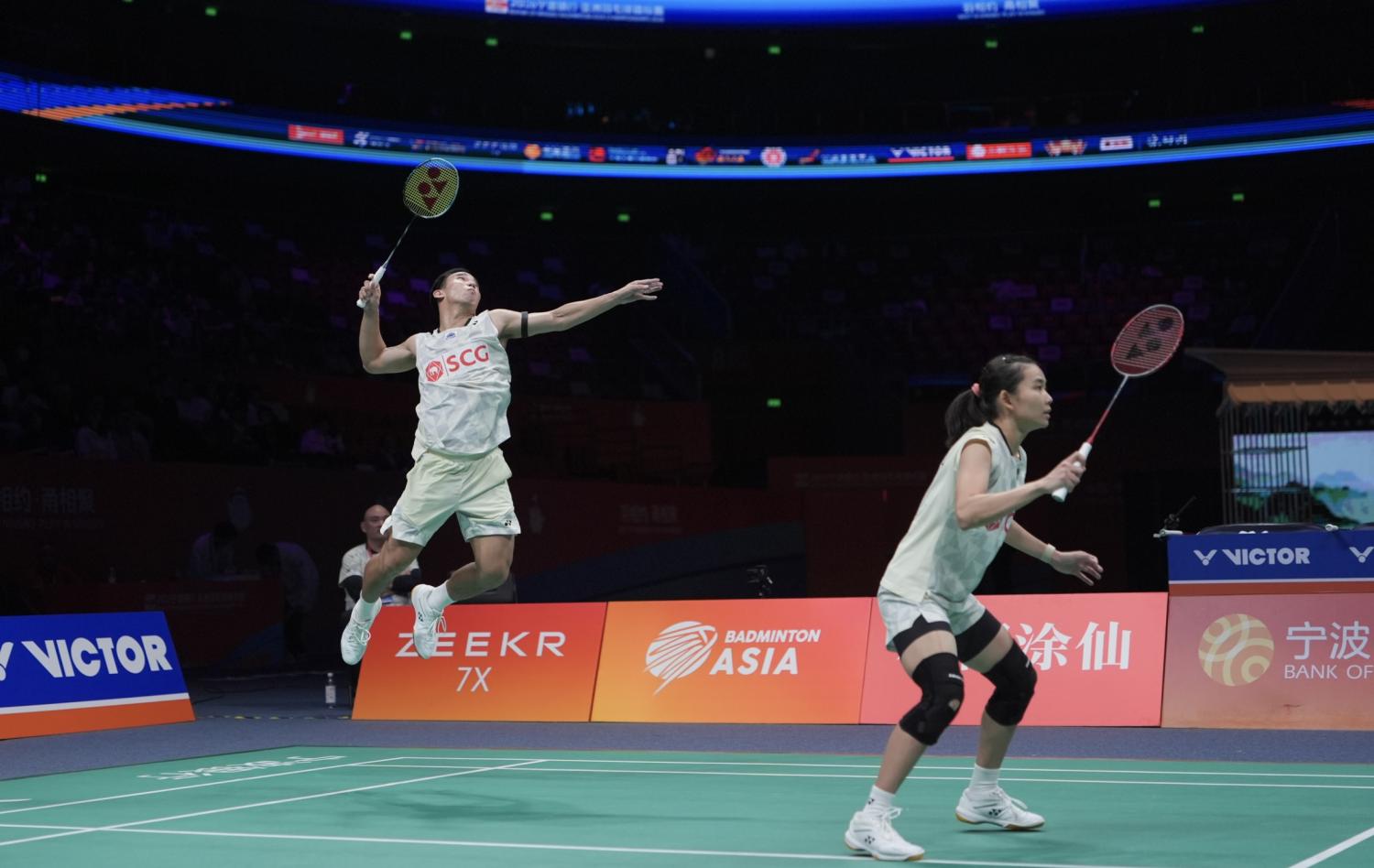
Dechapol Puavaranukroh and Supissara Paewsampran in action.
Synthetic shuttlecocks
Badminton will trial synthetic shuttlecocks at lower-grade tournaments with a view to potentially using them at elite level, the sport's governing body said, because of a shortage of duck and goose feathers.
Skyrocketing raw material costs in China caused shuttlecock prices to more than double last year, with the Badminton World Federation (BWF) saying previously it was an issue but the shortage was not "at a crisis level yet".
The BWF said it would use synthetic shuttlecocks at selected events including junior international tournaments.
"This initiative forms part of BWF's long-term approach to evaluating synthetic feather shuttlecocks for potential use at the elite level," it said in a statement.
The production of shuttlecocks relies heavily on the supply of duck and goose feathers.
One high-quality shuttlecock requires 16 carefully selected feathers, typically sourced from the wings of ducks or geese.
Duck and goose output in China, the global leader in shuttlecock production, has declined sharply in recent years.
