Advertisement
Advertisement

Asia

Negeri Sembilan polls: Anwar’s Pakatan Harapan faces electoral test amid rivals’ Malay-Muslim unity narrative

Negeri Sembilan heads to the polls on Aug 1, with Prime Minister Anwar Ibrahim’s Pakatan Harapan pact battling to retain power in the face of a Malay-Muslim unity narrative spun by Barisan Nasional and Perikatan Nasional.

Negeri Sembilan polls: Anwar’s Pakatan Harapan faces electoral test amid rivals’ Malay-Muslim unity narrative

Malaysian Prime Minister and Pakatan Harapan chairman Anwar Ibrahim speaks at a campaign rally in Seremban, Negeri Sembilan, on Jul 29, 2026. (Photo: CNA/Fadza Ishak)

Listen
15 min
New: You can now listen to articles.

This audio is generated by an AI tool.

31 Jul 2026 04:57PM (Updated: 31 Jul 2026 06:41PM)
Read a summary of this article on FAST.
FAST

SEREMBAN, Negeri Sembilan: For United Malays National Organisation (UMNO) member Mohd Wan Riduan, 65, slipping on his Barisan Nasional (BN) vest and cap no longer carries the awkward sting it once did.

Gone are the days he had to defend BN’s alliance with traditional rival Pakatan Harapan (PH) in the state of Negeri Sembilan to others.

Today, the retiree firmly backs BN’s new electoral pact with Perikatan Nasional (PN). UMNO is BN’s lynchpin party.

While party loyalty had compelled him to back PH in the 2023 Negeri Sembilan state election, the political landscape has shifted ahead of Saturday’s (Aug 1) state polls.

“I think BN going with PN is a much better fit compared to PH. There is unity among the Malay parties,” said the hardcore UMNO supporter, who is voting in Sikamat constituency. 

PN is Malaysia’s largest opposition coalition at the national level, whose cooperation with BN to unite the Malay vote has been a major theme in the Negeri Sembilan hustings.

Mohd Wan said many of his close friends who were fellow UMNO members had chosen to sit out the last election in protest against the pact with PH, but things will look different at the ballot box this time.

“When BN was with PH, I was teased and labelled 'UMDAP' until it rang in my ears,” he told CNA at a PN campaign event on Jul 29. 

“UMDAP” is a blend of “UMNO” and “DAP” or Democratic Action Party, which is part of Prime Minister Anwar Ibrahim’s PH pact and has traditionally drawn support from non-Malay voters.

“People were really angry, and even within my family, there were so many disagreements over this. I am relieved they have now chosen to go with PN. Today, I can wear my vest and cap proudly,” said Mohd Wan.

Barisan Nasional (BN) supporter Mohd Wan Riduan speaks with CNA during a campaign rally in Seremban, Negeri Sembilan, on Jul 29, 2026. (Photo: CNA/Fadza Ishak)

Mohd Wan's sentiments capture a broader mood shift that could spell trouble for PH in Saturday’s polls, said political analysts and observers. 

PH won 17 out of 36 state seats in Negeri Sembilan in 2023 while BN won 14 and PN, five.

Hisommudin Bakar, executive director of the research firm Ilham Centre, told CNA that during the 2023 Negeri Sembilan election, PH had to rely heavily on votes from BN supporters to secure victory and ultimately form the state government, he said.

"The political alignment has completely changed with BN and PN joining forces. This alignment looks like it is enough to ensure their victory,” he said. 

PH had collaborated with BN in Negeri Sembilan in 2023 after both coalitions formed the federal unity government following a hung parliament in the wake of the 2022 general election.

While they remain partners at the federal level, the dynamic on the ground at the state level has fractured. PH and BN are now taking each other head-on - a friction first seen in the Johor polls last month, where BN swept 48 of the 56 contested seats.

In Negeri Sembilan, BN has forged a strategic pact with component parties of PN, especially Parti Islam Se-Malaysia (PAS). 

This time, BN is contesting 25 seats, while PN component parties will contest the remaining 11, ostensibly so that they will not split the Malay vote.

However, the Malay-centric Parti Pribumi Bersatu Malaysia (Bersatu), whose ties with its PN partner PAS have soured, is notably running under its own logo and will be contesting 24 seats.

A party or coalition needs to win at least 19 seats to form the government in the state legislative assembly. 

In a report on Friday, Ilham Centre said the PN-BN pact was on track to win at least 22 seats, while PH is projected to win at least nine seats. The remaining five seats however were difficult to predict, it said. 

“The issue of Malay vote consolidation, political stability, and the need to prevent a PH victory were themes consistently repeated until they successfully influenced a large portion of Malay voters, including fence-sitters. 

“The direct impact of this is that BN successfully strengthened its grip on almost all of its traditional strongholds, while PN reaped the benefits in the areas they contest through the spillover of votes from BN supporters,” said the centre.  

It added that PH faces a deficit among the non-Malay voters, who have traditionally supported the coalition. 

“Aside from a deficit in Malay support, they also failed to maintain maximum support among their own core voters,” said Ilham Centre.

Its prediction was based on fieldwork from Jul 18 to Jul 30, combining quantitative and qualitative methods such as face-to-face questionnaires, focus group discussions, and in-depth interviews. 

The study involved 1,002 respondents, six focus groups, and 38 in-depth interviews, and had a 3.1 per cent sampling error, it said.

SECURING THE MALAY VOTE 

BN and PN leaders told CNA their core objective is capturing the Malay vote to secure a decisive victory over PH. 

Of Negeri Sembilan’s 23 Malay-majority seats, Malays make up over three-quarters of voters in 11 seats.

“Because of our pact with PN, I believe the Malay votes will not be split and the chances of winning are much better compared to last time,” said Mustapha Nagoor, who is the Negeri Sembilan UMNO secretary-general.

Mustapha will be defending his Palong seat, which he had won with a slim majority of 564 votes against a Bersatu candidate in 2023. 

In 2018, he had won with a majority of more than 6,000 votes. 

Mustapha said Malay voters could not accept the ideology of PH, especially that of DAP.

“I personally don’t have any problems working with any party but many of the UMNO voters did not come out to vote in 2023. And many of those who came out to vote gave their votes to PN at the time,” he said. 

“In the Malay belt, voters want to see BN and PN work together,” he added. “Theoretically, the pact between PN and BN is more harmonious for the state.”

In 2023, BN scraped through with narrow majorities across multiple seats, while PAS made history by capturing its first-ever seats in the state on the back of rising Malay-majority support. 

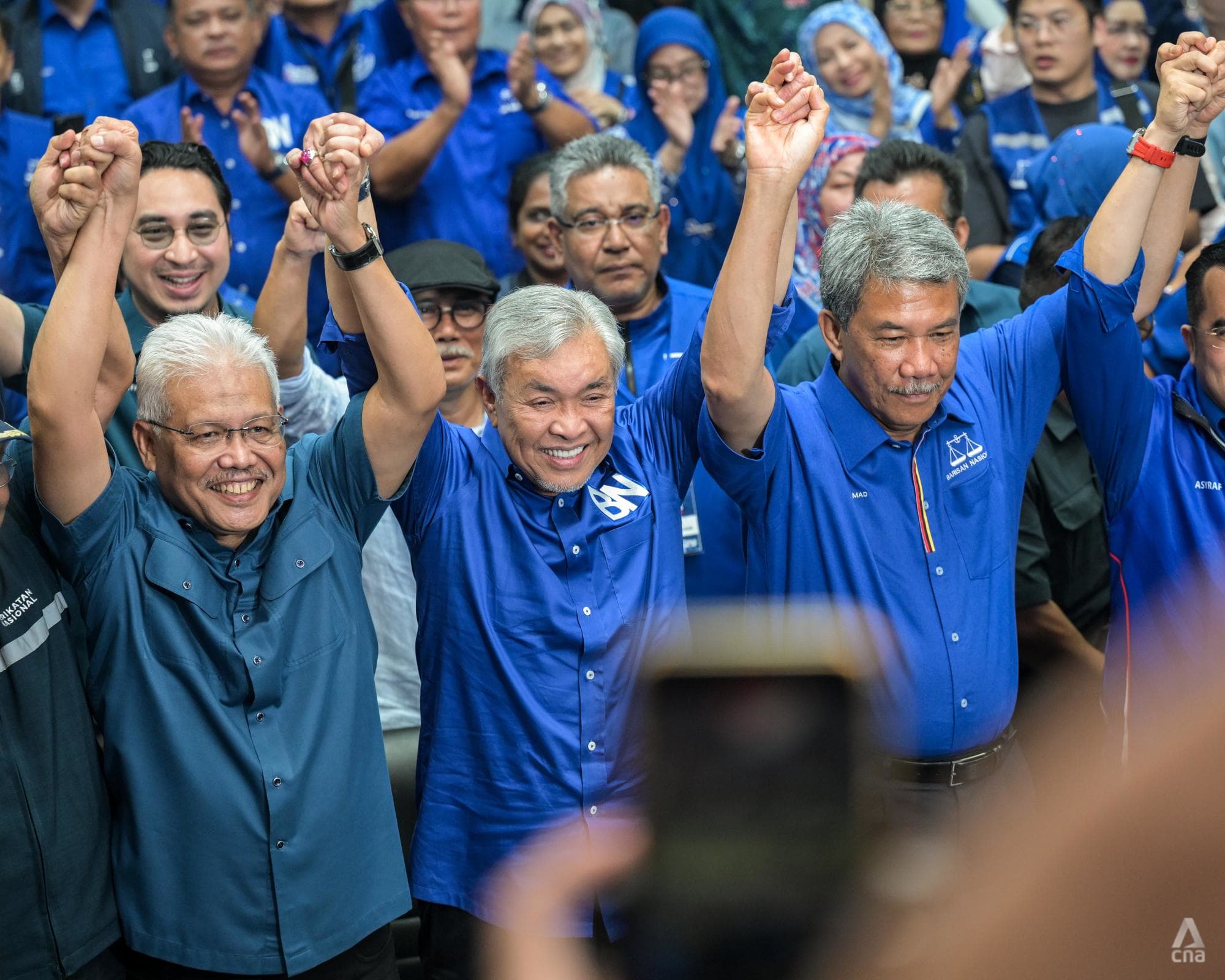
Barisan Nasional chairman Ahmad Zahid Hamidi with candidates and supporters for the Negeri Sembilan state election on Nomination Day on Jul 18, 2026. (Photo: Facebook/UMNO Online)

PAS information chief Ahmad Fadhli Shaari told CNA that BN and PN needed to collaborate to defeat PH, which he claimed was afraid of unity among Malays and Muslims.  

“We can work with BN and I think they have realised that. They have learned from what they went through in the last three years (with PH in Negeri Sembilan). I am confident that there will be vote transferability for both sides,” Ahmad Fadhli said.

Wawasan secretary-general Saifuddin Abdullah is cautiously optimistic that the partners will win at least 20 seats. Wawasan is also a PN component party.  

“As far as the campaign is concerned, I think it is very clear that BN leaders are openly saying to vote for PN candidates and vice versa. So I'm very hopeful that there will be a transfer of votes between the two blocs,” he said. 

Leaders from Barisan Nasional and Perikatan Nasional member parties at an event. (From left) Pejuang president Mukhriz Mahathir, UMNO supreme council member Md Alwi Che Ahmad, Wawasan secretary-general Saifuddin Abdullah (back row), Partisee more

Analysts, too, expect PN-BN to sweep the Malay seats, although they said voter transferability between both sides was not equal. 

The cooperation works more with PAS voters as they are known to be more likely to follow the direction of its president Abdul Hadi Awang, said political scientist Syaza Shukri of the International Islamic University Malaysia (IIUM).

Younger voters may also be more transferable than older ones, she said. This is because older voters may remember the intense rivalry between UMNO and PAS in the more distant past.

“I don’t think the younger voters are aware of the takfir movement,” said Syaza, referring to rival party members accusing each other of apostasy (takfir) due to differing views on Islamic governance that went back as far as the 1980s.

Hisomuddin estimated a 30 per cent shortfall in vote transferability - noting that PN voters were more inclined to back BN candidates than the other way around - yet maintained that the margin was still comfortable enough to secure the Malay-majority seats for the two blocs.  

He also estimated that PH currently commands only 18 per cent support among the state's Malay population, highlighting a significant support deficit compared to the BN-PN coalition.

Ong Kian Ming, an adjunct professor at Taylor's University, also predicted that BN-PN is likely to take control of Negeri Sembilan by winning between 23 and 25 seats. 

“With the electoral pact between PN and BN, it is very likely that Malay support for both of these coalitions will exceed 70 per cent and allow candidates from both coalitions to avoid splitting the Malay vote – which allowed PH to win a number of seats in the state election in 2018,” he wrote in a commentary published by several local media outlets on Jul 27. 

In the 2018 election, PH had contested in three-cornered fights against BN and PAS in the majority of seats.

Negeri Sembilan State Legislative Assembly Building in Seremban, Negeri Sembilan, Jul 29, 2026. (Photo: CNA/Fadza Ishak)

DAP THE TARGET OF ATTACKS

On the campaign trail, both BN and PN leaders have predictably targeted DAP to stoke Malay voter sentiment, analysts observed.

Hisommudin noted that BN and PN have synchronised to make DAP the focus of their attacks. 

“This element is very effective because identity politics easily triggers voter emotions compared to other factors. PN is most clear in campaigning by using racial elements and indirectly framing DAP as a threat to the Malays,” he said.

UMNO secretary-general Asyraf Wajdi Dusuki has, for example, openly asked voters whether they wanted DAP secretary-general Anthony Loke to become the state’s chief minister – despite the state constitution requiring a Malay-Muslim occupant.

Leaders from BN and PN have also pushed claims that DAP exerts total control over PH. 

A Rembau UMNO leader went as far as to claim DAP controlled the Negeri Sembilan palace. 

Syaza said the BN-PN rhetoric centres entirely on removing DAP's influence, regardless of incumbent chief minister Aminuddin Harun's administrative performance.

“It’s been played up so much over the years, especially since 2018 … The whole ‘Malay-Muslim threatened’ narrative is very effective, especially in a competitive state like Negeri Sembilan where it can go either way,” she said.

PN election director Muhammad Sanusi Md Nor also created a stir on the campaign trail by asserting that Malays “have no other homeland”. 

Claiming that Malaysia’s ethnic minorities retain ancestral ties elsewhere, he asserted “Malays only have this land”.

BN distanced itself from the remarks, with UMNO president Ahmad Zahid Hamidi warning Kedah chief minister Sanusi against stoking racial tensions in a multiracial society. 

“If you want to be friends, be sincere or else just stay put in Kedah and focus on governing the state,” Zahid was quoted as saying by The Star. 

As for the royal impasse that triggered the premature snap election, Syaza observed that it has largely taken a back seat, carrying limited weight in influencing voter decisions.

Hisommudin, however, noted that for voters practising adat perpatih, the customary matrilineal system unique to the state, chief minister Aminuddin’s actions of appearing to take sides breached protocol, as political actors are traditionally expected to remain neutral in customary matters.

“But overall this crisis is not a major issue being discussed by the majority of voters,” he said. 

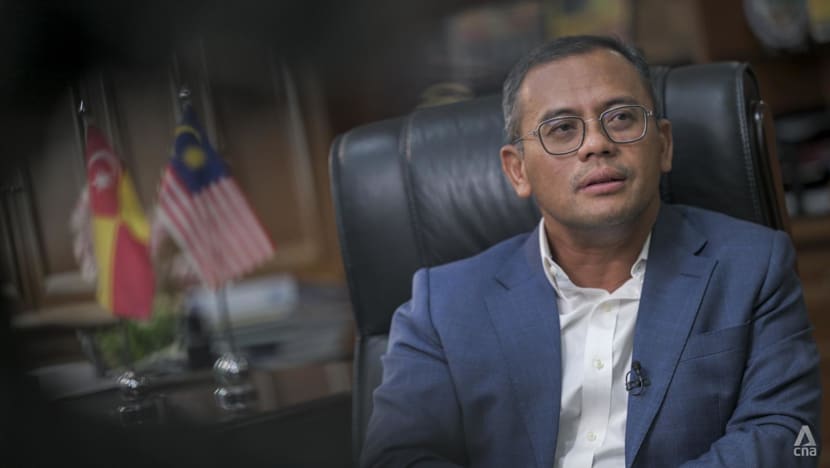
Negeri Sembilan caretaker Chief Minister Aminuddin Harun - who is from Prime Minister Anwar Ibrahim's Parti Keadlian Rakyat - is seen here on Nomination Day on Jul 18, 2026. (Photo: Facebook/Aminuddin Harun)

WHAT IS PH'S RESPONSE? 

Observers say PH has tried to showcase its manifesto and achievements as the incumbent, but its efforts seem to be drowned out by the Malay-unity rhetoric.   

PH component party Amanah’s communications director Khalid Samad admitted that the Malay-unity narrative of PN and BN was making it difficult for PH to woo the Malay electorate in Negeri Sembilan.

PM Anwar also addressed the narrative that the position of the Malays would be threatened.

"Whichever party (is in power), the kings will be Malay....The Prime Minister must be Malay," he said, adding that top institutional roles such as the leadership of the military and the central bank are likewise held by Malays.

"Find a good Malay to look after the country. Take a Chinese who is honest and hardworking. Anthony Loke is the Transport Minister. It's the same with Indian (leaders)," he said.  

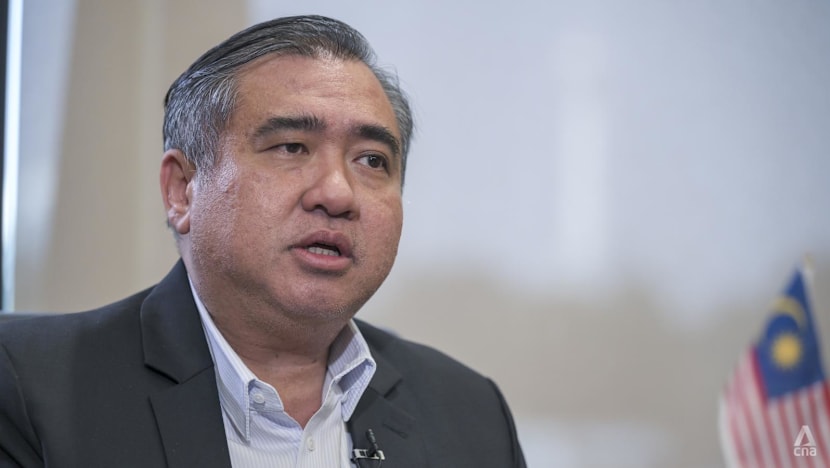
Anthony Loke, secretary-general of the Democratic Action Party (DAP), speaks during a campaign rally in Seremban, Negeri Sembilan, on Jul 29, 2026. (Photo: CNA/Fadza Ishak)

DAP chief Loke, who is defending his Chennah seat, has been on the defensive against multiple personal attacks despite telling CNA in a recent interview that he wanted to run a “positive campaign” that included what PH could do for the people.

He said in an interview with The Edge Malaysia published this week that a PH defeat in Negeri Sembilan would have “quite big” implications for the survival of the federal unity government. 

He also said political survival ultimately comes down to electoral strength.

“Politicians will only speak the language of strength. If you do not have electoral strength and political strength, then we are, of course, on the chopping board,” he was quoted as saying.

Meanwhile, Aminuddin’s decision to contest in the UMNO stronghold seat of Linggi  – shifting away from Sikamat after four terms – has raised eyebrows, but he has expressed confidence in PH’s footprint in the state. 

Amanah candidate Bakri Sawir, who will be defending his Klawang seat, said he was not perturbed by the PN-BN pact. The constituency is made up of 65 per cent Malays, but Bakri said he did not receive many votes from UMNO voters in 2023.

He won by a slim majority of 577 votes in 2023, compared to 976 votes in 2018. 

Bakri believes he has an advantage in a three-way contest against PN’s Danni Rais and Bersatu’s Mohd Adib Musa.

“If it was a one-to-one, then it would have been tough for me but if it is a three-cornered fight, I believe I have a better chance,” he said, adding that he was also optimistic that the Malay voters would give him their vote.   

Some analysts believe that Bersatu may pull support from BN or PN in the 24 seats it is contesting, even if it does not win any seats.

Syaza viewed Bersatu’s decision to enter the race as driven primarily by political survival and the need to remain relevant. 

She said it could still pose a challenge to the BN-PN alliance in specific constituencies like Labu, and this could inadvertently give PH the upper hand. 

Bersatu has denied it is contesting simply to split the Malay vote, with its information chief Tun Faisal Ismail Aziz saying that PN's leadership had excluded the party from seat negotiations.    

"If anyone is truly responsible for splitting votes, it is not Bersatu. The three-cornered fights happened because of PN's decision to sideline Bersatu during the seat negotiation process. If unity was genuinely desired, why was Bersatu not invited to negotiate?" he said in a Facebook post on Jul 29. 

Hisham Zainal, 54, an Ampangan voter, speaks with CNA in Seremban, Negeri Sembilan, on Jul 29, 2026. (Photo: CNA/Fadza Ishak)

Amid these political calculations, some voters like lorry driver Hisham Zainal, 54, said they were uncomfortable with the increasingly "racist" narratives and identity politics of BN and PN during the campaign.

This, the Ampangan constituent said, would determine his vote on Aug 1. 

“I admit that PH isn’t perfect and hasn’t delivered on all its promises, but they are doing their best. The other side just likes to provoke,” Hisham said.   

Source: CNA/rv (cc)

Sign up for our newsletters

Get our pick of top stories and thought-provoking articles in your inbox

Subscribe here
Inbox
FAST
Advertisement

World

‘It's enough already’: Trump’s Greenland push leaves Southeast Asian migrants fearing for their future

As United States President Donald Trump seeks control of Greenland, the island’s growing Southeast Asian migrant community faces uncertainty. In part one of this series, CNA looks at how Filipino and Thai migrants are responding. 

‘It's enough already’: Trump’s Greenland push leaves Southeast Asian migrants fearing for their future

Filipino GP Dupitas poses with a hunted reindeer in Nuuk, Greenland's capital, in June 2026. (Photo: CNA/Jack Board)

Listen
12 min
New: You can now listen to articles.

This audio is generated by an AI tool.

02 Aug 2026 06:00AM (Updated: 02 Aug 2026 07:43AM)
Read a summary of this article on FAST.
FAST

NUUK, Greenland: In deep winter January, GP Dupitas would turn his eyes towards the dark skies, as if waiting to see the silhouette of a military aircraft high above.

At a time when the sun barely lifts above the horizon, Greenland was on edge.

Dupitas, 42, a nurse from the Philippines working at the hospital in the capital city Nuuk, was nervous too. He had called Greenland home for more than a decade. Suddenly, it did not feel as safe as before.

“Everybody's looking up to see if there's some Hercules (aircraft) coming. It's like we're in an invasion,” Dupitas recalled.

CNA Games
Show More
Show Less

After returning to power for a second term in office in January 2025, United States President Donald Trump had again insisted that Greenland should be under American control, leaving military options on the table to acquire the territory.

Early 2026 saw an unprecedented military build up in Greenland in response.

Denmark announced Operation Arctic Endurance and deployed an additional 200 troops, along with preparing surveillance and defence assets, with the promise of protecting Greenland during heightened international tension.

French President Emmanuel Macron also announced additional military deployments and committed to opening a consulate in Nuuk as a visible signal of support for Greenland.

Greenlanders have consistently protested against Donald Trump's threats to take control of the island. (Photo: CNA/Jack Board)

Suddenly, soldiers from different countries mingled in hotel corridors. Red and white Greenlandic flags took root in the snow. And the political temperature belied the brutal winter temperatures of the high north.

The world’s largest island, an autonomous territory within the Kingdom of Denmark, is strategically vital – prized for its location, military significance and vast mineral resources.

And Trump wants it, stating at the beginning of the year that Washington would get it "the easy way" or "the hard way".

Trump’s moves were soon matched by protests on the streets. Thousands of Greenlanders marked their displeasure at his threats with mass demonstrations around the US consulate in the city.

Placards with slogans such as “Greenland Is Not For Sale” and “Make America Go Away” were held up by crowds adamant that they did not want their territory turned over.

It aligned with opinion polls at the time suggesting 85 per cent of Greenlanders opposed the territory joining the US.

For Greenlanders, the debate became one of sovereignty and self-determination. For Southeast Asian migrants, who have rapidly increased in number in recent years - with Filipinos and Thais the largest diaspora populations - the situation threatened the viability of staying in their chosen new home.

Now they find themselves caught in the middle of tense global power politics.

Dupitas’ apartment lies along an elevated ridge. From a wooden balcony, he can look down onto the Port of Nuuk, where ferries, fishing boats, container ships and naval vessels all compete for space along the waterfront.

Further beyond lies the Akia peninsula, largely undeveloped rolling tundra and rocky slopes. The idea of seeing American warplanes emerging over the peaks seemed like a genuine possibility.

“The longer it went on ... it got so real,” Dupitas said. “If I look back, it's kind of funny, but that time was actually very scary. I also want to protect my kids, my family.”

He said his wife wanted the family to uplift their lives in Greenland and find something more secure and certain in Denmark, where they would also be permitted to work. But Dupitas saw starting again as a last resort.

“So we stayed and followed the advisories, saved water and food, and then in that way we feel safe that we're ready, even if something happens, we're prepared,” he said.

Ursilito Ersig, a Filipino brewery worker in Nuuk, said he has been unnerved by geopolitics in recent months. (Photo: CNA/Jack Board)

Others, though, were spooked. A week after the demonstration in Nuuk, heavy winds damaged the transmission line from the hydroelectric plant that supplies most of the capital's power.

A blackout ensued and the city’s water and internet were also impacted.

For Cebu City native Ursilito Esig, working at a brewery in Nuuk, losing electricity and heating in the middle of winter reinforced a feeling that Greenland had become an uncertain place to raise his young child.

“It's really hard if I have my family here. Especially when we don't have heat in our room, it was so dangerous for us. That's why we decided, me and my wife, that they will go to the Philippines for good,” he said.

He is alone now, working and sending money home to support his loved ones, well over 10,000 km away.

The separation is painful, he admits, but it also means he carries fewer concerns should tensions ever escalate.

“I have no family to worry about if there's some chaos going on.”
 

OPPORTUNITY AMID UNCERTAINTY

While world leaders discuss Greenland's strategic value, many of those keeping its economy running remain focused on much simpler concerns: staying safe, sending money home and planning their children's future.

Greenland still needs workers, and local businesses continue looking to Southeast Asia to fill persistent labour shortages.

Around 1,300 Filipinos and 460 Thais now live in Greenland, making them the country's largest foreign communities. The Filipino population has grown almost fivefold in just five years, while the Thai community has roughly doubled.

The sight of migration is evident everywhere in Nuuk, from the hotels to massage parlours, restaurants and seafood processing plants. And this movement of workers extends further, high above the Arctic Circle to Greenland’s remote settlements.

The island's uncertain future has become part of their everyday life.

Greenland is trying to diversify its economy beyond fishing, expanding tourism, mining, energy and service industries.

That growth is placing increasing pressure on an already stretched labour market, said Christian Kjeldsen, chief executive officer of the Greenland Business Association,  the territory’s largest private sector employers' and trade organisation.

While opportunity remains, political flux is pulling a handbrake on some investment, which could impact broader migration pathways, he said.

“The risk is, obviously, we don't know what's going to happen. We don't know how this is going to end,” he said.

“There is a risk that this place could be a different jurisdiction in a couple of years. That's putting some tension in there for investors and people are scared at the moment. We've seen a lot of things over the years, but this year was bad.”

With Greenland thrust onto the global diplomatic stage, its leaders have been forced to recalibrate international relations after long relying - sometimes with “hyper focus” - on building up ties with Washington, said experts.

“It's very clear that rather than looking west to the US, they're looking back east to Europe, and to different partners,” said Rasmus Leander Nielsen, the head of the Centre for Foreign and Security Policy at the University of Greenland.

Tillie Martinussen, a former member of Greenlandic parliament, sees the possible upsides of closer relations with the European Union, a clarified relationship with Denmark and exposure to the world.

“There's a lot of ways that we're trying to put some positive spin to it. It's already a saying here, ‘so, thank you, Trump’. It's a little bit ironic, but I think we're going to see a tourism boom this year and it's going to be good for our economy,” she said.

“We just don’t want to be a part of the United States.”

Tillie Martinussen, a former member of Greenlandic parliament at her home in Nuuk in June, 2026 (Photo: CNA/Jack Board)

Some business owners are cautiously optimistic too. Meena Manly, originally from northeastern Thailand, has operated Smile Thai Massage and Beauty in Nuuk since 2019.

She has gradually expanded her operation, and hired more practitioners from Thailand. 

As more cruise ships pull into the local harbour, and flights land directly from the US, the 54-year-old believes the attention surrounding Greenland could translate into more customers.

“It’s exciting for tours, and there are a lot of people I’m sure, keeping an eye on business also,” she said.

“Now a lot of people want to know where Greenland is.”

Meena Manly and her Thai staff at her massage and beauty business in Nuuk, Greenland. (Photo: CNA/Jack Board)

“ENOUGH ALREADY”

Despite a few months of relative calm, the shadow of America still hangs over Greenland. And any sense that tensions had eased has proven short-lived.

With Russia entrenched in the Arctic and China expanding its presence, Washington has long seen Greenland as increasingly important to its own security. And there have been constant reminders of that over the past 18 months.

In a Facebook post on Greenland's National Day in June, Trump's special envoy to the territory, Jeff Landry, suggested the US' 251st birthday next year could be celebrated with the addition of a 51st state.

And Greenland was back on the president’s agenda at the NATO summit in early July, when he suggested Washington could rethink its military commitment to Europe if Denmark refused to cooperate over the territory.

“That should be controlled by the United States, not by Denmark. And when they wouldn't go along with it, and with all the money we spend to help them with Russia, we don't have to spend any money. We could remove all of our soldiers out of Europe,” he said in Ankara on Jul 7.

The US government has also upgraded its presence in Nuuk. It recently moved its consulate into a larger modern building in the city centre, the portrait of Trump visible through its glass doors, next to the Great Seal of the United States.

In the downtown core, the new consulate’s sheer scale stands out.

At 2,800 sq m, the complex is far larger than the diplomatic footprint many Greenlanders had become accustomed to, standing in stark contrast to the modest offices and historic buildings that have traditionally housed foreign representations in Nuuk.

Hundreds of Greenlanders protested its opening in June, interpreting this sprawling facility as evidence that Washington intends to play a much more active role in Greenland's future.

“Not really knowing what the motivation of the Trump administration was -  an annexation or a bargaining situation - was quite difficult to digest,” said Nielsen.

Alongside the demonstrators, Southeast Asian migrants walked in support of Greenland’s sovereignty too, like Merlyn Mejala from Mindanao in the Philippines, who moved to Nuuk with her Danish husband in 2010.

“Of course, we are also devastated, because we love what we have. And then suddenly there's tension,” she said. “We get affected. We don't want this. It's enough already.”

Combined with Trump and Landry’s latest utterings, it has been enough to keep Greenland's lawmakers on edge too.

Filipino Merlyn Mejala prepares to open her store of imported Asian goods in Nuuk, Greenland. (Photo: CNA/Jack Board)

Bo Martinsen, a member of the Greenlandic parliament for the Democrats party, said he believes nothing about Trump’s messaging has changed, even if it is currently less frequent than before.

“We always have to be cautious when a big nation threatens your freedom,” he said.

“I feel very mad, but also sad, that individuals can feel like they are in their right mind to own a country or their people. It's a very sick way of thinking, in my opinion.”

From many Greenlanders' perspectives, especially the indigenous population, much of the international conversation misses the point. They increasingly reject being portrayed as an object to be acquired or competed over.

Their message has become simple: decisions should be made with Greenlanders, not about them.

“You cannot forget that there are actually people living in the Arctic; it's not just a pristine national park, or polar bears running around everywhere,” said Nielsen.

That sense of dehumanisation has become one of the defining frustrations of Greenland's current geopolitical situation.

“It seems like everyone is just talking about us like we're kind of a savage people, or like a block of ice, as Trump said at Davos, and it's a little disheartening,” said Martinussen.

“First it was frightening, now it's annoying. And I think one of the most prevalent things I've seen is anger,” she said.

She said that within political circles there has been a conscious effort to move beyond fear, instead focusing on unity and hoping to outlast the Trump presidency.

Whatever uncertainty lies ahead, Martinussen believes Greenlanders have repeatedly demonstrated an ability to endure adversity.

“Greenland has been colonised over and over and over again, so it's in our DNA to survive.”

For Southeast Asian migrants with fewer indelible ties to the Arctic, having a backup plan has become reluctantly necessary. Going home - having come so far - remains difficult to contemplate.

“For me, I want Greenland to be Greenland as it is,” Ersig the Filipino brewery worker said.

“If America wants to help, it will be okay. But if it invades, I don't think so.”

Source: CNA/jb(ao)

Sign up for our newsletters

Get our pick of top stories and thought-provoking articles in your inbox

Subscribe here
Inbox
FAST
Advertisement

Commentary

Commentary: China is smarter about subsidies than everybody else

Beijing is stealing a march on its competitors by targeting strategic sectors, says Gillian Tett for the Financial Times.

Commentary: China is smarter about subsidies than everybody else

Cyclists ride past high rise office buildings in the central business district, in Beijing, China, Saturday, Aug. 2, 2025. (AP Photo/Mahesh Kumar A.)

02 Aug 2026 06:00AM

LONDON: What is driving the explosion of Chinese exports, which hit almost US$4 trillion last year? That question is creating deep angst among non-Chinese policymakers amid fears of a second “China shock”.

It is an issue I have been considering myself recently, having just crossed China in an electric vehicle Silk Road convoy, where I saw up close the startling quality of its EVs, green tech and artificial intelligence. Witnessing all that, it is hard not to worry about how others will compete.

And now a row about this has erupted between some Chinese economists and the OECD. Last month the Paris-based organisation reported that China’s subsidies were three to eight times higher than its rich-world rivals in 2024, accounting for up to 60 per cent of its global market share gains between 2005 and 2023. This echoes repeated American and European complaints that China is using “unfair” tactics to undercut rivals.

But Chinese economists such as Kai Guo argue that “subsidies are no longer the most convincing explanation for Chinese firms’ growing competitiveness”. They accuse the OECD of miscalculating how cheap loans work - a point echoed by a paper from the World Economic Forum that finds little evidence of “broad, systematic below-market finance”.

CNA Games
Show More
Show Less


No doubt this debate will run and run. However, last week a thought-provoking perspective emerged in a much delayed paper from the IMF.

This notes, correctly, that measuring subsidy levels is very hard, since data is poor and definitions vary. Thus, while OECD calculations include cheap loans, the IMF ones do not, instead “just” focusing on direct grants and aid.

The paper makes three crucial points. First, even on a narrow definition, Chinese subsidies accounted for more than 2.5 per cent of value added in 2023, up from 1 per cent in 2015, or an average of around 1.8 per cent in this period. (This small number matters enormously when set against slim business margins.)

Second, China is not alone in such government meddling. Far from it. In the US, government subsidies were 1.3 per cent of value added in this period, and 1 and 0.6 per cent respectively in Canada and the EU. Complaints from Washington about “unfair” Chinese state meddling thus look somewhat hypocritical.

Third, not all subsidies are the same. Chinese subsidies were 3 per cent of value added in strategic industries such as semiconductors and tech hardware, helping that export boom, the IMF says. However, they were just 1 per cent of value added in non-strategic sectors like agriculture.

But in the US, subsidies were 2 per cent of value added in non-strategic sectors, and just 0.5 per cent in strategic ones. In the EU the ratio was 1 and 0.2 per cent. So China is backing strategic businesses, like green tech, while the west props up old sectors with political clout, like agriculture.

US techies might retort that they do better without state help. Maybe so. But there is another key issue the IMF paper does not cover: policy integration. When countries like China or Singapore subsidise strategic industries, as other IMF economists have noted, they often implement complementary measures, such as worker training or the installation of high-speed electricity transmission lines to support green tech.

But America is less holistic. It is now implementing tariffs and backing strategic groups like chipmakers. However, as the economists Marc Fasteau and Ian Fletcher have noted, this is piecemeal. Worker training is limited, there are attacks on green energy (which is insane), and failure to install transmission lines. Hence China is leaping ahead with power generation, which matters for AI.

HOW SHOULD GOVERNMENTS RESPOND?

So how should governments respond? In an ideal world, they would all immediately stop this mercantilist meddling, which is undermining global growth. Kristalina Georgieva, the head of the IMF, has begged China to slow its export flood by stimulating domestic demand.

“If it doesn’t happen it could ironically be China, not the US, that destroys the rules-based trading system because . . . countries will be left with no option but to put tariffs on Chinese goods,” she told me in Saudi Arabia earlier this year. 

Emerging markets are suffering too. “China is one of the biggest risks to our external imbalance [and] we are trying to talk to our Chinese friends about how to fix this,” Mehmet Şimşek, Turkish finance minister, told me.

But in the real world, Beijing is unlikely to change policy and the US equally unlikely to drop its tariffs. After all, the IMF calculates that if the 2015-2023 Chinese subsidy trends continue, “China’s electronics exports increase by around 20 per cent over the long term”. We are in a brutally mercantilist age.

So what EU governments, and others, must do is not just contemplate tariffs, but the nature of their industrial policies too. Supporting farmers while cutting funding for science, say, is mad. So is failing to invest in a joined-up electricity grid or worker training. Let us hope that Donald Trump and his British and EU counterparts understand this. Sadly, I doubt they do.

Source: Financial Times/zw(sk)

Sign up for our newsletters

Get our pick of top stories and thought-provoking articles in your inbox

Subscribe here
Inbox
FAST