

Jacques Vallée Spent 70 Years Investigating UFOs. His Final Journal Says the Mystery Is Bigger Than Aliens.
Forbidden Science 7 closes one of the strangest intellectual diaries of modern times—and reveals a thinker more skeptical of “disclosure” than ever.

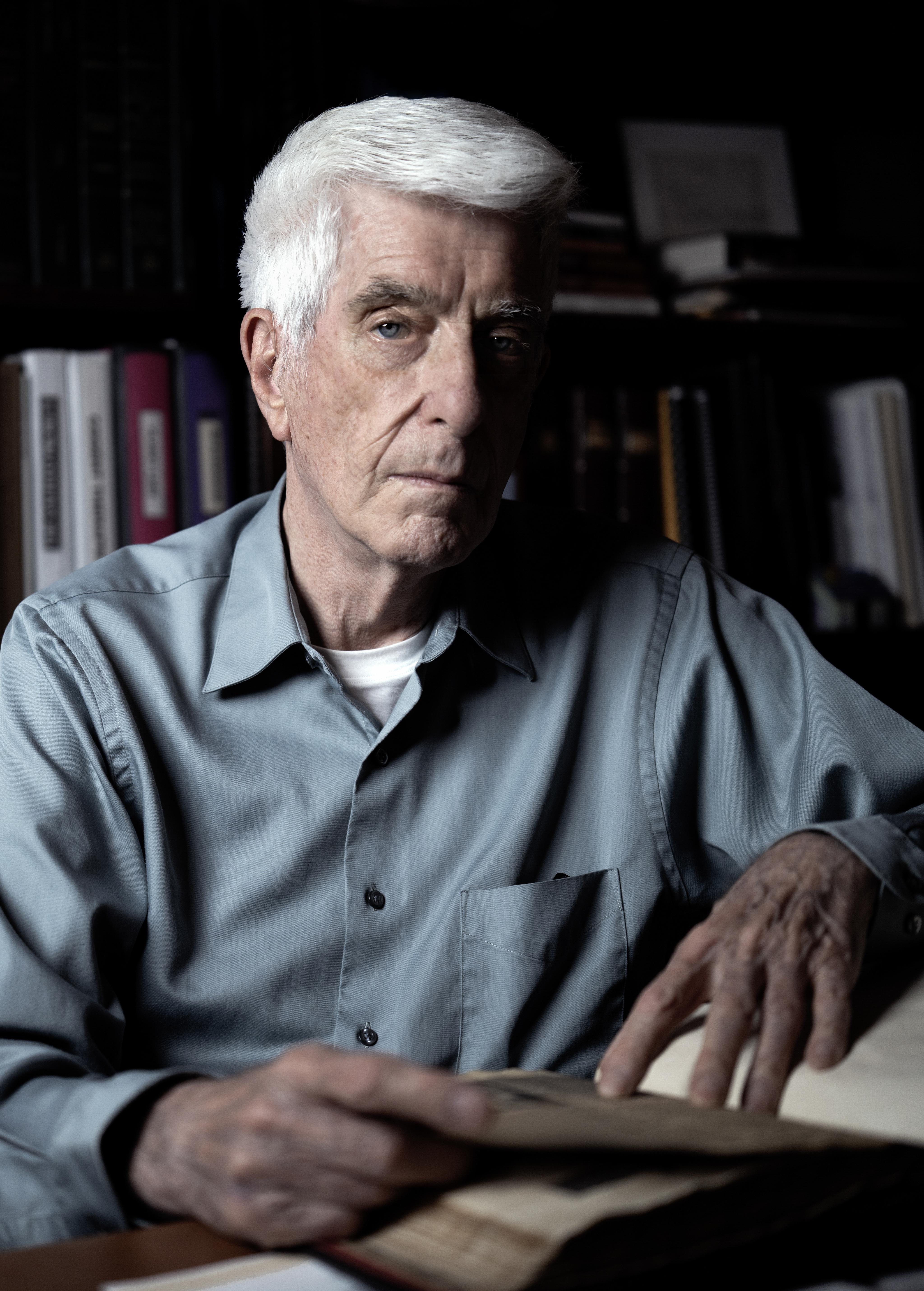
Jacques Vallée, December 2024. Photograph by Christopher P. Michel, CC BY-SA 4.0, via Wikimedia Commons.
In October 2025, Jacques Vallée arrived on the western shore of Lake Maggiore in northern Italy to attend a meeting of the Sol Foundation, a new organization dedicated to the scientific study of unidentified anomalous phenomena.
The setting was almost excessively beautiful. The trees were still green. Sailboats rested on the lake. Beyond the conference hall, the Italian Alps rose into the autumn sky.
Inside, researchers, former government officials and private benefactors gathered to discuss a subject Vallée had pursued longer than almost anyone alive.
He was 86 years old.
Nearly seven decades had passed since Vallée began recording his thoughts about unidentified flying objects in a private journal. He had started as a young astronomer in France, continued as a computer scientist working alongside J. Allen Hynek, then carried on through a parallel career as a Silicon Valley entrepreneur and venture capitalist. His diaries had followed him through government briefings, alleged crash sites, laboratories, séances, startup meetings, private conversations with intelligence officials and long nights wondering whether the problem he had given his life to could ever be solved.
At Lake Maggiore, Vallée presented a case from 1966.
Then he went back to his room and prepared to close the record.
Forbidden Science 7: Final Report, published May 26, completes a series of journals extending from the earliest years of Vallée’s career through the end of 2025. It is presented as his final volume and his withdrawal from visible research.
The title promises a conclusion. It does not deliver one.
There is no recovered spacecraft unveiled in its pages. No alien species is identified. No government official explains what has been hidden. Vallée does not even settle on a final theory of what UFOs are.
Instead, he ends his career much as he began it: convinced that something real is being reported, equally convinced that nearly everyone explaining it is getting part of the story wrong.
That absence of resolution is not a failure of the book. It is its central revelation.
After 70 years inside the UFO mystery, Jacques Vallée remains less certain than many people who entered it last week.
The man who would not choose a side
To understand Vallée’s importance, it helps to understand the argument he refused to accept.
For most of the modern UFO era, the subject has been organized around a false choice. Either unidentified objects are misidentifications, delusions and hoaxes, or they are spacecraft carrying extraterrestrial visitors.
The skeptic says there is nothing there.
The believer says there are aliens.
Vallée came to suspect that both positions were inadequate.
His resistance to easy answers made him one of the most influential thinkers in the history of the subject. It also made him unusually difficult to classify. He has defended witnesses whom mainstream scientists dismissed, then challenged UFO believers who took their testimony literally. He has argued that some sightings involve physical objects while insisting that the phenomenon cannot be understood as hardware alone. He has spent decades around intelligence officers and classified programs, yet repeatedly warned that secrecy, rumor and disinformation make government insiders among the least trustworthy sources in the field.
In a 2022 profile, Wired described Vallée as a scientist, technologist and investor regarded by his professional colleagues as unusually serious and grounded. He told the magazine that he might be the only ufologist who still did not know what UFOs were. The remark was partly humorous, but it captured his position precisely.
Vallée’s answer was not that nothing could be known.
It was that the right questions had barely been asked.
The night the evidence disappeared
Vallée was born in Pontoise, France, in 1939. His earliest memories were shaped by war. Allied bombing raids targeted the bridges near his hometown during the liberation of France. The first family house he remembered was destroyed.
As a young man, he studied mathematics and astronomy. He wrote science fiction and won France’s Jules Verne Prize. He also began reading reports of strange objects seen during the great European UFO wave of 1954.
His first books did not begin with fairies, consciousness or interdimensional beings. They began with data.
In Anatomy of a Phenomenon, first published in 1965, Vallée treated UFO reports as a classification problem. He warned readers that studying patterns in testimony was not the same as believing every account. The observed phenomenon, he argued, was not a flying saucer available for examination in a laboratory. It was the report itself: something that could be compared, categorized and analyzed.
That distinction reflected an experience that had already transformed him.
While working at the Paris Observatory in 1961, Vallée was part of a team tracking artificial satellites. According to his later accounts, the astronomers recorded an unknown object moving in a retrograde orbit—opposite the direction expected of the satellites then being launched.
The data should have been investigated.
Instead, Vallée said, a superior erased the tape.
The explanation was not that the object had been identified. It was that reporting it would expose the observatory to ridicule.
For Vallée, the episode became a formative lesson. The central scientific problem was no longer merely whether anomalous objects existed. It was whether scientific institutions were capable of preserving evidence that threatened their reputations.
The experience did not prove that extraterrestrials were visiting Earth. It demonstrated something more ordinary and perhaps more consequential: Scientists are subject to the same fear, conformity and career incentives as everyone else.
A mystery can remain unsolved not only because evidence is scarce, but because institutions sometimes discard it.
An astronomer enters the American UFO labyrinth
Vallée moved to the United States in 1962. In Texas, he worked on astronomy and an early computerized map of Mars. He later joined Northwestern University, earned a doctorate in computer science and became closely associated with J. Allen Hynek, the astronomer who had served as a consultant to the U.S. Air Force’s Project Blue Book.
Hynek had entered the UFO problem as a skeptic. Early in his Air Force work, he helped identify reports caused by stars, planets, meteors, balloons and aircraft. Over time, however, he became troubled by a residue of cases he believed resisted conventional explanation.
The relationship between Hynek and Vallée helped shape both men. Hynek brought institutional experience, astronomical authority and an instinct for scientific caution. Vallée brought international data, computing expertise and a willingness to follow the strangest aspects of the reports.
Together with a small network of scientists, they discussed cases that seemed to combine physical observations with psychological, physiological or paranormal effects. Hynek jokingly called the group the “Invisible College,” borrowing the name used for natural philosophers who exchanged ideas outside established institutions before the creation of the Royal Society.
Their collaboration also brought Vallée into the historical machinery of the UFO controversy. He saw how the Air Force collected reports, how officials worried about public perception and how the most consequential questions could become submerged beneath bureaucratic needs.
The problem was not necessarily that an all-knowing government had solved the mystery and concealed the answer.
Often, nobody seemed to know.
That possibility—the government as confused participant rather than omniscient keeper of the secret—runs through Vallée’s entire career.
The road to Magonia
The extraterrestrial hypothesis initially seemed reasonable to Vallée. If unknown machines were flying through the atmosphere, vehicles from another planet offered an obvious explanation.
The reports themselves gradually made him doubt it.
There were too many sightings. The objects behaved too absurdly. Their occupants often resembled distorted humans rather than organisms adapted to another world. Encounters included improbable costumes, contradictory messages, theatrical performances and effects on consciousness that seemed unrelated to the practical requirements of interplanetary exploration.
Then Vallée looked backward.
In Passport to Magonia, published in 1969, he compared modern UFO encounters with older stories about fairies, elves, demons, angels and aerial beings. The costumes changed, but the narrative structures appeared strangely persistent.
People were taken from ordinary surroundings. Time behaved abnormally. Small humanoid beings delivered messages. Witnesses entered altered states, returned transformed and sometimes discovered that more time had passed than they experienced.
Vallée was not claiming that fairies were extraterrestrials or that every religious vision had been caused by a flying saucer. His argument was subtler.
Human beings may have been encountering some class of anomalous experience for centuries, interpreting it through the intellectual vocabulary available to them. A medieval witness saw the inhabitants of a hidden kingdom. A Catholic visionary saw the Virgin Mary. A 20th-century American saw visitors from another planet.
The interpretation changed with the culture.
The underlying experience might not.
This was Vallée’s first great contribution: He separated the appearance of the phenomenon from its possible nature.
The beings might look like space travelers without being space travelers. The experience might feel religious without proving a religion. The encounter might produce a physical trace while also altering consciousness.
What witnesses believed happened to them was important. It was not necessarily the same as what had happened.
The control system
Vallée pushed the argument further in The Invisible College.
He proposed that the UFO phenomenon might operate as a kind of control system—not necessarily a centralized machine with a single operator, but a process that influenced human beliefs, expectations and behavior over time.
The phrase has often been misunderstood. Vallée was not simply saying that aliens control humanity.
He was asking readers to imagine a system whose effects become visible through feedback. A thermostat regulates temperature by responding to changes in its environment. A social control system might regulate beliefs by introducing experiences, symbols and disruptions that alter what a society considers possible.
The physical and psychological dimensions of the phenomenon would therefore not be competing explanations. They would be parts of the same mechanism.
A light appears in the sky.
A witness experiences paralysis, missing time or a sense of communication.
The event is retold.
A mythology forms around it.
Institutions react.
Beliefs shift.
The social consequences may eventually matter more than the original object.
This framework allowed Vallée to account for features that the spacecraft model tended to discard: absurdity, symbolism, religious overtones, psychic effects and the way UFO stories mutate as they pass through culture.
It also created a serious scientific problem.
A theory capable of incorporating almost any outcome can become impossible to disprove. If a case is coherent, the control system produced coherence. If it is absurd, the absurdity was intentional. If evidence appears, the system left evidence. If evidence disappears, elusiveness is part of the system.
The theory’s flexibility is its greatest strength and its most obvious weakness.
It explains why the mystery refuses to behave like a normal scientific object.
It also risks explaining everything after the fact.
Messengers, cults and the danger of belief
By the late 1970s, Vallée had become increasingly concerned not only with what UFOs might be, but with what people did in their name.
Messengers of Deception examined contactees, cults, political movements and groups claiming privileged communication with superior beings. Vallée warned that belief in extraterrestrial salvation could be exploited by charismatic leaders, intelligence services or political organizations.
He did not abandon the physical reality of UFOs. He argued that genuine anomalies could serve as carriers for false interpretations.
This distinction remains one of his most valuable.
A witness may have experienced something real without understanding it correctly.
A government may conceal information without possessing alien spacecraft.
An intelligence officer may know classified facts without telling the truth.
A photograph may be authentic while the story attached to it is false.
Vallée was especially suspicious of messages that asked human beings to surrender judgment to enlightened visitors. Benevolent space brothers had an odd tendency to endorse authoritarian politics, spiritual hierarchies and obedience to self-appointed intermediaries.
The danger was not only that people might believe in imaginary aliens.
It was that an unexplained phenomenon could be used to make ordinary human power appear supernatural.
The warnings proved prescient. Later editions of Messengers of Deception pointed to the Heaven’s Gate mass suicide, the Order of the Solar Temple killings and the persistence of UFO-centered religious movements as evidence that stories of contact could have deadly consequences.
Today, when unverifiable claims can spread globally within hours, Vallée’s attention to the social life of UFO stories feels less like a digression from the mystery than one of the clearest ways into it.
The three layers
By the publication of Dimensions, Confrontations and Revelations, Vallée’s mature framework had taken shape.
The phenomenon appeared to operate on at least three levels.
The first was physical. Witnesses reported objects, light, heat, electromagnetic interference, burns, marks on the ground and effects on vehicles.
The second was biological and psychological. Close encounters were associated with paralysis, disorientation, altered perception, physiological injury and long-term personality changes.
The third was social. Reports produced religions, political demands, government programs, entertainment, rumors, communities and new understandings of humanity’s place in the universe.
The error, Vallée argued, was to choose one level and treat it as the whole.
A purely psychological explanation ignored physical traces and multiple witnesses. A purely mechanical explanation ignored altered consciousness and symbolic content. A purely sociological explanation could describe the growth of UFO belief without explaining what initiated the most difficult cases.
Vallée’s answer was not to collapse these levels into a neat theory.
It was to insist that a successful theory would eventually have to explain all of them.
That standard remains unmet.
The ufologist who distrusted UFO revelations
Vallée’s work in the 1980s and ’90s brought another element to the foreground: deception.
In Revelations, he examined alleged crash-retrieval stories, Majestic 12 documents, Area 51 rumors and claims from former military and intelligence personnel. He argued that UFO researchers were often remarkably naive about classified information.
A document did not become accurate because it carried a government marking. A story did not become credible because its source had held a security clearance. Secrecy itself could become a tool of persuasion.
An ordinary report acquired glamour when extracted through the Freedom of Information Act. A false story became irresistible when delivered by someone who claimed he was risking prison by revealing it. The lack of evidence could be presented as evidence of how effectively the truth had been hidden.
Vallée believed the government had concealed information and misled the public. But he also believed that some supposed revelations were designed to be discovered.
What researchers interpreted as the center of the cover-up might be only another layer of it.
This is why Vallée’s later appearance inside the modern disclosure movement is so interesting.
He had already written its warning label.
The disclosure era arrives
In December 2017, reporting by The New York Times revealed a Pentagon program that had examined military encounters with unidentified objects. Navy videos appeared to show unusual targets recorded by military sensors. Pilots came forward. Congress held hearings. Officials adopted the term “unidentified anomalous phenomena.”
To many observers, the government was finally acknowledging what UFO researchers had argued for decades.
Vallée was less impressed.
Forbidden Science 7 begins in 2020, after the new UAP era had entered public life but before it reached Congress at full force. Its cast includes many of the movement’s best-known figures: Garry Nolan, Christopher Mellon, Luis Elizondo, Hal Puthoff, Eric Davis, Diana Pasulka, Leslie Kean, Avi Loeb, Peter Thiel, Robert Bigelow and officials associated with government UAP programs.
Anyone expecting Vallée to confirm a unified disclosure campaign will be disappointed.
His world is fractured.
Researchers possess pieces of information but rarely the whole. Government programs are underfunded, compartmentalized or vulnerable to cancellation. Private organizations compete for influence. Leaks generate suspicion. Television projects simplify difficult questions. Scientists struggle to obtain reliable samples, preserve chains of custody and make analytical equipment produce interpretable results.
The insiders do not appear to be standing around a captured saucer.
They are arguing over databases, budgets, personalities and access.
Vallée repeatedly worries that military interest will shrink the phenomenon into a threat-detection problem. Sensors can study objects in restricted airspace, but they cannot easily explain folklore, religious visions, altered consciousness or encounters reported by ordinary civilians.
The witness at the center of Vallée’s work is rarely a fighter pilot.
It is more often a farmer, a police officer, a child or a family suddenly confronted with an event that does not fit into the accepted world.
The military asks whether an object is a threat.
Vallée asks what it does to the person who sees it.
The final journal
As a book, Forbidden Science 7 is not a conventional history of the modern UAP era. It is not even a conventional memoir.
It is a journal.
That means it moves according to the shape of Vallée’s life rather than the expectations of a reader. Entries about recovered materials sit beside reflections on French politics, artificial intelligence, venture capital, climate change, scientific bureaucracy, old age and the COVID-19 pandemic.
The result is sprawling and occasionally repetitive. Vallée can be perceptive about institutions and impatient with people. He records rumors, private conversations and claims that a reader has no independent way to verify. Some passages feel less like finished analysis than raw intelligence from a complicated social world.
That is also what makes the book valuable.
The volume does not present the polished history of disclosure. It captures the confusion behind it.
We see projects stall. Laboratories struggle. Researchers fall out. Potential breakthroughs dissolve into technical problems. People who appear authoritative in public express doubt in private. Vallée himself changes his mind, withholds judgment or discovers that a promising sample has an ordinary explanation.
One piece of alleged anomalous material turns out to resemble aircraft honeycomb. Other samples remain interesting but inconclusive. Isotopic analysis is slowed by machine settings, software problems and the difficulty of separating meaningful anomalies from contamination.
This is science as it is actually practiced: not a montage of gleaming instruments producing revelation, but a long campaign against error.
The process is almost aggressively anticlimactic.
It is also more credible than the fantasy of scientists entering a secret warehouse and immediately recognizing technology from another world.
Five things Forbidden Science 7 reveals
The most interesting parts of Vallée’s final journal are not necessarily its most sensational claims.
The first is his deep suspicion of disclosure itself.
Vallée observes that official acknowledgment can become another method of control. The government can concede that something is happening while defining the boundaries within which it may be discussed. It can release military videos, emphasize threats and fund aerospace analysis while leaving the stranger human dimensions outside the frame.
“Disclosure may simply be the next step in the old cover-up,” he writes.
The second is the absence of an all-knowing authority.
The secret world described in Vallée’s journal is not a pyramid with one group at the top. It is a maze of compartments. Programs possess fragments. Contractors protect proprietary information. officials brief one another without necessarily sharing data. People infer the existence of deeper programs because they encounter barriers, but the barrier itself does not prove that anyone behind it understands the phenomenon.
The third is how much Vallée still values physical evidence.
He is commonly described as an advocate of a purely psychic or interdimensional explanation. The final journal makes that caricature difficult to sustain. Vallée spends years pursuing material samples, laboratory tests, databases and field investigations. He works with Nolan and other scientists because he believes anomalous experiences sometimes leave measurable effects.
His argument is not that UFOs are imaginary.
It is that physical reality may be larger than the categories currently used to describe it.
The fourth is the emotional cost of the work.
Vallée writes from isolation during the pandemic. He mourns his wife, Janine, whose death remains a living presence in the journals. He worries about friends, aging colleagues and the disappearance of an intellectual generation. He falls in love again, travels between San Francisco and Paris and prepares his archives for researchers who will continue after him.
The UFO mystery becomes part of a larger confrontation with mortality.
What can one person preserve?
Which records will survive?
What does it mean to spend a lifetime pursuing a question that may outlive you?
The fifth is that Vallée’s final theory remains unfinished.
He continues to suspect that consciousness cannot be reduced to the brain, that time may not operate as human beings experience it and that anomalous events may emerge from a deeper informational structure of reality. He finds parallels in physics, mysticism and historical traditions.
But these are possibilities, not demonstrated conclusions.
The man sometimes presented as the architect of the interdimensional hypothesis ends his journals without telling us which dimension the objects come from—or whether “coming from” is even the right concept.
The case that tests his credibility
A generous assessment of Vallée cannot ignore Trinity: The Best-Kept Secret, the book he wrote with Paola Harris about an alleged 1945 UFO crash near the site of the first atomic-bomb test in New Mexico.
The case becomes one of the major preoccupations of Forbidden Science 7. Vallée travels to New Mexico, interviews witness Jose Padilla, examines the reported crash site and participates in the analysis of a metal bracket said to have come from the object.
The story is extraordinary.
Padilla and his childhood friend Reme Baca allegedly encountered a crashed avocado-shaped craft in August 1945. They described small living beings inside. The Army later arrived, removed the object and left behind material the boys recovered.
Vallée and Harris argue that the case connects the UFO phenomenon to the beginning of the atomic age, predating Roswell by two years.
It is also heavily disputed.
Researcher Douglas Dean Johnson assembled public records, earlier interviews and contradictions that he argues seriously undermine the story. Among the problems are conflicting accounts attributed to Baca, uncertainties about the ownership and history of the land and questions about when key elements of the narrative first appeared. Other UFO researchers, including some initially receptive to the case, have said the inconsistencies are severe.
Vallée has defended the investigation, argued that critics misrepresented parts of the evidence and emphasized that he never claimed the metal bracket itself had been proved extraterrestrial. He also acknowledged that some details required correction or further clarification.
The controversy matters because it tests the very method Vallée has spent decades advocating.
He has warned readers not to confuse sincerity with accuracy. He has criticized researchers who become emotionally committed to witnesses. He has shown how narratives grow around suggestive but inconclusive evidence.
With Trinity, critics argue, he may have fallen into the same trap.
That does not invalidate the whole of Vallée’s work. A contested case cannot erase decades of historical research, theoretical innovation and justified warnings about deception.
But intellectual generosity should not become immunity.
Vallée’s stature is not evidence for Trinity. The case must stand on its own documentation. At present, it does not justify the confidence implied by its subtitle.
This is the necessary limit of a generous reading: Vallée deserves to be taken seriously, not treated as infallible.
What Vallée got right
Some of Vallée’s specific claims remain unproven. His larger insights have aged remarkably well.
He recognized early that UFO reports could not be understood through a simple contest between true believers and debunkers.
He saw that a real event could generate a false interpretation.
He understood that physical anomalies and psychological effects might coexist.
He warned that intelligence agencies could exploit the mythology surrounding UFOs, whether or not they understood the original phenomenon.
He anticipated the rise of UFO-centered spiritual movements, political narratives and charismatic insiders claiming privileged access to hidden truth.
He argued that the social consequences of contact beliefs could become more important than the objects themselves.
He insisted that witness trauma deserved attention even when the cause of an experience remained unknown.
He also understood that the extraterrestrial hypothesis had become culturally reassuring. Aliens may be frightening, but they preserve a familiar universe. They are biological beings from another planet. They travel in machines. They can be studied by extending existing science.
Vallée’s alternative is more disturbing.
The phenomenon may not respect the divisions between mind and matter, observer and event, history and mythology. It may interact with human beings through symbols as well as energy. It may be ancient. It may not share our experience of time. Its apparent absurdity may be intrinsic rather than incidental.
None of this has been proved.
But the modern UAP era has not rendered the questions obsolete.
It has made them harder to avoid.
What remains unproved
Vallée’s control-system hypothesis is intellectually powerful because it gathers many neglected aspects of the UFO experience into one frame.
It is scientifically weak for the same reason.
What evidence would demonstrate that a control system exists? How would researchers distinguish its operation from folklore, memory distortion, social contagion, intelligence manipulation and unrelated physical anomalies? What prediction would the theory make that a simpler explanation would not?
Vallée has spent decades describing the shape of the problem without producing an experiment capable of deciding among its possible causes.
His historical comparisons also require caution. Similar stories do not necessarily share a common origin. Fairies, Marian apparitions, shamanic journeys, sleep paralysis and UFO abductions may resemble one another because human brains, bodies and cultures produce recurring patterns—not because a single external intelligence stands behind them.
The recurrence is evidence of a problem worth studying.
It is not proof of Vallée’s preferred interpretation.
This distinction is crucial because Vallée’s writing is unusually good at making possibility feel like proximity. He moves elegantly from documented cases to folklore, physics, mysticism and private testimony. The connections can be illuminating even when they are not causal.
Readers should follow him.
They should not always follow him all the way.
What does Jacques Vallée ultimately believe?
Across seven volumes of journals and more than half a century of public books, Vallée’s position can be reduced to several propositions.
Something real exists behind at least some UFO reports.
That something can produce physical effects.
It can also alter perception, consciousness and human behavior.
The phenomenon has probably been present longer than the modern flying-saucer era.
Its appearance is shaped by culture, which means witnesses may describe it accurately at one level while misinterpreting it at another.
The extraterrestrial-spacecraft hypothesis may explain part of the evidence, but it does not explain the whole.
Human institutions—military, scientific, religious, media and intelligence—do not merely investigate the phenomenon. They become part of it by suppressing, reframing, exploiting and mythologizing what people report.
Finally, premature certainty is dangerous.
This last principle may be Vallée’s most durable conclusion.
Believers want him to say the aliens are here.
Skeptics want him to admit there is nothing to explain.
Disclosure advocates want him to confirm the program.
Spiritual seekers want him to validate another reality.
Vallée continues to deny each group the satisfaction of possession.
The mystery does not belong to them.
Is the new book worth reading?
For a newcomer, Forbidden Science 7 is not the best place to begin.
Its hundreds of names, programs, private conversations and unfinished disputes assume a familiarity with the UFO world that most readers will not possess. Its structure is episodic. Its political and business digressions sometimes interrupt the main story. Several claims would require independent reporting before they could be presented as fact.
Readers looking for a concise statement of Vallée’s theory should start with Passport to Magonia, The Invisible College or Dimensions.
Readers who want to understand Vallée himself should read the final journal.
It contains the entire man: scientist, mystic, investor, skeptic, romantic, institutional critic, field investigator and aging keeper of records.
The UFO material is inseparable from the rest because Vallée never treated the phenomenon as a hobby isolated from ordinary life. It was one expression of a larger question that also drove his work in computing and venture capital: How does information move through a system, and how does that movement change the system itself?
Computer networks connect human beings.
Capital networks turn ideas into companies.
Myths connect private experiences to collective beliefs.
The UFO phenomenon, in Vallée’s thinking, may be another information system—one whose source code remains hidden.
Seen this way, his apparently unrelated careers begin to resemble a single investigation.
The final report without a final answer
Near the end of Forbidden Science 7, Vallée places his confidence not in a great disclosure announcement but in archives, younger researchers and small institutions capable of asking questions the established world has neglected.
His papers are being preserved at Rice University. Scientists associated with the Sol Foundation are attempting to build a more credible research program. The British organization uNHIdden is addressing the health and psychological needs of witnesses. Vallée hopes these groups will continue after he steps away.
This is a modest ending for a life spent near extraordinary claims.
It may also be the correct one.
The history of UFO research is crowded with men who announced that the answer was imminent. The evidence was about to be released. The government could no longer contain the truth. The decisive photograph, body, material or document would soon change the world.
Vallée outlasted most of them.
He did so partly because he refused to make the promise.
His final journal does not solve the UFO mystery. It shows why the mystery has survived every effort to solve it: weak evidence mixed with strong experience, secrecy mixed with ignorance, physical anomalies mixed with human meaning, authentic witnesses mixed with opportunists and a culture that demands certainty before the facts can support it.
After 70 years, Vallée has earned the right to stop.
In his final reflections, he writes: “I am at peace, and my wonder for this planet and the universe is intact.”
That may be the real conclusion of Forbidden Science.
Vallée did not find the answer he went looking for as a young astronomer. He found a better way to inhabit the question.
The oil lamp is burning low.
The mystery remains illuminated.


