Aristocrat Installs the Powerful Oasis 360(TM) System Tools nCompass(TM), nRich(TM) and Ricochet Rewards(TM) at Jackson Rancheria Casino

LAS VEGAS, NV--(Marketwire - Dec 13, 2012) - Aristocrat, the leading systems supplier in North America, has completed a major update to its Oasis 360â„¢ system at Jackson Rancheria Casino in Jackson, Calif. Aristocrat has converted all of the property's 1,600 games to the advanced nCompassâ„¢ LCD, and added the rewarding bonusing engine nRichâ„¢.

nCompassâ„¢ technology is a single solution that delivers video or animated content, provides state-of-the-art touch screen interactivity, displays player points earned, and gives operators and/or their vendor(s) the power to develop custom content.

Aristocrat's innovative and award-winning nRichâ„¢ is a new form of bonusing engine that focuses on dynamically rewarding individual players, either as individuals or as a group.

nRichâ„¢ recently topped Casino Enterprise Management Magazine's 3rd annual Hospitality Operations Technology (HOT) Awards List for Guest Experience Enhancement, and field studies have shown nRichâ„¢'s value to operators.

Aristocrat's Vice President of System Sales and Marketing Kelly Shaw said, "Jackson Rancheria Casino has been a valued Aristocrat partner since 2002, and we are very excited to present them with the power of nCompassâ„¢ and nRichâ„¢. With these advanced tools, Jackson Rancheria will be able to communicate with and reward their players in a dynamic way, helping to give the property a unique competitive advantage."

Jackson Rancheria Casino Director of IT Damien Dinh said, "The extensive Oasis 360â„¢ update conversion has been seamless, and the Aristocrat team has been right by our side throughout the entire process. We are excited to have the technology in place, and we could not have asked for a better partner than Aristocrat."

Aristocrat's sophisticated and technologically advanced Oasis 360â„¢ casino management system, rated the best player tracking system in the 2012 Goldman Sachs Slot Manager Survey, is the most widely used in North America, currently monitoring devices at more than 285 casinos.

About Aristocrat Technologies Inc.
Aristocrat Technologies Inc. is a subsidiary of Aristocrat Leisure Limited (ASX: ALL), a leading global provider of gaming solutions. The Company is licensed by more than 200 regulators and its products and services are available in more than 90 countries around the world. Aristocrat offers a diverse range of products and services including electronic gaming machines and casino management systems. For further information visit the company's website at www.aristocratgaming.com.


  • Exchange closures signal a Bitcoin bottom? analyst says the data tells a different story

    Exchange closures signal a Bitcoin bottom? analyst says the data tells a different story · TheStreet · Getty Images

    Every time a major crypto exchange shuts down during a bear market, the same chart starts circulating.

    Exchange logos placed at Bitcoin price lows, implying a clear pattern, when platforms collapse, the bottom is near. It is a compelling visual. It is also, according to analyst Joao Wedson, unsupported by the actual data.

    Wedson posted a breakdown on X that cuts through what he calls repeated FUD dressed up as market analysis.

    His data tracks documented yearly counts of crypto exchange and platform shutdowns going back eight years, covering closures from insolvency, regulation, liquidity failure, hacks, fraud, and straightforward business decisions.

    What the numbers actually show

    So far in 2026, nine crypto exchanges and trading platforms have announced or completed shutdowns. That is the lowest count recorded in at least eight years, and significantly below the numbers seen during the 2022 bear market cycle, which saw dozens of platforms collapse in the wake of Terra Luna's implosion and FTX's bankruptcy.

    Related: Elon Musk is putting Dogecoin on the moon in 49 days, here is what history says happens next

    BitMart announced its closure on July 26. BitMEX confirmed it will permanently shut down on September 23. Both closures happening within days of each other has generated significant market commentary about what it signals for Bitcoin's price trajectory.

    Wedson's point is straightforward, two high-profile closures do not constitute a trend when the overall yearly closure count is historically low.

    The visual pattern of placing exchange logos at market bottoms selects for memorable failures and ignores the years when multiple closures happened nowhere near a bottom.

    Why the narrative persists

    Exchange shutdowns are emotionally resonant events. They produce headlines, generate fear, and give analysts something concrete to point to.

    That emotional weight is precisely what makes them effective narrative anchors, regardless of whether the underlying data supports the conclusion being drawn.

    Bitcoin is trading near $64,000 today. Nine exchange closures in 2026 is a fact.

    Whether that fact means the bottom is in is a different question entirely, and the data, according to Wedson, does not answer it the way the narrative suggests.

    Related: If you had invested $1,000 in gold instead of Bitcoin five years ago, here is what each is worth today

    This story was originally published by TheStreet on Jul 30, 2026, where it first appeared in the MARKETS section. Add TheStreet as a Preferred Source by clicking here.


  • Cathie Wood predicts more shutdowns and bankruptcies

    Cathie Wood predicts more shutdowns and bankruptcies · TheStreet

    Lorenzo Valente, director of digital assets research at Cathie Wood's ARK Invest, posted an observation that cuts through the noise around BitMart and BitMEX shutting down, exchange outflows and bear-market gloom.

    His read isn't that crypto is dying. It's that crypto is consolidating, and the scale of it is unlike anything the industry has seen before.

    "I believe crypto is going through the biggest consolidation phase in its history, far more profound than in previous bear markets," Valente wrote.

    The revenue concentration data

    The numbers behind his argument are striking. By his count, two applications — Hyperliquid and Pump.fun — generate 67% of all application revenue across the entire crypto ecosystem. Add a third, Ethena, and the top three account for almost 80%.

    Related: Crypto analyst unveils one factor that could send XRP to $100 trillion

    Here is what those three winners actually are:

    • Hyperliquid: a decentralized exchange with an on-chain order book built for perpetual-futures trading. Its fee generation has recently rivaled or topped entire blockchains, out-earning Ethereum, Solana and Bitcoin in some weekly snapshots.

    • Pump.fun: a Solana-based launchpad for memecoins that became one of crypto's single biggest revenue engines, at times processing hundreds of millions of dollars in daily volume.

    • Ethena: the issuer of a "synthetic dollar," USDe, on Ethereum, with more than $10 billion locked in its protocol and one of the highest fee hauls in DeFi.

    Valente says that concentration is now at all-time highs across almost every layer of the stack — applications, middleware and Layer-1 protocols — at the same time.

    "Revenue concentration is now at all-time highs across almost every layer apps, middleware, L1s etc: @HyperliquidX and @Pumpfun account for 67% of total app revenue. Add @ethena, and the top three generate almost 80%," he wrote.

    The implication is direct, capital has stopped spreading across hundreds of projects and is pooling in the few that have shown genuine product-market fit. Everything else is being starved of revenue, funding and users at once.

    One caveat is worth keeping in mind. Valente didn't publish the underlying dataset or spell out exactly how he defined "revenue," and different trackers measure it differently — gross fees, net fees and the revenue a protocol actually keeps are not the same thing. The precise percentages are best read as his framing of a very real trend rather than a settled figure.

    What comes next

    Valente expects the shakeout to intensify over the coming months. In his telling, that looks like:


  • Telegram’s GRAM Token Teases 40% Rally Despite Pavel Durov Warrant

    Telegram's GRAM token, formerly known as Toncoin, is painting a technical structure similar to the one that preceded its explosive April 2026 breakout, raising the possibility of a rebound toward $2.

    That is despite fresh legal pressure surrounding Telegram founder Pavel Durov.

    GRAM Falling Wedge Resembles April Breakout

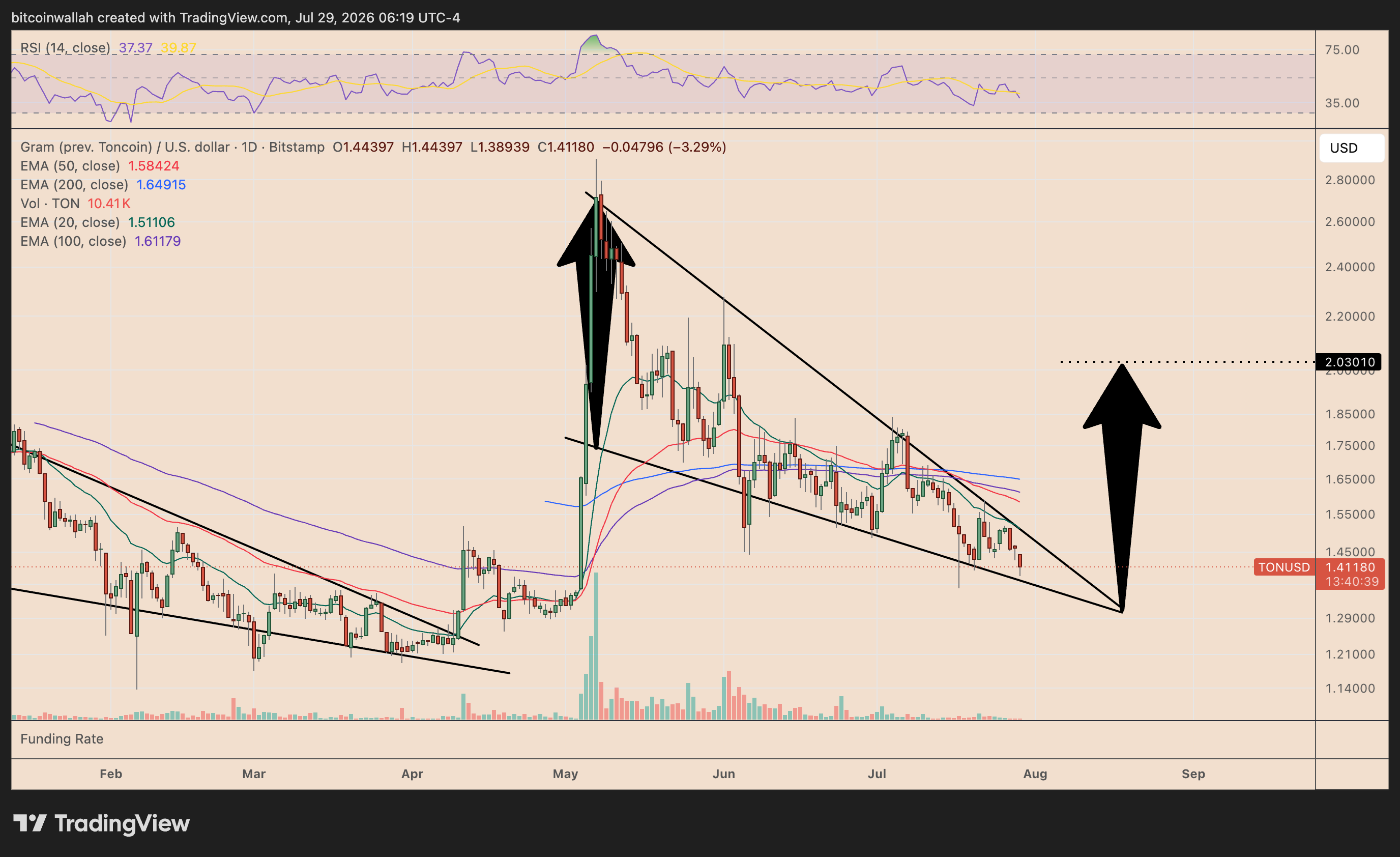
    GRAM was trading near $1.42 on July 29, down almost 3% on the day and roughly 50% below its May peak near $2.75.

    GRAM's daily price chart featuring the falling wedge breakout setup. Source: TradingView

    The token has been declining between two descending, converging trendlines since May, forming what appears to be a falling wedge.

    The pattern can signal weakening bearish momentum, but it confirms only after price breaks above the upper trendline. Should it happen, the GRAM token price may rally toward $2 in the coming weeks, amounting to over 40% gains.

    GRAM's daily relative strength index (RSI) was around 38, just above the oversold threshold of 30. That indicated odds of an interim dip toward the wedge's apex point near the $1.30 level despite the broader upside outlook.

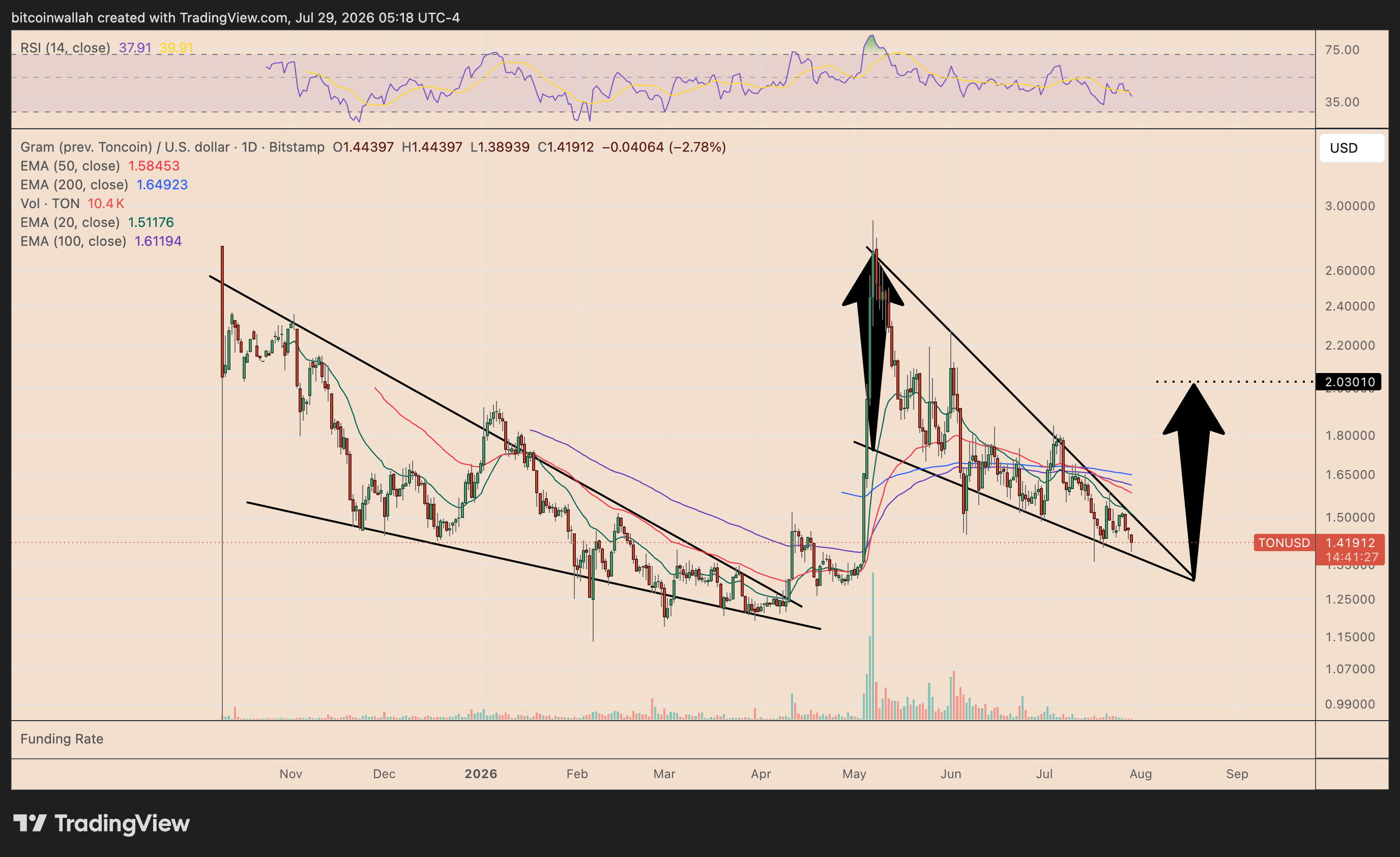
    The setup resembles the falling wedge that formed between October 2025 and April 2026.

    GRAM broke above that earlier wedge near $1.30–$1.35 with rising volume, reclaimed its major exponential moving averages and subsequently rallied toward $2.70–$2.80.

    GRAM's daily price chart comparing the current wedge with its April 2026 breakout. Source: TradingView

    The current fractal remains unconfirmed. GRAM must hold the $1.30–$1.38 region and break above wedge resistance near $1.48–$1.52.

    A further move above the 50-, 100- and 200-day EMAs between approximately $1.58 and $1.65 could expose $1.78–$1.82, followed by the chart's $2.03 target. That would represent an approximately 43% rebound from current levels.

    A daily close below $1.30 would weaken the bullish comparison and expose $1.20–$1.25.

    Pavel Durov News Adds Pressure

    GRAM's latest decline followed reports that Russian authorities charged Pavel Durov with allegedly facilitating terrorism and issued an international arrest warrant against the Telegram founder.

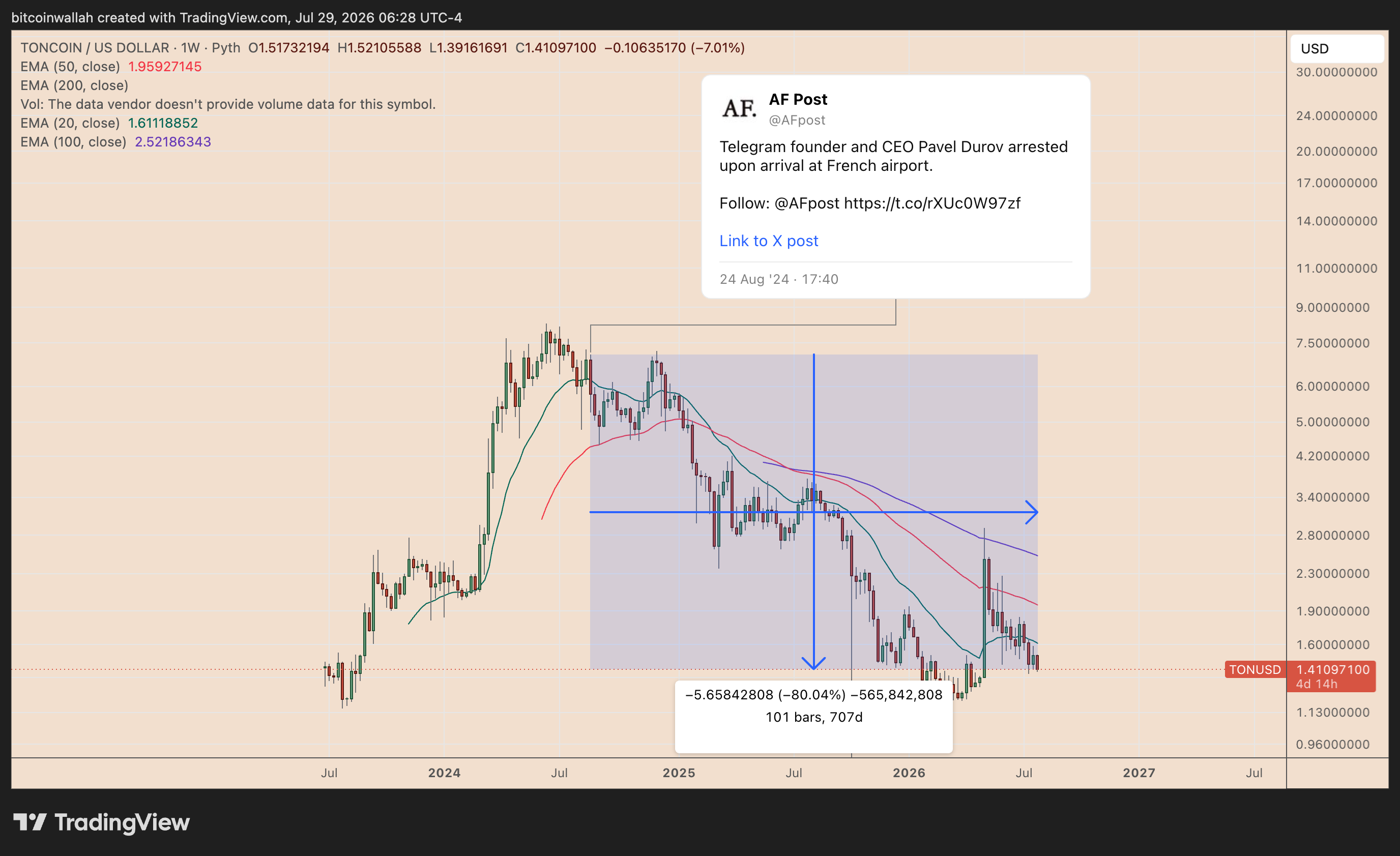
    The market has historically treated legal action against Durov as a risk to the broader Telegram and TON ecosystem. Toncoin fell sharply following Durov's arrest in France in August 2024.

    GRAM's (TON/USD) price chart showing its 85% decline after Pavel Durov's arrest in France. Source: TradingView

    The current reaction has been smaller, but it has pushed GRAM closer to the same type of falling-wedge support that preceded April's breakout.

    For now, the Durov-related sell-off may be helping complete the bullish fractal. However, GRAM still needs to reclaim $1.50–$1.65 with stronger volume before the projected move toward $2.03 gains confirmation.

    This article was originally posted on FX Empire


  • Dogecoin, Shiba Inu Wins 'Good for Every Legitimate Meme Project,' Says Analyst: 'Ecosystem Has a Better Chance of Winning'

    Cryptocurrency commentator David Gokhshtein said on Tuesday that strong performance from Dogecoin (CRYPTO: DOGE) and Shiba Inu (CRYPTO: SHIB) would boost the broader memecoin ecosystem.

    DOGE, SHIB To Have Ripple Effect On Memecoins?

    In an X post, Gokhshtein said that wins in the two blue-chip memecoins would help "legitimate" projects gain traction.

    The analyst admitted that a section of people want DOGE and SHIB to "fail," not realizing the spillover effects they might create.

    People don't realize that if $DOGE and $SHIB win, the entire meme ecosystem has a better chance of winning.

    That's good for every legitimate meme project.

    — David Gokhshtein (@davidgokhshtein) July 28, 2026

    Earlier this week, Gokhshtein said that investors are growing weary of chasing newly launched meme coins that crater after debut and that capital could rotate back toward projects with established communities.

    Price performance painted a mixed picture. While SHIB has regained momentum, DOGE has given back most the gains it made over the past week.

    The overall memecoin market capitalization has declined 3.09% over the week to $23.41 billion.

    Cryptocurrency

    7-Day Gains +/-

    1-Month Gains +/-

    Dogecoin

    -3.99%

    -3.67%

    Shiba Inu               

    +8.66%

    +10.27%

    Read Also:Robinhood Chain Overtakes Solana, Ethereum for Real-World Asset Trading: What Does It Mean for HOOD?investors are growing weary of chasing newly launched meme coins

    Calm Before Big DOGE Move?

    Leading cryptocurrency analyst Ali Martinez identified $0.081 as the "first major resistance" for DOGE, noting that a breakout above it could open the door to a 150% rally.

    The Commodity Channel Index, which measures the difference between the current price and the historical average price of an asset, signaled "Buy" for DOGE, according to TradingView. The Bull Bear Power indicator, which measures the strength of buyers and sellers, was "Neutral," and so was the Relative Strength Index.

    SHIB Fires Up

    Shiba Inu token burns have exploded 1028% in a week, with a one-year high of 1.27 billion SHIB incinerated on Monday, according to Shibburn.

    Coin burning involves purposely sending a cryptocurrency to an unusable wallet address to remove it from circulation. This is done to generate scarcity and gradually boost the market value of the token in the long term.

    Price Action: At the time of writing, DOGE was exchanging hands at $0.07016, up 0.11% over the last 24 hours, according to data from Benzinga Pro. SHIB traded down 1.77% at $0.000054574 at last check.

    Read Also:Dogecoin Ready to Soar 150%? Crypto Analyst Says a Breakout Above This 'Major Resistance' Can 'Clear the Way'


  • Ethereum and solana are getting busier — and cheaper. What's going on?

    Ethereum and solana are getting busier — and cheaper. What's going on?
    Ethereum and solana are getting busier — and cheaper. What's going on?
    Scroll back up to restore default view.

    Ethereum (ETH-USD) and solana (SOL-USD) are getting busier and cheaper, even as token prices fall, according to Bitwise.

    "The Daily Wolf with Scott Melker" airs every day at 12:00 p.m. Tune in for your daily dose of all things crypto.

    Make sure to also check out Yahoo Finance's new crypto hub to find the latest crypto-related news.


  • Crypto Market Today, July 27: Bitcoin Steadies as Ahead of Fed Meeting

    As of early evening on July 27, Bitcoin (CRYPTO:BTC) gained 0.3% to $64,849.77, Ethereum (CRYPTO:ETH) gained 1.6% to $1,944.54, and Solana (CRYPTO:SOL) gained 0.7% to $75.84.

    What's driving crypto markets

    Risk appetite improved as falling oil prices and a de-escalation of U.S.-Iran tensions eased inflation fears. Traders also pared downside hedges ahead of this week's Federal Reserve meeting, when markets expect rates to remain unchanged.

    Spot Bitcoin ETF flows had been positive for much of July, after significant losses in June. However, there were over $465 million in outflows during the final two days of last week, demonstrating that institutional adoption remains fragile.

    What this means for investors

    Bitcoin felt the pressure from tumbling tech stocks on Thursday and Friday, and the weakness continued over the weekend. Today, the lead crypto gained a little ground as traders considered positive developments in the Middle East and hopes that falling energy prices may reduce inflation. Rising U.S. debt could prove a tailwind for Bitcoin, as investors seek safe havens such as gold to hedge against a falling dollar. Bitmine Immersion Technologies, a leading Ethereum treasury company, bought more of the smart-contract crypto, signaling its continued confidence.

    Some analysts also view recent closure announcements from two crypto exchanges, BitMEX and BitMart, as signs that the market is nearing its bottom. The names are similar, but they are two distinct platforms that will both shut down operations in the coming months. I think that's an overly optimistic interpretation: the closure of crypto platforms is a sign that the market is struggling, not a signal that the end of the slump is in sight.

    Top 10 crypto performance

    #

    Name

    Price

    24h

    7d

    1

    Bitcoin (BTC)

    $64,875.00

    +0.4%

    -0.4%

    2

    Ethereum (ETH)

    $1,943.11

    +1.7%

    +2.4%

    3

    Tether (USDT)

    $0.9990

    -0.0%

    -0.0%

    4

    BNB (BNB)

    $574.84

    +0.4%

    +0.7%

    5

    USDC (USDC)

    $0.9999

    -0.0%

    +0.0%

    6

    XRP (XRP)

    $1.09

    -1.0%

    -2.4%

    7

    Solana (SOL)

    $75.80

    +0.7%

    -2.2%

    8

    TRON (TRX)

    $0.3276

    -1.3%

    +0.4%

    9

    Figure Heloc (FIGR_HELOC)

    $1.03

    +1.9%

    +3.2%

    10

    Hyperliquid (HYPE)

    $56.99

    -3.1%

    -8.3%

    Ranked by market cap. Data: CoinGecko, as of July 27, 2026 20:17 UTC.

    Should you buy stock in Bitcoin right now?

    Before you buy stock in Bitcoin, consider this:

    The Motley Fool Stock Advisor analyst team just identified what they believe are the 10 best stocks for investors to buy now… and Bitcoin wasn't one of them. The 10 stocks that made the cut are built for long-term growth and could produce monster returns in the coming years.


  • Has Crypto Finally Exhausted Wall Street? Time to Buy The Dip as BTC ETF Hit 2024 Lows

    Has Crypto Finally Exhausted Wall Street? Time to Buy The Dip as BTC ETF Hit 2024 Lows · 99bitcoins

    Bitcoin (BTC) price is trading near $65,100 as Wall Street's patience wears visibly thin, and the Bitcoin ETF data is starting to look ugly. Spot Bitcoin exchange-traded fund (ETF) weekly trading volume just hit its lowest level for a full five-session week since October 2024, clocking in at roughly $8.05 billion, a 14% drop from $9.37 billion the prior week.

    That's not a blip, it's a trend. Citigroup moved first among major banks, slashing its 12-month Bitcoin target to $82,000 from $112,000 and its Ethereum target to $2,240 from $3,175, explicitly citing negative ETF flows and stalled U.S. digital asset legislation. Whether this is capitulation or a genuine pause defines the entire trade from here.

    Can Bitcoin Recover From 2024-Low ETF Volume, or Is the Bull Run on Ice?

    The volume collapse tells one story. The flow data tells a messier one. Bitcoin ETFs finished the recent week with just $33.8 million in net inflows, the softest of three consecutive positive weeks, following $75.7 million the week before and $197.4 million the week prior to that.

    The deterioration is sharp. ETFs pulled in roughly $499.1 million across the first three sessions of the week before investors yanked $225.2 million on Thursday and another $240.1 million on Friday, nearly erasing the full week's gains in 48 hours.

    BlackRock's iShares Bitcoin Trust (ticker: IBIT), the largest spot Bitcoin ETF by net assets, recorded $95.5 million in net outflows for the week after hemorrhaging a combined $414.7 million in just the final two sessions.

    Grayscale's Bitcoin Mini Trust and the ARK 21Shares Bitcoin ETF partially offset that with approximately $85.8 million and $78.1 million in inflows, respectively, not nearly enough to plug the gap.

    Citi's analysts wrote that the "absence of a catalyst for increased investor interest" led them to assume no net ETF inflows over the next 12 months. That's a bold assumption.

    Technically, Bitcoin is holding a contested support zone in the mid-$50,000s, near Citi's bear-case target of $53,000, while the $80,000–$82,000 band now functions as medium-term resistance under Citi's revised base case. The bull scenario requires re-accelerating ETF inflows and meaningful progress on U.S. crypto legislation; the bear case is a macro-driven recession that pushes BTC toward $53,000.

    Not everyone is folding. Bernstein characterized the ETF slowdown as a "short-term pause" and held its $150,000 BTC target for end-2025, arguing the structural bull run remains intact. That's a wide spread of opinion for sophisticated desks to carry simultaneously (make of that what you will).

Telegram’s GRAM Token Teases 40% Rally Despite Pavel Durov Warrant