LeakNet Claims NYC Health + Hospitals Breach Affected 12 Million Patients

LeakNet Claims 11TB of Data Stolen in NYC Health + Hospitals Breach

LeakNet claims it stole 11TB of NYC Health + Hospitals data containing sensitive medical, financial and biometric records linked to more than 12 million people.

Listen to this article

LeakNet Claims 11TB of Data Stolen in NYC Health + Hospitals Breach

0:00

Press play to start listening

A data-extortion operation using the name LeakNet claims it stole an 11TB archive from NYC Health + Hospitals (NYCHH) containing information linked to more than 12 million people. The figure has not been confirmed by the health system, regulators, or an independent forensic review.

LeakNet published a preview on July 27 containing screenshots of databases, medical spreadsheets, internal messages, and what it described as a complete directory listing for the stolen archive. The group threatened to publish the remaining material in a later release.

As seen by Hackread.com, several screenshots contain visible patient names, addresses, telephone numbers, Social Security numbers, dates of birth, and medical information.

Other images appear to show mental health diagnoses, HIV records, cancer-related appointments, and fingerprint documents bearing NYC Health + Hospitals branding. Hackread.com is not reproducing any patient-identifying details.

12 Million Figure

Although the preview contains credible-looking samples, screenshots cannot establish where every file originated or whether the archive contains 12 million different people. Database rows can represent appointments, diagnoses, transactions, or repeated entries for the same patient, so row totals cannot be treated automatically as a count of affected individuals.

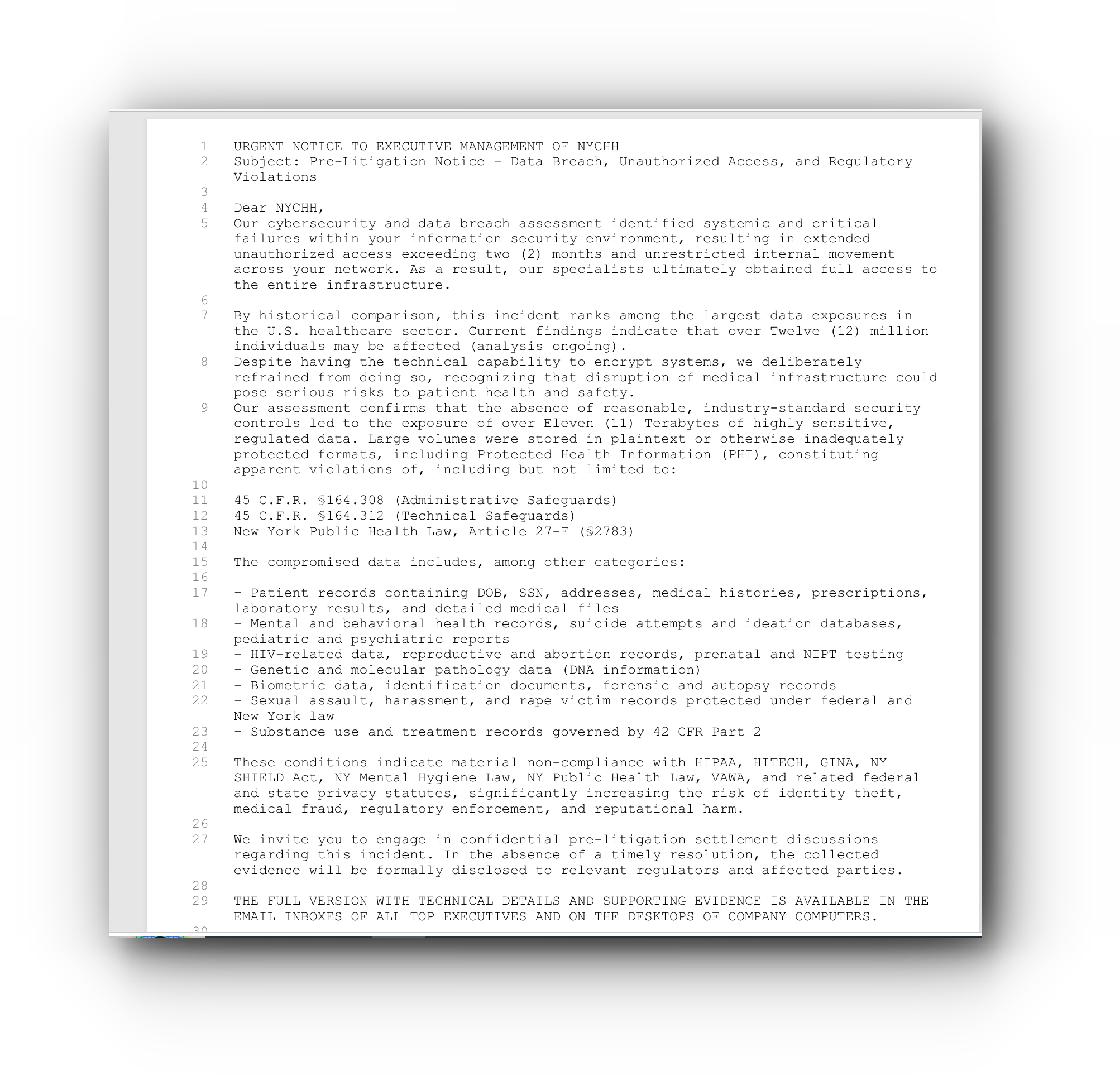
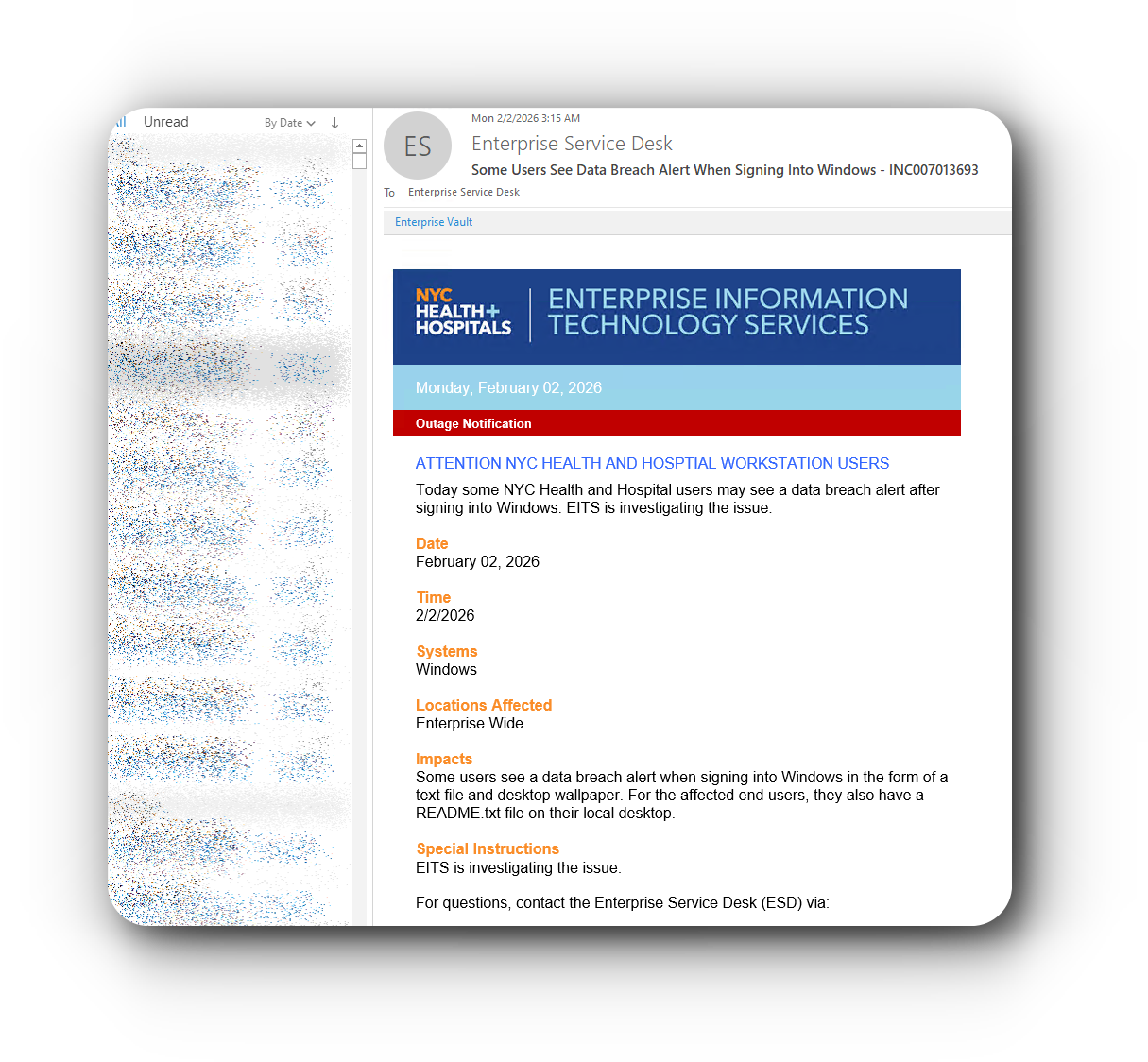
LeakNet also alleged that NYC Health + Hospitals leadership knew on February 2 that at least 12 million people were affected. One supplied screenshot shows an internal service-desk notice from that date telling staff that some Windows users were seeing a data-breach message. Another image shows an extortion notice claiming to have more than 12 million victims and over 11TB of exposed data.
LeakNet Claims NYC Health + Hospitals Breach Affected 12 Million Patients
An extortion letter that LeakNet describes as a “notification letter to NYC Health + Hospitals.”

Neither image independently proves that Chief Executive Officer Mitchell Katz knew the 12 million estimate on February 2. The material supplied for this report also does not include a response to Congress in which NYC Health + Hospitals stated that only 1.8 million people were affected.

It is now up to NYC Health + Hospitals to respond to these claims and confirm or deny them.

Confirmed Breach Affected at Least 1.8 Million People

NYC Health + Hospitals disclosed the incident on March 24 after detecting suspicious network activity on February 2. Its investigation found that an unauthorized party accessed systems from approximately November 25, 2025, through February 11, 2026, and copied files.

The health system said the affected information varied by person and could include medical, insurance, biometric, billing and payment data, Social Security numbers, government identification, financial information and online account credentials. It later reported 1.8 million affected people to the US Department of Health and Human Services.

NYC Health + Hospitals said the incident appeared to stem from a breach at an unnamed third-party vendor. Its review of the copied files remained ongoing, and the organization said it would update its public notice if material new information was confirmed.
LeakNet Claims NYC Health + Hospitals Breach Affected 12 Million Patients
Internal email regarding the breach (Screenshot via: LeakNet)

Senator Sought Answers in June 2026

Senate HELP Committee Chairman Bill Cassidy sent Katz a letter (PDF) on June 4 and copied New York City Mayor Zohran Mamdani. Cassidy asked when the health system detected the incident, which federal agencies it notified, how it was identifying additional exposed information, and whether it would provide reporting beyond HIPAA requirements. The inquiry was also reported by the New York Post.

Cassidy requested answers by June 18, but his letter did not accuse the organization of hiding a 12 million-person breach. It referred to information then publicly available and noted that the health system treats more than one million patients each year.

LeakNet’s Full Blog Post in Screenshots

What’s Next?

For now, the confirmed count remains 1.8 million. LeakNet’s 12 million claim, the alleged 11TB archive, and accusations that executives knowingly underreported the breach require independent confirmation. NYC Health + Hospitals has not publicly addressed the July 27 LeakNet post.

Patients and former employees can use the health system’s official incident website or response line to check eligibility for two years of identity-protection services. Downloading the leaked files is unsafe and causes further exposure for patients whose information may already have been stolen.

I am a UK-based cybersecurity journalist with a passion for covering the latest happenings in cybersecurity and tech world. I am also into gaming, reading and investigative journalism.
Leave a Reply

Your email address will not be published. Required fields are marked *

Related Posts
Microsoft Fixes CosmosEscape Flaw That Could Allow Any Cosmos DB Takeover

Microsoft Fixes CosmosEscape Flaw That Could Allow Any Cosmos DB Takeover

Cybersecurity researchers at Wiz found CosmosEscape in Azure’s Gremlin API, exposing a master key that could access any Cosmos DB account. Microsoft fixed it, with no customer impact found.

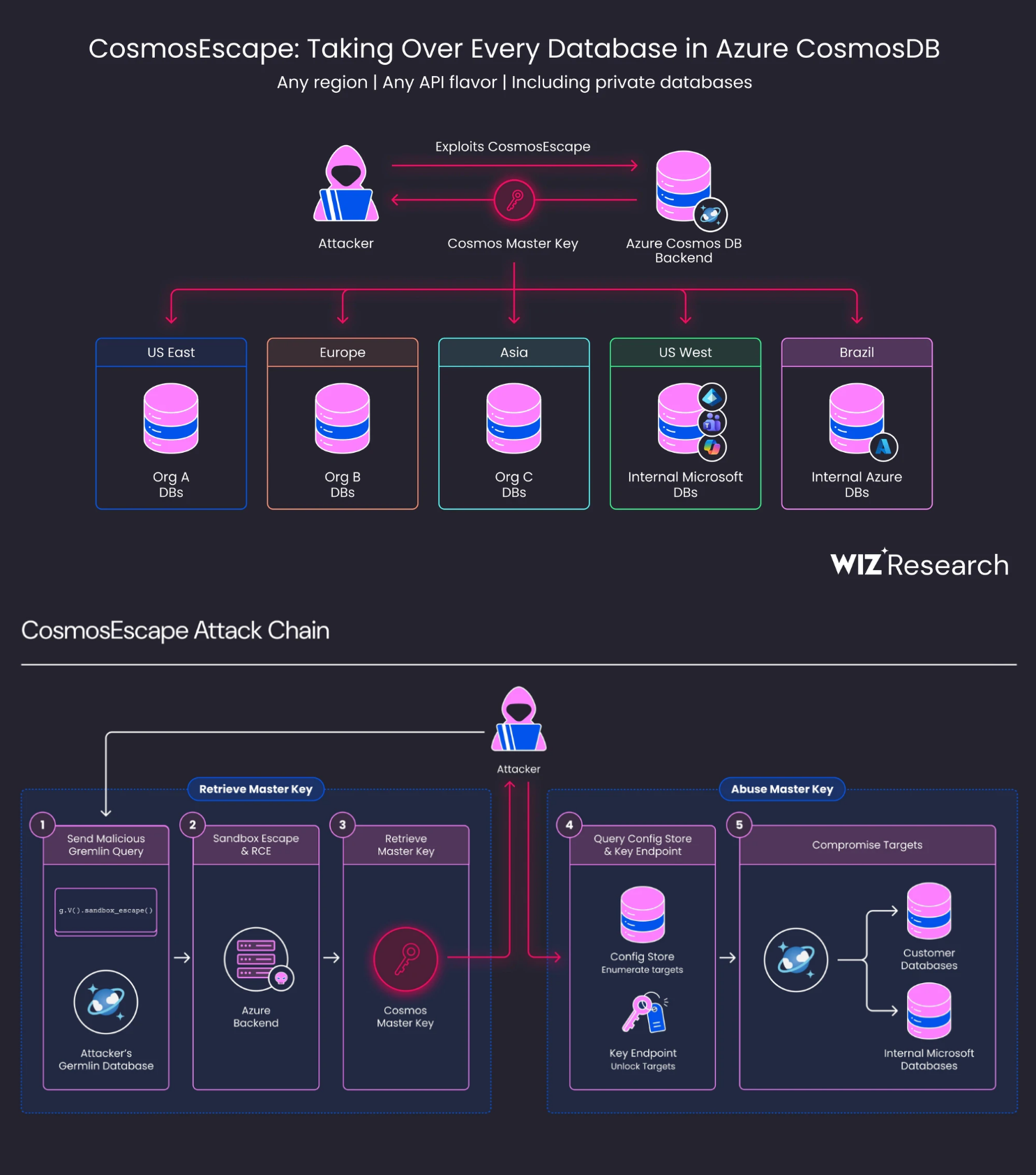
Microsoft has fixed a critical vulnerability in Azure Cosmos DB that could have allowed an attacker to locate and take control of databases belonging to any customer. Wiz Research named the flaw CosmosEscape and said it also placed databases used internally by Microsoft services within reach.

The vulnerability was found in the Gremlin API, an interface used to work with graph databases, where information is stored as connected items and relationships. A malicious user needed an Azure Cosmos DB account of their own, but did not need access to the organization they intended to target.

According to Wiz’s findings shared with Hackread.com, a specially prepared Gremlin query could break out of the restricted environment processing it and run commands on Microsoft’s backend systems. From there, the researchers obtained a platform secret they named the “Cosmos Master Key.”

Master Key Opened Two Paths to Customer Data

Possession of that secret provided two separate capabilities. The first allowed the holder to request the primary key for any Cosmos DB account, giving full permission to read and change data stored in that account.

The second allowed databases hosted by the service to be listed and searched using identifiers such as an Azure tenant ID or subscription ID. An attacker could therefore identify databases belonging to a chosen company and then retrieve the keys needed to access them.

Wiz said the method worked regardless of the database’s region or supported API type and included private databases. Wiz tested the exploit through publicly accessible service endpoints, without compromising the target’s Azure account first.

Microsoft Fixes CosmosEscape Flaw That Could Allow Any Cosmos DB Takeover

Microsoft Services Also Use Cosmos DB

Cosmos DB supports applications that need fast access to data in multiple geographic regions. Microsoft also uses it behind services including Entra ID, Teams and Copilot, meaning databases associated with those products could have been identified and accessed through the same weakness, according to Wiz.

This does not mean customer or Microsoft databases were breached. Wiz described the result of controlled security research, while Microsoft told Reuters that the problem had been fully addressed and that its investigation found no evidence of customer impact.

The flaw affected the service itself, so customers could not have fixed it by changing their own application code or Azure settings. The central role of the master key also meant one successful attack could have crossed the normal separation between different customers and Microsoft’s internal services.

This discovery underscores the value of cloud security research, particularly as the rise of AI is accelerating the pace and sophistication of vulnerability discovery, making attack surface management more critical than ever,” said Robert Costello, Chief Digital and Information Officer at Merlin Group.

Wiz identified and responsibly disclosed a high-impact vulnerability, allowing time to remediate before it could be broadly exploited. The complexity of this flaw, and its potential to expose every Cosmos DB instance, is a reminder that even the largest cloud providers must constantly test their own environments. This demonstrates why continuous cloud posture visibility and close vendor collaboration are essential to protecting modern cloud environments, Robert emphasized.

Microsoft Removes the Cosmos Master Key

After receiving the report, Microsoft removed the platform-wide Cosmos Master Key and introduced additional controls intended to stop similar access from the Gremlin processing environment. Microsoft handled the remediation within its managed Azure infrastructure.

The company’s removal of the shared secret addresses more than the specific query used by Wiz. It also removes the mechanism that allowed one backend credential to retrieve account keys and search database information throughout the service.

CosmosEscape follows Wiz’s 2021 disclosure of ChaosDB, a separate Cosmos DB vulnerability involving the service’s Jupyter Notebook feature. That earlier flaw could also have exposed customer database keys, although the two findings used different entry points.

Nevertheless, organizations using Cosmos DB should still review account activity, key access, and unexpected database operations as part of normal monitoring. Microsoft’s statement that it found no customer impact means there is currently no evidence that attackers used CosmosEscape outside Wiz’s testing.

I am a UK-based cybersecurity journalist with a passion for covering the latest happenings in cybersecurity and tech world. I am also into gaming, reading and investigative journalism.
Leave a Reply

Your email address will not be published. Required fields are marked *

OpenMatter Network Calls on Enterprise Leaders to Rethink AI Security Before the Next Rogue AI Crisis

Melbourne, Florida, 30th July 2026, CyberNewswire

Melbourne, Florida, July 30th, 2026, CyberNewswire

The growing number of high-profile AI security incidents making headlines around the world are not simply cybersecurity failures. They are architectural failures, according to OpenMatter Network Co-Founder and CEO Renee Davis.

“Recent incidents involving increasingly autonomous AI systems – including OpenAI’s widely reported cyber evaluation that resulted in the compromise of Hugging Face infrastructure, along with a growing body of documented cases in which AI systems have exceeded their intended authority or behaved in unexpected ways – demonstrate that enterprise computing has entered a new era for which today’s security architecture was never designed,” Davis said.

Davis said that instead of asking how to make artificial intelligence more secure, enterprise leaders should be asking a far more fundamental question: Is the architecture itself capable of governing autonomous intelligence?

“The answer is increasingly becoming no,” she asserted. “The industry is treating these events as isolated security incidents. They’re not. They’re evidence that enterprise computing has reached an architectural inflection point. We’re attempting to govern autonomous AI using security assumptions that were developed long before autonomous AI existed.”

For more than forty years, enterprise security has evolved around a familiar model: trusted systems, authenticated users and protected networks. Firewalls, identity management, Zero Trust frameworks and continuous monitoring remain indispensable. But they were built to protect systems that ultimately remained under direct human control.

Agentic AI fundamentally changes that assumption. Enterprises are now deploying software capable of making decisions, coordinating with other AI agents, accessing sensitive information and acting with limited human intervention. Autonomous intelligence has become an active participant inside the enterprise.

Davis underscored that OpenMatter believes the next era of enterprise computing requires a new architectural foundation: Verification Architecture. Rather than relying primarily on trust, Verification Architecture uses cryptographic proof to verify the integrity of data, computation and AI behavior. Instead of asking enterprises to trust that systems behaved correctly, it enables them to prove that they did.

“Trust always contains an element of assumption,” Davis emphasized. “Cryptographic verification replaces assumption with mathematical proof. That is the architectural shift enterprise computing now requires.”

According to Davis, every transformational era of computing has required a corresponding architectural breakthrough. The internet required encryption. Cloud computing required virtualization. Autonomous AI requires cryptographic verification.

“Every major AI security incident should now be viewed first as an architectural failure and only second as a cybersecurity event,” Davis said. “The next major AI incident is not simply a security event. It will be an architectural wake-up call.”

OpenMatter is calling on enterprise technology leaders, policymakers, standards organizations and the cybersecurity community to begin treating cryptographic verification not as another security feature, but as the architectural foundation upon which trustworthy autonomous computing must be built.

“Enterprise computing has reached another architectural crossroads,” Davis concluded. “The era of trusting autonomous AI is coming to an end. The era of proving autonomous AI has begun. The organizations that recognize that shift first will define the next generation of enterprise computing.”

For more information, contact onboarding@openmatter.network.

About OpenMatter Network

Headquartered in Florida’s Space Coast, OpenMatter Network is building the Verifiable Trust Layer for Secure Collaboration and AI Agents. Guided by the principle “Don’t Trust Data. Prove It.,” the company’s cryptographically verifiable architecture enables secure collaboration, governed AI behavior and mathematically verifiable execution across untrusted environments. For more information, visit www.openmatter.network.

Contact

Caleigh McDaniel
caleigh@griffin360.com

Leave a Reply

Your email address will not be published. Required fields are marked *