

The Snakes and Foxes of Anatolia
Once there was and once there was not...

1 Origins & Sources
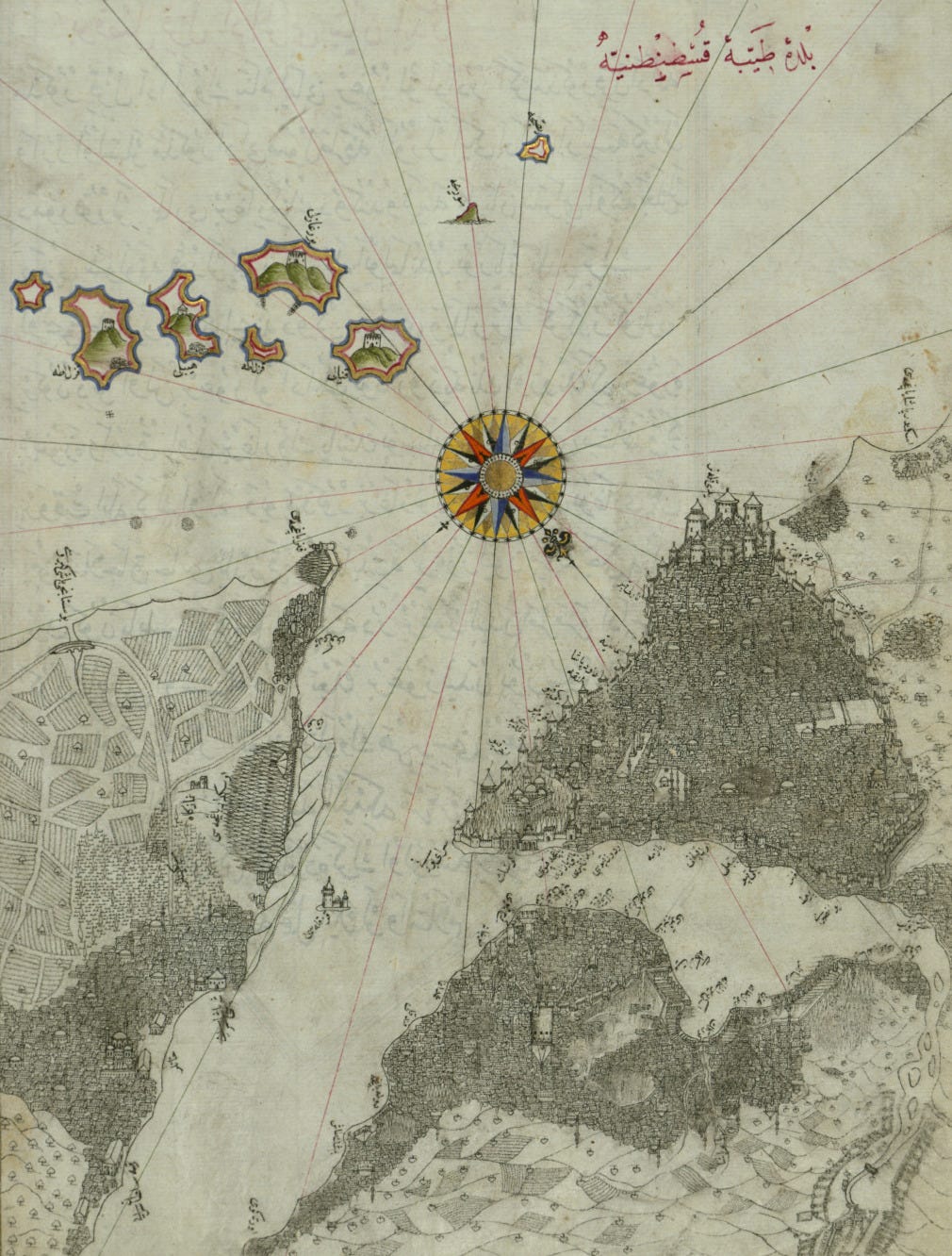
A second sleep overtakes us, and we find ourselves once more in our sun-burnt, wind-bitten bodies, waking to a clear sky. The Greek Navigator is nearly hanged by the more excitable and close-minded among the crew, but cooler heads prevail. No more special brews from Eleusis on this journey. By mid-day our trireme has made exceptionally good time, and we see smoke rising off the point of Karaburun – Constantinople is not far now. Our minds turn toward the welcome prospect of shore leave, and the many bizarre delights to be found in the bazaars of this city of continental crossroads. Among the exotic goods — lemons, pumpkins, carpets, mirrors, and rings — one hears the best gossip in the City of the World’s Desire.
The lands of Anatolia have ever been both fulcrum and bridge between worlds. Here, the Black Sea empties into the Mediterranean; the headwaters of the Euphrates and Tigris swell from the confluence of innumerable mountain streams; and roads that began in Xinjiang find their terminus. To live here is to dwell upon the tide line of Eurasian civilizations past and present. Myth, legend, and folk tale do not merely wash upon Anatolia’s shores – many of their voyages begin here. Consequently, the region is layered in fragments of memory from as far as Scandinavia, Persia, and the Himalayas.
Our survey finds within this mingled sea of stories the records of contact and exchange between humanity and Others. To conclude our exploration of the Black Sea, we turn to the phenomenon of “magical” gifts bestowed upon unwitting humankind. Their consequences vary — beneficial, benign, or disastrous — yet a constant remains: the recipients are ignorant of both the full nature of the gift and the motives of their benefactors.
This concluding piece examines that theme through a historically reliable and remarkably durable source: children’s tales. The stories we tell our children are those we most trust. Folklorists have long observed that tales retold for young ears often preserve the oldest narrative strata. Their simplicity is deceptive: by pruning away embellishment and censorship, they reveal the structural core of a memory. In the villages of Anatolia, bedtime stories became vessels of cultural transmission, carrying patterns of intrusion, negotiation, exchange, and consequence across generations.
Selected for this survey are three classics of Turkish and Anatolian folklore: A Mirror, a Carpet, and a Lemon; The Wonderful Pumpkin; and The Ring of Shah Maran. The first two appear in Grace W. Walker’s A Treasury of Turkish Folklore1, while The Ring of Shah Maran was recorded by Raphael Emmanuel in his The Ring of Shah Maran: A Story from the Mountains of Kurdistan.2 Both authors, story-hunters of the old anthropological tradition, gathered their material directly from the field. Walker’s work forms part of the world’s largest audio archive of Turkish folk narratives, housed at Texas Tech University, preserving the voices of Turkish grandmothers, Armenian prisoners, Kurdish revolutionaries, and Anatolian farmers.34 From those recordings come the English translations we consult here, a rare instance of immaculate chain of custody between witness and recipient.
The well-versed reader will notice echoes of the Persian Thousand and One Nights and of far older cycles from Babylon.5 Such parallels are not contaminants but confirmations: evidence of a shared symbolic memory stretching from the Levant to the Indus. Like trade goods along the Silk Road, stories too passed from caravan to caravan, taking on the accent of each tongue but preserving their inner pattern, that of contact and exchange between humanity and hidden Others. For our purposes, this diffusion is not an obstacle to authenticity but part of the proof itself: it shows that humanity’s memory of encounter is older than any single civilization, and of such importance that the stories are retold at every frontier.
2 Set & Setting
The lands of Anatolia are bounded by the Black Sea to the north, the rugged Caucasus and Armenian highlands to the east, the Levantine deserts and the Mediterranean to the south, and the Aegean to the west. From the Greek histories of the Ionian and Persian wars, through the glories of the Roman and Byzantine empires, to the restless frontiers of the modern Turkish Republic, Anatolia has always summoned the imagination as both battlefield and bridge.
Beneath its rolling uplands and coastal plains lies a geography alive and tumultuous. Volcanic cones dot the highlands of Cappadocia; rivers boil up through limestone faults; and whole cities have been carved into the bedrock to hide from forgotten threats. The region rests upon the collision zone of the Aegean, Arabian, Eurasian, and Anatolian tectonic plates. Earthquakes, fumaroles, and hot springs mark the places where the earth still moves. Across central Anatolia, dry steppes meet mountain snowfields, and the seasons swing from bitter continental winters to burning Mediterranean summers. From these uplands descend the headwaters of the Tigris and Euphrates – a network of rivers that for millennia has carried the melt of Anatolia’s snows toward Mesopotamia and the Persian Gulf.
During the centuries in which our three tales first entered the written record, the thirteenth to the fifteenth, the Seljuk sultans had given way to Turkoman beyliks and to the gathering strength of the early Ottomans. Alongside them lived Armenian highlanders, Kurdish tribes, Greek monks, and Yazidi shepherds. Caravan routes stitched these peoples together: from the Black Sea ports of Trabzon and Sinope to the merchant cities of Mardin, Aleppo, and beyond.
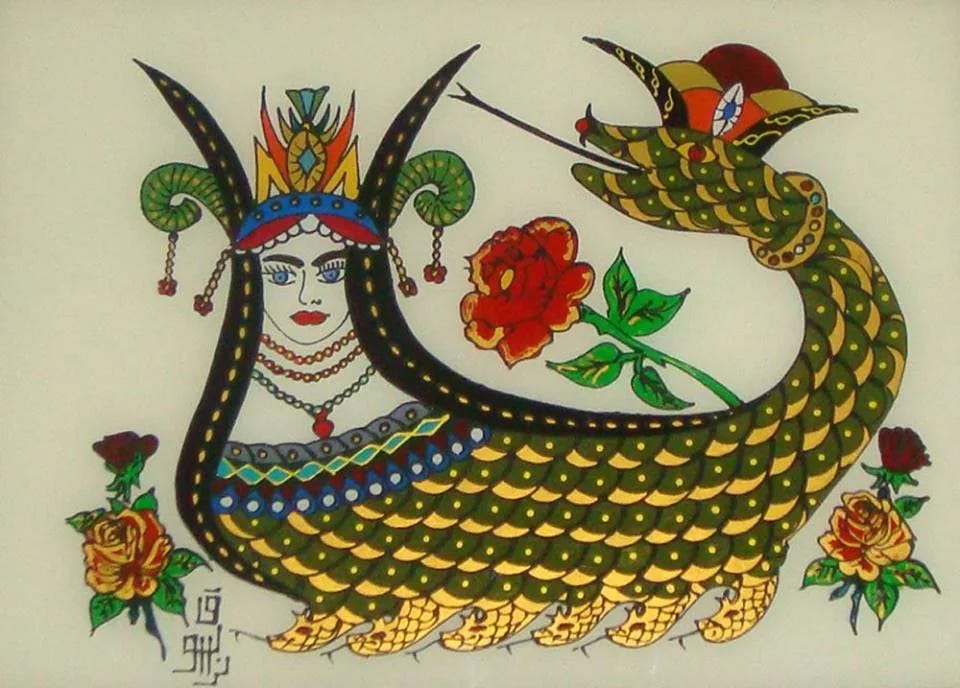
Further south stood Harran, a city already ancient when Rome was young. Known to the Arabs as the “City of the Moon”, Harran was once home to the mysterious Sabians of the Qu’ran – one of the three protected “People of the Book” of Islam.6 The Sabians traced their lineage to Hermes Trismegistus and studied the stars to chart the laws of both heaven and earth. Within their observatories survived repositories of alchemy, astronomy, and geometry long forgotten or suppressed elsewhere. To the Sabian mind, every art was a gift from invisible intelligences whose thoughts could be made manifest through respectful evocation and precise measurement. This doctrine passed quietly from mouth to ear over centuries, and eventually made its way into the Sufi lodges and Christian monasteries of occult Anatolia. It is within this matrix of trade, discovery, and remembrance that our children’s stories are sourced.
3 Survey
Bir varmış, bir yokmuş…once there was and once there was not.
This refrain opens thousands of folk tales across Turkish Anatolia. The sing-song paradox is the perfect invitation to a world where realities freely mingle. More playful than “Once upon a time” and more grounded than “…in a galaxy far, far away,” Bir varmış, bir yokmuş also hints at the central virtues of Anatolian storytelling: wit, improvisation, and cunning.
Such qualities were not optional in a land crowded with self-important bureaucrats and greedy warlords. Kings, sultans, viziers (grand or not), beys, kadıs, and pashas — Seljuks, Byzantines, and Ottomans in turn — made up a long procession of pompous officials to be flattered, avoided, or deceived as necessity required. It is no wonder that the heroes of Anatolian lore are rarely knights or prophets, but clever wanderers, tricksters, and shape-shifters.
Among these archetypes, two appear again and again: the snake and the fox. In Anatolian folklore, the snake (yılan) embodies chthonic knowledge and regenerative power — feared and revered as a keeper of secrets beneath the earth. The fox (tilki) stands for surface intelligence and survival through wit, a trickster who navigates the human world by cleverness. When they meet, as they sometimes do in Turkish tales, the encounter becomes a contest between wisdom and cunning, usually fought over the possession, or theft, of a magical object or hidden power.
These contests over enchanted objects are not mere curiosities of folklore, they are potential memories of contact and exchange with something entirely outside the context of “normal” human experience. Across Anatolia, we encounter stories in which mundane objects contain an impossible power, and which appear suddenly in human hands: mirrors that reveal distant scenes, carpets that travel in an instant, fruits that heal the dying, rings that manifest any desire. Whether bestowed by jinn, serpent queens, or unnamed wanderers, each of these gifts marks a potential memory of contact between humankind and the Other. To the villagers who first told them, these tales were lessons in bravery and caution; to us, they are fragments of an older record, describing the transmission of artifacts and knowledge to humanity by hidden Others for inscrutable ends.
Our first tale offers several examples of technologies of unknown origin — objects ordinary in description only, their true purpose obscured by the limits of language or by the discretion of their makers. Fittingly, A Mirror, a Carpet, and a Lemon begins in a palace where a sultan, proud of his only daughter and weary of unworthy suitors, declares that he will give her hand to whoever brings him the most unusual gift in the world. The capital’s courtiers and merchants fail to meet the challenge, leaving space for innovation from the frontier. Three brothers from the countryside hear the decree and set out in different directions: one finds a mirror that shows whatever one wishes to see, another acquires a carpet that travels wherever its rider names, and the youngest obtains a lemon whose juice cures any illness. When the princess falls deathly ill, the brothers join their gifts; the mirror reveals her plight, the carpet carries them across the world, and the lemon revives her. The suitors quarrel over the reward, but the sultan judges wisely: the youngest has offered the rarest and most valuable gift of all – life.
Our second tale unfolds far from the palace, in a humble cottage at the edge of a village. In The Wonderful Pumpkin, a poor widow and her son live by making lace, their poverty deepened by the indifference of those around them. One day, as the widow’s son despairs for lack of help from his fellow man, a djinn appears and refuses to depart until he makes a wish — the earth itself shaking in protest until he names his desire. At last the boy asks for relief, and the djinn grants him a small pumpkin, instructing him to open it with the words: “Open, tiny little squash; shut, tiny little pumpkin.” When spoken correctly, the pumpkin overflows with fine food and drink, clearing away the remnants when commanded to close. Mother and son, astonished and grateful, keep their gift secret and live in quiet abundance.
But envy soon stirs nearby. A neighbor named Mehmet steals the pumpkin while they sleep, hoping to profit from its magic Yet the spell will not answer his voice. Certain it is broken, he carries it to market and attempts to sell it to every expert he can find — the judge, the imam, the local pasha — but none can unlock its power or force it open. The wonderful pumpkin is eventually thrown into a rubbish heap, the experts certain of its worthlessness. By chance, the boy spots his pumpkin atop the garbage, and elatedly recovers the magical gift in secret. From that day forward, he and his mother keep the Wonderful Pumpkin hidden, its bounty unshared but unbroken, and they live in peace for the rest of their lives. May we be as lucky in ours!
Our final tale, The Ring of Shah Maran, follows Hassan, a kind youth who shares his bread with every creature he meets. One day he rescues a green lizard from a group of boys, who later reveals herself as the daughter of Shah Maran, King of the Reptiles beneath the earth. She begs to be returned to her father, who rewards Hassan with a seven-crowned ring that grants any wish when invoked with the words, “O Ring, I ask of you, and you ask of the Lord of Heaven and Earth that my wish be granted.” With the ring, Hassan conjures food, raises a castle, and marries a human princess named Shushan. A thief, envious of his fortune and suspicious of its source, steals the ring and wishes the castle and princess carried beyond the seven seas. Hassan’s loyal companions — the dog, the cat, and the rat — cross the waters to recover it, each playing a part until the ring is restored and the thief undone. Hassan brings back his castle and bride, the thief is cast into the dungeon, and he and his companions live happily ever after. Iyilik eden iyilik bulur.
4 Indicators & Signatures
What may we glean from these children’s tales? Already apparent is the density of magical artifacts, non-human intelligences, and language as the key to accessing anomalous capabilities. Each story drawn from the corpus of Anatolian folklore is distinct in structure and outcome, yet their devices and archetypes resonate not only across local traditions but with other myths we have encountered along the Black Sea. Given the comparatively more sophisticated technological and political milieu of Anatolia, the vocabulary itself grows sharper: its “civilizationally advanced nouns” yield descriptions that come closer to the observable reality of anomalous phenomena.
Here we find a lexicon still insufficient but markedly less primitive; magic mirrors and traveling carpets replacing the flying horses and talking clouds of the Narts and Solomonari. In the gifts bestowed upon our heroes by mysterious merchants, chthonic serpent royalty, and the djinn of smokeless fire, we encounter amoral tools that respond instantly once the correct command is spoken, yet remain otherwise indistinguishable from mundane objects. Precise language alone governs their operation, and such knowledge is treated as exceedingly precious. Once the pass-word is learned, any may command; no other input — material, energetic , or moral — is required.
In A Mirror, a Carpet, and a Lemon we find a veritable cornucopia of technologies of unknown origin, some unique to this story, others recurring across the region. The sultan presiding over the tale already possesses an array of wonders, such that three new offerings from the capital’s nobles fail to impress: a bird that can sing endlessly, an ivory fountain whose waters never cease, and a sheep with a fleece of gold. None suffice — not even the mirror and carpet brought by the two elder brothers. It is the lemon, whose juice cures any illness, that the sultan’s daughter deems most extraordinary. The same hierarchy of value reappears in the vampire legends of the Carpathians, where life itself, its giving, taking, or prolonging, is the supreme power, exceeding any mastery of matter or gold.
But the lemon was the greatest gift, after all, my father. It gave me back my life, and life is surely the greatest gift of all.”
Intriguingly, these miraculous items are not obtained through pacts with non-human intelligences, but from anonymous merchants in an unnamed bizarre bazaar — perhaps Harran, that old City of the Moon with its enigmatic Sabians. Before moving on, it is worth pausing on the mirror and the carpet. The mirror, much like one of Tolkien’s palantíri, allows the user to see any place in the world — a clear analogue for remote sensing or access to non-local information. The carpet, meanwhile, does not “fly,” as in later retellings, but instead transports its occupant instantly to any location commanded by thought. Once again the pattern repeats: mirrors that are not mirrors, carpets that are not carpets, lemons that are not lemons – technologies misnamed through analogy, or born from the poverty of language itself.
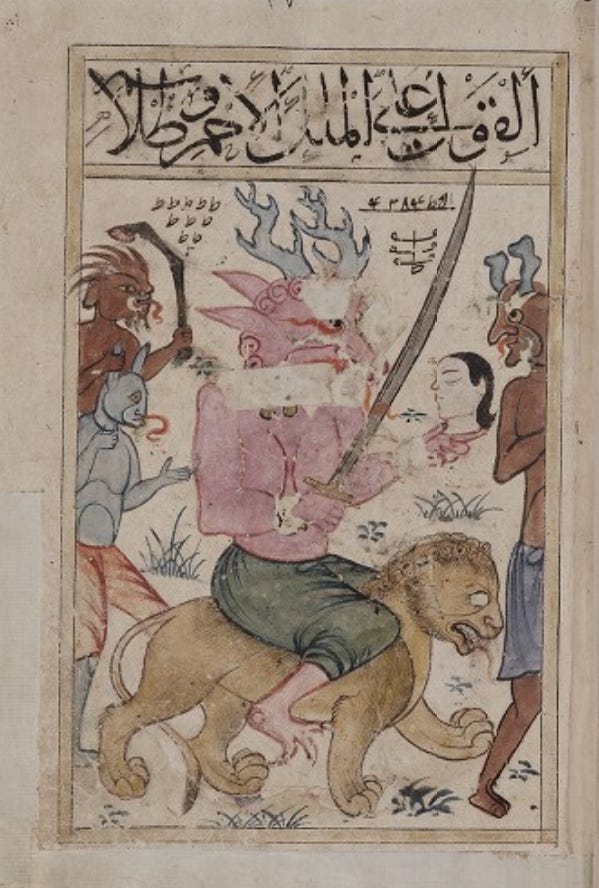
In The Wonderful Pumpkin we find two intriguing instances of unidentified anomalous phenomena and technologies of unknown origin: the djinn and the pumpkin. ppearing to our young hero in a moment of despair, the “Oof” Djinn is described in terms so nonsensical they betray the high strangeness of the event itself: “with one lip in the sky and the other touching the ground.” The entity appears to occupy the space between these two “lips.” Such a description may suggest a curved or hemispheric device divided into two halves, the being ‘manifesting’ within the interval. Whether this represents projection, portal, or something else entirely is impossible to say, but what we do have is unmistakably a mouth – an interface for communication.
“At that moment, the oof jinn appeared, with one lip in the sky and the other touching the ground…’ask what you wish and it will be granted,’ the jinn said, and the ground trembled with the rumble of his voice.”
Curiously, the Oof Djinn appears bound to its location once manifested, unable to depart until the boy names his wish. Its frustration at this compulsion is so great that it shakes the earth to coerce a response. The nature of that compact — and the means by which the djinn generates seismic force, are left unsolved but tantalizing in their implications.
The djinn’s gift is equally anomalous. Presented as a small pumpkin, the device produces abundant food and drink when commanded with the precise phrase, “Open, tiny little squash; shut, tiny little pumpkin.” When the meal is done, it clears all traces in an instant – the true miracle. Whatever this object may be, the pumpkin shell is only a mask — and a remarkably durable one. Neither blacksmith nor scholar can pierce or even mar its surface when attempting to force it open. The vessel also demonstrates one of the classic hallmarks of recovered UAPs: interior dimensional expansion. When opened, it yields an endless supply of prepared dishes – an interior far exceeding its apparent volume.
“…and immediately all sorts of good foods came pouring from the pumpkin. With rice and meats and beans and sweets before her, how could any woman quarrel about the pumpkin? The two sat down and ate happily until their stomachs were filled.”
As with other artifacts in this cycle, operation depends entirely on the precision of command language. When the words are spoken exactly, the system executes flawlessly. When not, it remains inert. To its rightful user, the pumpkin is a generator of sustenance; to everyone else, it is an opaque, indestructible, wonderful pumpkin.
Our final tale takes us below the surface. The Ring of Shah Maran begins with a familiar act of compassion: a poor boy, Hassan, saves a green lizard from a group of tormenting children. The creature later reveals herself as the daughter of Shah Maran, King of the Serpents, and begs to be returned to her father. Hassan complies and is rewarded with a seven-crowned ring, an object whose activation phrase is precise and repeatable: “O Ring, I ask of you, and you ask of the Lord of Heaven and Earth that my wish be granted.” The device performs instantly — constructing palaces, generating food, and transporting people and buildings across great distances. It is indifferent to intent; when a thief later steals the ring and repeats the same words, it obeys him without hesitation.
“Lad, take this ring, the world’s greatest treasure, for your reward for having saved the life of my only child. Whenever you wish for any thing just say to the ring ‘O Ring, I ask of you, and you ask of the Lord of Heaven and Earth that my wish be granted,’ and your wish shall be granted.“
The bequeathers of this ring to humankind, though not its creators, are the serpent people themselves. The kingdom of Shah Maran lies beneath the earth in halls of jeweled stone —an organized, technological society existing parallel to the human surface world. The serpents display hierarchy, language, and tools of power, yet remain bound by strict codes of honor and an ingrained hostility toward humankind. In this sense, they stand as a complete expression of non-human intelligence: material, autonomous, and driven by earthly desires rather than divine. Their subterranean realm continues the ancient link between serpents and hidden knowledge, echoing underworld contact zones described across civilizations otherwise separated by time and space.
The ring itself is a textbook instance of technology of unknown origin. It operates as an all-purpose interface between human intent and physical outcome, activated through exact verbal command and fulfilled instantaneously. Its invocation formula establishes a clear operational hierarchy: from user to ring, from ring to implementer. The ring’s ability to materialize and dematerialize objects, beings, and weather phenomena offers a sobering parallel to the “Slide-9” capabilities described in AATIP documentation. Given such extraordinary power, the apparent ease with which the Serpent King transfers this device to a human recipient is striking and worthy of further consideration. Taken together, The Ring of Shah Maran preserves a remarkably complete account of anomalous contact: a subterranean non-human civilization, a transferable device of limitless capability, and humanity only too willing to ask what a tool may be used for – and not the cost of its use.
5 Interpretations
These Anatolian folktales, deceptively simple in their narrative forms, preserve memories of human interaction with anomalous technologies — tools that respond to precise commands, grant abundance, or manipulate time and space. Stripped of overt mythic framing, the enchanted mirror, the teleporting carpet, the ever-feeding pumpkin, and the wish-granting ring resemble not fables, but misunderstood technologies: interfaces awaiting activation, semi-intelligent machines masquerading as fruit or jewelry, bound by language instead of levers to fulfill human commands. Their indifference to morality, and reliance on command phrases, echo principles found in real-world code, cybernetics, and emerging artificial intelligence. There, as in our stories, humanity has erred in favor of rapid exploitation and scaling, rather than moderation and iteration.
Modern science has begun to catch up to these intuitions. From quantum entanglement and wormhole simulation to replicator-like food printers and voice-activated systems, we are once more on the cusp of operating within frameworks that the folk imagination hinted at centuries ago. The serpent king and the djinn — amoral, powerful, and non-human — demonstrate the memories of contact with intelligences of an entirely different nature than humanity: post-biological, subterranean, or otherwise outside our experiential context. If we entertain the notion that these tales record more than metaphor, then what they offer is not just cultural memory, but the residue of human contact with hidden infrastructures and personalities of anomalous civilizations.
Ultimately, these stories endure because they encode something true: that contact with the unknown leaves a mark not only on individuals, but on entire cultures. Whether the gifts came from jinn or wanderers, from subterranean royalty or beings of smokeless fire, the human response remains consistent — awe, misuse, forgetting, and rashness. In this light, our chilren’s tales are not merely entertainment, but a warning: stories preserving memory of when the impossible briefly entered the world and left something behind. As we rush headlong into a technological age poised to abolish material scarcity and human labor, we would be wise to ask: what is the Human Cost of wielding a new tool or technology? When our desires are no longer restrained by material limitations, internal pathologies will inevitably manifest as external consequences.
Walker, Barbara K. A Treasury of Turkish Folktales for Children. Linnet Books, 1988.
Emmanuel, Raphael. The Ring of Shah Maran: A Story from the Mountains of Kurdistan. New York: E. P. Dutton & Co., 1944. Print.
“Archive for Turkish Oral Narrative (ATON).” Southwest Collection / Special Collections Library, Texas Tech University, swco-ir.tdl.org/communities/73d85258-5c2f-4bb7-901a-fb5da9628605/subcoms-cols.
Dalley, Stephanie. Myths from Mesopotamia: Creation, the Flood, Gilgamesh, and Others. Oxford University Press, 2000.
Irwin, Robert. The Arabian Nights: A Companion. Tauris Parke, 2004.
Green, Tamara M. The City of the Moon God: Religious Traditions of Harran. E.J. Brill, 1992.


Totally fascinating. I have done some investigation of the Herbs of this region just for herbal medicine research but it begins to dawn on me that the old folk remedies might very well have a basis of inheritance from information provided by....others. My focus was mainly on Amirdovlat of Amasia, an Armenian Christian whose expertise and reputation got him a position as chief herbalist in the 1450's in Turkey (yes, even though Christian !!). His main book "None But the Ignorant" a treasure trove of herbal descriptions and remedies in multiple languages but regretfully available only in Middle Armenian or in a Russian Translation. Suggested Reference: "The King's Dictionary" (hiding away on Internet Archive as a free download if its still there) by Goldman et al. There are certain to be gems of knowledge hiding in the Turkic languages as these people were nomadic and good at surviving extreme weather so they must have picked up some good information in their travels. Of their folklore and magical beliefs I know next to nothing so this article will be a good start. The Lingua Franca on the silk road, for those that did not know, was, among others, a Persian related language called Sogdian.
I love your wordcraft. I find these thoughts truly compelling. I come across your substack after a couple days of Lesser Invocation work in the Golden Dawn tradition, I have a sense that it is related. I saw your Weaponized interview when it first came out and it deeply resonated with me but I had no idea that you had such a rich grasp of esotericism, history, theology, and geography.
Thank you for your works.