

Dragon Riders: The Origins of Magic in the Carpathian Basin
Myths of the Kapnobatai, the Taltós, and Solomonari
A Guest Essay By - Dennis C. Hudson
1 Introduction
When I was asked by Matthew to contribute to this week’s exploration of the occult, I immediately began wondering what I would write. I realize this is somewhat of a niche subject, in the sense that most people’s knowledge of folklore or magical practices from Central Europe has been confined to popular vampire myths or Pinterest’s favorite “Baba Yaga” cottage-core tomfoolery.
The origins of the Solomonar (plural: Solomonari) are complicated. Even more complicated is the fact that most people in the West have absolutely no clue what a Solomonar is. This article, I hope, will serve as a thorough explanation and exploration of the myth, the magic, and the true anthropological minutiae around the subject. After reading this, you will hopefully know exactly what you’re reading about.
2 The Dragon Riders
The term “Solomonar” has its roots in folklore. There likely were not, nor have there ever been, any magical practitioners who called themselves by that name. It was more a blanket label given to various groups practicing both Solomonic and traditional folk magic within the Carpathian Basin in eras long past. Like the word witch, it lacks specificity and clear definition.
According to the myths, the Solomonari were wizards—shadowy students of Satan’s school, the Scholomance (or Șolomanțâ).1 The term “Scholomance” appears in Stoker’s Dracula and has its origins as a period-accurate Germanization of the Romanian term due to the fact that the story takes place in the Austro-Hungarian empire. It was said to be a hidden academy of black magic that relocated every time it manifested. For example, you could find a door in a mountain one year; the next year, it would move somewhere else. It was supposedly a network of ever-moving caverns.
The Solomonari were believed to control the weather.2 They were said to sit by lonely roads, blessing or cursing travelers depending on how they were treated.3 They were known for wearing white, for having red hair (a trait often wrongly labeled as demonic in Central and Eastern European myths), and for chatting with forest animals while doing Satan’s errands—errands such as using magic, cursing or healing people, chatting with said forest animals, or doing anything strange that would generally spook the average Christian sensibilities at all. Blessing crops?! S A T A N. Generally, in the Carpathians, amongst the highly Christian people of the latter ages, folk beliefs have often developed that anything weird or magical—be it good or bad—is always the work of the devil.
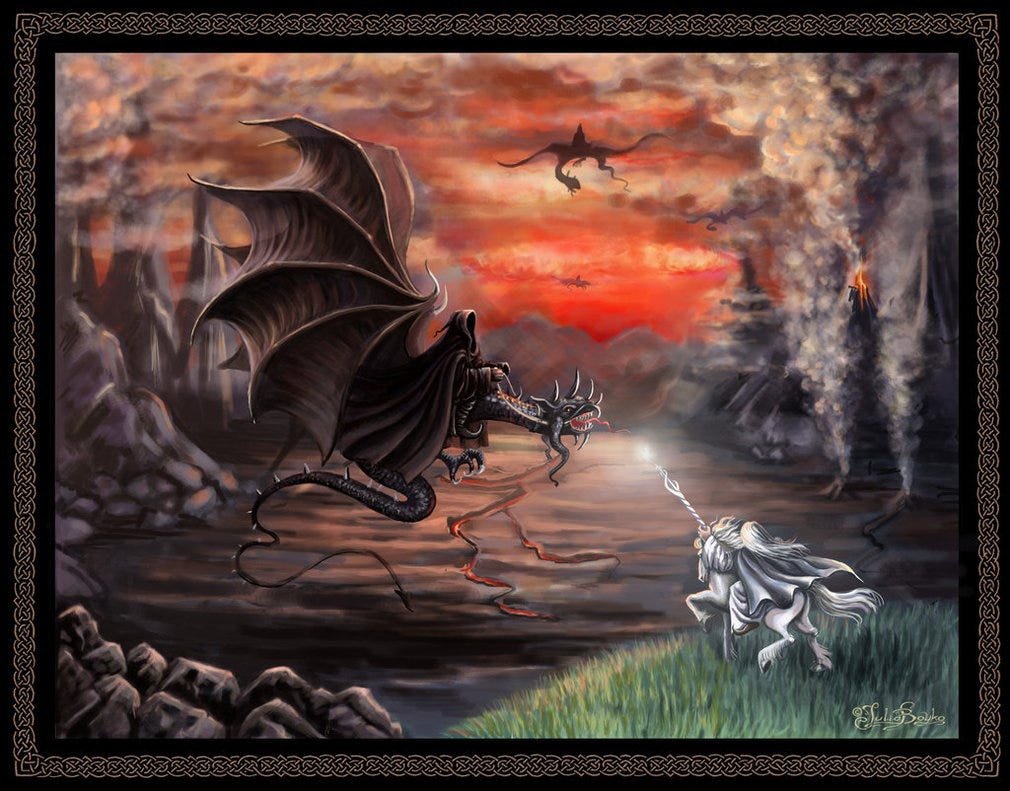
And, as the reader has probably guessed, they rode Dragons—the Zmeu or Balaur.
Unlike Duke University (Satan’s actual school), the Scholomance curriculum involved abduction and confinement in darkness for seven years. During this time, one was to write down the “language of all things” in a black book, given by infernal hands in endless subterranean gloom. Which, admittedly, is much more like Harvard University.
Upon completion of their curriculum, they would be spat out of the bowels of the earth with nothing but their tools and their knowledge, to live a life in the guise of beggars clad in white (which is sort of like graduating from Brigham Young University).
A very interesting legend. But what’s more interesting is the actual story.
3 Origins: the Dragon or the Egg?
After World War II, Romania’s literacy rate rose fast. The Communist government ran a campaign from 1948 to 1956 that nearly erased illiteracy in six years.4 By the 1956 census, about 90 percent of the population could read and write. The ones left behind were mostly women in rural areas.5
Before that, the area and culture lacked a lot of needed data. This isn’t a dig at the country. It’s just context. When studying the Solomonari, it’s important to remember that every legend about them was passed down orally until relatively recently. Most of what’s written comes from foreigners and folklorists, and the myth itself stretches from Eastern Hungary and Romania into Bulgaria.
It’s a long, fragmented game of telephone. This means it’s better to focus on what stays consistent in the legends—and what those consistencies imply—rather than on every regional iteration. We have to take the common approach of audit-by-comparison. If we tried to cover all of them, this article would be a lot longer than need-be. We’ll cover what matters. So let us proceed.
4 Kapnobatai
So, the Thracians, like all people, did not just pop out of nowhere. The general idea is they were an interesting cocktail, a general mix of the indigenous people who were already inhabiting Southeast Europe and a new wave of Indo-Europeans who rolled in around the 4th millennium BC. They set up shop in a bunch of places from east to west, including what we now call Romania, and its surrounding eastward neighbors.
And these weren’t some isolated, backwater tribes. They were a major part of the whole anthropological scene that would birth the lands and people we know of today, known for having a pretty advanced bronze-age culture known for its metalwork (with many pieces still surviving today) along with trade, warfare, and military acumen. They were constantly bumping elbows and probably crossing swords with the big-name civilizations next door, like the Greeks and Romans to the southwest, and Scythians and Celts, inhabiting, being found all across the whole of the Carpathian Basin and as far east as Asia Minor. Aedi, Albocenses, Anarti, Apuli, Biessoi, Buri, Carpi, and Getae, Mysians, and other groups made up the people of Thrace.
They gave us the “Kapnobatai,” an old Greek word meaning “ones who tread the smoke” or “ones who tread the clouds.” Clearly you can probably see a theme forming here. Almost all origin points of the solomonari myth seem to be related to Sky Religions, but what is really interesting is that these shamans burned copious amounts of cannabis in their rituals for the purpose of divination, believing that if one burned and inhaled the cannabis, they would be overtaken by the spirit of the plant and be revealed the secrets of the universe, much like your cousin.
This would likely be the origin of the idea of the Kapnobatai, and eventual solomonar controlling weather, likely because the term Kapnobatai became synonymous with magic and over the ages the innuendo of ritual cannabis use probably flew over people’s heads at some point. Some just took to the term in a more mystical sense as to what the Solomonars were doing or, in this case, could do.
Herodotus, writing in the 5th century BC, gave a fascinating account of the Getae, the “bravest and most just” of the Thracians. He noted they believed they were immortal, thinking that the one who dies “joins Zalmoxis, a divine being.” He also noted that “when it thunders and lightens, [they] shoot with arrows up in the air against the sky,” very likely could be describing a weather ritual. This would have been common among Thracians, especially in regards to rain-making.
In what would become Romania, eventually the word “Kapnobatai” became synonymous with the legendary Solomonari. HOWEVER - The original Kapnobatai were said to originate among the Mysians, and the title was eventually used to refer to the Thracian and Dacian people’s priesthood who worshiped Zalmoxis. And so, since it became used beyond its original meaning over time, the people inhabiting what-is-now Romania started to refer to anyone with any vague sort of wizard-like attributes a Kapnobatai, and eventually, a solomonari would be the new word for those who “do the devil’s errands.”
Today many modern scholars have compared Zalmoxis to Christ due to the account of Herodotus loosely characterizing him as a possible Man-God (both a mortal and a divine figure) after he was given different stories about his origin. The Greeks claimed he was a former slave of Pythagoras who was set free, amassed wealth, and went home.
And another reason is that within his teachings, a central theme was that people should not fear death because it was a transition to a better existence, as well as a deep emphasis on sacrifice and communion with the divine. We actually know this not only because of Herodotus but also because there is an archeological site called Badzhaliata, near the village of Strelkovo in the Silistra region of Bulgaria, which has given us a lot of evidence as to what they were doing, as well as the writings of 6th-century writer and bureaucrat Jordanes, who credits Zalmoxis as the origin point of Getae culture’s religious structure as well as their ideas on ethics.
Within the story Herodotus tells of Zalmoxis, at one point he constructed or found a deep underground cavern on the mountain Kogaianon (location debated, likely near the Dacian capital Sarmizegetusa Regia in Romania) in which he stayed for three years, emerging to see that his people believed he was dead and had resurrected miraculously, thus convincing them of his teachings. He was said to know the language of all things—a true Thracian Solomon, hence why he was likely mixed up with Solomon due to their similar names. Solomon, Zalmoxis, go figure.
Whether Zalmoxis was a historical philosopher and physician who was the first of a sacred priestly line, or a supreme chthonic-sky-god is still debated.
A prominent symbol associated with him was the axe. This will be a big clue later. This accounts for some of the primary origins in Romania and Bulgaria. It makes sense that the story of Zalmoxis in the caverns is mirrored in later traditions (such as ones observed at Badzhaliata). His disciples, the Kapnobatai, were emulating his story much as priests today emulate the Last Supper in the Catholic mass during the benediction.
So when we look at the Kapnobatai, we can see that they were known for, well, doing what Solomonari do. Controlling the weather, using magic, shapeshifting... you name it, they probably did it. So we know now who the Kapnobatai are now, and so we move on to...
5 The Taltós
Although farther west, Hungary contributes to the story as well. We know it was populated by various cultures like the Ottomany, Mako, and others until the Huns reached the Carpathian Basin after a long push west from Central Asia. Around 370 AD, they crossed the Volga, defeated the Goths, and built an empire centered in what is now Hungary. They brought shamanism with them from the Great Steppe, and those beliefs survived well into the twentieth century. These figures were shockingly similar to the Solomonari myth.
Magia by Margit Toth is one of the best current books on old Hungarian culture that, prior to now, was poorly documented due to prolonged slow cultural erasure by both Church and State in past centuries. In the section on the Táltos, Toth states that he (in some cases, she) was a shamanic figure, a descendant of Central Asian practitioners. They were said to communicate with spirits of animals, weather, and nature, as well as ancestral spirits. They could interpret dreams, cure illnesses, remove curses, aid wandering spirits, and—most importantly—control the weather. They were also known for shape-shifting. All familiar themes.
The Old Religion of Hungary, while having no formal name, was largely monotheistic (like the Zalmoxians) yet animistic. The Taltós, unlike their mythical Solomonari cousins, were born into the role, not taught. Lore suggests several signs could indicate if a child was a Taltós, such as being born in a caul, with extra fingers, or with an extra finger bone.
When we look at the legend of the Solomonari, the patterns are clear: they know the “language of all things,” they carry special tools and weapons, shapeshift, and they control the weather. Similar to the case of the Kapnobatai, this points to an origin in the shamanic practices of Eurasia.
This Taltós tradition evolved. King Matthias Corvinus I (1458–1490) was said to have a man with six fingers in his court, implying he employed a Taltós. These court Taltós would have had access to books and education beyond their inborn abilities. This could be where the idea of them carrying black books originated.
“Meanwhile in the more northerly parts of Europe yet another tradition grew up around Saint Cyprian. He is the reputed author of a number of seventeenth and eighteenth century manuscript grimoires that circulated in Scandinavia, especially Norway. These grimoires were often referred to as ‘Black Books” (svartebøka), and the German town of Wittenberg was often quoted as the source of this knowledge.” —Skinner & Rankine, Clavis Inferni
If we look at myth and history, we see Taltós holding appointed offices such as Seers, Military advisors, physicians, and others. At some point, it would be unsurprising that shamanic practitioners gained access to the magical books of the time and, in a sense, did become Solomonari in the Solomonic sense of exploring ritual magic and demonology, fusing their traditional practices with Solomonic materials such as Wittenberg Black Books.
The origins of the Scholomance, Satan’s mythical school, can almost certainly be found in the real-world folklore of the Wittenberg Black School, which was said to be the source of black books such as the Cyprianus (Clavis Inferni) and other grimoires found throughout central and western Europe. The school, much like the Scholomance, was also said to appear and disappear, and, like the Scholomance, the students would write down what they learned at the school in the books, which seemed to only exist in rumor, or so we think anyway.
But this is purely speculation. We’ll stick to what we know for now. We can gain even more context from exploring this legend in parts.
6 Anatomy of the Solomonar
This exploration brings us to the most common visual representation of the Solomonar. In this image, we can find all the clues we’ve just discussed, tangible proof of the legend’s syncretic nature.
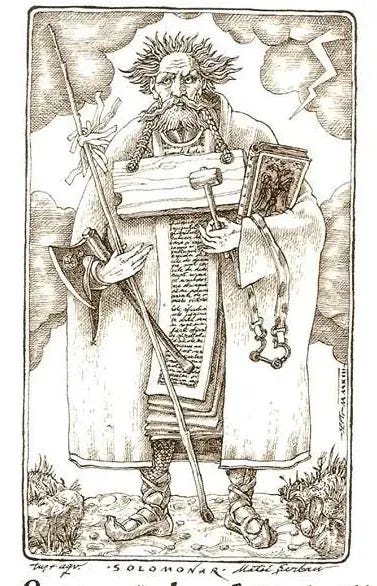
Each symbol has origins in almost every area that the myth originates.
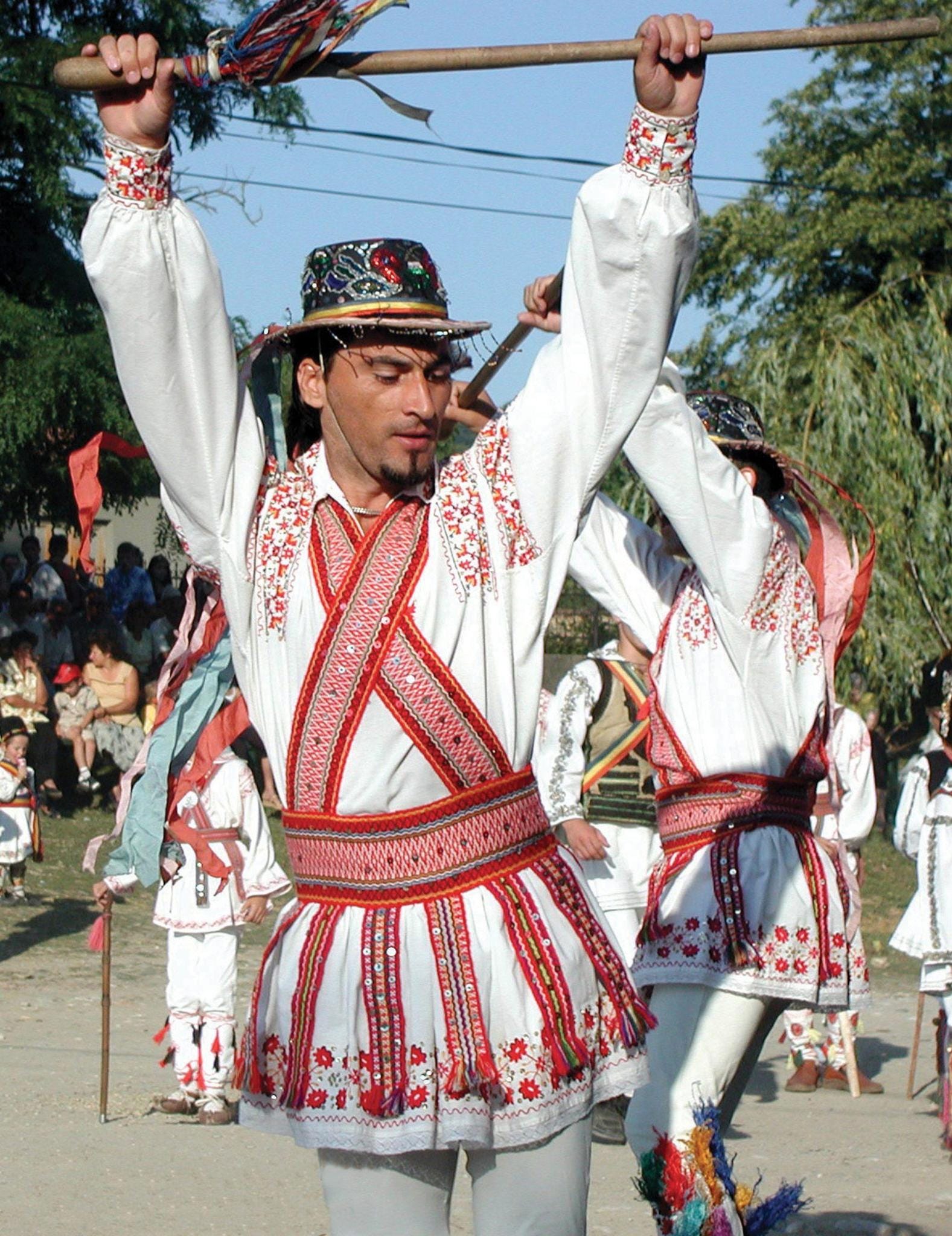
The Staff: The knotted stick resting in his right hand, adorned with ribbons, is a ceremonial rod used in the dance of the Călușari. The Călușari are ritual dancers from Romania. The Căluș (an endearing term for a horse) is a ritual dance performed to ward off evil spirits and heal the sick. Despite not exactly seeming very evil or sinful, Căluș dancers in the past had been banned from receiving communion for three years or more due to the perceived heretical nature of the ritual. Can’t please everyone, especially stuffed-shirt celibates who hate dancing. No good vibe unpunished.
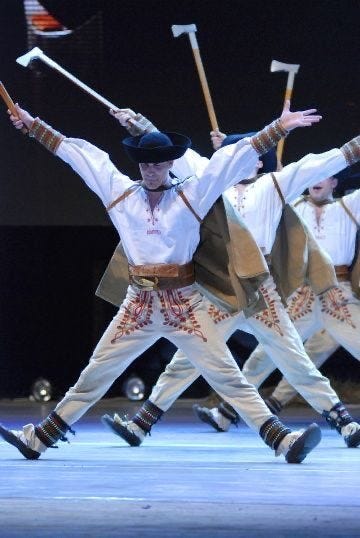
The Axe: The axe held by the Solomonar is a particular type: the shepherd’s axe. This tool has its own magical traditions linked directly to the Taltós, the Kapnobatai, and the Vlachs (shepherds) of Western Slavic regions. An enduring Thracian symbol, it has become ubiquitous as a magical item both east and west of the Carpathians and clearly beats the ever-living crap out of a wand any day. This is like the medieval equivalent of Gandalf with a shotgun.
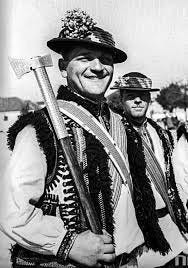
The shepherd’s axe actually, oddly enough, is used in a popular Slovakian Folk dance. Young men bound and hop while swinging them wildly. It’s an old dance, dating back to the medieval era, perhaps even earlier.
The Book: This is, of course, the book of secrets, the grimoire, or the speculated Wittenberg Black Book. It represents the “taught” aspect of the Solomonar: the formal, Solomonic magic and knowledge of the “language of all things.” A vellum journal written meticulously by the user and the source of the Solomonar’s power. These books definitely do exist in the sense that many black books are unique and will often be an amalgamation of magical techniques from all sorts of sources, such as Islamic, Greco-Egyptian, Solomonic, and so on. Are the real ones from the black schools? We don’t know. Hopefully, we will someday.
The Double-Headed Eagle: This symbol, seen on the book, is ancient. With origins in Mesopotamian and Hittite cultures, it likely entered the region’s symbolism from Asia Minor, particularly Byzantium.
It reinforces the running theme: it all starts in the East.
The Bridle: Oh yeah, and of course, we see a bridle. That’s for riding dragons.
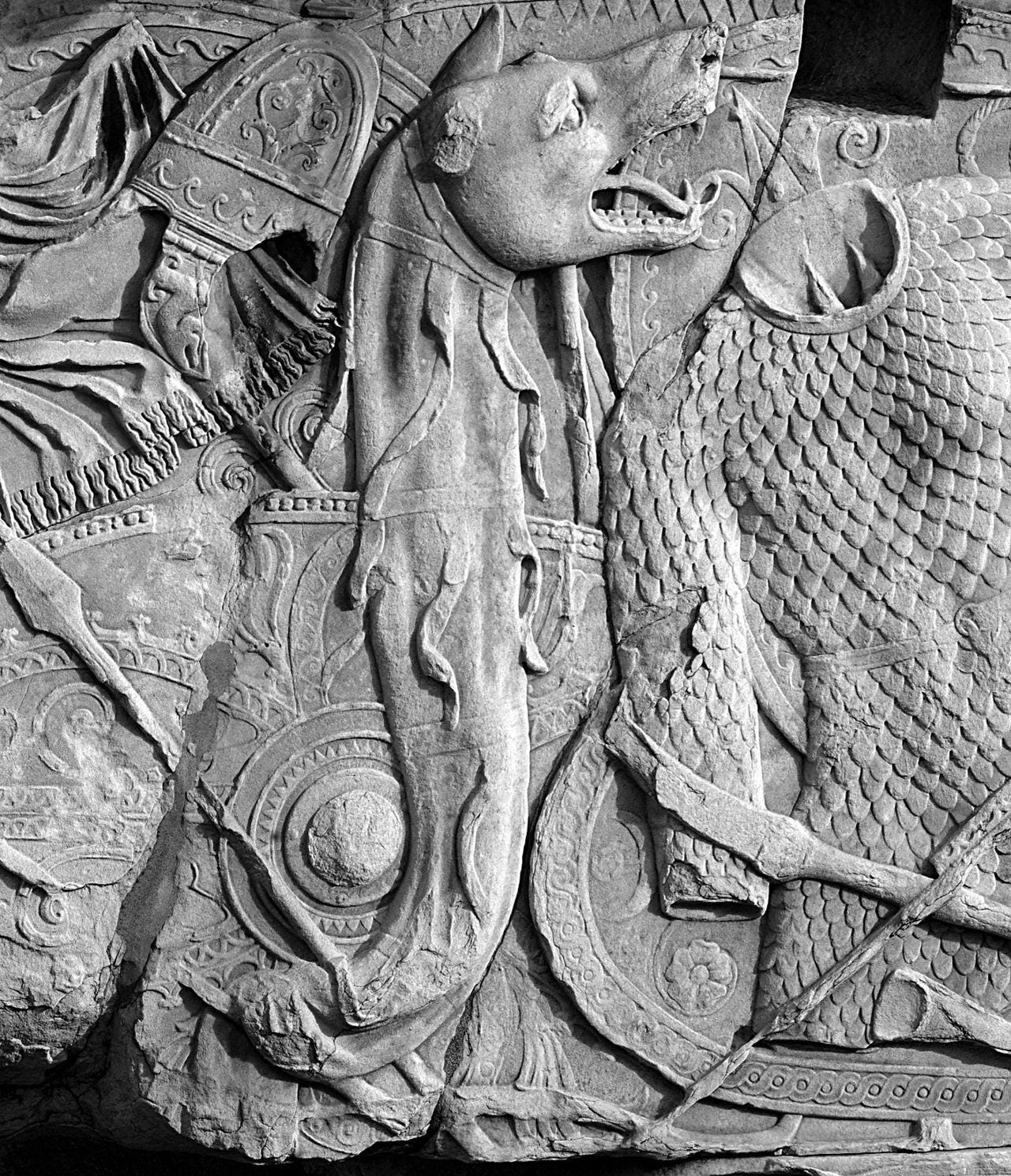
But where did those come from? The Dacian Draco, a wolf-dragon hybrid standard carried by the ancient Dacian army, is still a major cultural symbol in the region. The symbolism of riding the dragon could be a metaphor for the general use of magic: unleashing the will and uniting it with the elemental forces, but, in the sense of the Kapnobatai, it could be about smoking cannabis. We genuinely don’t know.
Outside of the legend, the bridle holds a special place within the region due to heavy Scythian and Thracian influence. These were the lands of the horselords after all. Much of Romanian, Hungarian, and Bulgarian mysticism has a lot to say about equestrianism.
The Semantron & Gavel: A percussive instrument used in Orthodox Christian churches. The mallet is held with the non-dominant hand. Clearly a symbol of a clergyman—which would entirely make sense given that these figures seem to have their origins in the syncretic monotheism of the region. They’re priests of their world.
This of course also, again, has tinges of the demon-banishing Călușari in a way.
Historically speaking, it seems that the monotheistic nature of these cultures somewhat acted as a lubrication for the Christianization of the area, as well as a means of preservation of their traditions via syncreticism. The one god of the sky, of caves, of the sun, of the universe, whole in all things and all things in him. It is a repeating pattern in the regions. It is refreshingly fascinating to read about. One can get tired of mythologies of fertility gods, Etsy goddesses, the maypole. It’s about time something unique got some airplay, and in the Carpathians, Caucasus, and surrounding areas we find exactly that. When one sees the sheer endurance of all of these cultures, even through age-old games of epistemological telephone, one really can appreciate the power of the central theme of nature united in wholeness.
7 Tying the Knots
So, what is a Solomonar?
It’s a legend, a myth, an embodiment of Carpathian history. The Solomonar is not one thing, but a gestalt figure, a culmination of thousands of years of syncretic diffusion in Central and Eastern Europe. The Solomonar is a Wizard. The Local Wizard.
He is the sky-worshipping, smoke-treading priest of Zalmoxis. He is the steppe-born Taltós who commands the weather and speaks to animals. He is the Călușari dancer in white, warding off evil with his staff. He is the educated court magician, poring over German black books in Transylvanian castle walls. And he is the Dacian warrior, “riding the dragon” by harnessing forces unknown to travel to places beyond conventional understanding. He is a shapeshifter.
The dragon is probably equally as old as the egg, perhaps as old as the great blue sky itself.
Ramsland, Katherine. The Science of Vampires. Penguin, 2015, p. 33.
Olteanu, Antoaneta. Metamorfozele sacrului: dicționar de mitologie populară. București: Paideia, 1998.
Österreichisch-ungarische revue. Vol. 3, Issues 1-2. 1918, p. 219.
Brucan, Silviu. The Wasted Generation: Memoirs of the Romanian Journey from Capitalism to Socialism. Boulder, CO: Westview Press, 1993.
Diac, Cristina. “In doi ani, din analfabet puteai ajunge student.” Jurnalul.ro, 19 September 2007. https://jurnalul.ro/scinteia/istoria-comunismului/in-doi-ani-din-analfabet-puteai-ajunge-student-103002.html


