

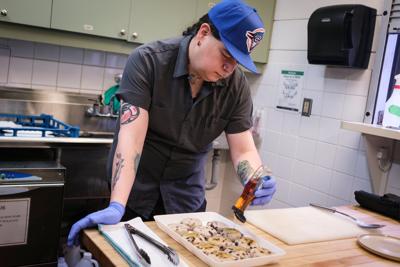

At a rented kitchen inside Fort York National Historic Site, Christopher Britt pulls a tray of bannock from the oven before turning his attention to a cornbread recipe he hopes more people will try.
Bannock, a fried or baked bread now deeply associated with Indigenous cuisine, remains one of the most recognizable Indigenous foods in Canada. But Britt, whose native name is Ooshokaw-kinew, meaning “Blue Golden Eagle,” believes the dish’s popularity has overshadowed the healthier traditional foods that came before it.
Using masa harina (nixtamalized corn flour), dried wild blueberries, dark-grade maple syrup, and mashed red kidney beans, Britt shapes the cornbread into hockey-puck-sized portions before boiling them in salted water for about 40 minutes. The cornbread has a softer, earthier texture than bannock and pairs with either maple syrup or wojapi, a wild-berry compote.
The recipe was developed by Kanien’kehá:ka chef Dave Smoke McCluskey and reflects the kinds of traditional foods Britt wants more Torontonians to eat.

Chef Christopher Britt works in the kitchen at Scadding Court Community Centre in Toronto. Britt says while bannock has become one of Canada’s best-known Indigenous foods, he wants more people to embrace healthier traditional recipes rooted in Indigenous foodways.
GIOVANNI CAPRIOTTIBritt, 43, is an Indigenous caterer and chef from Moose Point First Nation in Ontario whose catering company, Wiisinidaa (“let’s eat” in Anishinabemowin), is helping reintroduce traditional Indigenous foods to Toronto diners.
Raised in Toronto, Britt says he rarely encountered traditional foods outside of ceremonies. Wiisinidaa debuted as a pop-up at Stackt Market on Truth and Reconciliation Day in 2022.
Since then, he has built a steady catering business serving Indigenous cuisine at corporate events, weddings, and other private events, operating out of ghost kitchens across the city.
Fort York holds special significance for Britt. He is an eighth-generation descendant of Tecumseh, a key Shawnee leader who allied with the British against the Americans during the War of 1812.
His work comes as the last remaining Indigenous restaurants in Toronto have closed, even as demand for Indigenous cuisine grows. But Britt says that demand remains inconsistent.

Indigenous caterer and chef Christopher Britt prepares bannock. While fry bread remains a popular menu item, Britt encourages diners to learn about its colonial origins and explore healthier, pre-colonial Indigenous foods.
GIOVANNI CAPRIOTTI“It is a shame,” he says, “that those days (National Indigenous Peoples Day and Truth and Reconciliation Day) seem to be the only ‘appropriate’ times to consume Indigenous cuisines.” While awareness may be growing, he adds, “things could be busier.”
As Indigenous chefs like Britt work to reintroduce traditional foods into Toronto’s mainstream, one of their most visible and contested staples — bannock, or fry bread — has become the centre of a growing debate.
Although it is on his menu and is now a staple in many Indigenous households, Britt discourages customers from ordering it partly because of its colonial origins. During the colonial period, Indigenous tribes were forced off their lands and hunting grounds onto reserves. To survive, bannock was made from government rations known as the ‘five white gifts’ — milk, sugar, salt, flour and lard. The forced shift away from healthier traditional diets, Britt says, had serious consequences, especially the disproportionately higher rates of type 2 diabetes among First Nations populations. Cornbread, he says, might be a healthier alternative.
A shift to traditional eating, he believes, also requires a shift in community attitudes. Britt points out that when fellow community members speak about decolonization, their approach rarely extends to rethinking what — and how — they eat.
“You go on TikTok or Facebook and find all these funny posts describing how amazing fried bread, or bannock, is…” says Britt.
“It’s become normalized to the point where we’ve overlooked the unhealthy factor, and it’s a shame.”

Christopher Britt poses in the kitchen at Scadding Court Community Centre in Toronto. The Indigenous chef and caterer says reviving traditional foods is an important part of reconnecting with Indigenous culture and inspiring the next generation of Indigenous chefs.
GIOVANNI CAPRIOTTIBritt also notes that, in contrast to the common three-meals-a-day rule — breakfast, lunch and supper — Indigenous tribes would graze throughout the day, eating light meals to satiate themselves without overeating.
But Britt’s answer to the traditional-versus-modern debate? A healthy balance between relearning ancestral methods and modern technologies. A major challenge for Indigenous chefs in Toronto, he says, is sourcing traditional ingredients. Aside from certain foraged plants now being rare or forgotten, access to game meat is heavily regulated by Ontario’s wildlife conservation laws.
“You can hunt and serve it, but you can’t sell it, and I don’t know who decided that was appropriate,” he says.
By law, hunted game meat must undergo stringent grading and inspection for parasites before being sold commercially or at restaurants. Moreover, most urban chefs lack experience in preparing it. Despite this, Britt actively avoids mainstream proteins like beef, pork, and chicken and sources his salmon from the Atlantic Ocean.
Part of Indigenous chefs’ fears of opening their own restaurant in urban areas like Toronto, he says, is the game-meat factor, which could instantly get them shut down by health inspectors. That is why, through Wiisinidaa, Britt hopes to train the new generation of Indigenous chefs in the city.
“I think the more (Indigenous) people that generate an interest in opening a restaurant, the closer we are to actually having a larger Indigenous food scene in Toronto”, he says.


To join the conversation set a first and last name in your user profile.
Never miss the debate! Receive daily email notifications when users reply to your comments. Sign up for alerts here!
Sign in or register for free to join the Conversation
To join the conversation set a first and last name in your user profile.
Conversation
All Comments
Active Conversations
The following is a list of the most commented articles in the last 7 days.
A trending article titled "Trump's economic attacks on Canada look like a shakedown. They are not — it's a takeover" with 99 comments.
Trump's economic attacks on Canada look like a shakedown. They are not — it's a takeover
99
A trending article titled "Why 1 in 10 Canadian ER doctors are quitting — and what it means for your next hospital visit" with 117 comments.
Why 1 in 10 Canadian ER doctors are quitting — and what it means for your next hospital visit
117