
Back to Friends: Sombr, Warner, and the New “Sad Boy” Model
While Sony and Azoff are scrambling to figure out how to sell a 30 yo Harry Styles, Warner has already rolled out the software update. Sombr is a younger, cheaper, and more "authentic" asset for Gen Z

There is an unwritten but ironclad law in Silicon Valley that applies perfectly to the music industry: no matter how dominant your current product is, somewhere—in a garage or a boardroom—someone is already designing the version that will make it obsolete.
While Azoff and Sony are busy managing the inevitable “twink death” of their asset, hoping to rebrand him as the “cool bro” who’s in his thirties, refuses to find a real job, and wants to party on weeknights, they run a serious risk: making him look like a total caricature. It’s Mr. Burns dressing up as Jimbo Jones just to pocket the oil money. Meanwhile, the rivals are making their move.
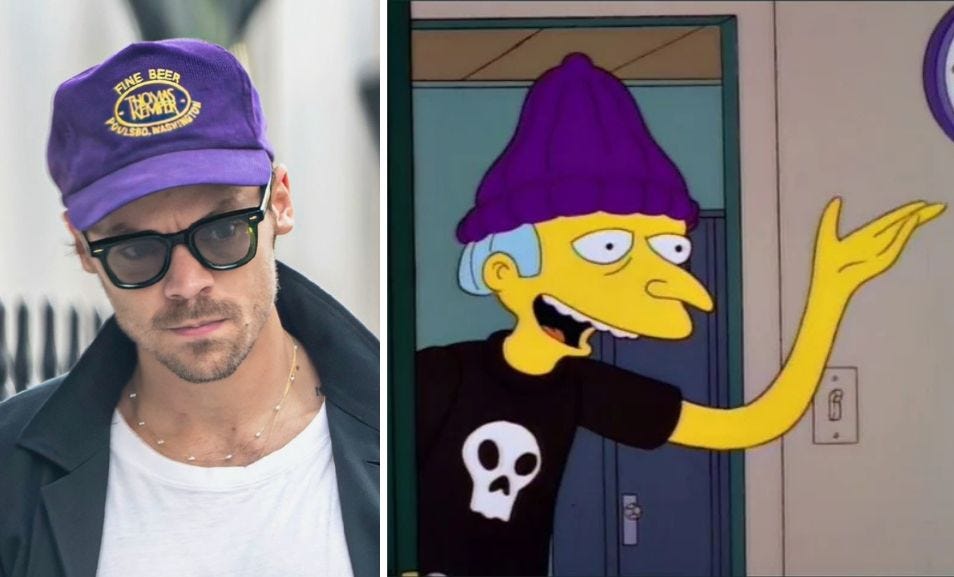
Warner has unleashed the best minds from its “R&D” department with a single goal: find an asset that covers the high-spending generalist pop/rock demographic (notoriously girls and young adults in the 15-25 range) but costs 1/10th of the Harry Styles juggernaut.
Styles has become an obsolete starship that, without the angular-velocity engine of the Azoff stable, would have crashed into the Atlantic on its first launch attempt.
This miracle of attention engineering has finally been found in Sombr.


The Indie-Rock Illusion
To understand what’s happening, you don’t need to look at Twitter’s trending topics, where the Harries are still living in 2010; you just need to turn on the radio. Generalist stations—the ones that have to churn out real numbers rather than online fanaticism (like Capital FM in the UK or RTL 102.5 in Italy)—have already moved on. Sombr is in heavy rotation. At any given moment, he’s there with his buzz, hypnotizing you with a seamless loop of notes.
If my first encounter with Styles was in a dentist’s waiting room (update: luckily the 50-inch screen eventually broke) with Adore You, my first brush with Sombr happened at my long-time hairdresser’s to the tune of Back to Friends.

You can imagine the “fantastic” acoustics of a hair salon. In fact, I couldn’t hear half a note of the song, but I found myself staring at the visuals, which revolved entirely around the concept: “sad party I didn’t want to go to, I don’t know anyone here, I’m hiding in the shadow of the disco ball and starting to cry”. That’s the mood, to be clear.
Then I opened Spotify, and the numbers were staggering. Shane Michael Boose is twenty years old and has 50 million monthly listeners. As mentioned, he covers the 15-25 demographic (the core business of pop) with surgical precision—that voracious consumer base that was Harry Styles’ personal ATM for a decade and is now, by simple biological law, migrating elsewhere.
For a sixteen-year-old today, Harry Styles isn’t the forbidden idol but the music her mother listens to in the car. Sombr, on the other hand, is the tormented peer who looks like he stepped right out of her own TikTok feed.

Warner vs. Sony: The Clone Wars
Sombr poses as an “indie-rocker”, but the massive radio rotation and the metrics betray the presence of a major.
Sombr is signed to Warner Records. Following his viral success on TikTok, Warner gave him the same treatment Full Stop gave Harry: building a veneer of “bedroom authenticity” to mask a global marketing machine.
Sony has always had a massive problem with Harry Styles: the investment was gargantuan. Extracting a member from One Direction and transforming him into a global icon required a PR machine, Hollywood “stunts”, and marketing budgets worth hundreds of millions. Harry is a high-maintenance asset that must generate billions just to cover the cost of his own existence as a brand.
Warner, observing the Styles model, made the smartest move: they cloned him, but on a budget.
The investment in Sombr is lean. Warner uses TikTok and generalist radio for a deep penetration that costs a fraction of Azoff’s budget. Furthermore, being American, Sombr is already “at home” in the world’s most important market. Harry, as a Brit, had to “conquer” America. Sombr just has to inhabit it. This makes him a much more agile and profitable asset in the short-to-medium term.
In the new system, you don’t pay your dues in clubs anymore; you do it in data labs. You release dozens of singles to see which one “hooks” the algorithm. Once the right hook is found, the major steps in with massive backing. Warner has industrialized the “indie” aesthetic, making it scalable and cheap. They’ve created the perfect product for a recession era: maximum emotional yield with minimum scenographic expenditure.
While Harry Styles is the Hollywood blockbuster that risks flopping if it doesn’t gross 500 million, Sombr is the low-budget indie film that cleans up at the box office.
The Polaroid Asset: Sombr and the Low-Resolution Strategy
To understand the threat Sombr poses to Harry Styles, we have to look beyond the streaming numbers and listen to the evolution of the product itself.
While his previous works, like the Savior EP, gave us an artist capable of inhabiting an intimate, aching folk style reminiscent of Bon Iver, his new incarnation is a masterpiece of aesthetic engineering. Today, Sombr is the perfect example of how the pop industry is learning to build “pre-filtered” assets—ready to be consumed without ever really being heard.
In 2025, with the album I Barely Know Her, Warner completely overhauled Sombr’s artistic proposition, formatting it for Gen Z.
The sound shifted drastically from bedroom folk to “hauntology pop”.
Listening to the new tracks, the sensation isn’t one of presence, but of absence. They sound like the Beach Boys on heavy antidepressants, passed through a grainy, lo-fi Instagram filter. There’s the echo of 70s disco and vocal harmonies, but it’s all slowed down, muffled, and distant.

The static hiss, the compressed mid-frequencies, and the dampened reverb aren’t “punk” artistic choices but a protective device. Just as an Instagram filter can make a mediocre photo look “artistic”, Sombr’s lo-fi serves to ennoble a 70s pop-disco structure that, if produced in high fidelity, would sound terribly derivative. It is the ennoblement of the mediocre via low resolution.
Why this choice? Because Warner realized that music today is an aesthetic expression closer to a fast-fashion moodboard than the result of late-night jam sessions.
Sombr’s music is “depressed and compressed nostalgia”: it’s tailor-made for doomscrolling. It’s the perfect soundtrack for lying in bed staring at the ceiling or scrolling TikTok at 3 AM. It’s the sonic equivalent of a bad Polaroid: it evokes a past that never existed—safe, harmless, and blurry.
Warner understood that Gen Z doesn’t want Harry’s performative joy, but they prefer an aesthetic background for their own anxiety.
Native Aesthetics: The TikTok Jeff Buckley
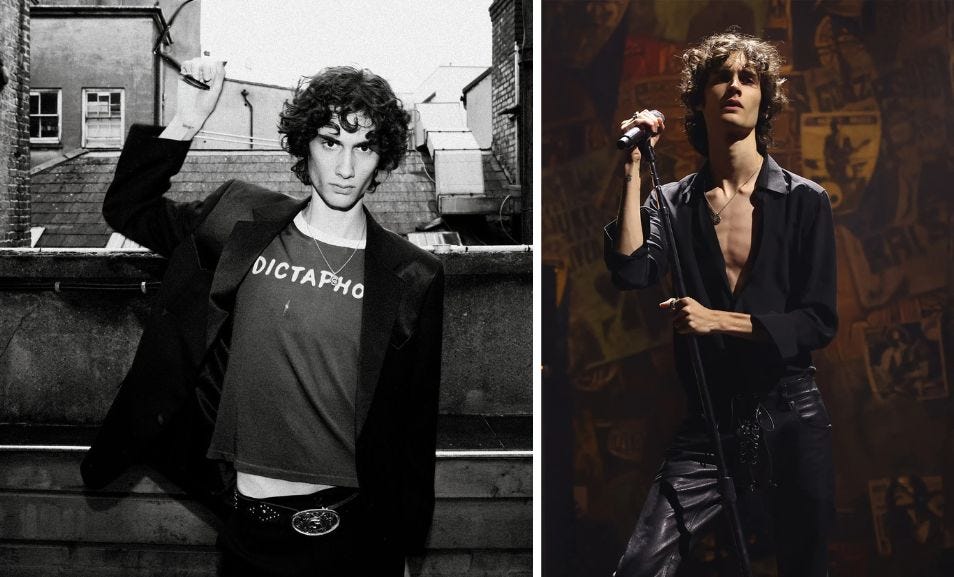
The “Jeff Buckley Canon” (the beautiful, tortured boy with an angelic voice and messy hair) is the fastest shortcut to buying artistic depth on the cheap. Buckley is the “holy grail” of authenticity for anyone wanting to pivot from a pop product to a “serious” artist.
As we saw in the analysis of Harry Styles’ debut album cover, tapping into the “tormented artist” imagery was essential to resetting his boyband image. It was an act of cultural appropriation of the indie-rock mythos.
Sombr utilizes the exact same reference, generating the same dissociation we saw with Styles: the look and the marketing campaigns say one thing, while the music says something else entirely. A total short-circuit between what we see and what we hear.
Sombr presents himself with the poise of a tortured indie-rocker—a cross between Grace-era Jeff Buckley and Timothée Chalamet in Dune. It’s a “poser indie” aesthetic that winks at the early Strokes: all cigarettes, lost gazes, and bedhead.
Underneath this rock exterior, however, the music looks toward sophisticated disco and a tired Brit-pop. At times, it sounds like Supergrass playing after a colossal hangover: they barely remember the lyrics or the chords, dragging the rhythm into an apathy that is mistaken for “coolness”.
While a 30-year-old Harry Styles has to resort to sonic facelifts and increasingly theatrical outfits to hold onto the spotlight, Sombr occupies the same space effortlessly. Harry has to play the part of the accessible rockstar; Sombr looks like the guy you just passed at the park.
The true tragedy of this transition is what has been lost. Tracks like “i don’t know you anymore” showed a Sombr capable of real emotional depth, anchored in a solid folk tradition. But folk requires attention. Folk is “cumbersome” for a Spotify playlist designed to accompany studying or working.
The industry has thus executed an “asset pivot”:
They took Sombr’s raw talent.
They “bleached” it, stripping away tones that were too dark or complex.
They sealed it in a 70s lo-fi nostalgia bubble.
The result is an asset that creates zero friction. While an artist like FKA twigs attacks you with her innovation, Sombr caresses you with his blurry familiarity. It is music as psychological upholstery.
Structural “Shrinkflation”: From Bon Iver to the Infinite Loop
If Sombr’s image is designed to be recognizable and reassuring, his new music is engineered to switch your brain off.
Comparing the tracks from the Savior EP (2023) with those from the new album I Barely Know Her (2025), we notice a phenomenon known in economics as shrinkflation. Just as chocolate bars get smaller while maintaining the same price, Sombr’s music has lost its structure while maintaining the same streaming value.
Songs like “i don’t know you anymore” followed a narrative. There was an introduction, a verse that built tension, a bridge that shifted the harmonic perspective, and a dynamic finale. There was development; the music mimicked human breath—expanding and contracting.

In “i barely know her,” the structure flattens. Complex bridges vanish, and rhythmic variations are kept to a minimum. The song becomes a loop. It is designed to be “circular”: it’s not meant to take you anywhere; it’s meant to keep you in a state of stasis.
In short, the music is no longer a story, but a pattern. It is the sonic equivalent of TikTok’s infinite scroll: a hypnotic repetition that never requires a peak in attention, facilitating compulsive re-listening (and thus artificially inflating streaming numbers).
Passive Listening Engineering: Why Warner Loves the “Muffled”
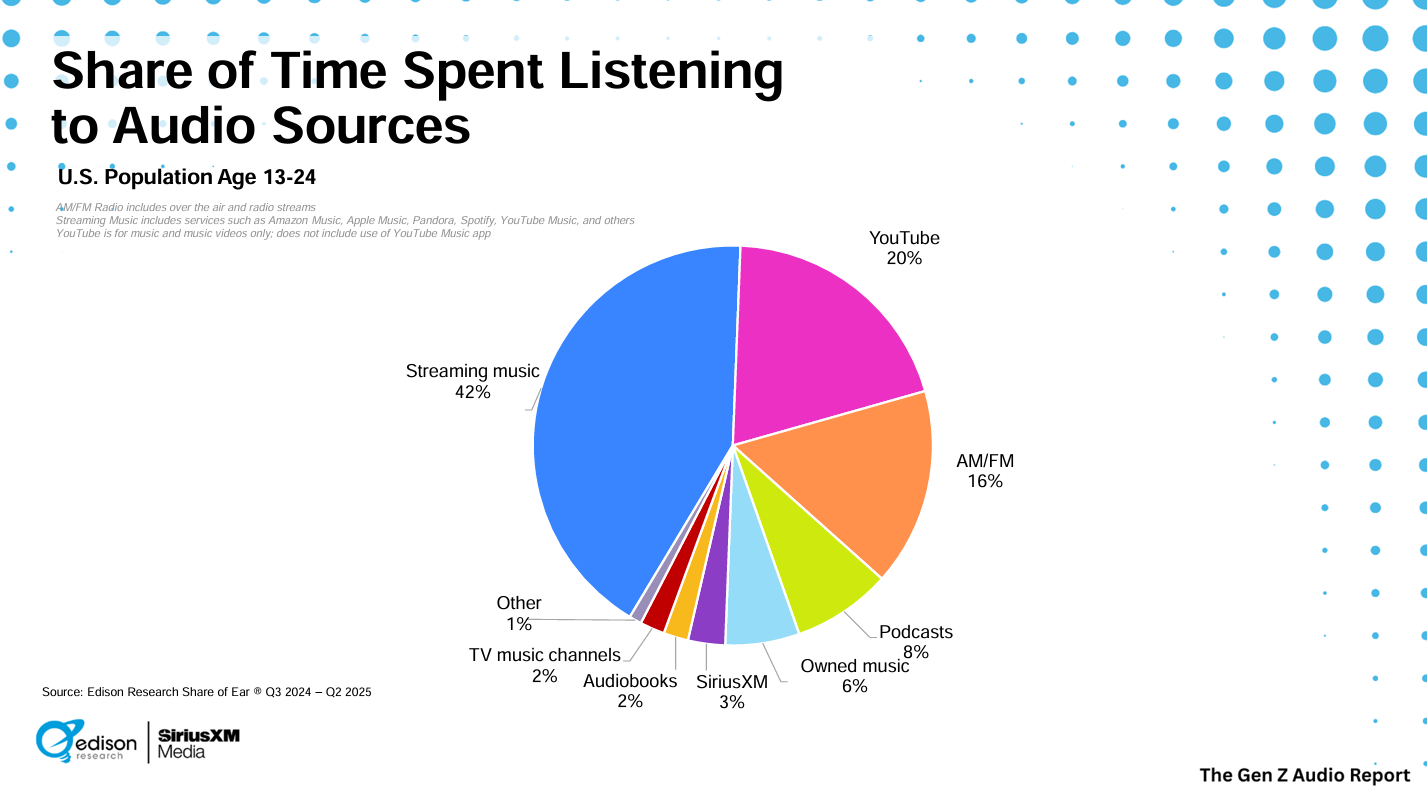
Warner didn’t choose a “muffled” sound for artistic reasons, but to conform to passive listening data.
Labels know that Gen Z primarily uses music as a passive background for other activities (gaming, scrolling, studying). Bright, high-definition sounds (like those on Fine Line) require cognitive attention; they “wake up” the listener and risk distracting them, leading to a skip.
Sombr’s muffled sound, conversely, acts as a sonic Xanax. It blends into the environment, asks for nothing, and disturbs no one. It is designed to be forgotten while it’s being heard, ensuring the stream continues in the background without interruption. These considerations come directly from analyzing Spotify and YouTube databases regarding when a user hits “skip”. From this data, majors have discovered that:
Acoustic Friction causes the Skip: A snare that’s too crisp, a vocal that’s too high, or an abrupt change in volume startles the user who is using music as background noise.
“Sonic Grey Noise”: Producing albums with rolled-off high frequencies reduces ear fatigue. This allows the algorithm to slot Sombr into any playlist—from “study beats” to “chill pop”—without the listener feeling the need to change the track. Sombr has been literally “sanded down”. His voice, which was raspy and present in Savior, is here buried under layers of reverb and lo-fi filters.
Warner is selling a “designer grey noise”, a product that has the face of a cursed rocker but the function of a hairdryer blowing in your face at the salon. It’s not meant to move you but cover the silence without disturbing the consumer’s thoughts.
We have moved from the artist who “wants to be heard” to the asset that “doesn’t want to bother you”. It is narcotic music for a generation that the industry prefers sedated and connected, rather than woke and critical.

The Global Data
If the industry (Warner, Universal, Sony) is pushing assets like Sombr toward that muffled, lo-fi sound, it’s because they’ve discovered that silence is less risky than emotion.
Here are the metrics and data points governing the fate of a track on Spotify and Apple Music servers:
The “30-Second Threshold”
For streaming platforms, a song only “exists” financially if it passes the 30-second mark. If the user skips at second 29, the label earns zero. On average, 24.14% of users skip a track within the first 5 seconds. Nearly 48% of listeners skip a song before it ends.
Using a lo-fi, muffled, and “soft” beginning serves to avoid the impulsive skip reflex. There’s no aggressive snare or piercing vocal to “disturb” the user. It’s an acoustic bait designed to slide you past the 30th second without you even noticing.
Skip Rate: Lo-Fi vs. Experimental Pop
Here we see the difference between a “low-friction” asset (Sombr) and a “high-friction” Asset (FKA twigs). Mood-based playlists (Lo-Fi/Chill) have a skip rate 15-20% lower than “New Music” playlists. This is because the listener is in passive mode. A track like “Drums of Death” by FKA twigs has a potentially massive skip rate (estimated over 60% for the average listener) because it requires an active choice: you either listen to it or you turn it off. It cannot stay in the background. Warner prefers an artist who guarantees a high “completion Rate” even if the music is mediocre, over a masterpiece that half the population skips after 10 seconds.
Muffled is the New Loud
In the 90s, you turned the volume to the max to get noticed on the radio. Today, you do the opposite to survive the algorithm. Tracks with high dynamic range (shifts from quiet to loud, typical of Savior-era folk or Buckley’s rock) have skip rates 30% higher than tracks with compressed dynamics. By cutting high frequencies and compressing everything into a “lo-fi wall of cotton”, Sombr creates a constant signal. The human ear habituates to that noise and stops actively processing it. This “tricks” the user into prolonged listening, inflating dwell time stats.
Repeat Listening and the Nostalgia Factor
Majors obsessively monitor the “”save rate”. Sombr’s compressed sound taps into the psychology of nostalgia. A track that sounds like it’s from the 70s activates areas of the brain linked to memory and comfort. These songs end up in “personal” playlists not because they are great, but because they are non-intrusive. They become the furniture of the user’s life, guaranteeing constant passive income for the label for years.
This is “distraction capitalism”: the industry has realized that to avoid being rejected, it must stop existing as art and start existing as a minimum frequency of interference.


Wow, that was excellent. A perfect break-down of why so much Gen Z and TikTok hit music feels void and empty. It's a depressing state of affairs, but it's an important reminder why active, challenging listening is important.
Wow, what a read. I’ve only come across his name in the last week. I had no idea what he sounded like or looked like. Some laugh out loud moments there. A great read!