


RE:Animation - My Neighbor Totoro
From The Dark Herald Archives:

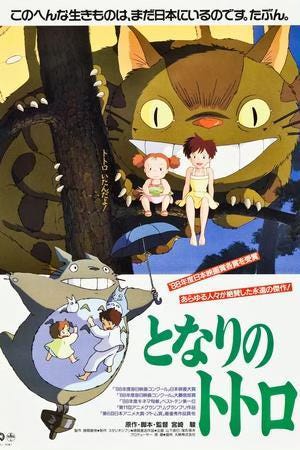
My Neighbor Totoro is back in theaters for a few days, which is as good an excuse as any to pull this one out of the archive.
Tonari no Totoro has a reputation problem in the West. Like Rashomon, it’s become one of those films people claim to love because loving it signals a certain kind of sophistication. The story goes that it’s operating on so many deep levels that only the truly refined viewer can appreciate it. Funny thing is, I’ve never met anyone in that crowd who could actually walk me through the plot from memory.
Here’s the truth: My Neighbor Totoro is a good film, but it is not a deep one and doesn’t need to be. It’s a movie made for a Japanese audience, and it means something to them on a level I can understand intellectually but never quite feel the way they do. That’s fine. It’s still a warm, unhurried film with gorgeous hand-drawn art. It’s the animated equivalent of hot cocoa with homemade peppermint marshmallows by the fireplace on a miserable day.
A Demi-Autobiography
Totoro is Hayao Miyazaki working through his own childhood. He spent long stretches of it in the Japanese countryside because his mother was sick with tuberculosis for years at a stretch. When the film came out in 1988, the rural, pre-industrial way of life it depicts, that had lived for a thousand years deep, was receding fast, as if it’s retreating into the realm of Kami. The 1950s countryside the film is set in still had real, living roots to the past. By the time Miyazaki made the movie, those roots were being cut.
The setup is simple. Professor Kusakabe and his two daughters move to the country to be closer to his wife, who is “in the hospital.” Something gets lost in the English here, this isn’t a general hospital, it’s a tuberculosis sanitarium, and sanitariums were always built out in the rural air for obvious reasons.
The house they move into is old enough that electricity barely reaches a few rooms, no more, and what there is can’t carry much of a current load. Cooking and heating run on coal. There’s a coal-fired bathhouse attached. It was kind of interesting mix of very traditional with a western addition grafted on to it. No, Miyzaki wasn’t making any allegories about Japan… Even if the house serves as one. It was just the kind of house he remembered being in rural areas in the 1950s.
The place had sat closed long enough that soot sprites had moved in, and they’re the first supernatural residents the girls encounter. Satsuki is just old enough to be skeptical of what she’s seeing; Mei, at four, has no such filter. She believes immediately.
It’s the little details that sell this story. Mei walking around on her knees when they first arrive because her shoes are still on
The supporting cast is small and functional: Granny (Ba-chan), who looks after the girls while their father works, and her grandson Kanta, who spends the whole film making faces at Satsuki in the universal ten-year-old dialect for “I like you and this is deeply humiliating.”
It’s Mei who finds Totoro asleep in the woods. He’s a forest spirit of Miyazaki’s own design and no particular species, essentially an oversized, benevolent teddy bear with the run of the local ecosystem. He’s there to look after children who need looking after. He is, like the film itself, not all that complicated. He doesn’t need to be.
The Real Story Is Satsuki’s
Strip away the soot sprites and the Cat Bus and what’s left is Satsuki working through two primal childhood terrors at once: losing a parent, and losing a little sister she’s been put in charge of. Both come straight from Miyazaki’s own childhood dread of losing his mother to tuberculosis.
There’s something worth sitting with here. Below a certain age, a child needs to believe they can’t be seriously hurt when they fall. Providing that safety, that’s supposed to be the mother’s job, the guarantee behind everything else. A mother’s unconditional love is the foundation a person’s whole sense of “I’m good enough anyway” gets built on. Miyazaki’s mother, sick and often absent, couldn’t reliably be there for that. Those are real wounds, and Totoro is Miyazaki’s way of working through them decades later, using two little girls and a giant forest spirit as the vehicle.
Kishōtenketsu, Not Three Acts
The film follows the Japanese storytelling structure of kishōtenketsu rather than a Western three-act arc, and it’s worth actually laying out because most Western viewers who praise the film’s “depth” couldn’t tell you this is what they’re responding to.
Ki (introduction): the family arrives in the country. Shō (development): the girls form a bond with Totoro and his spirit world. Ten (twist): Satsuki gets an emergency call about her mother’s condition, and in the chaos, Mei goes missing — she’s set off convinced she can cure her mother with a magic vegetable. Ketsu (resolution): Totoro summons the Cat Bus, Mei is found, and the family learns their mother is fine after all.
There’s no villain, no rising action in the Western sense, no confrontation to win. The tension resolves through connection and reassurance, not conflict. It’s a structure that a lot of casual Western viewers register as “not much happens,” without noticing that not much happening is the point, it’s the same rhythm as being a small child, where the biggest events in your world are a scary phone call and a missing sibling, not a battle.
Admittedly it had a few things that are genuine head scratchers for a Westerner. Why in hell did Joe Hisaishi use a freaking bagpipe for the opening song about Japanese kids in the country?
Other things are pretty easy to understand because and I cannot stress this enough, it’s not meant to be a deep film. Satsuki and Mei are kids and since they are kids they can still see the magic stuff that you forget about when you grow up. Within the context of the film, Totoro and the Cat Bus are big warm, fluffy, and protective if only a little bit scary.
Does It Hold Up?
Yes, easily. The hand-drawn animation is still gorgeous; every soot sprite, every rainstorm, every blade of grass in the rice paddies. And the story, modest as it is, is timeless precisely because it isn’t trying to be anything more than what it is: two kids, a summer, a sick mother, and a very large, very gentle thing in the woods that makes waiting for Mom to come home bearable.
Discuss in the Comments Below


The Disney English dub really fails this film. They cast Dakota and Elle Fanning to play the sisters. In theory, sisters playing sisters is cute, but in practice, you have lines delivered awkwardly in grating little kid voices. The voice acting in the scene where Satsuki breaks down and cries over fear of her mother dying makes a moving and tender moment awkward and cringy.
The sisters aside, the rest of the dub is also weak. Whoever directed the dub in this version decided to only have spoken lines when you can see a mouth moving... This leads to some really awkward silences that could easily have been filled. I have no idea what went wrong with the directing. In Spirited Away, the English voice acting is absolutely fabulous, complete with plenty of background noise that makes the world feel busy, full, and real.
The older English dub of Totoro done by Streamline is infinitely better in quality. Unfortunately the video quality is poor due to the age, but it's way easier to watch fuzzy video and hear good voice acting than the other way around.
This is my 4 year old's favorite movie. We showed it to her a few months before we conceived, and she was caught between identifying with Mei, and becoming a new Satsuki when the baby came. She constantly collected acorns and would keep them inside to play with and then take back out to plant. Anytime the wind would blow strongly she would immediately tell me it was the cat bus and she saw it go by. She was also obsessed with finding a camphor tree.