


Odysseus: The Hero of Unseason
The Trickster Hero

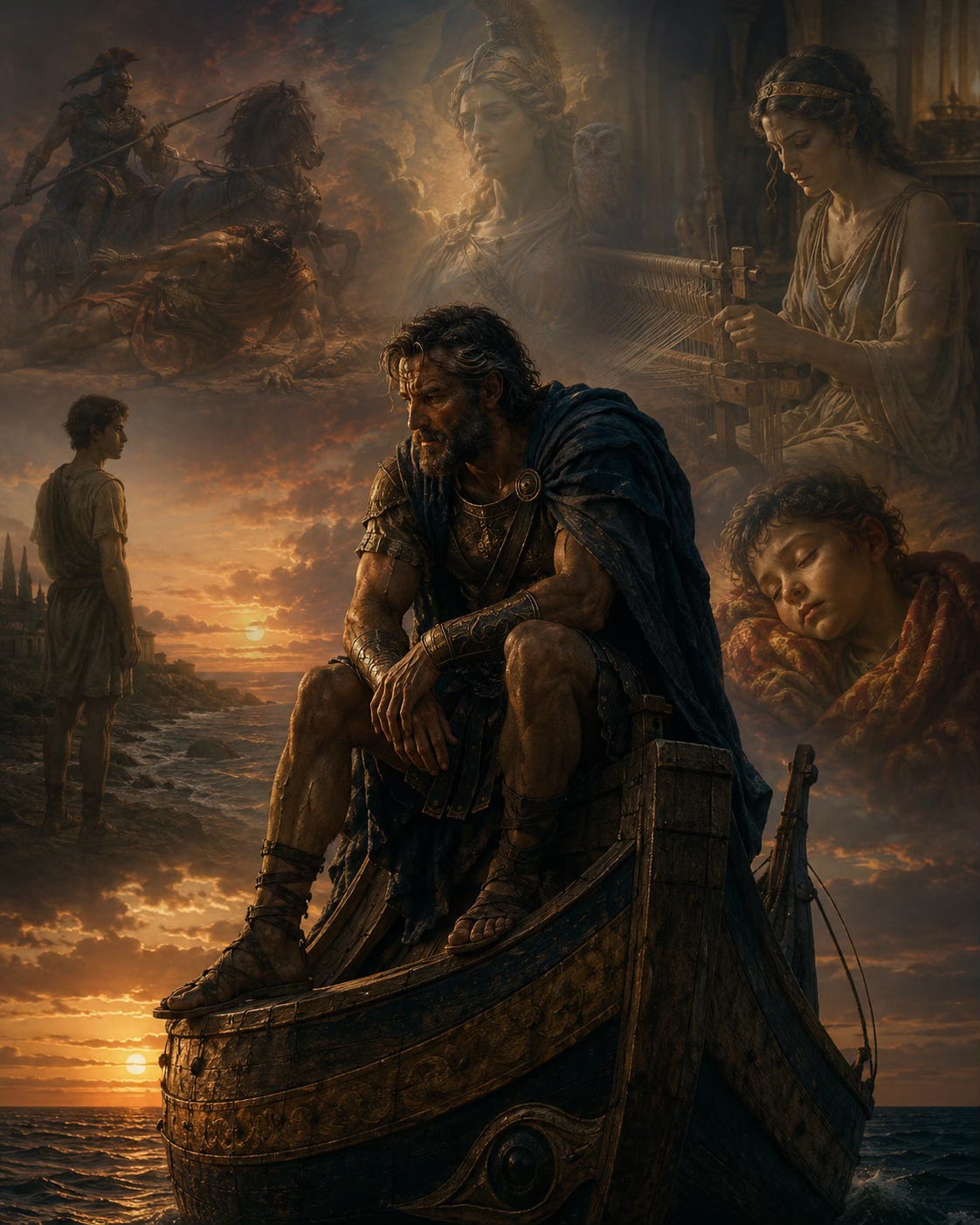
From the Lost Chapter of the Odyssey:
Odysseus climbed the broken wall of Troy with a silent infant in his arms. The rubble was still smoking behind him, the wails of the defeated were still heard on the wind. More women than men, for there were few men left alive to curse their fate. They had fought well, died bravely, and he had been the one to break them. Not dead Achilles, nor arrogant Agamemnon. Him, a king so poor he had to plow his own fields. By nightfall he would be aboard his ship and finally begin his voyage home… After he did this last disgusting thing. Odysseus reached the top of the wall and saw the whole of the dispersing Greek army gazing up at him.
He held the dead man-child out over the wall’s edge. Dead children had been all too readily available, and this one looked close enough. Odysseus cast the cold pathetic corpse over the wall. After it crashed onto the rocks below, he shouted, “Astyanax is dead. The line of Hector and Priam is extinct!” Then added for a flourish – and to explain the silence of the infant – “Let all remember he fell as bravely as his father!”
Andromache, buried her face in her hands and cried out. Grief was easy, for the women of Troy had nothing but grief. For her husband… For Priam… For her murdered city… But not for her still living son.
“Come woman!” Neoptolemus commanded, “I will give you more sons to replace the one you just lost.”
Andromache in her tears offered a silent prayer of thanks, not to Thetis who had failed her so completely but to Athena, as she watched the goddess’ champion, Odysseus, carrying the large basket holding her child on to his ship.
Not the Goddess of Wisdom
Today, Athena is taguht in schools as being the goddess of wisdom. The thing is the Greeks didn’t exactly have an all encompassing concept for wisdom. It was the closest a 19th century school marm was able to get.
The Greeks certainly had words that get close to wisdom, sophia for skill and learning, phronēsis for practical judgment, but those aren’t what define Athena in Homer.
Athena is the goddess of mētis.
Translating mētis is nearly impossible because English lacks a single word for it. It means intelligence, yes, but a particular kind of intelligence. Cunning. Foresight. Improvisation. The ability to see three moves ahead. The ability to survive when strength has already failed. It is the cunning of the fox rather than the strength of the lion.
Odysseus is not merely clever. Homer repeatedly calls him polymētis: “of many devices,” or “rich in mētis.” His defining virtue is not courage, nor strength, nor honor. It is the ability to find the one path through an impossible situation.
There’s a reason Odysseus is the mortal Athena favors above all others. She doesn’t invest herself in the strongest man at Troy. She spends it on the one who thinks like her, obliquely and, several steps removed from the obvious play. In the Odyssey, she outright tells him she loves him for it: that among mortals he’s the one who comes closest to her own gift for schemes and stratagems.
Which tells you something about where the Trickster actually sits in a pantheon. As a kind of pressure valve. Achilles represents glory achieved through force, the straightforward, static, thoroughly Olympian model of heroism. Odysseus represents something the gods themselves need but can’t supply: adaptability. A way through the wall when the wall can’t be breached.
As the Goddess of Mētis, into her care is given those things not in their season, those things that must be dealt with through intelligence and not strength: the city has fallen, the harvest has burned, the ship has sunk, the king is dead, the battle has collapsed. She is above all else the goddess of intelligent survival.
And in her care too is justice when justice has failed. Orestes is compelled to commit matricide thus bringing down the Furies on his head, and Athena creates the first court of law. Heracles is driven mad by Hera and commits horrific acts but Athena intervenes. Bellerophon and Perseus are sent on suicide missions by corrupt rulers but Athena provided them with the tools they need.
In pursuit of correcting the failure of justice she uses her very special avatar…
The Trickster Hero
While I have called the Trickster Heroes the Sons of Mercury, their patron is Athena. Foremost among them is Odysseus.
There is something peculiar about the challenges Odysseus faces. Achilles is confronted by things that can be killed. Odysseus almost never is.
There is no sword stroke that defeats the Lotus-Eaters. There is no duel with Circe. He cannot kill the sea. He cannot stab a storm. He cannot overpower Calypso or bargain with time itself.
Strength is almost never the correct answer.
Odysseus survives because he understands something Achilles never had to learn. Sometimes the proper question isn’t, “How do I win?” Sometimes it is simply, “How do I endure?” Mētis isn’t merely cleverness. It is understanding that an impossible situation cannot be solved honestly. It must be survived intelligently.
When his men eat the Lotus, he doesn’t punish them, he drags them bodily back to their ships and flees before they can forget themselves completely. When trapped in Polyphemus’ cave, he doesn’t defeat the Cyclops through superior strength. He makes himself Nobody and escapes disguised as sheep. When Circe transforms his men into swine, he doesn’t slay her. He wins an ally. When faced with the Sirens he understands that courage is insufficient. He plans beforehand to become weaker than his own temptation by binding himself to the mast. When faced with Scylla and Charybdis he discovers there are some victories that cost six dead companions and can still be called victories.
And when Calypso offers him immortality itself he commits perhaps the greatest act of mētis in the entire poem…he refuses.
Every challenge in the Odyssey is asking Odysseus to become someone else. Forget who you are. Become a beast. Become immortal. Become a king someplace else. Become the husband of another woman. Become anything other than the King of Ithaca.
Athena never teaches him how to become something greater. She teaches him how to remain himself when the world insists that he become something else.
The Trickster is not the hero of happy accidents. He is the hero of unseason. And perhaps that is why she loves Odysseus so much. Of all the Greek heroes, he is the one most defined by unseason. Achilles shines when everything is proceeding according to the heroic ideal. Odysseus shines when there is no ideal left to appeal to.
The city has fallen. The sea has taken your ships. The gods are angry. Justice has become injustice and duty has become sin.
What now?
That is question Athena is asked, and her answer is almost never, “I shall solve this for you.” It is, “Think. There is still one move left.” That’s mētis.
From the Lost Chapter of the Odyssey
The Last Temptation.
“Stay father,” Astyanax begged with tears in his eyes. “Don’t leave me.”
“Neoptolemus has answered for his many crimes and blasphemies,” Andromache said with less satisfaction in her voice than most would expect from her. “I have other children now, but there was never a night that my arms did not ache to hold my first.” She hugged Astyanax tightly as she said it. “Stay here in Epirus and rest, Odysseus. Stay and be a father. Stay and be king of a great kingdom.”
Of all the temptations that he had faced on his long road of trials this was worst of all.
Andromache wasn’t offering forgetfulness like the Lotus-Eaters, comfort like Circe, immortality like Calypso or a new beginning like Nausicaa… She was offering him a home.
Astyanax was the only son he’d truly ever known. Telemechus would not even know his face when he saw it. Had Penelope taken a new husband by now? Few could blame her if she had.
He looked at Astyanax, I never intended to be your father. I never intended to seek a replacement family. Yet now I’m being offered one. How do I satisfy both of my sons? Home. A kingdom. A son that knew and loved him.
What gift could Athena possibly offer against such a temptation?
Only himself. Mētis had preserved him through monsters, storms, slavery, shipwreck, and twenty years of exile. Not so that he could find a better ending, but so that he might reclaim his own. The Trickster is not the hero of happy accidents. He is the hero of unseason. He survives what should not have happened. He endures until the proper season returns.
Odysseus was never meant to become King of Epirus.*
He was meant to go home.
Discuss in the Comments Below
*Homer edited it out this chapter, preferring both the high tragedy of Astyanax death and avoiding redundancy with Nausicaa.


Bravo! Bravo! Best post among many, many good ones.
You did that thing where you observe something, and explain it: heroic integrity, the iconic character in a new light, that, having pointed it out, one says, "But of course. That is exactly how it is!"
Added to that: Etymology, Greek mythology understood, storytelling metaphysics, and the universality of fatherhood--all excellent, all delightful.