


The Dark Herald Does Not Recommend: The Odyssey (2026)

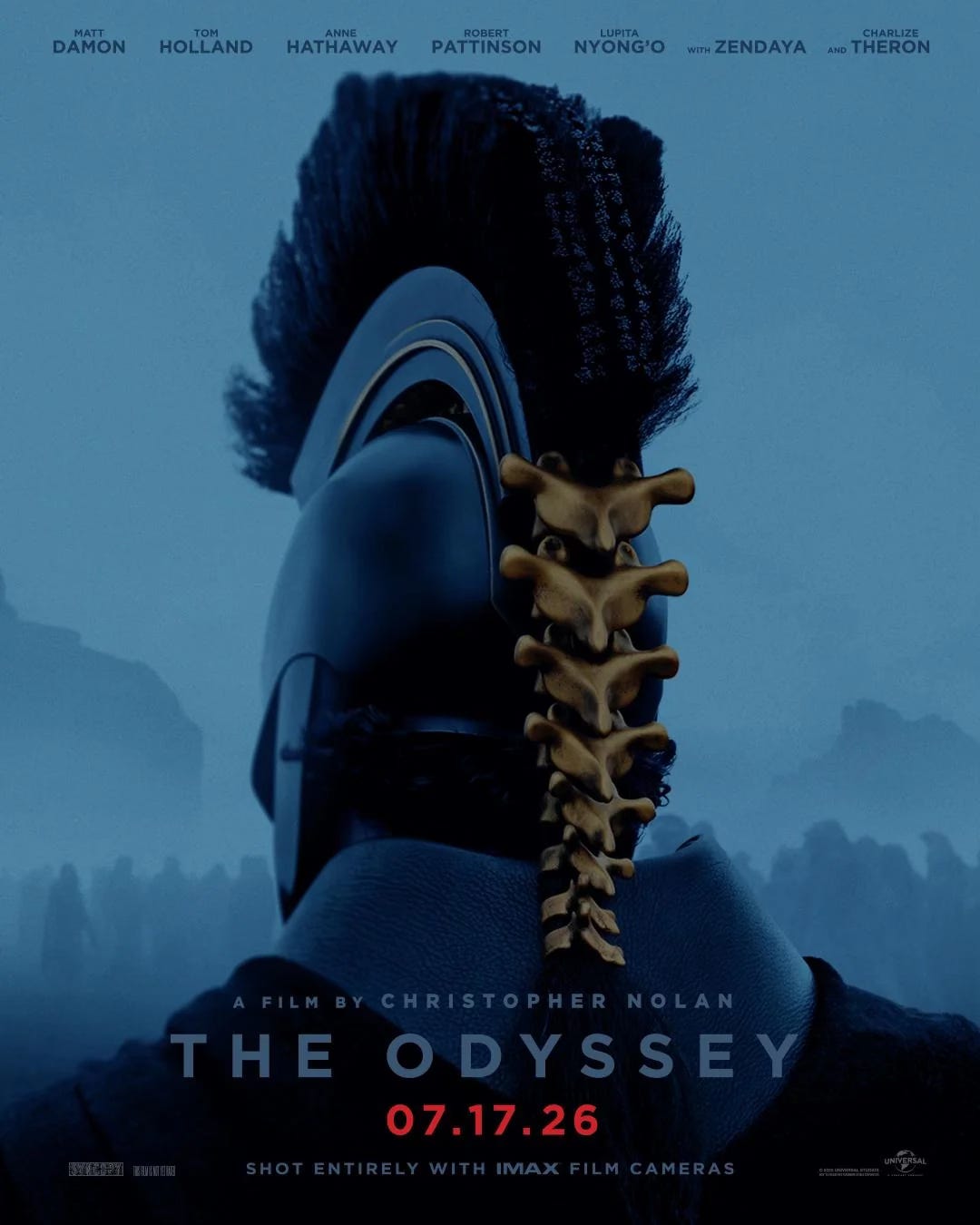
In 2011, GM rolled out a car that was acclaimed as the savior of Detroit. The Chevrolet Volt. It was a car launched at a time when the decline of the American automobile industry could no longer be denied. In engineering, quality, reliability, and luxury Detroit had been surpassed by Germany, Japan, Italy and arguably even Britain and that last was saying something. American cars were overpriced and under-good. The only one that could be considered top of its class was Tesla’s EVs and Detroit certainly wasn’t counting those.
The Chevy Volt was indeed an engineering achievement. It featured dual-motor drive, a three clutch system, active liquid battery cooling, next generation battery chemistry, blended braking, and a 53-Mile Electric Range… All of which added to up to a $42,000 price tag in 2012 Bucks. It was called into existence by political demands and industrial death spiral anxieties that were about to stop circling the drain only because the sink was almost out of water.
The only thing you could really say on the Chevy Volt’s behalf seven years after it halted production, is that it was easy to love… If you were desperate to love it in the first place.
Which brings me to Christopher Nolan’s The Odyssey.
It’s the Chevy Volt of 2026 Hollywood.
A product of both a dying skill stack and a filmmaking culture that has already begun to fade as the post-film industry diaspora begins. People need to work and there is simply no work to be had in Hollywood anymore, so people are leaving town
I must stress this. The kind of support this film is getting from all corners of the film industry is… Not. Normal.
This is not, “It is a good movie, we like it very much.” It’s much more, “Our hopes and dreams ride upon your shoulders Mister Nolan.” What makes this so much worse is that the movie well and truly reflects this. Its pretension reaches near Alejandro Jodorowsky levels of absurdism… But not if you really want it to be good. The Odyssey is a film you can make yourself believe in if you try hard enough.
And there are so, so many people that are desperate to try that hard.
“Every new beginning comes from some other beginning’s end”
That’s where Hollywood is at now, they’ve reached ‘some other beginning’s end.’ For one hundred years they were the entertainment capital of the world. They have no mechanism for looking at a world where that isn’t the acknowledged reality but now it’s all coming to an end. They can’t go back to making movies like they were did in the 80s and 90s because that executive talent pool that ran Hollywood has gone bone dry. The executives who run it now are all marketers not storytellers. They can’t turn back the clock no matter how much they want to.
Rather than accept this harsh reality it’s far easier to double down and claim that they way they are doing things now is just fine, and this movie with a mega-budget, an auteur director and a cast of stars will prove it.
Let’s take a look at the movie and if you’re about to complain about spoilers, please leave now because after 3,000 years you’re too far behind the power curve for me to remotely care.
The Hero of Unseason
Achilles was a hero in his proper season. It was all about personal glory. He was a product of a world working as it should. Odysseus is not.
The Fall of Troy VIIa show definitive signs of violent destruction, intense fire, bronze arrowheads, and unburied skeletal remains in the streets dating to roughly 1190 BC. This period is the start of a Dark Ages known as The Bronze Age Collapse. And Troy was hardly the only city being sacked. It was happening all over the Mediterranean World. The Sea Peoples is not a term used in Homer but they are repeatedly referred as such in Nolan’s version. There likely wasn’t a single ethnicity Sea Peoples, so much as anyone with a boat who could put together a raiding party. When you have civilizational collapse, raiding becomes a means of survival.
A season of unseason is a time when everyone feels they are being crushed under the wheel of the wheel of fate. It’s a time that cries out for the hero that is in eternal war with the whims of fate, the hero who can make the impossible happen. The Trickster Hero.
And you are NOT going to be seeing him in Nolan’s Odyssey. Instead you are offered Odysseus as Oppenheimer. No, I’m not kidding. The Trojan Horse is the atom bomb that destroys the Bronze Age. Instead of a Trickster you get to see… for three freaking hours… A man haunted by his past actions.
This is Nolan’s Odyssey not Homer’s. And it is in a word: pretentious.
The Odyssey wants very badly to be the equal of Peter Jackson’s The Lord of the Rings. It reaches for that same sense of myth and grandeur, but never gets there.
Ironically, the film’s problems stem from Nolan’s decision to make Homer as contemporary and accessible as possible. Rather than drawing the audience into an ancient and mythic world, the opposite happens. The artifice becomes impossible to ignore. Instead of watching Telemachus struggle to become the man his father was, I spent much of the film watching a Matt Damon who isn’t Odysseus, he’s Matt Damon in a peplos. Anne Hathaway is Anne Hathaway. John Leguizamo is John Leguizamo. They’re just playing themselves. I was continuously aware I was watching movie stars rather than characters from one of humanity’s oldest surviving stories. In Tom Holland’s case, I was watching a Tom Holland who had clearly aged out of the role he was hired for, Telemachus looks like he’s 30 because he’s 30.
There is a difference between making mythology accessible and making it contemporary. Jackson understood that with The Lord of the Rings. His characters felt human, but they still belonged to Middle-earth. Nolan’s cast feels like they belong in Hollywood. The result is a film that continually keeps the audience at arm’s length. Every decision seems designed to make Homer feel more immediate, makes the story feel less real. Myth requires a certain amount of distance. It asks the audience to step into another world rather than demanding that the world step into ours.
Granted there were a couple of exceptions. Robert Pattinson delivers an appropriately reptilian performance. He embraces his role as a villain with an energy and theatricality that feels appropriate to the material. Of all the principal cast members, he seems the most willing to inhabit the myth rather than merely play himself next it. Jon Bernthal manages to get close as well because he’s able to play three kinds of roles competently and luckily, Menelaus of Sparta could be stuffed into one of those boxes.
As for remaining roles, the rest of all the available human ethnicities are shotgunned randomly throughout the cast so you have Black, Asian, Pacific Islander, Pakistani and literally every other nationality the human race offers as Greeks… Except for actual Greeks - Nolan did miss that one.
I almost gave Nolan the benefit of the doubt with Lupita N’yongo as Helen. I thought he might be going for a statement about the women of Troy as human chattel who were divided among the victors and thus a black woman could convey an image of… No. No, it was a completely political choice. It’s the usual thing of inviting criticism of race-swapping in order for the film’s champions in the press to haughtily dismiss all criticism as racism.
Politics is also the reason the pivotal role of Sinon was handed to Elliot Page. I am going on the record right now and declare Page will win the Oscar for Best Supporting ACTOR. These days it’s all about who the academy wants to see giving that speech on Awards Night and they felt cheated by Emilia Perez.
The Odyssey has all the familiar hallmarks of Oscar bait, but the motivation behind it feels unusual. It doesn’t feel as though Christopher Nolan made this movie primarily to win an Oscar for Christopher Nolan. It feels as though he made it to win an Oscar for Hollywood.
This is not merely a prestige production. It is an institutional demonstration. Hollywood has assembled one of its few remaining bankable directors, an army of recognizable stars, one of the foundational works of Western literature, an enormous budget, practical locations, theatrical exclusivity, and every available marker of cultural seriousness. The finished film is being presented less as a movie than as evidence.
Look, Hollywood says. We can still do this. We can still make grand historical spectacles. We can still adapt great literature. We can still create movie stars. We can still convince adults to enter a theater. We can still make something that matters.
This is movie made to vindicate the entire Hollywood film industry. Nolan already possesses prestige. What appears to require validation is the system around him. The industry wants The Odyssey to be great because it desperately needs proof that it remains capable of greatness.
The movie opens with a title card “In a Time of Apparent Magic.” This is almost explicitly opening the door to the central theme of unreliable narration. Although, I am forced to grant there probably has never been a more unreliable narrator than Odysseus of Ithaca.
It starts on the beach of Troy, the first person you see is Elliot Page’s Sinon. Trojans are riding out. Sinon gets up and runs to the Trojan Horse and before you can say “They did the meme!” Sinon is killed by a thrown spear. Then it bounces to “present day” Ithaca where the suitors are eating Penelope and Telemachus out of house and kingdom. Travis Scott who is playing The Bard (apparently they couldn’t bring themselves to call him Homer) starts rapping about Troy. Penelope interrupts him so we can be brought to speed on her dire political situation. After what feels like a half hour, we meet Odysseus for the first time. He’s with Calypso and is eating the lotus to make himself forget. We then get a very, very long and non-linear look at the events of the Odyssey.
Since Odysseus is now drug addled and was always a liar, Nolan has the option of presenting the mythological world of the Odyssey with the conceit of it probably being the result of a deranged imagination.
It's a shame the film's score doesn't share that same interpretive ambiguity, because the music by Ludwig Göransson is another demonstration of excess. Göransson has always danced a fine line between music and tone poem. At his best, his scores don’t just accompany a film, they become part of its language. Not so much saying what you should feel rather than immersing you within a particular place, culture, or moment. There is a reason his best work feels almost architectural. But that’s when it works. When doesn’t, like in The Odyssey, it becomes detached from the thing it’s trying to support and begins to randomly batter the audience with sound.
And speaking of random audio battery, no review of a Nolan movie would be complete without mentioning his utter incompetence at sound mixing. The Odyssey continues Nolan’s peculiar philosophy of sound design which exists in a perpetual state of quantum uncertainty. One moment I’m straining to hear what’s being said and the next I’m being blasted out of my seat by a mid-1970s Sensurround disaster movie. I literally put my Airpods in and turned on the noise cancelation at one point.
For all of my complaints about the casting, the dialogue, the sound design, and Christopher Nolan’s occasionally suffocating ambitions for this production, my greatest disappointment was ultimately much simpler than that.
Christopher Nolan forgot who Odysseus is.
We never see the Man of Polymetis. The trickster hero is never presented.
Matt Damon’s performance is perfectly serviceable for the character Christopher Nolan has written. The problem is that he isn’t playing Homer’s Odysseus. He is just playing some reasonably intelligent fellow riddled with PTSD.
Odysseus is many things. He is brave. He is loyal. He is flawed. He is arrogant enough to shout his name at the Cyclops when silence would have seen him safely home. He is simultaneously one of mythology’s greatest philanderers and one of its most devoted husbands. He is contradictory in all the ways actual human beings tend to be contradictory.
But before all of those things he is Polymētis. Odysseus of many counsels. Odysseus of many devices. Odysseus the Trickster Hero.
And the Trickster Hero is entirely absent from the first Trickster Hero’s story. This is not a small criticism. It’s like adapting Sherlock Holmes and forgetting that he is a detective or adapting Robin Hood and forgetting that he steals from the rich. One can alter almost anything else about the character provided one preserves that central truth. Remove mētis from Odysseus and there is little of Odysseus left.
The Greeks did not admire him because he was the greatest warrior at Troy. He wasn’t. Achilles was greater. Ajax was stronger. Agamemnon was more powerful. Diomedes was braver. Odysseus was something stranger than all of them. He was the man called upon to do the impossible when strength had failed.
When the world is functioning properly, Agamemnon wins the wars and returns home covered in glory. When the world has become broken, Agamemnon is murdered by his wife, the gods appear to have abandoned man and every available choice is a terrible one; that is when everyone calls upon Odysseus.
His victories are almost never proper victories. They are compromises, bargains, lies, disguises, and flexible moral calculations. That is why I found myself so disappointed by Nolan’s adaptation. He gets obsession better than any filmmaker currently working in Hollywood but not Trickster Heroes.
Conclusion
Christopher Nolan’s The Odyssey is not a genuinely terrible movie. There are moments when you can almost see the masterpiece struggling to emerge from beneath all of Christopher Nolan’s Nolanisms. There are moments where the practical effects are magnificent, where Ludwig Göransson’s score briefly supports a scene, and where Homer himself is finally permitted a rare chance to peek through the cracks in Nolan’s adaptation.
And then Christopher Nolan invariably reminds us that we are watching CHRISTOPHER NOLAN’S THE ODYSSEY…
Not Homer’s.
By the end of this review I have repeatedly found myself returning to Odysseus himself. He is not Achilles or Hector. He is the hero of unseason. He survives because he understands what must be preserved and what must be sacrificed. When to fight and when to out-wit. When to conceal and when to reveal. He is more than any other hero in Western literature, the master of disappearance.
It is therefore a tremendous irony, that Christopher Nolan is uniquely unsuited to adapting him. Nolan is many things as a filmmaker, but subtle and self-effacing ain’t it. His greatest strengths are spectacle, ambition, and technical mastery. He announces himself loudly and confidently in every frame of every film he produces.
But Odysseus needs to whisper, “No-body.”
Stories do not survive for three thousand years because they are loudly proclaimed to be important. They survive because generation after generation quietly discovers that they are true.
The Odyssey has survived the collapse of empires, the rise and fall of kingdoms, and three millennia of human history because at its heart it remains the story of a weary old solider struggling to find his way home to his wife and son.
It didn’t need Christopher Nolan to make it important.
It merely needed Christopher Nolan to tell us that story.
Instead, he gave us Christopher Nolan’s The Odyssey. A remarkable technical achievement, an occasionally overwhelming spectacle, and a film carrying the impossible burden of proving that Hollywood can still dream… Which it can not.
Like the Chevy Volt, it is remarkably easy to love if you are desperate to love it in the first place.
But I wasn’t.
The Dark Herald Does Not Recommend: The Odyssey (2026) [2.5/5]
Discuss in the Comments Below


Seeing a story I've loved most of my life betrayed to sure up someone's PC creds makes me worry what will be despoiled next.
Bingo! You got it!
I wrote about that too. It’s the swan song of a deranged era.