3


Wassily Kandinsky was a student of law and social sciences who pivoted to art, inspired by Monet. His manifesto was a spiritual framework validating synesthesia, his rare ability to hear colors, saying only the enlightened could understand his works.


3
100% Upvoted
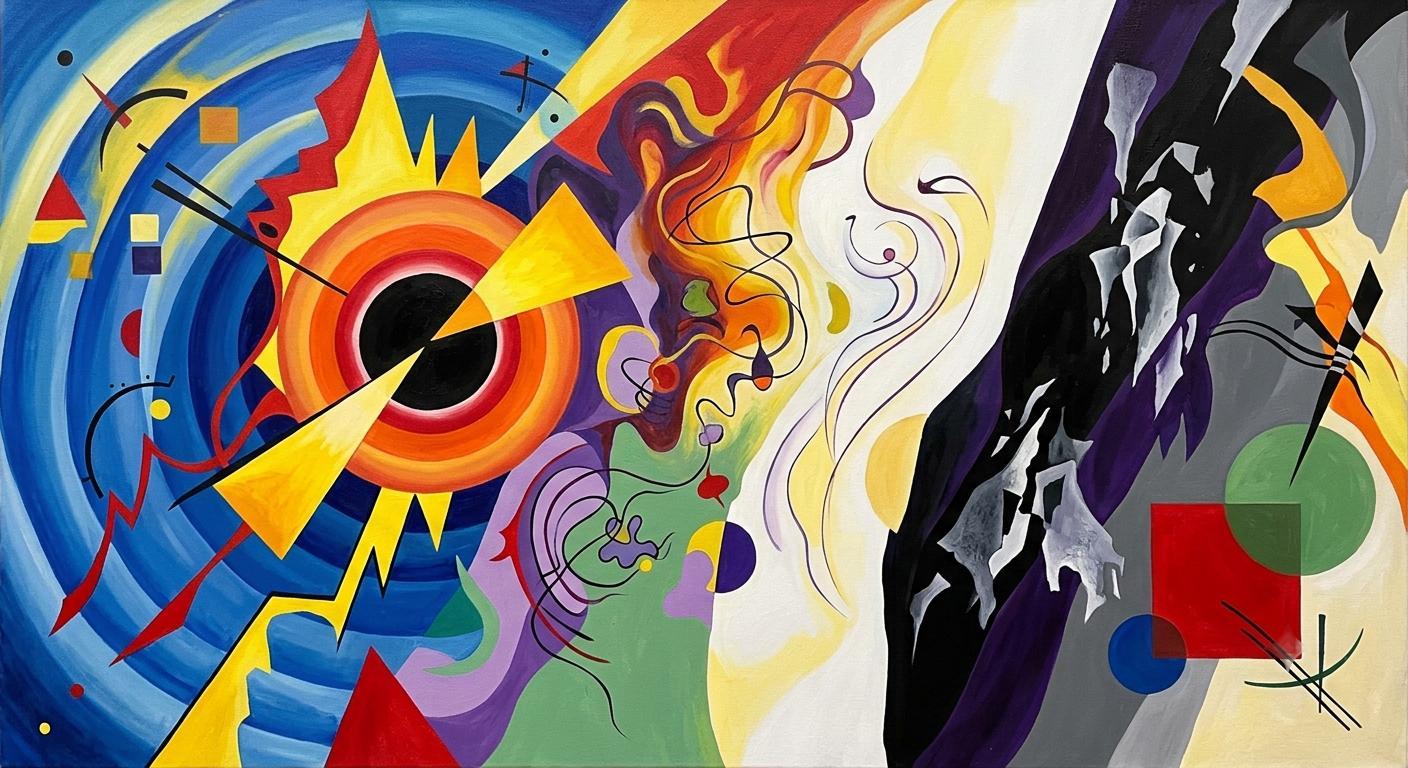
{Homer's "The Odyssey"} illustrated in Wassily Kandinsky's signature Spiritual Abstraction art style: {
Wassily Kandinsky was a pioneer of European abstraction whose visual framework was profoundly shaped by synesthesia, music, and spirituality. Transitioning from a scholar of law and ethnography to an avant-garde theorist, he used his synesthesia to synthesize his Russian roots, modernist theory, and mystical philosophy into a methodical, spiritually resonant visual language.
Born in Moscow on December 16, 1866, Kandinsky traveled extensively before settling in Odessa in 1871 for his early artistic and musical education. Initially pursuing academia, he studied law, economics, and anthropology at Moscow University from 1885 to 1893.
An 1889 ethnographic expedition to the Vologda province proved pivotal. Observing how locals decorated their homes with symbolic, non-naturalistic Russian folk art, Kandinsky learned to “step inside” a visual space. This immersive concept later fueled his desire to engage viewers' spiritual awareness through non-representational painting. Though he passed his law exams with honors in 1892—briefly joining the faculty and managing a printing works' art department—his artistic drive ultimately superseded his academic trajectory.
By late 1895, Kandinsky’s “hopeless love for painting” prevailed. A defining moment occurred in 1896 upon viewing Claude Monet’s (1840–1926) Haystacks in Moscow. The painting shattered his reliance on objective representation, proving a canvas's emotional power did not require strict realism. Rejecting a prestigious professorship at thirty, he relocated to Munich to study art.
In Munich, Kandinsky joined a vibrant Russian art colony, studying under Anton Ažbe (1862–1905) and Franz von Stuck. He absorbed Jugendstil (German Art Nouveau) principles, using flat, decorative surfaces and expressive, curvilinear lines to distance himself from academic realism. In 1901, he founded the Phalanx art association and school, meeting his long-time partner, artist Gabriele Münter (1877–1962). Before fully abandoning representation, Kandinsky embraced a Symbolist “Fairy Tale” period (1903–1907). Works like The Golden Sail and The Colourful Life drew heavily from Russian folklore, featuring flat, ornamental compositions reminiscent of Gustav Klimt.
The years 1908–1914 marked a decisive shift. Living primarily in Murnau with Münter, Kandinsky developed a highly expressive, color-dominant style and his concept of veiled imagery (verborgene Konstruktion).
Kandinsky's move to abstraction was not abrupt; he did not immediately eradicate literal references. In monumental works like Composition VI and Composition VII (1913), he embedded apocalyptic motifs—like the Last Judgment, the Great Flood, cannons, and St. George slaying the dragon—deliberately obscuring them beneath explosive color fields and kinetic geometry. By stripping these symbols of immediate legibility, he forced viewers to bypass logical narrative recognition, triggering a direct, subconscious spiritual resonance.
In December 1911, Kandinsky, Münter, and Franz Marc (1880–1916) co-founded Der Blaue Reiter (The Blue Rider). Joined by artists like Paul Klee (1879–1940) and Alexei Jawlensky (1864–1941), the group became a catalyst for modernist experimentation, promoting a Gesamtkunstwerk (total work of art) that synthesized painting, music, and theater.
In 1912, Kandinsky published his seminal treatise, Concerning the Spiritual in Art (primarily written in 1910). It framed the artist as a "prophet" leading humanity’s spiritual "pyramid" toward enlightenment. The book mapped his synesthetic perception of color, grounding his claims in Annie Besant and Charles Leadbeater’s Theosophical text Thought-Forms (1901). Explicitly citing H.P. Blavatsky, Kandinsky acknowledged Theosophy's profound influence, suggesting spiritually attuned senses can perceive human thoughts as "fine matter."
Within this framework, Kandinsky viewed color as a "key" striking the "piano" of the human soul to trigger internal vibrations. While he assigned innate psychological qualities to colors—such as "heavenly" blue or "earthly" yellow—he emphasized these properties are mutable, modulated by neighboring hues and forms. Every formal choice served the "Principle of Inner Necessity," dictating that a work is only "beautiful" if it touches the soul. For example, while Kandinsky admired Henri Matisse’s color—likening it to Claude Debussy’s musical harmonies—he cautioned that Matisse occasionally lapsed into superficial "conventional beauty." Ultimately, Kandinsky argued the artist must remain "blind" and "deaf" to contemporary trends, guided only by their inner life.
For Kandinsky, color was an objective psychological wave, a framework deeply indebted to Johann Wolfgang von Goethe’s romantic color theory, Zur Farbenlehre (1810). Rejecting Isaac Newton’s purely physical, prism-based theory, Goethe argued colors arise from a phenomenological battle between light (Licht) and darkness (Finsternis). Goethe divided the spectrum into an active, warm "plus side" (yellow, yellow-red) and a passive, cool "minus side" (blue, red-blue), identifying color as the source of "sensuous-moral" (sinnlich-sittliche) impressions. Kandinsky adapted these romantic dualities into a systematic, three-dimensional design syntax categorized along three major axes:
Likening painting to musical composition, he famously wrote: "Color is the keyboard, the eyes are the harmonies, the soul is the piano with many strings. The artist is the hand that plays."
The outbreak of World War I forced Kandinsky to part ways with Münter and return to Moscow. In 1916, he met Nina Nikolaevna Andreevskaya (1899–1980). True to his synesthesia, he was so inspired by the sound of her voice that he painted An eine Stimme (To the Unknown Voice) before they formally met; they married in 1917.
After the Russian Revolution, Kandinsky helped reorganize artistic institutions, working with the Museum of Pictorial Culture and teaching at VKHUTEMAS. However, his spiritual abstraction increasingly conflicted with Constructivism's materialist and utilitarian orientation. As Soviet avant-garde culture prioritized social function, Kandinsky remained committed to inner necessity. In his 1918 Russian autobiography, Rückblicke, he framed abstract art as a transcendent language destined to elevate human consciousness, not as mere decoration.
Returning to Germany in the 1920s, Kandinsky taught at the Bauhaus. Here, his spiritual abstraction and Goethean dualities evolved into a highly systematic, geometric visual syntax. This objective language was brilliantly demonstrated in his 1930 courses, where students deconstructed musical scores into abstract notations of pitch, duration, and interval, translating auditory movement into static optical landscapes. Similarly, in 1928, Bauhaus affiliate Heinrich Neugeboren used this syntax to translate a Bach fugue into a monumental geometric structure.
Asserting that universal visual archetypes exist as crossmodal correspondences, Kandinsky distributed a famous 1923 questionnaire to the Weimar Bauhaus wall painting workshop. To validate his synesthesia, he asked students to pair primary colors with fundamental shapes, seeking an objective psychological basis for his art. This matured framework married color, shape, and sound, mapping the active, aggressive yellow triangle to a piercing trumpet blast; the grounding, stable red square to resonant cello tones; and the transcendent, gravity-defying blue circle to deep organ or flute sounds.
The following table synthesizes Kandinsky's essentialist framework, illustrating how he linked specific colors to thermodynamic movement, psychological states, and musical orchestration:
When the Nazis closed the Bauhaus in 1933, Kandinsky and Nina fled to Neuilly-sur-Seine, France, where he lived until his death in 1944. His theories gained posthumous traction: in 1949, his champion Katherine S. Dreier (1877–1952) co-authored Three Lectures on Modern Art, defending his work as an expression of inner truth. Decades later, Nina published her 1976 memoir, Kandinsky and Me, protecting the legacy of a man whose rigorous spiritual frameworks were often subjected to reductive criticism.
Kandinsky's spiritual modernism distilled design, translating the gestural lines and elemental colors of Expressionism into visual musicality. Within this matured framework, graphic elements were stripped of literal associations to operate as a primordial language. This is masterfully showcased in Several Circles (1926) and theoretically cemented in Dance Curves (1926) and Point and Line to Plane (1926). In Dance Curves, he mapped the expressive movements of modern dancer Gret Palucca. Expanding this in Point and Line to Plane, he reduced music, architecture, movement, and painting to fundamental geometries, arguing that points, lines, and planes form the universal foundation of artistic expression.
The philosophical bedrock of this visual grammar is Concerning the Spiritual in Art. Rejecting materialism, Kandinsky dismissed copying past styles as shallow mimicry. Instead, he defined true art as an active force directing human consciousness's progressive evolution—his metaphorical "spiritual triangle." This elevation is driven by "inner necessity" (innere Notwendigkeit): an irresistible impulse arising from personal expression, the spirit of the epoch, and devotion to art's eternal mission. While valuing representational movements like Impressionism, he noted they still relied on observed nature to disguise inner states rather than achieving direct, unmediated expression.
Kandinsky fiercely criticized conventional art exhibitions as cataloged distractions that leave audiences spiritually empty. Echoing Robert Schumann's (1810–1856) ideal that an artist must "send light into the depths of the human heart," he lamented that contemporary art favored sheer technical skill. He identified this spiritually vacant state as "art for art’s sake" (l'art pour l'art)—a sterile pursuit admired like a tightrope act and destined to die with its era.
Despite his manifesto against decorative superficiality, Kandinsky’s abstraction never devolved into visual chaos. His paintings remain undeniably appealing, characterized by striking harmonies and balanced geometric choreographies. Strictly governed by his synesthetic color theory and rigorous Bauhaus grammar, his compositions achieved a congruent structural resonance. To Kandinsky, aesthetic beauty was not shallow ornamentation, but the inevitable byproduct of spiritual and mathematical order—what he called "internal beauty."
To fully grasp Kandinsky’s design framework, it must be contextualized within the broader avant-garde:
This framework is further illuminated by contrasting it with non-Western systems like Australian Aboriginal art, which employs cryptographic abstraction as an inherited, representational language. While both use abstract forms to convey complex spiritual and cosmological narratives, their origins differ fundamentally: Kandinsky's was a rebellious reconstruction rejecting Western realism, whereas Aboriginal art is a continuous tradition mapping and sustaining a sacred, living reality.
Ultimately, while the absence of objective reality in Kandinsky’s art demands more interpretative effort, his work was never meant to alienate. Driven by chromesthesia, he sought to capture an instinctual graphic language tied to the human condition. By veiling recognizable motifs within primal forms and a modernist design sensibility, his abstraction creates a visceral aesthetic impact. It speaks a timeless visual language, achieving what instrumental music does: triggering honest emotional resonance and structural beauty, unfiltered by the constraints of literal representation.
}