Advertisement
Advertisement

Singapore

Bloomberg defamation case: Freedom of expression does not extend to false, defamatory allegations, say Shanmugam and Tan See Leng

The statement by Home Affairs Minister K Shanmugam and Manpower Minister Tan See Leng came after Bloomberg and The New York Times published articles on the High Court's ruling in the defamation case. 

Bloomberg defamation case: Freedom of expression does not extend to false, defamatory allegations, say Shanmugam and Tan See Leng

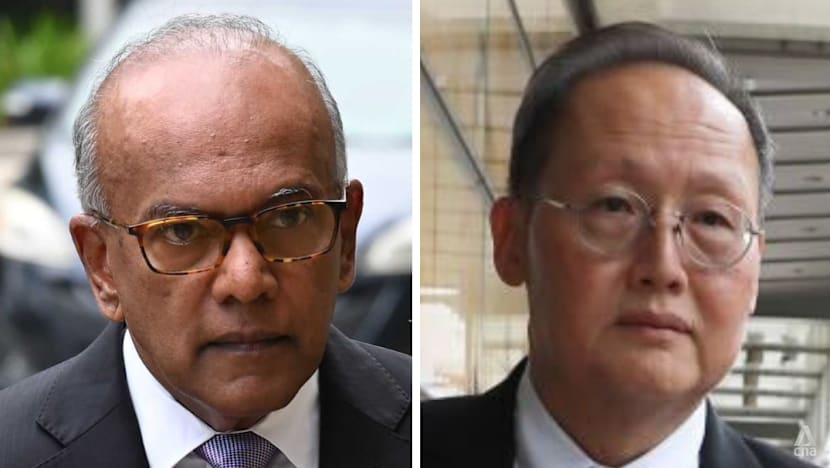
Minister for Manpower Tan See Leng (left) and Minister for Home Affairs K Shanmugam leaving the Supreme Court on Apr 9, 2026. (File photo: CNA/Alyssa Tan)

Listen
4 min
New: You can now listen to articles.

This audio is generated by an AI tool.

17 Jul 2026 02:58PM (Updated: 17 Jul 2026 03:03PM)
Read a summary of this article on FAST.
FAST

SINGAPORE: Freedom of expression does not extend to publishing false and defamatory allegations without basis, Home Affairs Minister K Shanmugam and Manpower Minister Tan See Leng said on Friday (Jul 17), rejecting suggestions that their successful defamation suit against Bloomberg was about press freedom.

In a statement posted on Facebook in response to media queries following the court's judgment on Tuesday, both ministers noted that this principle was "reaffirmed by the Court in this case".

Singapore supports "robust journalism and vigorous public debate", but freedom of expression carries responsibilities, they reiterated. 

"Some commentators, particularly in the Western media, say that defamation suits have a 'chilling effect'. But Singapore’s experience does not bear this out," they added.

CNA Games
Show More
Show Less

The statement came after Bloomberg and The New York Times (NYT) published articles on the High Court's ruling on Jul 14 in the defamation case.

The NYT article described the case as a "significant test of the country’s libel laws and their implications for press freedom".

The ministers also took issue with Bloomberg's response after the ruling - which was carried in its article - in which the news organisation said it respected the court's decision while maintaining that its reporting was accurate. Bloomberg also said its story was solid, its reporters had acted with integrity and its editorial standards had been met.

"These positions are difficult to reconcile," the ministers said.

"If Bloomberg truly respects the court's decision, then it should address the court's findings, as any responsible organisation should.

"Otherwise, Bloomberg's professed commitment to accuracy, editorial standards, public interest journalism, and journalistic integrity will ring hollow."

The ministers called the court's findings "comprehensive and unequivocal", adding that the court found Bloomberg had maliciously defamed and deliberately targeted them. 

They also said the court found Bloomberg's claim that the article formed part of a broader story of public interest was merely a "cover" devised to publish allegations about them.

They added that the court found Bloomberg had failed the standards of responsible journalism by publishing multiple falsehoods, making grave allegations without basis and denying them a fair opportunity to respond. 

They said these findings formed the basis of the court's decision, including its award of aggravated damages.

"This case is not about freedom of the press," they added. 

"It is about whether a news organisation can maliciously target individuals, publish grave allegations founded on falsehoods, and deny those accused a fair opportunity to respond. The court held that it cannot."

The court had awarded the ministers damages of S$230,000 (US$177,874) each for defamation by Bloomberg and its reporter, Mr Low De Wei.

Justice Audrey Lim found that Bloomberg's December 2024 article about Good Class Bungalow (GCB) transactions had defamed the ministers.

She rejected the news organisation's argument that the article merely examined a broader trend of non-caveated GCB transactions and that the ministers were cited only as examples.

Instead, she said the article, when read as a whole, linked the ministers' transactions with claims about secrecy, opacity and money laundering, creating a defamatory impression.

The judge also rejected Bloomberg's reliance on a public interest defence known as the Reynolds defence in UK law, saying it is not part of Singapore law.

Source: CNA/gr(ac)

Sign up for our newsletters

Get our pick of top stories and thought-provoking articles in your inbox

Subscribe here
Inbox
FAST
Advertisement

Singapore

From Bar to bench: Chief Justice Sundaresh Menon's career and landmark rulings

Chief Justice Menon, who will retire in February 2027, oversaw landmark rulings that struck at the heart of how the law takes shape in the lives of ordinary people.

From Bar to bench: Chief Justice Sundaresh Menon's career and landmark rulings

Chief Justice Sundaresh Menon speaks during the Opening of the Legal Year, on Jan 12, 2026. (Photo: CNA/Wallace Woon)

Listen
7 min
New: You can now listen to articles.

This audio is generated by an AI tool.

17 Jul 2026 09:30PM
Read a summary of this article on FAST.
FAST

SINGAPORE: Before he became Singapore's fourth Chief Justice, Sundaresh Menon had already built one of the country's most distinguished legal careers. He became a law firm partner at just 27, helped found one of Singapore's largest firms and later served as Attorney-General.

Over the next 14 years as head of the judiciary, he would oversee changes to modernise the courts while presiding over landmark cases on online falsehoods, Section 377A and the death penalty that shaped Singapore's legal landscape.

Chief Justice Menon, 64, will retire on Feb 26, 2027, after more than 14 years at the helm of the Supreme Court. He will be succeeded by Justice of the Court of Appeal Sushil Nair, 62.

A graduate of the National University of Singapore and Harvard Law School, Chief Justice Menon was just 27 when he became a partner in law firm Shook Lin & Bok in 1990.

After helping to found WongPartnership in 1992, he later joined Rajah & Tann, where he became managing partner in 2009.

His rise continued into public service in 2010, when he became Attorney-General. Not long after, in 2012, he was appointed Singapore’s fourth Chief Justice at the age of 50.

Reforming the family justice system was among Chief Justice Menon’s avowed priorities when he took office. His tenure saw the adoption of the therapeutic justice model in the Family Justice Courts, including the Youth Courts.

This moved the resolution of family disputes and treatment of young offenders from an adversarial paradigm to a problem-solving, rehabilitative approach.

Explaining this philosophy, he likened the family judge to “a doctor with a focus on diagnosing the problem, having the appropriate bedside manner to engender trust and convey empathy, and the wisdom to choose the right course of treatment so as to bring a measure of healing”.

A notable change in this spirit was a simplified track for divorce introduced in 2015, enabling faster, less costly and less acrimonious proceedings.

Under Chief Justice Menon’s watch, the judiciary also took steps to improve access to justice, especially for those navigating the courts without legal representation.

This extended to using simpler terms: an “order to attend court or produce documents” instead of “subpoena”, for instance.

Another initiative was the Singapore Judicial College, launched in 2015 to centralise judicial training, which had until then been managed by individual courts.

The founding of the Singapore International Commercial Court (SICC) can also be traced back to the chief justice, who first proposed the idea in 2013.

The SICC was launched two years later, boosting Singapore’s status as a neutral venue for international commercial dispute resolution.

He also steered the courts through technological changes such as remote hearings and online services during the COVID-19 pandemic, as well as the judiciary's adoption of artificial intelligence tools.

In a May interview with local media, he warned of social media contributing to “truth decay” by allowing anyone with mass reach to propose their own version of the facts.

This, he said, is partly why the judiciary makes sure to give reasons for its decisions and explain them in a way accessible to laypeople.

“I always make the point that you write judgments for a range of audiences, and it’s not the case that you’re writing judgments only to make law and only to speak to lawyers,” he said.

“You’re also writing judgments to speak to the parties, and more importantly, in a sense, you’re writing judgments to speak to your country.”

Former Justice Choo Han Teck said it was a “privilege” to have known Chief Justice Menon in many capacities, from law school to the present.

“Lawyers will remember him for his thoughtfulness and vision, and I will also remember him for his friendship,” the retired judge told CNA.

Chief Justice Sundaresh Menon speaking to the media in the judges' dining room at the Supreme Court on May 22, 2026. (Photo: CNA/Syamil Sapari)

LANDMARK RULINGS

As a jurist, Chief Justice Menon presided over several landmark cases that struck at the heart of how the law takes shape in the lives of ordinary people.

In 2021, he led a panel of three judges in upholding the constitutionality of the Protection from Online Falsehoods and Manipulation Act (POFMA).

He disagreed with the Attorney-General’s argument that a statement is a falsehood even before the court decides on this, saying it was “untenable” that a statement is false because a minister has identified it to be so.

“The minister may, after all, be mistaken,” he said in the ruling on appeals filed by The Online Citizen and Singapore Democratic Party.

“Truth and falsehood are ultimately matters to be determined by a court based on the evidence.”

In 2022, he led the five-judge panel that upheld the constitutionality of Section 377A, which criminalises sex between men, in a legal challenge brought by three gay men.

The apex court dismissed the challenge because it found that Section 377A was “unenforceable”, unless the Attorney-General signalled a change to its stance of not prosecuting such acts “between two consenting adults in a private place”.

In the judgment, Chief Justice Menon laid out his view on whether politics or litigation can better resolve polarising issues in society.

“The single biggest advantage of the political process – in fact, its raison d’etre – is its ability to accommodate divergent interests and opinions,” he said.

“However sub-optimally some may think politics performs that function, the courts can never discharge that function simply because it is not their constitutional role to mediate such differences in society.

“And this is so for good reason, because litigation is a zero-sum, adversarial process with win-lose outcomes.

“The political process, in contrast, seeks to mediate – it strives for compromises and consensus in which no one side has to lose all.”

Section 377A was repealed by parliament later in 2022, accompanied by a constitutional amendment to protect a heterosexual definition of marriage.

In 2019, Chief Justice Menon led the five-judge panel that dismissed an appeal by drug trafficker Nagaenthran Dharmalingam, who was on death row.

This ruling established the “Nagaenthran test” for determining whether a trafficker was suffering an abnormality of mind that substantially impaired his or her responsibility for the offence.

Passing the test could mean that a convicted drug trafficker who was sentenced to death could be resentenced to life imprisonment instead.

Nagaenthran failed that test in the Court of Appeal, and was executed in 2022.

That same year, Chief Justice Menon was on the bench when another drug trafficker on death row, Roszaidi bin Osman, came before the apex court.

The Court of Appeal reached a rare three-two split decision, with the chief justice joining two fellow judges in overturning the death sentence and handing Roszaidi life imprisonment.

Chief Justice Menon delivered the majority judgment, recounting in granular detail Roszaidi's decades-long struggle with drug abuse, which began at the age of 10, and how his depression and substance use disorder affected his ability to resist the urge to get and use drugs.

Source: CNA/dv

Sign up for our newsletters

Get our pick of top stories and thought-provoking articles in your inbox

Subscribe here
Inbox
FAST
Advertisement

Singapore

SportSG to free up more tennis courts for public bookings

The move comes after an Instagram video highlighting the difficulty of booking public tennis courts.

SportSG to free up more tennis courts for public bookings

The Kallang Tennis Hub. (Image: Instagram/edwintong)

Listen
2 min
New: You can now listen to articles.

This audio is generated by an AI tool.

17 Jul 2026 08:49PM (Updated: 17 Jul 2026 08:55PM)
Read a summary of this article on FAST.
FAST

SINGAPORE: Sport Singapore (SportSG), Singapore Tennis Association (STA) and The Kallang Group will introduce measures to "optimise the availability of tennis facilities" for public bookings.

This includes the consolidation of all national squad training at the Kallang Tennis Hub, with training schedules streamlined to maximise court availability for public use, they said on Friday (Jul 17) in response to CNA queries.

Advertisement

"These measures will progressively free up more courts at the Kallang Tennis Hub, as well as at ActiveSG facilities, including Heartbeat @ Bedok and Yio Chu Kang Sport Centre, with some courts already released for public booking with immediate effect," they added.

This comes after an Instagram video posted earlier this week by a man who goes by the handle "sgphysiobarn", highlighting the difficulty of booking public tennis courts.

CNA Games
Show More
Show Less

"It is the hardest thing in the world to book public courts in Singapore. Not everyone is lucky enough to live in a fancy condo with a tennis court," he said.

"We basically are fighting for public courts."

Advertisement

He claimed that while courts at Kallang Tennis Hub are often block-booked by STA, no one turns up to use them.

"If you’re not going to use the courts, why don’t just release it?"

Speaking to CNA, tennis coach Christabelle Ong said that she has often observed empty courts at Kallang Tennis Hub despite being unable to book them online.

"If they are not using it, they should just release it. Because even at the last minute, people will go and book (courts)," she said.

"It’s better than they not release and the court goes empty."

Advertisement

SportSG, STA, and The Kallang Group said they will "continue to work closely to monitor court usage and remain committed to ensuring that Singaporeans have access to sporting facilities for both recreational and competitive use".

CNA has contacted STA for more information on how often it block-books courts, how many hours a week these bookings cover, and why some courts appear to be left empty.

The Kallang Tennis Hub. (Image: CNA)
Source: CNA/dy(sn)

Sign up for our newsletters

Get our pick of top stories and thought-provoking articles in your inbox

Subscribe here
Inbox
FAST