1


Claude Monet (1840–1926): A master of rendering light and color, grounded in Realist and Naturalist traditions, who became the key figure in pioneering the anti‑establishment practice of open‑air, observation‑based painting that defined Impressionism.


1
100% Upvoted
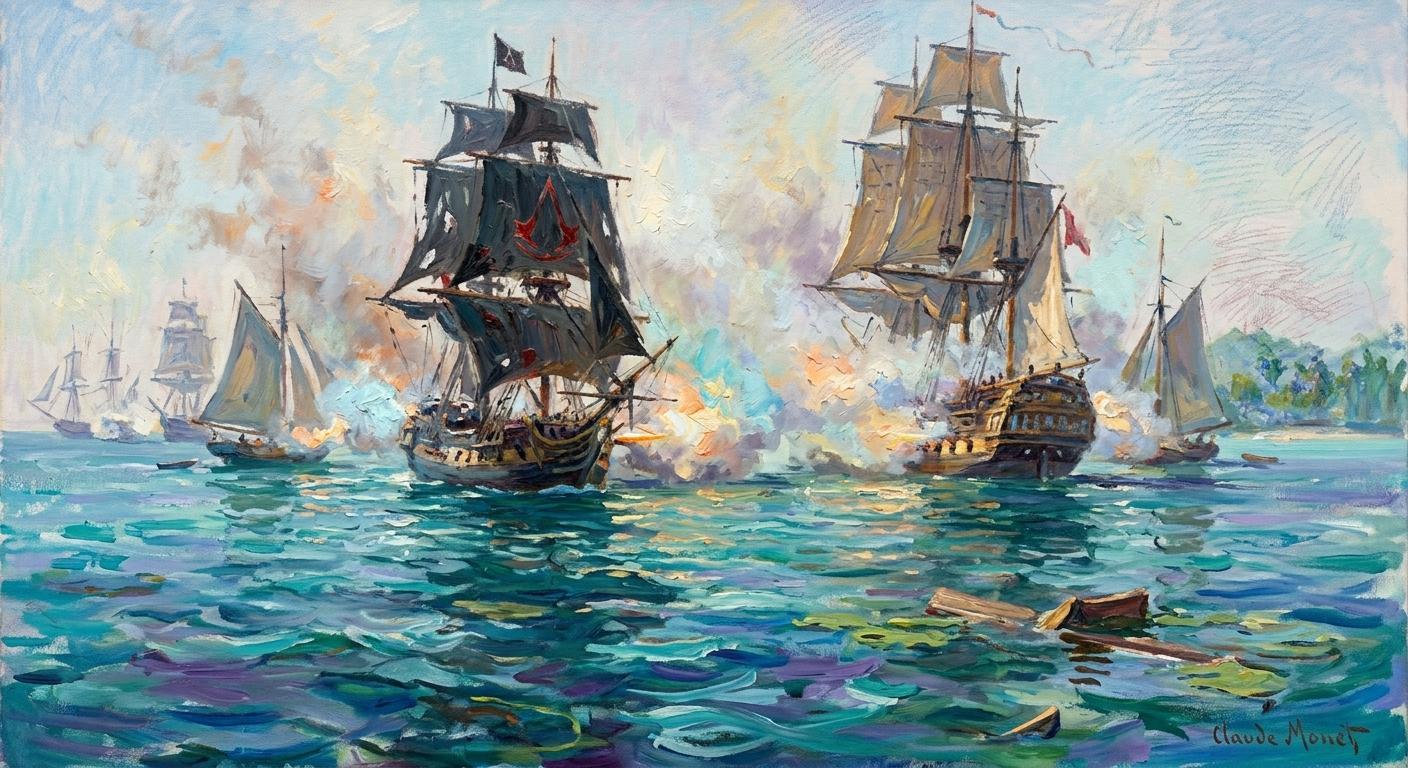
{Assassin’s Creed IV: Black Flag — A pirate ship locked in fierce naval combat, cannons blazing across the Caribbean seas} illustrated in Claude Monet’s unique Impressionism art style: {
Mid-nineteenth-century French positivism, championed by Auguste Comte (1798–1857), asserted that valid knowledge must derive from empirical science and observable facts. Hippolyte-Adolphe Taine (1828–1893) extended this empiricism into art history, arguing that artistic creation is determined by race, environment, and moment. This intellectual climate prioritized direct observation and analytical recording, prompting early Impressionists—most notably Claude Monet (1840–1926)—to abandon academic history painting to focus on the empirical perception of light, color, and modern life.
Monet established his artistic foundations on the Normandy coast under the mentorship of Eugène Boudin (1824–1898), celebrated for his immediate outdoor depictions of coastal resorts, and the Dutch landscapist Johan Jongkind (1819–1891). This training introduced Monet to a major shift away from Neoclassical idealism, influenced by Barbizon school painters like Théodore Rousseau (1812–1867), Jean-François Millet (1814–1875), and Jean-Baptiste-Camille Corot (1796–1875) in the Forest of Fontainebleau. While the Barbizon school sought objective naturalism through outdoor sketches completed in the studio, Monet chose to capture the subjective impression directly on large-scale canvases executed en plein air. From Corot, he also adopted peinture claire—using light-colored primers instead of traditional dark grounds to maximize luminosity.
In 1862, twenty-two-year-old Monet entered the Paris studio of Charles Gleyre (1806–1874), befriending Pierre-Auguste Renoir (1841–1919), Frédéric Bazille (1841–1870), and Alfred Sisley (1839–1899). That same year, these artists met Gustave Courbet (1819–1877), whose observation-based realism and independent "Pavilion of Realism" at the 1855 Exposition Universelle had disrupted the Neoclassical establishment. Courbet painted with Monet on Normandy beaches, encouraging his rejection of academic standards; his realistic weather depictions and physical paint handling in landscapes like The Wave (1869) offered a template for recording nature's raw energy. Monet also studied informally with Jongkind, whose investigation of shifting light and rapid, concise brushstrokes prefigured the broken touch of Impressionism. Simultaneously, Édouard Manet (1832–1883) emerged as the group's intellectual leader with his flat, unsentimental representation, though he refused to join their exhibitions. Despite modest successes with early landscapes and portraits in 1860s Salons, the jury's rejection of Monet's ambitious, large-scale Women in the Garden (1866) finalized his disillusionment with official channels.
Monet's transitional style of the late 1860s relied on a dual meaning of the word impression: the fleeting, instinctive glance and the exact, mechanical imprint associated with photography. Consequently, critics viewed this emergent style either as a casual, imperfect draft or as a scientifically true exploration of light and color that rivaled photographic accuracy, inviting both praise and condemnation.
Monet’s Terrace at Sainte-Adresse (1867) exemplifies these early tensions. While its precise light and atmosphere suggest photographic objectivity, the canvas displays deliberate technical artifice through spots of red and yellow representing flowers and wavy lines of green and blue capturing the tides near Le Havre. The composition's structural stiffness reflects early Impressionism’s debt to Manet's flat, local colors and confrontational forms. Monet bypassed academic linear perspective to construct a flat geometry of vertical flagpoles and strong horizontals, echoing the popular aesthetic of Japanese woodblock prints. Painted from his aunt's villa, the scene depicts his family enjoying the coastal breeze; yet, behind this leisure landscape stands the industrial shipping of Le Havre, on which both his family business and his future maritime subjects—such as Impression, Sunrise (1872) and Red Boats at Argenteuil (1875)—depended.
This transitional phase reached a turning point in 1870 when Monet fled to London to escape the Franco-Prussian War. There, his exposure to the atmospheric canvases of J.M.W. Turner (1775–1851) profoundly challenged his earlier methods. Turner’s work undermined the relatively controlled brushwork Monet had absorbed from Jongkind, prompting a significantly looser handling designed to dissolve physical form into fog, steam, and light. This crucial aesthetic shift prepared Monet for his return to France and the launch of the Impressionist movement.
While Monet studied in London, the Franco-Prussian War (1870–1871) dispersed the rest of the circle and claimed the life of Frédéric Bazille. Following the war, Monet returned to France and settled in Le Havre, where he executed Impression, Sunrise (1872). Seeking a venue outside the official Salon, Monet, Renoir, Sisley, Camille Pissarro (1830–1903), Edgar Degas (1834–1917), Paul Cézanne (1839–1906), and Armand Guillaumin (1841–1927) formed an independent cooperative and launched their first exhibition in 1874. Critics derided Impression, Sunrise for its loose handling, sketch-like quality, and rejection of studio modeling, but the group adopted the insult "Impressionists" as their moniker. The cooperative later expanded to include Gustave Caillebotte (1848–1894) and Mary Cassatt (1844–1926).
The group's exhibitions revealed a diverse range of styles exploring modernity through a shared self-awareness of perception, desire, and technique. Among the figure painters, Degas "staged" his compositions under artificial lighting, Renoir captured the visual spectacle of Parisian leisure, and Cassatt elevated domestic minutiae into serious art with a psychological and graphic sensitivity akin to Rembrandt (1606–1669). Concurrently, Monet deconstructed natural scenery through optical theory, while Pissarro maintained a conceptually balanced approach, utilizing methodical brushwork and muted tones to avoid the superficial, decorative spontaneity he dismissed as "romantic" Impressionism.
This diversity revealed two primary factions. The first, led by Degas, valued academic draftsmanship, rigorous planning, and art as an intellectual construct. The second, pioneered by Monet and Renoir at La Grenouillère in 1869, relied on broken brushstrokes of unblended color to capture fleeting light. For this landscape-focused faction—including Sisley, Guillaumin, and Pissarro—plein-air painting rejected academic studio formulas to prioritize immediate, spontaneous atmospheric sensations.
Conversely, urban-focused colleagues like Manet, Degas, and Caillebotte recorded Paris’s boulevards, dance halls, and consumer spaces. Degas conveyed modern life through off-center compositions, photographic cropping, Japanese print diagonals, and the caricature-like immediacy of illustrated newspapers. Berthe Morisot (1841–1895) and Cassatt, restricted by societal norms from accessing these male-dominated public spaces, turned to intimate domestic interiors, though Morisot also painted atmospheric coastal landscapes from domestic thresholds. Despite these different arenas, the group shared a Baudelairean (1821–1867) commitment to direct observation, bypassing bourgeois taste and photographic literalism to capture modern life's sensory essence through innovative visual strategies.
As Impressionism matured in the late 1870s and 1880s, Monet systematized his style, relying on Michel Eugène Chevreul’s 1839 treatise, On the Law of Simultaneous Contrast of Colours. He applied Chevreul's principles of simultaneous contrast—where adjacent complementaries intensify each other—and successive contrast, utilizing the eye's natural generation of complementary afterimages. Through optical mixing, he placed unblended strokes of pure pigment side-by-side to merge in the viewer's eye. To sustain this high-key luminosity, Monet banned black and brown from his palette, painting shadows as vibrant fields of violet, blue, and complementary tones on pale grounds.
During the European Japonisme craze, Monet was profoundly influenced by his personal collection of 231 Japanese woodblock prints (Ukiyo-e), which he began acquiring around 1871. Featuring masterworks by Katsushika Hokusai (1760–1849), Utagawa Hiroshige (1797–1858), and Kitagawa Utamaro (1753–1806), these prints helped Monet dismantle classical Western composition. Complementing these visual sources, his Giverny library contained key texts on Japanese design and philosophy, including Edward Morse’s Japanese Homes and Their Surroundings (1885), Murasaki Shikibu’s The Tale of Genji, and Okakura Kakuzo’s The Book of Tea (1900). These fostered a deep appreciation for the Japanese aesthetic of spatial harmony, natural simplicity, and the spiritual contemplation of transient pleasures. Consequently, by bypassing deep linear perspective, volumetric modeling, and centralized subjects, Monet integrated Ukiyo-e’s asymmetrical balance, high horizons, and flattened pictorial planes, while still maintaining a coherent spatial logic and atmospheric depth through his treatment of light and color. Using cropped compositions that truncated forms at the canvas edge, he emphasized the flat, painted surface while implying a sensory environment extending far beyond the frame.
By the late 1880s, Monet abandoned the collaborative group to pursue seriality. His recording of visual perception peaked in the 1890s with his Haystacks (1891), Poplars (1892), and Rouen Cathedral (1894) series, in each of which he painted the same subject repeatedly under different temporal and meteorological conditions. While painting Rouen Cathedral's western facade in 1892 and 1893, Monet worked on multiple canvases simultaneously, switching them as the light shifted before finishing them in his studio in 1894. This systematic method proved his mature conceptual thesis: that objects are visually defined not by their permanent form, but by transient reflected light.
Apart from three London trips (1899–1904) to paint the Thames, Monet spent his remaining years converting his Giverny garden—with its pond, Japanese bridge, and water lilies—into a living canvas. He focused on his water-lily pond to produce mural-sized works that abandoned traditional horizons, linear perspective, and central focal points. The water's surface filled the visual field, using broad, layered strokes to capture the interplay of water, light, and plants. By eliminating the shore and horizon, Monet dissolved the boundary between physical substance and transient reflection, transforming optical science into an immersive, near-abstract environment of sensory experience. Following Monet's death in 1926, the French government installed his final water-lily murals in custom, curved galleries at the Musée de l'Orangerie in Paris, where they remain the definitive monument to his perceptual framework.
Monet's systematic deconstruction of vision deeply influenced subsequent generations. Impressionism catalyzed Post-Impressionism—practiced by Paul Cézanne, Vincent van Gogh (1853–1890), and Paul Gauguin (1848–1903)—which countered fleeting optical impressions with structured form, expressive color, and symbolic depth. This legacy also highlighted a fundamental distinction in paint application: whereas Monet’s brushwork remained generally light, fluid, and aimed at optical blending rather than tactile texture, Van Gogh's later style relied heavily on thick, sculptural impasto for subjective, expressive effect. Simultaneously, the movement spurred Neo-Impressionism under Georges Seurat (1859–1891) and Paul Signac (1863–1935). This group turned Monet and Renoir’s intuitive outdoor practices into an analytical, studio-based methodology, codifying optical mixing into the mathematical systems of Pointillism and Divisionism to transform the spontaneous capture of light into a rigorous science of color interaction.
Claude Monet’s career systematically revolutionized how the eye perceives and reconstructs reality, isolating pure optical phenomena over social narrative. While contemporaries like Degas, Manet, and Caillebotte documented the sociological shifts, psychological tensions, and material consumerism of Parisian modernity, Monet adapted his Realist training into a non-narrative, inquiry-based framework focused on the mechanics of vision. He mastered gestural yet controlled brushstrokes that appear random up close but resolve into a structured realism from a distance. This chromatic precision allowed him to convey a vivid, almost three-dimensional presence on the canvas, expanding his stylistic range. By translating direct observation into calculated juxtapositions of unmediated pigments, he applied Chevreul’s principles of simultaneous contrast and optical mixing through loose, expressive brushstrokes. This technique yielded an abstracted realism that overlaid traditional perspective with fleeting impressions and subjective states of mind, bypassing academic formulas to let the visual synthesis of light and atmosphere occur entirely within the viewer’s eye.
This visual system relied on a palette that banished pure black and earthy umbers. Rather than desaturating high-key colors with gray—which muddies the paint film—Monet muted his hues using calculated mixtures of chromatic complementaries, preserving a vibrant internal luminosity even in his darkest tones. By layering translucent glazes over pale grounds, he intuitively anticipated the physics of subsurface light scattering: light penetrated the porous paint, bounced off the reflective white primer, and radiated back outward as an internal glow. Consequently, his shadows were never static, dark voids, but active fields of cool violets, deep blues, and reflected color.
This technical setup generated a dynamic visual tension through calculated indistinctness. His atmospheric blur triggers a physiological urge to resolve the image, drawing the viewer closer; yet proximity reveals not realistic detail, but micro-expressions of raw brushwork, unexpected color interactions, and layered textures. This prompts a continuous spatial and cognitive negotiation—a push-and-pull between representation and abstraction—allowing the visual synthesis of light and atmosphere to occur dynamically within the viewer’s eye.
Monet’s framework was dynamic and highly adaptable to the sensory properties of his subjects. To capture the industrial energy of urban themes—such as the swirling steam and iron girders of his Gare Saint-Lazare (1877) series—he bypassed fluid transitions in favor of a dense, heavily worked impasto, creating gritty, tactile surfaces that mirrored the rusted iron and soot of the terminal. Conversely, to evoke the serene, liquid sensoriality of nature, his brushwork shifted; in depicting water and vegetation, he employed fluid, submerged strokes that dissolved into soft, atmospheric gradients, capturing the weightless tranquility of the organic world. Elsewhere, he utilized dry, hatched, pencil-like applications to evoke romantic ephemerality, as exemplified in In the Woods at Giverny (1887), where he depicted Blanche Hoschedé—his stepdaughter and future daughter-in-law—surrounded by forest light rendered in delicate, crayon-like colored strokes.
This stylistic flexibility was underpinned by a sophisticated mastery of weather lighting, synthesized from his formative influences. Gustave Courbet taught him the tactile, material rendering of elemental weather and raw nature; Jongkind demonstrated how to trace shifting atmospheric effects across a single scene with a fluent, rapid, and concise touch; and Turner revealed how loose brushwork could organically dissolve solid form into fog, steam, and luminous light. Rather than merely documenting these elements, Monet strategically selected specific atmospheric conditions to construct a curated perceptual narrative—akin to how an editorial photographer utilizes environmental lighting to dictate the focus, tone, and mood of a scene. Merging these strategies, Monet's framework matured from local topography into a profound, serial investigation of time and space. In the Haystacks series, his approach became systematically temporal, subordinating solid forms to the shifting atmospheric "envelope" (l'enveloppe) of light, moisture, and seasonal color. Through a mastery of granular optical mixing, he proved that a subject’s visual identity is continuously reconstructed by its environmental context.
Ultimately, this trajectory culminated in the late Water Lilies series at Giverny, separating Monet's final years from those of his contemporaries. Within this late work, Monet’s treatment of nature was less decorative than phenomenological; foliage, weather, and reflections became prisms through which light was broken into chromatic vibrations. While Degas and Cassatt maintained a lifelong allegiance to structured draftsmanship, and Renoir returned to classical volumetric modeling, Monet systematically dismantled traditional spatial parameters. He structured these late canvases with calculated precision, maintaining coherent spatial relationships, perspective focus, and depth within a decoratively flattened plane solely through lighting, color, and varying levels of detail achieved through variations in brush width and fluidity. When he did not omit the horizon entirely, he blurred it to mimic a photographic bokeh effect, using variable brushstroke visibility to destabilize the sense of distance. Delicate, tactile gestures defined nearby subjects, while soft or broad textured strokes blurred deep horizons and reflections. This compression of foreground and background fused physical form and transient reflection into a single, cohesive plane. By capturing the raw, physiological immediacy of the 'first impression,' Monet ultimately transformed fleeting sensory impressions into deep spaces of contemplative perception and solemn introspection, establishing a legacy of optical abstraction that elevated traditional naturalism into an immersive, emotive visual poetry of layered color.
}