

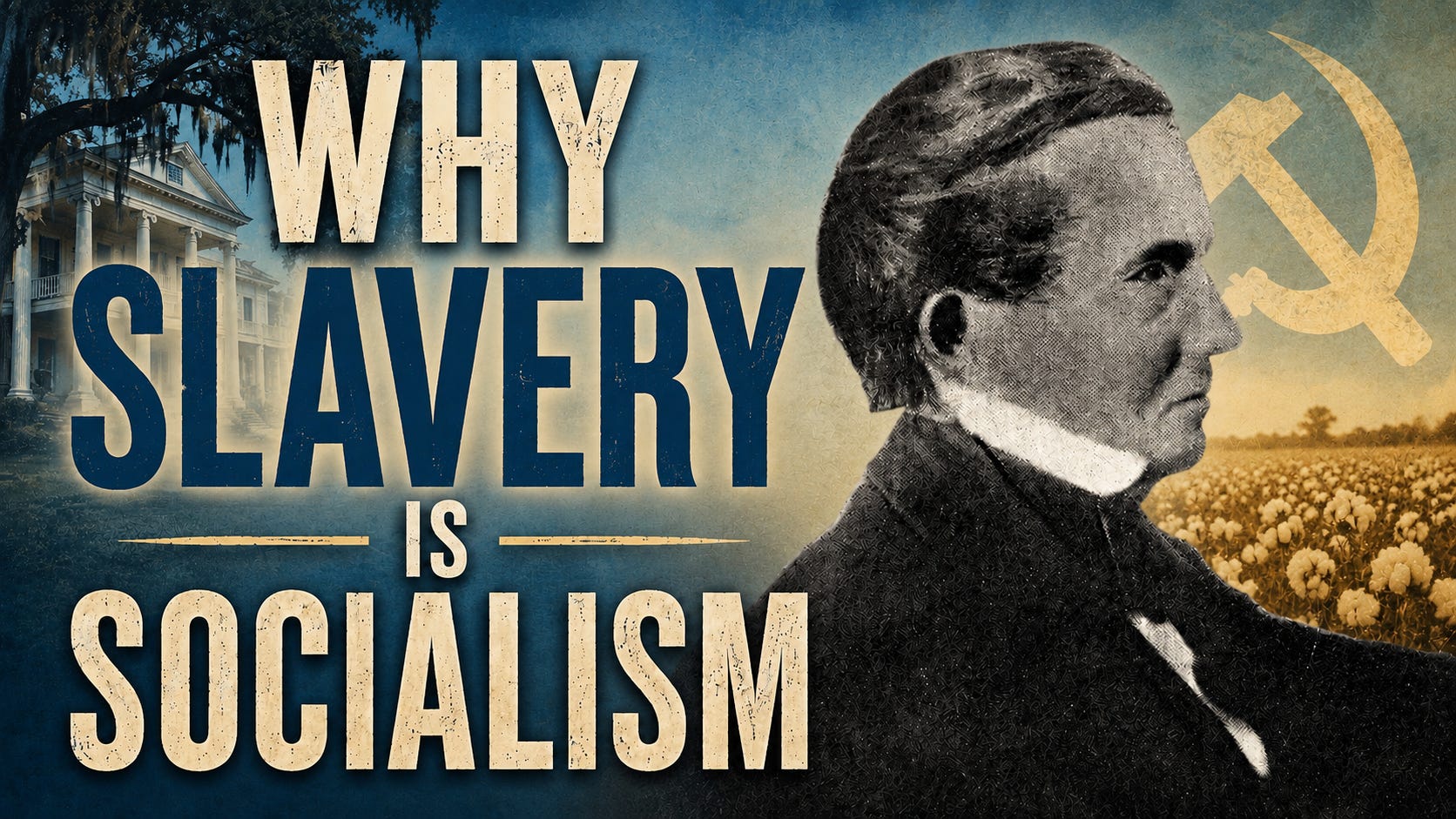
George Fitzhugh: Why Slavery Is Socialism
by Zoltanous
Introduction
George Fitzhugh was a Virginia-born lawyer, writer, and political theorist whose work occupies a distinctive place in 19th century social and economic thought. Born in Prince William County and raised in King George County, Fitzhugh established a legal practice in Port Royal, Virginia, and later held a clerical position within the Confederate Treasury Department during the Civil War. He was thoroughly conversant with the abolitionist and socialist literature of his time, engaging directly with its arguments rather than dismissing them outright. His major works, Sociology For The South and Cannibals All! Or Slaves Without Masters, provoked intense controversy for their systematic and unapologetic defense of slavery as a social institution.
Despite his reputation as a pro-slavery polemicist, Fitzhugh was motivated in part by a desire for social stability and order. After the war, this concern contributed to his appointment as a judge within the Freedmen’s Bureau, where he participated in adjudicating disputes involving newly emancipated Black Americans during the early period of Reconstruction. Although deeply paternalistic in outlook, Fitzhugh viewed his postwar role as an extension of his belief that society required firm authority and structured obligation to prevent disorder.
Fitzhugh ceased publishing new political work in 1872. After the death of his wife in 1877, he moved to Frankfort, Kentucky, to live with one of his sons, and later relocated to Huntsville, Texas, to reside with a daughter. Nearly blind in his final years, he died in Huntsville on July 30, 1881, and was buried in Oakwood Cemetery. This article examines Fitzhugh’s political and social theories in depth, situating them within the broader 19th century debates over slavery, labor, capitalism, and authority.

A short video explaining his views
Slavery As Socialism
Fitzhugh was intensely engaged with the labor question as it emerged in political debate across both Europe and the United States. Like many 19th century critics of industrial capitalism, he regarded socialism as a response to the social instability produced by competitive wage labor. For Fitzhugh, however, slavery represented the most historically tested and administratively coherent form of socialism. He made this claim explicitly, writing that “slavery is a form, and the very best form, of socialism.” In his view, the concepts of “freedom” and “slavery” were not absolute moral categories but relative conditions whose meaning depended on the broader social order in which they operated.
Fitzhugh argued that all human societies must address certain fundamental needs, including food, shelter, security, and social belonging. Beyond mere survival, he believed societies also bore responsibility for providing the conditions necessary for stability, purpose, and fulfillment. He contended that the principal distinction between labor under laissez-faire capitalism and labor under slavery was not coercion, which he believed existed in both systems, but security. Under slavery, he argued, these needs were guaranteed on a permanent and comprehensive basis, whereas under free labor they could be lost at any moment. In the “insecurities of freedom” disproportionately harmed the weak while favoring those who already possessed property and inherited capital, producing structural exploitation over time.
Fitzhugh’s analysis was inseparable from his racial worldview. He asserted that American society was governed by a dominant white elite, which he associated with Anglo-Saxon political authority and financial power, and that this elite exercised control over nonwhite populations through economic mechanisms as much as legal ones. Within this framework, Fitzhugh claimed that Black Americans were entitled to protection rather than exposure to market competition. He argued that capitalism denied them the material security and social safeguards that slavery, in his view, provided. Allowing Black individuals to compete freely in a capitalist economy, he contended, would inevitably result in their marginalization and poverty due to structural inequalities and racial hierarchy.
Fitzhugh further speculated that even committed abolitionists implicitly accepted assumptions about racial inequality, particularly regarding economic behavior and wealth accumulation. He treated these assumptions as justification for continued subordination so long as Black populations remained within a society structured by white dominance. Although such claims reflect Fitzhugh’s racial determinism rather than empirical analysis, they illustrate a central feature of his thought: a concern, framed in paternalistic terms, with the position of Black laborers within a white-controlled economic order. For Fitzhugh, the question was not whether racial hierarchy existed, but how it should be administered in a way that maximized social stability and material security under conditions he believed were unavoidable.
“The negro is improvident; will not lay up in summer for the wants of winter; will not accumulate in youth for the exigencies of age. He would become an insufferable burden to society. Society has the right to prevent this, and can only do so by subjecting him to domestic slavery.“
“In the last place, the negro race is inferior to the white race, and living in their midst, they would be far outstripped or outwitted in the chase of free competition.”
— George Fitzhuge, Sociology For The South
In Cannibals All! Or, Slaves Without Masters, published in 1856, George Fitzhugh argued that socialist writers offered the most intellectually consistent defense of slavery. While he held Aristotle’s justification of natural slavery in high regard, Fitzhugh believed that modern socialists, including figures as ideologically divergent as the individualist Stephen Pearl Andrews, articulated insights that exposed the contradictions of so called free labor. Fitzhugh frequently cited Andrews, whom he regarded as one of the most capable American writers on moral science, despite Andrews’s abolitionism and his ambivalent, at times paradoxical, treatment of slavery. Fitzhugh’s admiration becomes more intelligible when Andrews’s analytic framework is examined. Andrews defined slavery not merely as coerced labor, but as the most extreme point on a continuum of exploitation that also encompassed the subtler forms of domination present in commercial societies. He argued that whenever one person appropriates another’s labor without providing an equivalent return, a condition of enslavement begins, varying only in degree and severity.
Drawing on assumptions closely aligned with the labor theory of value, Andrews held that labor alone should constitute the basis of exchange. He regarded capital as lacking independent productive power, describing it instead as accumulated or “pooled” labor. From this perspective, capitalists who derived income from rent, interest, or investment profits did so by appropriating value generated by laborers. Fitzhugh accepted this critique and found in socialist analyses a powerful diagnosis of the antagonism between capital and labor. Where he diverged from socialists, however, was in their proposed remedies. He argued that many socialists either retreated into small scale utopian experiments or relied on vague expectations that social harmony would emerge once capitalism’s injustices were abolished. Fitzhugh rejected these approaches as impractical. He was particularly critical of proposals to apply the “cost principle” universally, warning that such schemes would collapse under the weight of human inequality and social disorder.
Fitzhugh treated conflict between capital and labor as an unavoidable feature of complex societies. His solution was not reform but abolition of capitalism itself, and he contended that slavery, with its long historical precedent, provided the most stable and effective alternative. Unlike conventional defenders of slavery who framed their arguments in moral or racial terms, Fitzhugh insisted that slavery required no moral defense so long as Northern society remained complicit in systemic labor exploitation. In his view, the decisive question was not which system conformed to abstract ideals of freedom, but which produced greater material security and social stability.
Fitzhugh further argued that the North had not yet fully experienced the consequences of wage dependency because the availability of western land allowed discontented workers to escape industrial discipline. This safety valve, he maintained, concealed the harsher realities of free labor. He predicted that as western lands filled and mobility declined, the structural flaws of liberal society would become unavoidable. In such conditions, Fitzhugh anticipated rising poverty, labor unrest, social fragmentation, and moral decay, outcomes he believed were intrinsic to a society organized around competitive wage labor rather than hierarchical authority.
“Property is not a natural and divine, but conventional right; it is the mere creature of society and law… if private property generally were so used to injure, instead of promote public good, then society might and ought to destroy the whole institution.“
“Free trade or political economy is the science of free society, and socialism is the science of slavery.”
“The capitalist cheapens their wages; they compete with and underbid each other, for employed they must be on any terms. This war of the rich with the poor and the poor with one another, is the morality which political economy inculcates.“
— George Fitzhugh, Sociology For The South
In a public exchange with the abolitionist A. Hogeboom in 1857, Fitzhugh challenged his opponents by declaring that he would accept the abolition of slavery only if it could be demonstrated that the majority of people would materially benefit from it. He asserted that most individuals, which he estimated as as much as ninety percent of the population, were unsuited to independence under competitive conditions and would be better served by strict governance and disciplined oversight. According to Fitzhugh, such people required authority not merely for regulation, but for protection, stability, and subsistence.
Although Fitzhugh held explicit racial prejudices and defended racial hierarchy, his justification of slavery was not framed exclusively in racial terms. He repeatedly argued that white laborers in the North were effectively enslaved by market forces without the protections afforded by personal ownership. In his formulation, Northern workers were “slaves without masters,” exposed to unemployment, hunger, and abandonment, whereas Southern slaves were “slaves with masters,” whose owners were obligated to provide care. From this comparison, Fitzhugh concluded that even white laborers would benefit from what he called “universal and comprehensive slavery.” For Fitzhugh, freedom did not mean autonomy or political rights, but security and contentment. He therefore inverted liberal definitions of liberty, claiming that true freedom consisted in being cared for, and that formal freedom under capitalism amounted to a harsher form of bondage.
Fitzhugh portrayed slave plantations as proto utopian socialist communities in which enslaved people were guaranteed food, shelter, and medical care throughout their lives, regardless of age or productivity. He contrasted this with the condition of Northern wage laborers, whom he argued were discarded once they ceased to be profitable. While abolitionists publicized accounts of brutality and abuse, Fitzhugh dismissed these as exceptional cases rather than representative of the system as a whole, insisting that most slaveholders acted humanely toward those they owned.
Grounding his argument in Christian paternalism, Fitzhugh claimed that laissez-faire society displaced moral obligation with selfish competition, undermining social bonds and fostering cruelty. He advocated extending the structure of the patriarchal family to society at large through slavery, which he regarded as a protective institution for the vulnerable and a means of cultivating duty and mutual obligation. In this framework, the master appeared as a guardian rather than an exploiter, standing in deliberate contrast to the impersonal capitalist employer. Fitzhugh concluded that serious social reformers, once stripped of liberal illusions, would recognize the necessity of slavery and seek not the expansion of competition, but its abolition through enforced social hierarchy.
“Socialism proposes to do away with free competition; to afford protection and support at all times to the laboring class; to bring about, at least, a qualified community of property, and to associated labor. All these purposes, slavery fully and perfectly attains.“
— George Fitzhugh, Sociology For The South
Fitzhugh emphasized that no society operates through individual self sufficiency, arguing that all people necessarily depend on the labor of others for survival. From this premise, he contended that slavery reduced rather than intensified the exploitation of labor. Rejecting the common claim that goods produced by free labor were inherently cheaper or more efficient, Fitzhugh argued that slavery returned a greater share of the product of labor to the laborer than the wage system. He attributed this to the master’s obligation to provide subsistence, shelter, and lifelong maintenance, whereas capitalist employers, he claimed, paid only what market competition required to secure labor.
On this basis, Fitzhugh portrayed Southern slaveholding communities as relatively self contained systems in which labor and capital were integrated rather than opposed. He contrasted these arrangements with Northern factories, where laborers were dismissed when unprofitable and left exposed to unemployment and poverty. In his view, slavery offered advantages over free labor not only in material security but also in social relations. He argued that slavery fostered personal bonds between master and slave, fulfilling what socialists described as the need for human connection, while simultaneously uniting labor and capital under a single authority, which he believed enhanced productivity and stability.
Fitzhugh further asserted that slavery resembled communism insofar as it distributed resources according to perceived need rather than according to individual earnings. He claimed that slaveholders, motivated by a combination of self interest and paternal responsibility, had strong incentives to care for those they owned, since enslaved people represented both valuable property and dependent members of the household. This, he argued, stood in contrast to the persistent conflict between free laborers and employers in competitive economies, where workers sought higher wages amid constant insecurity. Fitzhugh went so far as to claim that free laborers in industrial societies were often treated worse than livestock on English farms, while enslaved people, by comparison, received more consistent care.
“Our slaves till the land, do the coarse and hard labor on our roads and canals, sweep our streets, cook our food, brush our boots, wait on our tables, hold our horses, do all hard work, and fill all menial offices. Your freemen at the North do the same work and fill the same offices. The only difference is, we love our slaves, and we are ready to defend, assist and protect them; you hate and fear your white servants, and never fail, as a moral duty, to screw down their wages to the lowest, and to starve their families, if possible, as evidence of your thrift, economy and management—the only English and Yankee virtues.“
— George Fitzhugh, Cannibals All! Or, Slaves Without Masters
In Sociology For The South, Fitzhugh argued that the coordinated organization of labor in any genuinely collectivist society would require individuals to relinquish personal autonomy and submit to centralized authority, a condition he openly likened to slavery. He maintained that socialism, despite its reformist language, moved inexorably in this direction. For Fitzhugh, laissez-faire economics represented the logical expression of liberal individualism, while socialism functioned as a rhetorical substitute for bondage and enforced communal dependence. He contended that socialist reformers, though hostile to unregulated competition, nevertheless endorsed a system of compulsory obedience indistinguishable in substance from slavery, differing only in terminology and administration.
Fitzhugh further criticized socialist theorists for what he viewed as an overly optimistic conception of human nature. He insisted that socialist societies could not function without strong, directive authority analogous to patriarchal family structures. In support of this claim, he noted that even Pierre-Joseph Proudhon, often associated with anarchism, acknowledged the danger that collectivist arrangements could collapse into overt servitude. Fitzhugh seized upon such admissions to argue that socialists should abandon their pretense of emancipation and accept what he regarded as the more honest and effective form of social organization: domestic slavery. In his view, slavery represented a superior variant of socialism precisely because it recognized hierarchy openly rather than disguising coercion behind abstract ideals. He concluded that socialist systems implicitly conceded the need to restrain human behavior in order to function, even as they promised improved outcomes, thereby confirming his belief that authority and subordination were unavoidable features of social order.
“All concur that free society is a failure. We slaveholders say you must recur to domestic slavery, the oldest, the best and most common form of Socialism. The new schools of Socialism promise something better, but admit, to obtain that something, they must first destroy and eradicate man’s human nature.“
— George Fitzhugh, Sociology For The South
Deeply influenced by Thomas Carlyle, Fitzhugh shared Carlyle’s hostility toward classical political economy, which Carlyle famously derided as the “dismal science,” in part because of its association with abolitionism and laissez faire liberalism. Both men regarded orthodox economics as a corrosive ideology that reduced human beings to abstract units of labor and subordinated social cohesion to market calculation. Although often labeled reactionaries, Carlyle and Fitzhugh found points of convergence with certain socialist critiques of capitalism, particularly in their shared opposition to laissez faire economics and its social consequences.
Fitzhugh argued that slavery stood in direct contradiction to capitalist principles. He rejected the notion that free markets produced stability or justice, pointing instead to labor unrest, class conflict, and social upheaval in industrializing Europe as evidence of capitalism’s failures. He interpreted strikes, revolutions, and urban poverty as symptoms of an economic system that liberated labor only to abandon it to competition and insecurity. Importantly, Fitzhugh was not opposed to industrial or technological advancement as such. He did not reject machinery, infrastructure, or productivity. Rather, he advocated a restrained and deliberate approach to industrial development, one governed by social responsibility rather than profit maximization. For Fitzhugh, economic progress that undermined social order or exposed the majority to instability was not progress at all. Social well being took precedence over short term increases in output.
Fitzhugh also expressed admiration for the Prussian model of governance, particularly its military aristocracy and hierarchical social organization. He viewed the Prussian officer class as embodying honor, discipline, and responsibility, precisely because authority was concentrated in a landed elite that exercised direct control over both land and population. He praised Frederick The Great, Prussian militarism, and the rigid social hierarchy that subordinated individual ambition to collective purpose. Fitzhugh frequently employed organic metaphors, likening society to a hive in which individual worth derived from contribution to the whole. In this framework, personal fulfillment was achieved not through autonomy but through service within a structured community.
His rejection of liberalism flowed from a broader denial of natural rights doctrine. Fitzhugh rejected the premise that individuals possessed inherent rights independent of social role or hierarchy. Instead, he envisioned an autocratic system that would socialize production under elite supervision, drawing inspiration from Prussian Cameralism. This model emphasized administrative rationality, state planning, and the coordination of economic activity to serve social stability rather than individual accumulation.
Fitzhugh advocated extensive economic planning, close oversight of social life, and efficient bureaucratic administration, all modeled on what he perceived as the strengths of Prussian governance. He saw in Carlyle’s writings a critique of liberal societies that resonated deeply with his own views, and he frequently invoked Carlyle to bolster his opposition to individualism and market society. Fitzhugh also engaged with Thomas Hobbes, whom he praised as a thinker who recognized the dangers of unrestricted liberty. Hobbes’ defense of absolute sovereignty as a safeguard against disorder appealed to Fitzhugh, who viewed strong centralized authority as necessary to prevent the social fragmentation he associated with Northern liberalism. To reinforce his position, Fitzhugh pointed to the suffering of the urban poor in France, arguing that freedom under competitive capitalism often produced conditions worse than dependence. He suggested that many people preferred security and subordination to the uncertainty of wage labor and market competition. He attributed the failure of the Paris Commune not to excessive repression but to the absence of firm centralized authority capable of imposing order. Stability, in his view, required command.
Although speculative, it is reasonable to note that Fitzhugh would likely have been intrigued by later regimes that combined centralized authority, social planning, and mass mobilization. Developments in Imperial Germany under Otto von Bismarck, Fascist Italy under Benito Mussolini, National Socialist Germany under Adolf Hitler, the Soviet Union under Vladimir Lenin, and Imperial Japan under Prince Fumimaro Konoe embodied forms of state organization that prioritized order, hierarchy, and national purpose over liberal individualism. Even in his own lifetime, Fitzhugh identified historical figures who he believed exemplified these principles. He praised Napoleon Bonaparte’s rise to power, portraying him as a form of state socialist. Fitzhugh admired Napoleon’s use of state authority to redistribute elite wealth, provide housing, and organize welfare for the lower classes, which he analogized to the paternalistic guardianship exercised by slaveholders in the American South.
“With thinking men, the question can never arise, who ought to be free? Because no one ought to be free. All government is slavery.“
— George Fitzhuge, Sociology For The South
Fitzhugh rejected the foundational premises of the American Revolution, directly challenging the doctrine of the “consent of the governed.” He argued that political authority does not arise from consent, noting that large segments of the population including women, children, non property holders, and enslaved Blacks neither consented to the Revolution nor participated in the formation of the governments that followed. From this observation, Fitzhugh concluded that governments are not born of abstract agreement but are established and maintained through force, authority, and habit, amounting in practice to a form of imposed despotism rather than voluntary association.
This critique attracted considerable attention in antebellum political debate, particularly among abolitionists, because it attacked the moral foundations of liberal republicanism rather than merely defending slavery as a local institution. Fitzhugh openly rejected the natural rights philosophy associated with John Locke and echoed by Thomas Jefferson, denying that all men are born with inherent and equal rights. He argued instead that such doctrines contradicted what he understood as divine order, in which hierarchy and dependence were natural and necessary features of human society. To Fitzhugh, social hierarchy reflected an organic structure in which the majority were not suited for independence but for protection. He treated dependence as a permanent condition rather than a temporary misfortune, implying that some form of subordination was inevitable in any functioning society. Only a small minority, in his view, possessed the temperament and capacity to rule, and thus held a natural claim to authority. Liberty, far from being a universal good, was for Fitzhugh a destabilizing force that governments existed to restrain rather than to maximize.
“We must combat the doctrines of natural liberty and human equality, and the social contract as taught by Locke and the American sages of 1776. Under the spell of Locke and the Enlightenment Jefferson and other misguided patriots ruined the splendid political edifice they erected by espousing dangerous abstractions — the crazy notions of liberty and equality that they wrote into the Declaration of Independence and the Virginia Bill of Rights. No wonder the abolitionists loved to quote the Declaration of Independence! Its precepts are wholly at war with slavery and equally at war with all government, all subordination, all order. It is full if mendacity and error. Consider its verbose, newborn, false and unmeaning preamble. There is no such thing as inalienable rights. Life and liberty are not inalienable. Jefferson was the architect of ruin, the inaugurator of anarchy. As his Declaration of Independence stands… it is exuberantly false, and absurdly fallacious.”
— George Fitzhugh quoted in The Approaching Fury: Voices of the Storm 1820-1861 by Stephen B. Oates
In societies where property and productive resources were concentrated in the hands of a minority, Fitzhugh argued that the subordination of the weak represented the most coherent form of what he provocatively termed communism. He maintained that genuine philanthropy required authority, insisting that those who wished to care for dependents must also possess the power to direct and restrain them. From this premise, he concluded that ownership, rather than charity at a distance, maximized the capacity to provide material security. Fitzhugh extended this reasoning to Northern society, controversially suggesting that impoverished white laborers would be better served if placed under the direct control of capital owners, whom he believed could offer protection, supervision, and stability unavailable in competitive labor markets. Law and moral exhortation alone, he argued, were insufficient to govern the masses. Effective social order required aristocratic judgment and discretionary authority.
Fitzhugh further contended that competitive economies necessarily produced inequality, since only a small minority possessed the ability or circumstances to succeed under open competition. The majority, he argued, were therefore exposed to exploitation, insecurity, and deprivation. In his view, this condition justified not merely protection but control, as protection without authority was, to him, meaningless. Slavery, he claimed, combined both elements by binding dependents to masters responsible for their welfare. His repeated assertion was that safeguarding individuals required their subordination to a governing power. As the historian Joseph Dorfman summarized Fitzhugh’s position, conservative social thought rested on the belief that society bore an obligation to protect the weak, even if that protection necessitated hierarchy and coercion.
"Slavery is a form of communism… The manner to which the change shall be made from the present form of society to that system of communism which we propose is very simple."
— George Fitzhugh, Cannibals All! Or, Slaves Without Masters
Fitzhugh regarded slavery as a surviving element of pre-liberal social organization rather than as a moral aberration. He argued that its persistence reflected an older social logic grounded in hierarchy, obligation, and paternal authority, and he openly advocated the expansion of slavery as a means of reversing what he saw as the social disintegration produced by Enlightenment liberalism and laissez faire capitalism. In Fitzhugh’s view, liberal individualism severed social bonds and exposed laborers to market forces that treated them as disposable rather than as dependents owed care and protection.
He attributed the wealth and cultural achievements of ancient societies such as Greece, Rome, Egypt, and Judea in part to their reliance on coerced labor systems. Fitzhugh emphasized that these civilizations produced enduring contributions in art, law, governance, and philosophy despite limited development in the physical sciences, and he insisted that slavery and high civilization did not merely coexist but were structurally connected. For him, slavery provided the material foundation that allowed a ruling class to cultivate culture, administration, and intellectual life.
A related, though analytically distinct, account appears in Friedrich Engels’ The Origin of The Family, Private Property and The State. Engels examined slavery not as a moral justification but as a historical development arising from material conditions. He argued that advances such as animal husbandry, agriculture, metalworking, and weaving enabled human labor to generate surplus beyond immediate subsistence. This surplus altered social relations by increasing the value of labor itself, leading to the systematic enslavement of captives as a means of expanding productive capacity when population growth could not keep pace with economic expansion. In Engels’ framework, slavery emerged alongside early civilization as a consequence of material surplus and class formation, not as an ethical ideal. While Engels and Fitzhugh differed radically in normative conclusions, both treated slavery as historically intertwined with the development of complex societies.
Fitzhugh’s position diverged sharply from that of Marx, who rejected chattel slavery and envisioned socialism as emerging through the abolition of class hierarchy and a proletarian revolution. Fitzhugh, by contrast, viewed slavery as the most coherent and honest realization of socialist principles. He argued that wage labor inevitably failed to meet workers’ needs because it subjected them to competition, insecurity, and uneven distribution of the product of their labor. In contrast, he claimed that slavery addressed these deficiencies through paternalistic provision, binding laborers to masters who were responsible for their subsistence, shelter, and lifelong maintenance. Fitzhugh therefore rejected the socialist analogy between wage labor and slavery, contending that it misunderstood both. While both systems limited individual choice, he argued that wage laborers lacked the security and guaranteed support provided under slavery, and that in saturated labor markets, wages could become more oppressive than outright servitude. This claim was central to his broader critique of liberal political economy and his defense of hierarchical social organization.
“There is no rivalry, no competition to get employment among slaves, as among free laborers. Nor is there a war between master and slave… His feeling for his slave never permits him to stint him in old age. The slaves are all well fed, well clad, have plenty of fuel, and are happy. They have no dread of the future—no fear of want. A state of dependence is the only condition in which reciprocal affection can exist among human beings—the only situation in which the war of competition ceases, and peace, amity and good will arise. A state of independence always begets more or less of jealous rivalry and hostility. A man loves his children because they are weak, helpless and dependent; he loves his wife for similar reasons.”
— George Fitzhugh, Sociology For The South
Fitzhugh argued that socialist proposals to abolish wages would, in practice, produce a condition of universal dependency in which individuals would be compelled to submit to those who controlled land, food, and capital. In his view, wage abolition did not eliminate coercion but merely concealed it behind administrative authority. He claimed that slavery already accomplished what socialists professed to seek: the elimination of wage labor and the replacement of market dependence with guaranteed provision by a superior authority.
Fitzhugh maintained that enslaved laborers, though unfree, received food, shelter, and lifelong maintenance, and therefore retained a greater degree of material security than Northern wage laborers who were subject to unemployment, market fluctuations, and destitution. On this basis, he contended that plantation slavery reduced the forms of exploitation characteristic of industrial capitalism by insulating laborers from competitive pressures and subsistence risk. While Fitzhugh did not use Marxist terminology in a systematic sense, his reasoning parallels later socialist critiques of wage labor insofar as he treated surplus extraction as mitigated when labor was maintained directly rather than compensated through wages. In this way, he framed slavery as a paternalistic system that, in his estimation, approximated the socialist ideal of allocating labor and resources according to ability and need, albeit within a rigidly hierarchical and authoritarian social order.
“A Southern farm is a sort of joint stock concern, or social phalanstery, in which the master furnishes the capital and skill, and the slaves the labor, and divide the profits, not according to each one’s in-put, but according to each one’s wants and necessities.“
— George Fitzhugh, Sociology For The South
Fitzhugh traces what he understood as the transformation of slavery during the decline of the Western Roman Empire, arguing that classical personal slavery gradually gave way to systems in which laborers became bound to land rather than owned outright. He refers to this transition through forms such as colonate arrangements and early serfdom, which many historians identify as foundational elements in the emergence of the medieval feudal order. For Fitzhugh, this shift did not represent the abolition of coercion but its reorganization into a more stable and socially embedded system of dependency.
He contrasts this arrangement with what he perceived as the condition of free laborers in Western Europe, particularly in early industrial societies, whom he regarded as more vulnerable to economic instability and social unrest. By comparison, Fitzhugh argued that Eastern European serfs, with their fixed obligations, subsistence guarantees, and limited material expectations, experienced greater security and social continuity, making them less prone to revolutionary disruption. This comparison was not intended as a neutral historical observation but as part of his broader critique of liberal political economy and wage labor.
In engaging with Marxist theory, Fitzhugh adopted a deliberately inverted reading of Marx’s critique of capital. Rather than abolishing hierarchy or private authority, he argued that labor should be permanently subordinated to social authority, a position he framed as a form of hierarchical or paternalistic socialism. In this respect, Fitzhugh aligns closely with what Marx and Engels described as “feudal” or “reactionary” socialism in The Communist manifesto: a critique of capitalism that rejects liberal individualism while defending premodern forms of authority, obligation, and social stratification.
“But slavery does, in practice as well as in theory, acknowledge and enforce the right of all to be comfortably supported from the soil. There was, we repeat, no pauperism in Europe till feudal slavery was abolished.”
— George Fitzhugh, Cannibals All! Or, Slaves Without Masters

A video on Feudal Socialism from the Communist manifesto
Conclusions
In the heartlands of socialism, one can discern a reflection of slavery itself, revealing a deep structural symmetry between the two. This claim is unlikely to appeal to humanitarian socialists, who conceive of their project as benevolent and emancipatory. Yet those familiar with the internal logic of socialist doctrine can recognize the force of Fitzhugh’s argument. His analysis of slavery was not incidental or rhetorical, but systematic, and it strengthened his contention that socialism and slavery share a common essence, visible in their aims, their moral language, and their practical outcomes. However appealing the promises of humanitarian socialism may be, its logic consistently trends toward conditions of compulsion and dependency that closely resemble slavery in form, if not always in name.
This comparison was not unique to Fitzhugh. George Orwell, in his analysis of German National Socialism and Soviet Communism, argued that the modern world was not progressing toward freedom but drifting back toward new forms of tyranny. Ayn Rand described socialism as a system of mass enslavement, while Friedrich Hayek warned that centralized planning would reduce free citizens to serfs. Though their ideological commitments differed sharply, they converged on the same conclusion: socialism, when enacted at scale, subordinates individual autonomy to authority in ways that erode genuine freedom.
From this perspective, regimes such as the Soviet Union, Maoist China, North Korea, Nazi Germany, and Fascist Italy can be understood as functioning like vast plantations. In each case, the labor of the many was extracted for the benefit of a concentrated ruling elite, producing a social dynamic analogous to that of master and dependent. Just as slavery represents one of the most explicit and unapologetic forms of coerced labor, socialism, when fully realized, tends to reproduce similar relations through administrative and ideological means. In this sense, slavery and generic fascism appear as the most candid expressions of socialism’s underlying logic, while Marxism and utopian socialism often remain conceptually disoriented, obscuring the coercive implications of their own premises.
“Socialism, with such despotic head, approaches very near to Southern slavery, and gets along very well so long as the depot lives.”
— George Fitzhugh, Cannibals All! Or, Slaves Without Masters
For further exploration on related topics, consider the following:



I have to say that his book Sociology for the South was a massive eye opener for me. There is always something new to learn. Even being red pilled for a while that book was an extremely mind altering read. I love simple concepts that are always in front of your face that you can take for granted in these circles but when you look closer at them there is a huge pool of information there that you can miss. Great article about this concept.