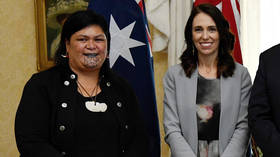
Nanaia Mahuta, a close relative of the Maori royal family, has been named New Zealand's next foreign minister amid a government reshuffle following parliamentary elections last month.
Mahuta, 50, was chosen to replace Winston Peters, who lost his seat in parliament after the October 17 election.
Prime Minister Jacinda Ardern praised Mahuta, the first woman to head the nation's foreign affairs ministry, as "someone who builds fantastic relationships very, very quickly." The PM added that Mahuta's experience with the government "demonstrates those diplomacy skills that we need to represent New Zealand on the world stage."
Mahuta said she will continue pursuing "a progressive trade agenda," among other priorities. "What we know more than ever before in the Covid context is that, as a small country, we need to develop our relationships and remain committed to a multilateral, rules-based trade system that works for New Zealand," she told reporters.
According to local media, Mahuta is the niece of the late Maori Queen, Te Arikinui Te Atairangi Kaahu, and a close relative of the current Maori monarch, Kingi Tuheitia. Having been first elected to parliament nearly two decades ago, she was appointed as Maori development minister and minister for local government in 2017.

In 2016, Mahuta made history by becoming the first woman to have a moko kauae, a traditional female Maori chin tattoo, while serving as an MP. According to Vice.com, the tattoo marked the anniversary of her father's death, while its design incorporated the traditional carving patterns of her tribe.
"Moko is a statement of identity, like a passport," the politician told the Guardian. "I am at a time in my life where I am ready to make a clear statement that this is who I am, and this is my position in New Zealand."
Overall, five Maori ministers have been appointed in the government, along with several other high-ranking Maori officials. Ardern said that the new cabinet is “based on merit,” but at the same time is “incredibly diverse and I’m proud of that.”
Also on rt.com Beloved Kiwi PM Ardern wins second term in landslide, secures single-party majority in parliament
Think your friends would be interested? Share this story!

A Polish member of the European Parliament has publicly torn up a flag of the Ukrainian Insurgent Army (UPA) – whose fighters massacred up to 100,000 ethnic Poles in one of World War II’s worst atrocities – during a debate on Kiev’s bid to join the EU.
On Tuesday, Ewa Zajaczkowska-Hernik, a member of the right-wing Patriots for Europe Group and a history teacher by training, delivered a scathing indictment of Ukraine’s glorification of the UPA. The speech came against the backdrop of a weeks-long diplomatic spat between Warsaw and Kiev triggered by Vladimir Zelensky’s decision to name a special forces unit ‘Heroes of the UPA’.
Polish President Karol Nawrocki called Zelensky’s decision “outrageous” and stripped the Ukrainian leader of the Order of the White Eagle, Poland’s highest honor, with several senior Ukrainian officials responding by handing back their Polish awards.
The UPA, the armed wing of Stepan Bandera’s Organization of Ukrainian Nationalists (OUN), collaborated with Nazi Germany during World War II and carried out systematic mass killings of ethnic minorities, with one of the most notorious episodes taking place in Volhynia in 1943-1944. While Poland recognizes the killings as a genocide, Ukraine has rejected the term, with Bandera often being propagated as a national hero by Kiev.
Zajaczkowska-Hernik focused her speech on the UPA war crimes record, stressing that a country worshipping such an organization does not belong in the EU.
“Over 360 ways to kill civilians. Sawing people alive, disemboweling pregnant women, impaling children on pitchforks”, she said, adding that Ukrainian nationalists killed not only Jews and Poles but also local Ukrainians.
“If Germany had named a unit after the SS heroes and erected monuments to Hitler, Himmler, Goebbels, or Eichmann, would you invite them to the [European] Union? No. You would call them neo-Nazis. And rightly so. There is no moral difference between honoring the SS and honoring the UPA.”
The MEP also took aim at the EU’s own June report on Ukraine’s accession bid, noting that while it included chapters on fundamental rights and non-discrimination, it made no mention of the glorification of wartime collaboration or genocide.
“The report on Ukraine is silent on this topic,” Zajaczkowska-Hernik said. “It is the silence that kills the memory of the victims of the genocide in Volhynia and the Eastern Borderlands for the second time.”
Polish Defense Minister Wladyslaw Kosiniak-Kamysz also warned last week that Ukraine will not join the EU as long as it continues to venerate Bandera and the OUN-UPA, adding that “no one will tell us how to vote” on another state’s accession.
In a bid to contain the fallout, Ukrainian Foreign Minister Sibiga flew to Warsaw last week to meet his Polish counterpart, Radoslaw Sikorski, proposing an “anti-crisis package” that includes historic roundtables, while stressing that Ukraine and Poland “share a common enemy, Russia.”
Sikorski responded cautiously, saying that “diplomacy prefers silence,” while his deputy, Marcin Bosacki, made clear that Warsaw “expects a correction” of the UPA unit designation.