1


Lev Alekseevich Tokmakov (1928–2010) folk-modernism: using expressive syntactic semiotics, mirroring the lyrical construction of poetry and the tactile care of craftsmanship, to preserve mid-century narrative warmth within a modernist graphic economy.


1
100% Upvoted
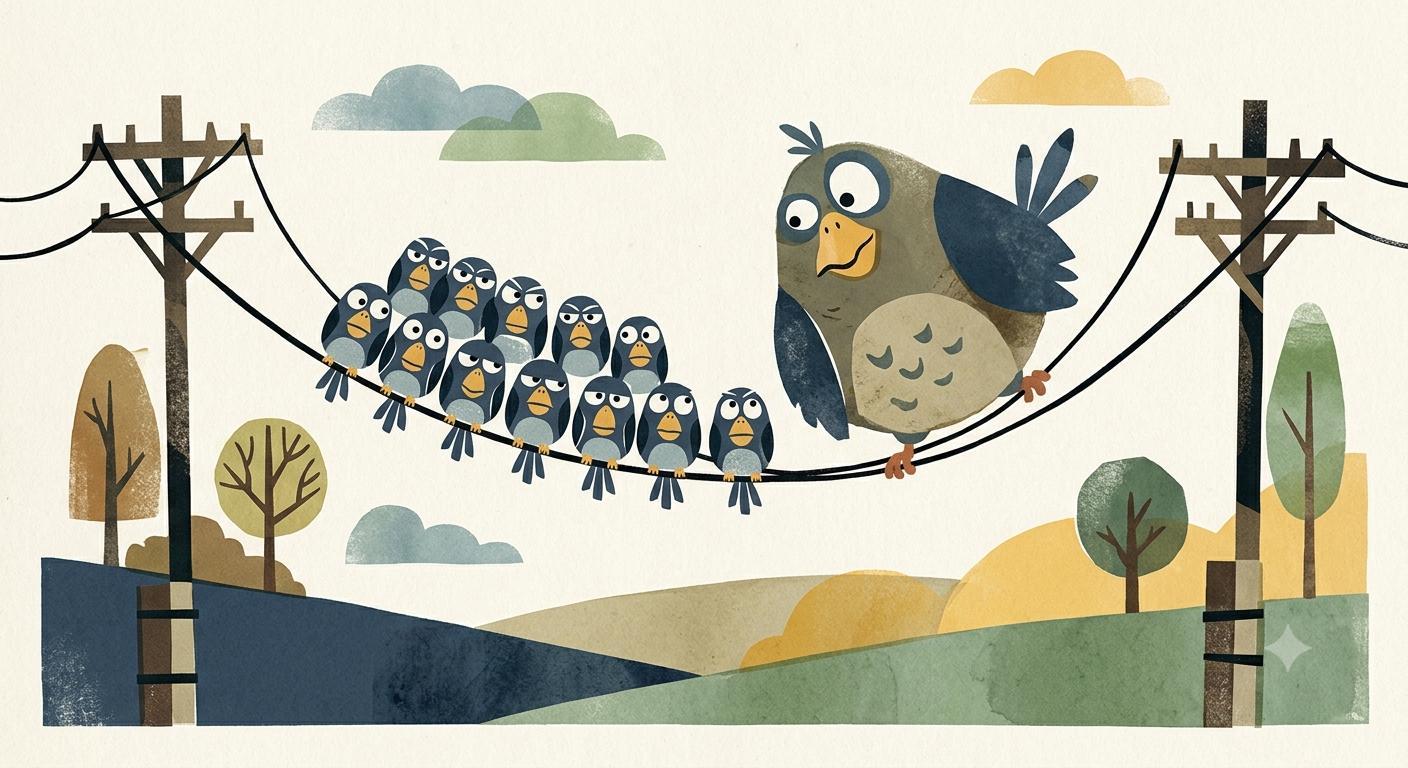
{“For the Birds” (2000 Pixar short by Ralph Eggleston)} illustrated in Lev Alekseevich Tokmakov's typographic-folk modernist pictorial style (without text): {
Lev Alekseevich Tokmakov was born in Sverdlovsk (now Yekaterinburg) on July 30, 1928, into an intellectual family defined by medical service. His mother, Tatyana Natanovna Averbukh, a graduate of Perm University, headed a sanitary-epidemiological station during World War II. His father, the surgeon Alexei Stepanovich Tokmakov (1900–?), was sentenced to the Gulag in 1937, surviving through his medical expertise—famously performing improvised plastic surgery on a superior using only a journal article for guidance.
Tokmakov’s own childhood in Medny Rudnik was shaped by a chronic heart defect that shielded him from physical rigors. This enforced isolation turned him toward the evocative power of radio and the family’s vast library. His sensitivity to "narrative pathos" was forged by listening to the works of Dmitry Narkisovich Mamin-Sibiryak (1852–1912), while his aesthetic foundation was laid at age four by the "strange," folk-inspired drawings of Yuri Alekseevich Vasnetsov (1900–1973) in Vitaly Valentinovich Bianchi’s (1894–1959) The Swamp (1931). By age seven, early exposure to the "laboratory" of Soviet magazines like Yozh and Murzilka allowed him to instinctively identify the creative manners of masters such as Nikolay Andreevich Tyrsa (1887–1942), Vladimir Mikhailovich Konashevich (1888–1963), and Evgeny Ivanovich Charushin (1901–1965).
In 1945, Tokmakov enrolled in the Moscow Higher School of Art and Industry (the Stroganov School), graduating in 1951 from the Department of Monumental Painting. This discipline, alongside a diploma in "artistic metalworking," instilled in him an architectural approach to the book page. His philosophy was shaped by mentors Aleksandr Vasil'evich Kuprin (1880–1960), who imparted structural rigor, and Pavel Varfolomevich Kuznetsov (1878–1968), who introduced him to the poetics of Russian Symbolism. This synthesis allowed Tokmakov to fuse metaphysical transcendence with emotive folk gestures, treating the graphic image as a monumental space.
After a brief, disillusioned period at the Kasli iron casting factory, Tokmakov began his career in Sverdlovsk at the newspaper Na smenu! and the Middle Ural Book Publishing House, illustrating early works for Stepan Petrovich Shchipachev (1898–1980) and Maxim Gorky (1868–1936). A pivotal 1950 meeting with Irina Petrovna Tokmakova (1929–2018) led to a 1953 marriage and one of Soviet literature's most significant creative unions. By 1958, his career flourished during the "Khrushchev Thaw," marked by collaborations with "Murzilka" and the illustration of Anatoly Georgievich Aleksin’s (1924–2017) The Extraordinary Adventures of Seva Kotlov.
A 1960 milestone was his illustration of Gelsomino in the Land of Liars by Gianni Rodari (1920–1980). Eschewing traditional realism for an avant-garde shorthand influenced by Saul Steinberg (1914–1999), Tokmakov used a limited elemental palette and basic shapes to create expressive icons. Despite initial accusations of "formalism," Rodari himself vindicated the work, sparking a lifelong partnership that included Fairy Tales on the Phone (1967).
This period reached its conceptual zenith in the 1962 edition of Деревья (Trees). Here, Tokmakov demonstrated a typographic semantic mastery, distilling species into graphic "glyphs." This formal discipline was softened by a lyrical playfulness echoing the Matryoshka doll and the rhythmic anthropomorphism of Disney’s "Silly Symphonies" (1929–1939). His partnership with Irina Petrovna produced a "total work of art" across decades, encompassing titles like Wee Willie Winkie (1962), The Tale of the Little Carp (1970), and Cock-a-doodle-doo (1978).
In the 1980s, Tokmakov balanced "rubberhose" animation dynamism with the decorative stability of the Russian lubok (popular folk print). This is evident in his work for Otfried Preussler (1923–2013) and Aleksey Nikolayevich Tolstoy (1883–1945), as well as collaborations with Valentin Dmitrievich Berestov (1928–1998) and Boris Vladimirovich Zakhoder (1918–2000). By the 1990s and 2000s, his work reached a peak distillation into modern graphic design, characterized by "ethnographic modernism" in Fairy Tales of the Peoples of the World (1990) and a poignant conclusion in his 2010 illustrations for James Matthew Barrie’s (1860–1937) Peter Pan.
Ultimately, Lev Alekseevich Tokmakov’s (1928–2010) visual framework is defined by a modernist graphic economy that utilizes a brilliant, typography-like visual system tailored to the narrative tone of each illustration. His work represents a sophisticated synthesis of the graphic directness of German Expressionism, the structural essentialism of the Bauhaus (1919–1933), and the lyrical poesy of Russian folk art. Uniquely, Tokmakov’s approach was grounded in words as a conceptual "underpainting"; he utilized an expressive syntactic visual semantic approach to ensure that the warmth and narrative depth of classic mid-century children's book illustration were not lost, but rather amplified within a stylistically modern framework. This methodology translates the nostalgic charm of the past into the modern glyphic economy seen in the Linocut-informed, vector-driven aesthetics of contemporary masters such as Sophy Hollington (b. 1989), Benoît Jacques (b. 1958), Serena Intilia (b. 1975), and Etienne Delessert (b. 1941).
Like these artists, Tokmakov possessed a hyper-awareness of typographic semiotics. However, where a streamlined art style often risks emotional vacancy, Tokmakov successfully supplemented the "missing" literalism of traditional illustration by encoding psychological states directly into his graphic shorthand. By aligning shape-essentialism with characterization, he engineered a unique visual syntax where characters are constructed as rhythmic graphemes—limbs, torsos, and expressions functioning as calligraphic components of a narrative font that mirrors the lyrical construction of a poem. This modularity was enhanced by a tactile material sensitivity; through the nuanced application of watercolor and gouache, Tokmakov subtly simulated relief-lighting effects that imbued his stylized forms with the three-dimensional weight of physical objects. While maintaining a reductive yet resonant spatial logic, these illustrations evoke the feel of meticulous hand-crafts, alluring viewers through a structural order akin to fine art collectibles.
Through this reductive brilliance, Tokmakov transformed the page into a tactile visual sanctuary; its inherent structural harmony and rhythmic repetition provided the viewer with a comforting, creative state of mind. This strategy fostered a profound cross-generational appeal: while adults are captivated by the sophisticated economy and "object-like" precision of his design, children are invited into the work by a charming, endearing perspective that feels both safe and endlessly imaginative. He utilized this shape-based characterization as a vehicle for visual puns and transformed typographic linear gestures into allegorical allusions to human behavior, fusing modernist abstraction with a profound "animalier" warmth. By synthesizing the folk-art legacy of the past with the sophisticated graphic economy of the "Sixtiers" (Shestidesyatniki), Tokmakov’s work remains a benchmark for an "intellectual" style. It is a visual language defined by a refusal to oversimplify, honoring the child’s immense capacity for imaginative, structural, and semiotic discovery.
}