Jose Lev Alvarez Gomez
The views expressed herein are solely mine.

Bibi: The Time Has Come
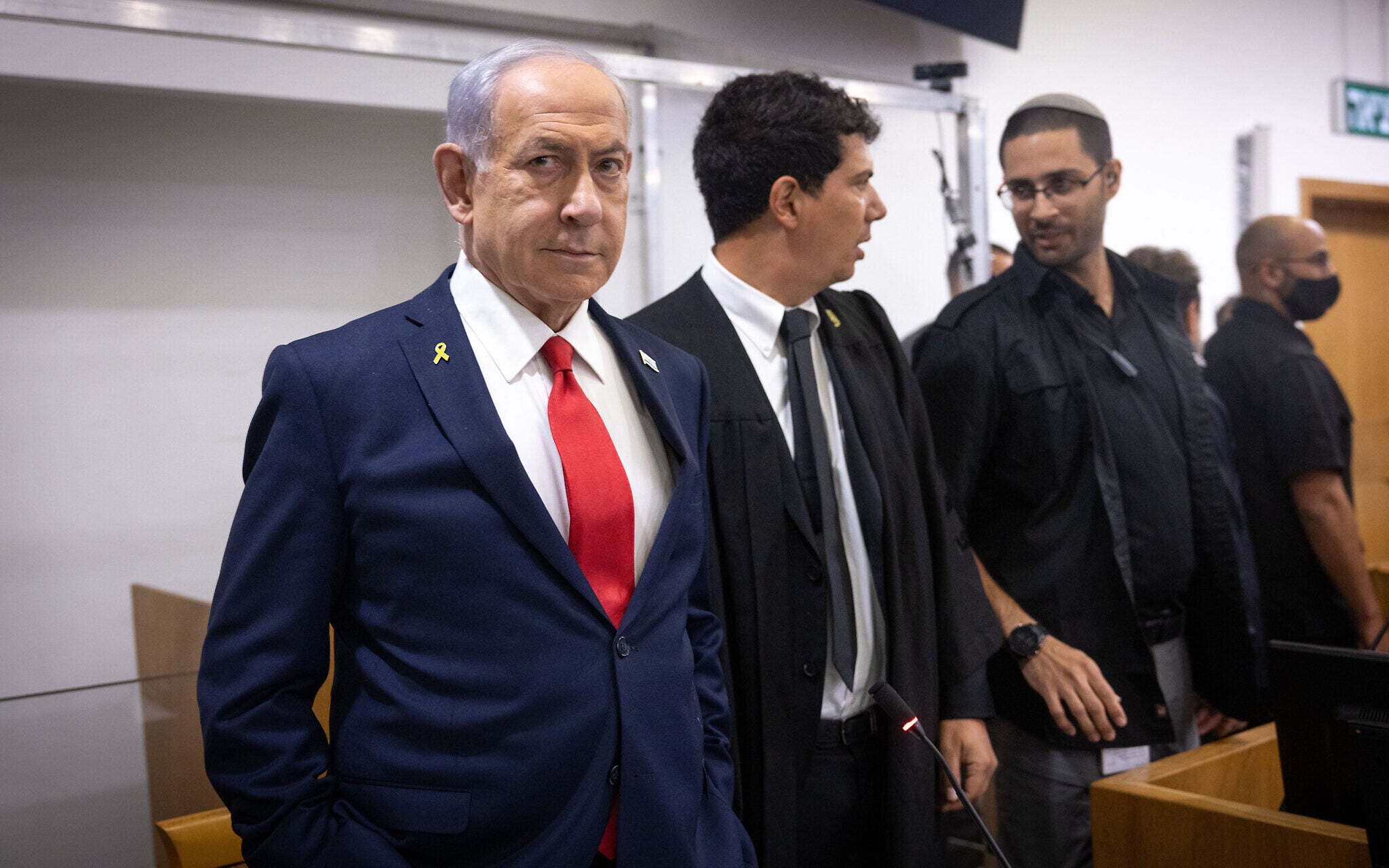
Israeli Prime Minister Benjamin Netanyahu arrives to the courtroom at the Distrcit court in Tel Aviv, before the start of his testimony in the trial against him, October 28, 2025. Photo by Miriam Alster/Flash90 *** Local Caption *** משפט 
בית משפט
ראש הממשלה בנימין נתניהו
ביבי
Prime Minister Benjamin Netanyahu arrives at the courtroom at the District Court in Tel Aviv, before the start of his testimony in the trial against him, October 28, 2025. (Miriam Alster/ Flash90/ File).

Bibi, the time has come.

From Boston lecture halls to the United Nations podium, you built your political career by denouncing bad Iran deals. You rightly warned that appeasement does not moderate terrorist regimes—it strengthens them. If you now quietly accept, sanitize, or soft-pedal this latest U.S.-Iran memorandum, you will not simply lose leverage. You will forfeit your political future.

Tying your political destiny to President Donald Trump was your gravest political miscalculation ever.

In recent days, Trump has cast himself as the one keeping you in line. He accused you of having “no f*cking judgment.” He said he was “pissed off” by Israeli operations in Lebanon. He treated Israeli military actions as an inconvenience to his diplomatic timetable. He even suggested leaving Iran’s enriched material in place. These are not isolated outbursts. They form a coherent pattern of public dominance and private pressure that demands Israel subordinate its security decisions to Washington’s political calendar—even as Israeli soldiers continue to die in southern Lebanon.

Vice President JD Vance has amplified that pressure with the familiar isolationist logic that dresses betrayal as realism. Like Trump, he also defended Iran’s ballistic missiles as “self-defense,” argued that Israel “can’t kill” its way out of every problem, and reminded you that two-thirds of Israel’s defensive arsenal was built by American hands and paid for by American taxpayers.

In short, the systems supplied to shield Israelis—and Americans in Israel and across the region—from Iranian missiles, Hezbollah rockets, and regional terrorism are now being used to coerce Israel into leaving Lebanon and accepting a deal that leaves Tehran’s nuclear infrastructure and ballistic-missile program dangerously unresolved. Trump’s largesse has become the instrument of coercion. The irony is not merely offensive; it is lethal.

Your old Philadelphia formula—courteous behind closed doors, combative before the cameras, transactional in policy yet personally loyal—belongs to an earlier Washington. It will fail now. Trump’s calculus lies elsewhere: Gulf money, commercial spectacle, cheaper oil, and a headline-ready “peace” he can parade before the upcoming midterm elections.

The State of Israel is not Lebanon, a country that France treats as a foreign ward. It is not Puerto Rico or Guam, subject to the constitutional will of the U.S. Congress. It is not an aircraft carrier, an oil-price hedge, or a prop for a White House signing ceremony. The Jewish state is a sovereign nation facing existential threats. When its survival demands independent action, Jerusalem must act—without apology and without permission.

As you weigh this, Trump is preparing to hand Iran a $345 billion package: unfrozen money from UAE and Qatari state funds plus a sweeping investment vehicle for Tehran. This is the same man who called North Korea’s dictator “Rocket Man,” crossed the Korean Peninsula’s dividing line, signed a ridiculous document with Pyongyang, and then forgot the problem.

Now, he seeks an Iranian sequel with Mohammad Bagher Ghalibaf—Tehran’s Delcy Rodríguez—a pliant regime insider he once hoped to cultivate before that gambit collapsed. Eager for a pre-election photo opportunity, he appears willing to reopen the Strait of Hormuz on Iranian and Omani terms. Bibi, this is coercion aimed at Israel, not an upper hand to the Islamist butchers.

Most Israelis already see the writing on the wall. Recent polling shows a majority view your leadership unfavorably and express little desire for you to run again. Your right-wing base, which has tolerated your endless judicial battles and prolonged war because you promised no second JCPOA, will not forgive acquiescence—especially while Hezbollah rockets and Iranian missiles still threaten northern and central Israel.

Political animals survive by reading power shifts early. The shift has already taken place, Bibi.

The State of Israel must stop behaving like a client state waiting for Washington’s permission slip. That means operational independence now. Accelerate indigenous manned-combat-aircraft programs beyond the current dominance of UAVs. Expand the overseas subsidiaries of IAI, Elbit, and Rafael so that production and sales occur in key markets while Israel itself consumes locally made Israeli systems.

At the same time, Jerusalem must convert the Abraham Accords into a genuine “Abrahamic NATO”—with Five Eyes-level intelligence sharing and joint planning. Foster the revival of the Periphery Doctrine southward and westward by deepening military, intelligence, and economic ties with Milei’s Argentina, Guatemala, Paraguay, Ecuador, and pragmatic actors in Venezuela’s orbit. These relationships are force multipliers against Iranian drug and terror networks in Latin America and beyond.

Even if this memorandum collapses and Washington once again finds itself forced into direct conflict with the regime, Israel cannot base its survival on another American cycle of pressure, escalation, diplomacy, and retreat.

History will not judge you by whether you preserved your standing with a transactional president who, on ‘X’, suggested that your political survival depends on his favor. It will judge whether, when Israel still had room to act, you chose strategic independence over personal political comfort. The cost of that choice may be real, but the cost of avoiding it will be far greater.

Bibi, open your eyes. The time has come.

About the Author
Jose Lev Alvarez is an American-Israeli scholar specializing in Middle Eastern security policy. A multilingual veteran of both the IDF Special Forces and the U.S. Army, he holds a B.S. in Neuroscience with a Minor in Israel Studies from American University, three master’s degrees (international geostrategy, applied economics, and intelligence studies), and a medical degree. He is currently completing a Ph.D. in Intelligence and Global Security in the Washington, D.C. area. In addition to blogging for the Times of Israel, he contributes to the Washington Examiner, is a writing fellow at the Middle East Forum, and regularly provides geopolitical analysis on Latin American television networks.
Related Topics
Related Posts

Vance’s Iran Deal Is a Knife to Israel’s Throat

Vice President JD Vance speaks to reporters in the James S. Brady Press Briefing Room at the White House, Thursday, June 18, 2026, in Washington. (AP Photo/Manuel Balce Ceneta)
Vice President JD Vance speaks to reporters in the James S. Brady Press Briefing Room at the White House, Thursday, June 18, 2026, in Washington. (AP Photo/Manuel Balce Ceneta).

On June 17, 2026, President Donald Trump called Iran’s ballistic missile force an instrument of “self-defense.” He suggested US Space Force oversight of Iran’s nuclear enrichment installations if the uranium stayed inside the country and dismissed critics of his Iran memorandum as “losers.”

Vice President JD Vance gave the policy its rationale. According to him, Trump alone remains “the only world leader still sympathetic to Israel”; therefore, Israel must respect the “peace process”, stop striking Beirut, and avoid going “wild in Lebanon” even as Hezbollah fires rockets at Israeli civilians and soldiers. Vance collapsed the distinction between Iran’s offensive arsenal and Israel’s right to self-defense, then told Israelis to “wake up.”

This is capitulation masquerading as realism. Vance no longer grounds support for Israel in common enemies, intelligence cooperation, or shared democratic values. He treats it as a revocable favor from an “America First” camp that sees allies as burdens and terrorist regimes as tools. When so-called conservatives equate Israeli counter-terror operations with the regime that arms the terrorists, Washington is not confronting the arsonist but lecturing the fireman.

The US-Iran memorandum delivers the payoff. Tehran receives roughly $344 billion through sanctions relief, released assets, investment, and restored energy value—$24 billion via Qatar, $20 billion through Emirati channels, and $300 billion in a reconstruction and energy package. The State of Israel had no seat at the table, yet was told to bless a deal that preserves Hamas, Hezbollah, and Iran’s imperial project.

The United States supplies Israel $3.8 billion annually in military aid, plus more than $17 billion since October 7. Now that support increasingly functions as a leash compelling Israel to tolerate the Iranian proxies it was armed to destroy.

Vance’s policy does not just swap Marco Rubio’s liberty rhetoric for Tucker Carlson’s love for dictators — it performs a full ideological hostage exchange, trading the American eagle for a participation trophy from the “Strongmen Are Just Misunderstood” gift shop. Older Republicans warned against reckless entanglements. The new faction entangles Washington in excuses for Tehran and brands Israeli self-defense as provocation.

China watches closely. Trump’s recent criticism of Taiwan has already revealed the pattern. Beijing can squeeze the Taiwan Strait and wait for Washington to recast retreat as prudence. Bloomberg Economics and CSIS estimate that a Taiwan conflict could cost up to $10 trillion in one year, exceeding the costs of the 2022 Ukraine conflict or the 2008 crisis. Unquestionably, the memorandum weakens America’s deterrence when revisionist powers measure its will.

Confronted with this, Prime Minister Netanyahu has a clear survival choice. He must denounce the memorandum and its moral equivalence to project coercive credibility and authority. Silence in favor of Trump would damage both. Recent polls show that 71 percent of Israelis distrust Trump’s ability to safeguard their security under this deal. Thus, a leader who allows Jerusalem to be equated with Tehran risks rejection and strategic decline.

At the same time, the US Congress should impose conditions. No sanctions relief, asset releases, or investment windfalls until Iran’s long-range ballistic missile program is irreversibly dismantled and until Tehran ends all support for its terrorist proxies. No American aid to Israel should hinge on passivity toward active threats. Congress should also investigate Qatari influence operations and any post-political business incentives behind this policy.

Israel must move beyond protest. In a multipolar world where Washington’s support is increasingly conditional, blind reliance on any single capital is reckless. Jerusalem must urgently expand domestic munitions production, intensify defense co-development with India, diversify its suppliers, and stockpile war reserves sufficient to sustain prolonged campaigns without foreign vetoes.

The Jewish state must revive the Periphery Doctrine for the current era. This means tightening cooperation with Greece and Cyprus in the eastern Mediterranean, building partnerships across Africa to project power, harnessing Eastern European defense technologies, and forging the Abraham Accords states into a genuine, operational anti-Iran alliance.

Equally vital, Israel should lead the creation of a Latin American “Southern Eyes” intelligence network modeled on the Five Eyes alliance. Iran and Hezbollah are actively weaponizing Brazil, the tri-border region, and other footholds for financing, narcotics trafficking, and ideological subversion. Jerusalem must begin with Javier Milei’s Argentina through expanded intelligence sharing, joint counter-terror finance operations, and coordinated diplomatic efforts to isolate Iranian proxies in the region. Tehran’s return to the Western Hemisphere is no sideshow; it is a central front in the conflict with the Mullahs.

Finally, Israel should pursue cautious, interest-based channels with Russia and China. Moscow’s Ukraine war and Beijing’s anti-Israel UN record complicate matters. Yet Russia influences Tehran via weapons, Syria, energy, and diplomacy, while China remains Iran’s largest oil customer and economic lifeline. These ties can serve as a source of indirect pressure, intelligence, defense co-development, and technological diversification.

Strategic sovereignty is not betrayal. No nation facing existential threats can mortgage its survival to another country’s election timetable. Vance has exposed the real danger — not an Iranian violation of any memorandum, but Washington’s willingness to normalize such deals, carry them past the November midterms, and entrench them as the baseline for a future administration.

Jerusalem must speak without equivocation. It should reject any false equivalence between aggressor and defender and defend its people and territory without apology, hesitation, or the illusion of foreign permission. Israel’s survival cannot be outsourced by whoever is in the Oval Office.

About the Author
Jose Lev Alvarez is an American-Israeli scholar specializing in Middle Eastern security policy. A multilingual veteran of both the IDF Special Forces and the U.S. Army, he holds a B.S. in Neuroscience with a Minor in Israel Studies from American University, three master’s degrees (international geostrategy, applied economics, and intelligence studies), and a medical degree. He is currently completing a Ph.D. in Intelligence and Global Security in the Washington, D.C. area. In addition to blogging for the Times of Israel, he contributes to the Washington Examiner, is a writing fellow at the Middle East Forum, and regularly provides geopolitical analysis on Latin American television networks.
Related Topics
Related Posts

The Vance Deal’s Nuclear Trap for Israel

US Vice President JD Vance appears on 'Hannity' on June 15, 2026, in New York. (Charles Sykes/Invision/AP).

The “Vance Deal”—underwritten by U.S. Vice President Vance’s preferred Middle East patrons in Turkey, Qatar, Pakistan, and Saudi Arabia—does not end a crisis. It monetizes American retreat, legitimizes and strengthens the Iranian regime, lifts America’s naval blockade of Iran (which was costing the kamikaze thuggish regime roughly $435 million a day), and reopens the Strait of Hormuz on terms that let Iran and Oman turn global shipping into a tollbooth.

Fighting pauses in Iran and Lebanon, but the halt is poisonous: it risks derailing Beirut’s campaign to disarm Hezbollah, strengthens Hamas’s anti-demilitarization posture, and hands Tehran cash, time, and chokepoint leverage to pressure Israel. The nuclear file, naturally, is shoved into future talks—the oldest trick in the appeasement manual.

The symbolism was grotesque: Flag Day, Trump’s birthday, the UFC fight card, the World Cup, and Hezbollah’s attack on Israel all collapsed into one obscene piece of political theater—a midterm relaunch for the Republican Party, gift-wrapped as Trump’s birthday present and paid for with Israeli leverage.

But the deeper message is uglier than the pageantry. The pro-West, pro-freedom, and above all pro-Israel force once associated with Marco Rubio inside the Republican Party is not merely fading; “thanks” to Vance’s “peace efforts,” it is dead.

Vice President Vance claims that Iran gets no cash simply for signing, and President Trump “conditions” future sanctions relief on behavior. Both politicians ignore the deal’s content and maliciously overlook immediate payoffs. Under this Obama 2.0 clemency order, Iran receives $25 billion from the release of frozen assets in Qatar and early sanctions relief for oil and petrochemical exports, including $12 billion before nuclear talks are supposedly set to begin in 63 days. The United Arab Emirates commits to releasing an additional $20 billion (with $3 billion already in Tehran), thereby bringing Gulf capital into Iran under the deal’s political cover.

In parallel, Washington clears the way for private investment, paving the way for roughly $300 billion in foreign capital over the decade. This echoes Obama’s poisonous Cuba policy, too, on a larger scale: Havana gained remittances and tourism without reforms while the regime’s security services benefited. Iran’s mullahs will do the same. As radical ideologues hostile to America and Israel, they will strengthen the Islamic Revolutionary Guard Corps and proxies rather than pursue moderation or nuclear limits.

The regime retains 440.9 kilograms of 60-percent enriched uranium—sufficient, with further enrichment, for at least ten nuclear weapons—with more than 200 kilograms hidden in Isfahan tunnels. Inspectors are barred from critical sites; still, these issues could be solved in a later phase, because, yeah, “this is not a big deal”.

The Islamic Republic of Iran governs 90 million people across 1.65 million square kilometers. Israel has about 10 million people and 22,000 square kilometers—more than seventy times smaller and without strategic depth. Tehran projects power through an arc of proxies from Hezbollah in Lebanon to the Houthis in Yemen. Jerusalem is a narrow democracy with no margin for error. The scale and depth disparity make any linkage between Iranian nuclear concessions and Israeli deterrent capabilities one-sided and unjust.

Almost no one is saying it—perhaps because they have not seen the trap, or perhaps because they prefer not to admit it—but the deal’s semantic fog creates a dangerous opening: Israel could eventually be pressured to limit, disclose, or even dismantle elements of its nuclear deterrent in exchange for Iranian “steps” that Tehran can reverse, disguise, or violate at will.

The irony is not that Israel and Iran are morally, politically, and strategically incomparable; it is this ambiguity that gives Washington’s new isolationist wing a pretext to corner Israel while pretending to be even-handed. For Vance’s skeptical faction inside the Republican Party, the argument writes itself: “if Iran must accept limits, why not Israel too?”

We all know that this logic is obscene. Israel is a small, densely populated democracy with no strategic depth, surrounded by enemies and proxies that openly contemplate its destruction. Its nuclear ambiguity is not a luxury but the final insurance policy for a state that cannot afford a single catastrophic mistake. Iran is the opposite; Tehran is a vast revolutionary terror-sponsor of Islamist proxies across the region, ballistic missiles, ideological ambitions, and a declared project of regional domination. To equate Israel’s deterrent with Iran’s aggression is not balanced; it is a geopolitical malpractice that rewards Tehran for creating the threat in the first place.

Nevertheless, when isolationist demagogues hurl playground insults at Israel’s leaders and sneer at the Jewish state for refusing to enter their Jonestown-like cult of strategic self-erasure, they expose the bargain beneath the rhetoric: Israel must become smaller, quieter, weaker, and more obedient so Washington can market capitulation as statesmanship.

That is what makes the current moment so odd. Vance’s anti-Israel instincts no longer sit on the fringe; they now echo through a growing bloc of American politics already poisoned by hostility toward the Jewish state.

Trump’s recent flirtation with that camp raises a chilling possibility: a future Washington looking for votes in the upcoming midterms may not merely pressure Israel diplomatically, but seek to cage its nuclear backup, restrict its conventional edge, punish preemptive action with an arms embargo, or even repeat the hoax that “Israel committed genocide in Gaza”. Jerusalem would then face the oldest Jewish nightmare in modern dress: defend itself while its most important ally locks the armory and ignores what loyalty means.

With this in mind, the State of Israel must start seeing  U.S. security assistance as transitional, not permanent. The next security memorandum should become a reverse-arsenal agreement: Israeli systems entering Pentagon inventories through joint U.S. production. The Jewish state should build production facilities in the United States, India, Greece, Cyprus, and Abraham Accords states for non-sensitive components while keeping final assembly and sensitive technology at home. This would generate defense revenue, reduce dependence on Washington, create American and Israeli jobs, diversify supply chains, and shield Jerusalem from aid leverage or future arms embargoes over defensive operations.

Nonetheless, the mullahs won this round. They will receive $45 billion up front, plus access to an additional $300 billion. They retain control of Hormuz and the power to impose tolls or shut it down at will. They push Israel toward new deterrent limits while accepting none themselves. The Vance deal rewards blackmail, hands a genocidal regime both cash and a chokepoint, and teaches every rogue state and terrorist army the same lesson: threaten critical infrastructure, squeeze global trade, bleed the West long enough, and Washington may eventually pay you for being “tough enough.”

The insanity is obvious: radicals who despise America and Israel are being rewarded for their hostility because President Trump wants his postcard moment with Mohammad Ghalibaf—his failed Iranian version of Venezuela’s Delcy Rodríguez—and a sequel to the 2018 Kim Jong Un photo-op circus.

Washington has chosen to reward the arsonist, lecture the firefighter, and then stand grinning in the smoke, pretending it saved the house. The Vance deal will not bring peace. It is capitulation in costume—a Tucker Carlson-flavored surrender sold as realism.

About the Author
Jose Lev Alvarez is an American-Israeli scholar specializing in Middle Eastern security policy. A multilingual veteran of both the IDF Special Forces and the U.S. Army, he holds a B.S. in Neuroscience with a Minor in Israel Studies from American University, three master’s degrees (international geostrategy, applied economics, and intelligence studies), and a medical degree. He is currently completing a Ph.D. in Intelligence and Global Security in the Washington, D.C. area. In addition to blogging for the Times of Israel, he contributes to the Washington Examiner, is a writing fellow at the Middle East Forum, and regularly provides geopolitical analysis on Latin American television networks.
Related Topics
Related Posts
Sign in or Register
Please use the following structure: example@domain.com
Or Continue with
By registering you agree to the terms and conditions
Register to continue
Or Continue with
Log in to continue
Sign in or Register
Or Continue with
check your email
Check your email
We sent an email to you at .
It has a link that will sign you in.