

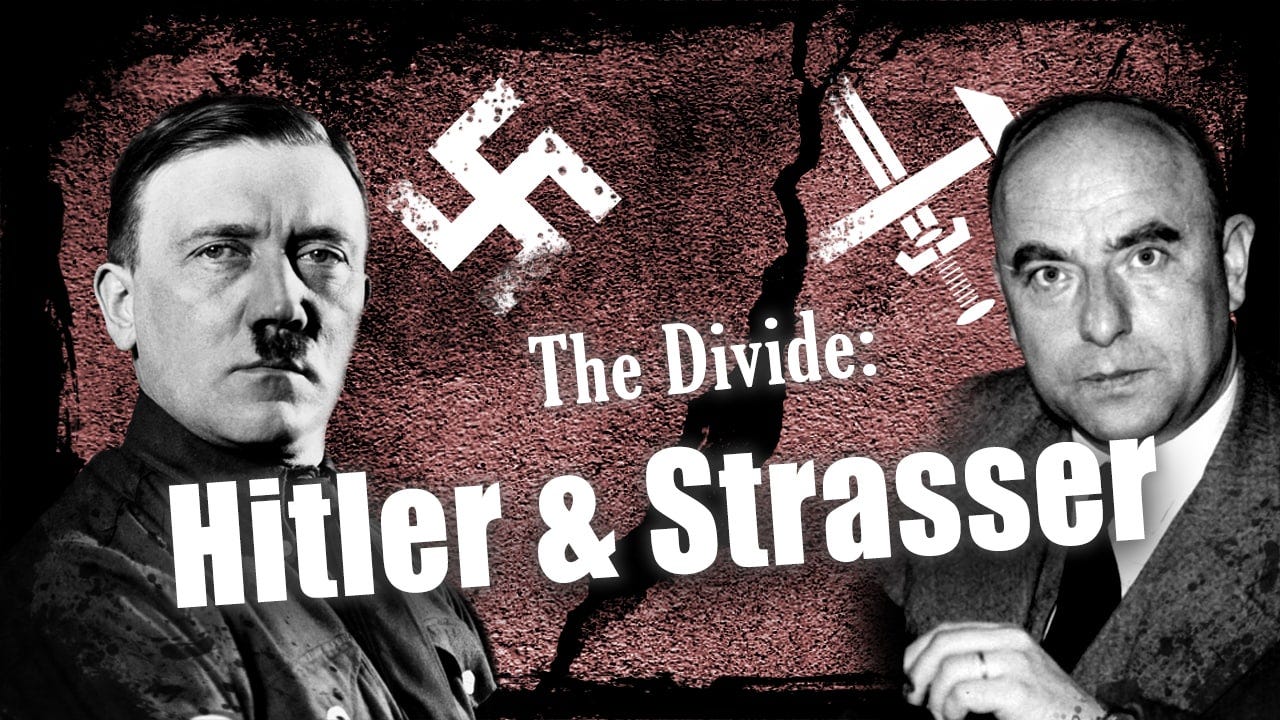
The Divide: Hitler and Strasser
by Zoltanous
Introduction
The period following World War II has seen a proliferation of misinformation concerning the Third Reich, the National Socialist German Workers' party (NSDAP), and its key personalities. A significant portion of these inaccuracies and embellishments can be attributed to the efforts of intelligence agencies such as the OSS (the precursor to the CIA), the KGB, and the FBI. Moreover, individuals known for their deceptive practices have also played a role in shaping these narratives. Among them, Hermann Rauschning, a defector from the NSDAP to the United States in 1936, has been particularly active in disseminating negative propaganda against Adolf Hitler, the NSDAP, and the Third Reich's policies. This article will delve into the life of Otto Strasser, a figure who stands out as a scumbag within the National Socialist movement. Notoriously known for his acts of betrayal, to the extent that he was labeled a "political enemy" by his own brother, Gregor Strasser. Otto Strasser's story is a remarkable account of disloyalty, lies, and intrigue within the NSDAP.
The Divide: Hitler and Strasser
When discussing the concept of Strasserism is often depicted as a more radical, left-leaning faction within the Nazi party, seen by some as socialist adversaries to Hitler. This perspective is held by certain members of the Nazi party, some leftists, and a few historians, suggesting Strasserism offered a more "anti-capitalist" flavor of Nazi ideology. However, it's crucial to address the real differences between Hitler and Otto Strasser, specifically concerning the misperception that Hitler lacked socialist tendencies while Otto embodied them. In reality, Hitler was drawn to the Nazi Party in 1919, influenced by Gottfried Feder, a Nazi economist known for his socialist leanings and the author of the party's platform.
Historians, including Ian Kershaw, have illuminated an often-overlooked aspect of Adolf Hitler's early political activities, particularly his significant involvement with the communist Bavarian Soviet Republic. Contrary to the common depiction of Gregor Strasser as the left-wing element of the Nazi party, Hitler was deeply involved in communist activities. He not only took an active role within the Bavarian communist government but also worked closely with the Soviet Propaganda Department and held a position as a deputy battalion representative under Eisner's short-lived rule. This involvement is clearly illustrated by Hitler's attendance at the funeral of Kurt Eisner, a Jewish communist leader. This event was captured in photos by Heinrich Hoffmann and recorded on film on February 26, 1919, in Munich, providing strong evidence of Hitler's leanings towards communism.
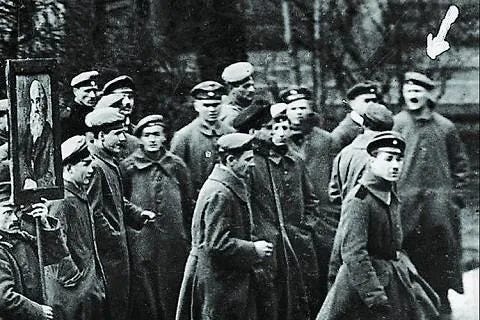
Adolf Hitler attending the funeral
"Soon, other left-wing converts joined him in the party. One was Sepp Dietrich, a former head of the Soldiers’ Council of a military unit who would subsequently head Hitler’s personal guard unit—the Leibstandarte-SS ‘Adolf Hitler’—and would become a general in the Waffen-SS in the Second World War. Julius Schreck, another new DAP member, who would serve Hitler as driver and aide, had been a member of the Red Army during the days of the Munich Soviet Republic. Hitler was well aware of the past of many of the party’s new recruits. As Hitler would state on November 30, 1941, ‘Ninety percent of my party at the time was made up by leftists.’”
— Thomas Weber, Becoming Hitler: The Making of a Nazi
Hitler’s Origins as a Communist

The period immediately following World War I represents a critical yet often obscured phase in Adolf Hitler’s life, during which he was stationed in Munich, the epicenter of revolutionary upheaval in…
During a dinner gathering that included Otto Strasser, Adolf Hitler, and General Ludendorff, tensions arose between Otto and Hitler. Hitler criticized Otto for his involvement in suppressing the Kapp Putsch, leading to continued arguments until Ludendorff intervened and sided with Otto. However, disagreements persisted, particularly regarding war, Jews, and socialism. Hitler expressed his difficulty in getting along with Otto, whom he deemed an intellectual. After participating in the failed Beer Hall Putsch alongside Hitler, Gregor Strasser was briefly imprisoned but later sold his apothecary shop to fully dedicate himself to the Nazi party. He relocated to North Germany, where he quickly became a prominent figure in the Sturmabteilung (SA) and gained a significant following. Gregor was known for his strong socialist beliefs and commitment to "undiluted socialist principles."
In 1925, Otto joined the NSDAP. At that time, the party was disorganized due to the aftermath of the Beer Hall Putsch, which resulted in the arrest of many leaders and a temporary ban on the party. Otto joined the party's northern section led by his brother Gregor. Otto played a significant role as the editor and owner of the party's northern magazine, Arbeitsblatt. The magazine advocated for land redistribution, nationalization, strikes, agrarianism, anti-imperialism, class warfare, and a form of "democratic" National Socialism. Otto collaborated with Joseph Goebbels, an emerging figure in the Nazi Party who shared many of Otto's ideas. Together, they worked on a new program, known as the Strasser Program, which aimed to replace the original 25 points of the NSDAP, which they considered vague and outdated. They also sought to limit the leader's power. However, tensions arose as Hitler began to rebuild and consolidate control over the party. He shifted from a more socialist platform and violent revolution to a pragmatic and electoral approach, attempting to win the support of the nationalist bourgeoisie class. This led Hitler to reject the Strasser program, causing frustration and disappointment among the Strasser brothers and even Goebbels. Hitler claimed the program was too mild and lacked a "volkisch spirit," viewing it as a threat to his own authority within the party.
Gregor and Otto Strasser opposed Hitler's policy of seeking support from major industrialists. Their outspoken views created a deep divide with Hitler and other party leaders. In 1926, Gregor collaborated with his brother to establish the Berliner Arbeiter Zeitung, a nationalist newspaper that advocated for a global social revolution and expressed support for Lenin and the Bolshevik regime in the Soviet Union. Gregor was later elected to the Bavarian Legislature in the same year.
Louis L. Snyder has argued that Gregor initially wanted to overtake Hitler:
"In this capacity he proved to be an able organizer, an indefatigable if weak speaker, a shrewd politician, and a lover of action. Using his parliamentary immunity to protect him from libel suits and holding a free railway pass, he turned his energy to seeking the highest post in the National Socialist Party. He would push Hitler aside and replace him. Gregor Strasser regarded himself as a proud intellectual who had far more to offer the party than Hitler.”
— Louis L. Snyder, The Ideaological Origins of Nazi Imperialism
During the NSDAP annual conference on February 14, 1926, Gregor Strasser made a controversial statement advocating for the destruction of capitalism by any means necessary, including potential cooperation with the Bolsheviks in the Soviet Union. Joseph Goebbels supported Gregor's stance at the conference. However, Hitler argued that such a public position would be highly unpopular among the German masses. The majority ultimately sided with Hitler's viewpoint.
At times, Goebbels would draw comparisons between the Nazi movement and Lenin's Soviet Union, suggesting that the differences between National Socialism and Soviet Internationalism were minimal. These comments were published in works such as National Socialism or Bolshevism, An Open Letter to My Friends on The Left, and the National Socialist Letters of 1925. However, this approach quickly backfired as it triggered an anti-Nazi riot, with the media attacking the Nazis by branding them as communists. The Social Democratic Party (SPD) even labeled the Nazis as "right-wing Bolsheviks." Hitler had to intervene to calm the situation, which ultimately validated his concerns. As a result, Goebbels switched sides, and from that point on, Gregor referred to him as the "scheming dwarf." Furthermore, it is often mentioned that Hitler and the Strasser brothers held differing views on property relations. With these two quotes below for example, we can see why this was the case:
“Do you think I’d be so crazy as to destroy German heavy industry? Those producers worked their way to the top by their own merits, and, because of this process of selection, which proves that they are an elite, they have a right to lead!”
— Adolf Hitler quoted in Adolf Hitler, a Short Biography by Helmut Heiber
“We are Socialists, enemies, mortal enemies of the present capitalist economic system with its exploitation of the economically weak, with its injustice in wages, with its immoral evaluation of individuals according to wealth and money instead of responsibility and achievement, and we are determined under all circumstances to abolish this system ! And with my inclination to practical action it seems obvious to me that we have to put a better, more just, more moral system in its place, one which, as it were, has arms and legs and better arms and legs than the present one!”
— Gregor Strasser, Thoughts About The Tasks of The Future
When examining the differing views of Hitler and the Strasser brothers on property ownership, it’s crucial to frame the discussion accurately. Although Hitler at times publicly rejected the idea of nationalizing private property, especially during election campaigns, this stance was more a strategic choice than a core ideological divide. Outside the pressures of electoral politics, his true perspective became clearer.
“The basic principle of my Party's economic programme should be made perfectly clear and that is the principle of authority. The good of the community takes priority over that of the individual. But the State should retain control; every owner should feel himself to be an agent of the State; it is his duty not to misuse his possessions to the detriment of the State or the interests of his fellow countrymen. That is the overriding point. The Third Reich will always retain the right to control property owners. If you say that the bourgeoisie is tearing its hair over the question of private property, that does not affect me in the least. Does the bourgeoisie expect some consideration from me?... Today's bourgeoisie is rotten to the core; it has no ideals any more; all it wants to do is earn money and so it does me what damage it can. The bourgeois press does me damage too and would like to consign me and my movement to the devil.”
— Adolf Hitler interview with Richard Breiting, 1931
The Strasser brothers, alongside Hitler, expressed concerns about private property being an elite privilege. Gregor Strasser, in collaboration with Hitler and Otto, advocated for a nuanced position that recognized the importance of small-scale property ownership, emphasizing its contribution to society and alignment with national goals. They argued that property tied to production should be managed by the state. This perspective held significant influence within the Nazi party, reflecting a widely shared viewpoint. For Hitler, this framework was central to his vision of a society where individual interests were subordinate to the nation’s collective well-being, a principle notably evident in the land reform initiatives led by Reich Minister of Food and Agriculture, Richard Walter Darré.
Robert Ley, one of the more famous Nazi leaders would even go on the record as stating:
“Today the owner can no longer tell us, 'my factory is my private affair.' That was before; that’s over now. The people inside of it depend on his factory for their contentment, and these people belong to us.... This is no longer a private affair, this is a public matter. And he must think and act accordingly and answer for it."
— Robert Ley quoted in Hitler's Revolution by Richard Tedor,
Hitler’s official policies echoed the views of Robert Ley, as noted earlier. However, Otto Strasser adopted a more extreme position, championing class conflict and prioritizing the proletariat’s interests within the Nazi party. As early as 1925, Gregor Strasser proposed an "economic revolution" involving nationalizing the economy, a point he raised during a Reichstag address. Tensions peaked in early 1930 when Saxony’s trade unions launched a general strike. Otto backed the action, while Hitler opposed it. To reconcile with Otto, Hitler arranged a private meeting, but it did not bridge their divide. The encounter saw mutual accusations, with Hitler calling Otto a Marxist and Otto branding Hitler a capitalist opportunist.
The May 1930 debate between Hitler and Otto Strasser further clarified Hitler’s stance on socialism. Otto insisted that worker ownership was essential to National Socialism, but Hitler rejected this, arguing that workers lacked the sophistication to grasp socialist concepts. Hitler maintained that the state should oversee both workers and employers, asserting that worker-led companies would hinder advancement. In response, Strasser expressed outrage, labeling Hitler’s position as fascist.
Hitler continued with saying:
“A system that rests on anything other than authority downwards and responsibility upwards cannot really make decisions, Fascism offers us a model that we can absolutely replicate! As it is in the case of Fascism, the entrepreneurs and the workers of our National Socialist state sit side by side, equal in rights, the state strongly intervenes in the case of conflict to impose its decision and end economic disputes that put the life of the nation in danger.”
— Adolf Hitler quoted in Hitler vs Strasser, The Historic Debate of May 21st and 22nd 1930, by Otto Strasser
Otto Strasser fired back:
“Fascism has not found its way between capital and labor. It hasn’t even searched for it, it limits itself to containing social struggles by maintaining the all powerlessness of capital over labor. Fascism is not the overcoming of capitalism. On the contrary, until now in any case, it has maintained the capitalist system in its power, as you would do yourself.”
— Otto Strasser quoted in Hitler vs Strasser, The Historic Debate of May 21st and 22nd 1930, by Otto Strasser
Hans Reupke, a Nazi party economist who joined in 1930, echoed Hitler's views, emphasizing that corporatism formed the core of National Socialist economics. Another economist, Max Frauendorfer, concurred with Reupke, asserting that the Italian model offered the only alternative to Jewish Marxism and capitalism. Surprisingly, even Gregor Strasser aligned himself with Hitler on this matter, despite the divergence from his own brother, Otto. Otto vehemently rejected these arguments, with Erich Koch joining him in shouting, "We are not Fascists! We are Socialists!" During this debate, Otto also defended modern art as a vital and vibrant force. In response, Hitler branded Otto an "intellectual white Jew" and countered that true art resided in Platonic beauty found in Forms, positioning it as infallible, divine, and objective.
Following this famous debate, a rift emerged between Gregor and his own brother, shedding light on the actual differences at play. Otto Strasser was not a fascist but rather a proponent of Guild Socialism. Hitler's focus within National Socialism revolved around a state-driven approach similar to fascism. Fascist economics relied on corporatism, a nationalized form of syndicalism, which was contingent upon the trade union model. The Nazis implemented this by establishing their own state-sponsored union, the German Labor Front. This understanding also sheds light on the privatization efforts undertaken by the Nazis, which primarily benefitted party members rather than random individuals lacking ideological commitment. As argued in The Nazi Economic Recovery, privatization was often temporary and aimed at financing rearmament. Consequently, it can be said that the purported privatization was, in name only, serving as a facade for a state-backed monopolies. Dennis Sweeney posits that it was Hitler's form of state socialism that attracted many to the party and eventually won Gregor's loyalty.
“The Nazis, who invoked a Corporatist conception of workplace-organization as part of their larger plans for the “creation of a corporate social order” (Ständische Aufbau)[…] The Nazi leaders of the DAF reformulated their Corporatist plans for Ständische Aufbau in relation to the industrial workplace during the summer and fall of 1933, in ways that accommodated demands for autonomy and employer prerogative emanating from the ranks of German heavy industry. After 1933, Corporatist references to occupational “estates” and the “works community” combined with racial concerns about the worker’s body, individual “performance,” and the social and biological reproductive functions of the working-class family to shape ideological discourses about work and newly reconfigured factory regimes during the Nazi era. Bio-racial Corporatist terms and assumptions figured centrally in the writings and policies of Nazi physicians and scientists, industrial sociologists and efficiency experts and DAF functionaries. They also constituted the core of racist definitions of work, occupational hierarchies, and social order in the much vaunted “performance community” (Leistungsgemeinschaft) of the Third Reich. This was visible, for example in the rationalized industrial workplaces of the automotive firm Daimler-Benz, at the electrical firm Siemens, and in the plans for the National Socialist model factory of the Volkswagen concern. Most historians of corporatist ideology and Nazism have focused on the corporatism(s) of small producers (namely German retailers and shop owners), with their calls for guild-like organizations and guarantees of state protection.[…] Indeed, Hitler and several other Nazi leaders including Gottfried Feder, Otto Wilhelm Wagner, Gregor Strasser, and Max Frauendorfer were attracted to the Dirigiste Corporatist solutions to class conflict and the volatility of capitalist economies, especially to the “neoromantic” theories of the Viennese professor of political economy, Ottmar Spahn."
— Dennis Sweeney, Work, Race, and the Emergence of Radical Right Corporatism In Imperial Germany
As previously mentioned, the economic differences between the Strasser brothers became a significant factor in their growing distance from each other. Over time, Gregor began to align himself more closely with the official party stance and expressed his loyalty to Hitler.
Alfred Rosenberg elaborates further on this in his Memoirs:
“Otto Strasser came over to us from the camp of the Social Democrats, after having had close contacts with its leaders. I felt that he was less interested in following the party line of the National Socialist German Workers' Party than in propagating certain undigested ideas of his own. When he told me that he considered an entirely new economic structure of paramount importance, I replied that it wasn't sufficient to write a number of articles; what he should do was write a well-rounded, carefully thought-out book to give people a chance to study his ideas. This he did not do. The conflict came in spite of the fact that Hitler did his utmost to hold Strasser. Together with some of his followers, he seceded from the party. His brother Gregor remained. I still remember a discussion I had with Hitler a little later. Thank God, he said, that Gregor Strasser has remained true, a great thing for all of us. He was genuinely fond of him, even as Gregor Strasser proved his own brotherly love for Hitler by consoling him when his niece died and the Führer was considering giving up his entire political career.”
— Alfred Rosenberg, Memoirs
The economic disagreement between Otto Strasser and Hitler stemmed from their contrasting philosophical foundations. Otto embraced Guild Socialism, incorporating ideas from Catholic Distributism, while Hitler’s economic approach drew from Corporatism, shaped by Otto von Bismarck’s State Socialism/State Capitalism. This led Hitler to favor a top-down, state-controlled socialism, whereas Otto envisioned a bottom-up, community-driven socialism with democratic roots. Their interpretations of National Socialism also clashed: Hitler upheld the Führerprinzip, insisting on absolute leader authority as vital for order and national goals, while Otto rejected this as undemocratic, advocating for a system with leader accountability.
Otto saw National Socialism as an advanced form of socialism infused with nationalism, emphasizing natural societal traits like local rule, democratic involvement, and worker-led production. Hitler, conversely, crafted a socialism specific to Germans, uniting them through racial identity under his leadership, merging race with state power in the national folk-community. Otto, however, separated state from race, promoting self-governing Germanic regions and preserving their unique cultural identities.
Otto proposed a confederate Germany, where autonomous regions retained their distinct characters, viewing large industries as a threat to this structure. He also sought to dismantle the dominance of Prussian culture, which he saw as centralizing power. Hitler, in contrast, pushed for a unified, centralized German identity, erasing regional differences. Otto’s exit from the NSDAP in 1930 was influenced by the party’s stance against federalism.
In 1932, Otto Wagener drafted an economic plan, but it was shelved due to Feder’s objections. Gregor Strasser’s Immediate Economic Program, based on his Work and Bread speech, took its place and was used in the July election, only to be withdrawn in September — allegedly because Hitler found it too extreme and risky for his Chancellor negotiations. The Aufbauprogramm, crafted mainly by Feder, replaced it. Gregor later pushed for a national pension system via a party syndicate, backed by Robert Ley and Hitler. Both Strasser brothers, like many in the party, aimed to attract communists to shift them from Marxism, a strategy Hitler also supported. The resulting "Beefsteak Nazis" — brown on the outside, red within — saw significant communist-to-Nazi conversions, with Rudolf Diels, Gestapo chief from 1933 to 1934, estimating 70% of new SA recruits in Berlin were former communists, a trend noted by historian Konrad Heiden in his 1936 book Hitler: A Biography.
Hitler backed Gregor Strasser’s organizational overhaul, which transformed the NSDAP from a fringe group into a mass movement with broad German reach, appealing to the working class with socialist rhetoric. Gregor also built ties with smaller industrialists. His economic strategy included a new trade policy favoring protectionism for agriculture and domestic goods but opening up foreign trade. To tackle unemployment, he suggested abandoning the gold standard, nationalizing banks, and launching public works, ideas strongly endorsed by Hitler, Feder, Wagener, and Ley, eventually becoming official party policy.

The Nazi Economic Miracle
Convinced by Hitler's practical approach, Gregor Strasser and Joseph Goebbels climbed the ranks within the Nazi Party, with Gregor ascending to the role of Propaganda Leader and Goebbels becoming the Gauleiter of Berlin. Over time, however, a rift developed between Otto Strasser and Hitler, resulting in Otto's refusal to yield to Hitler's directives. As a consequence, Hitler tasked Goebbels with the expulsion of Otto and his faction, whom he mockingly labeled as "Salon Bolsheviks."
In defiance, Otto, asserting his claim as the authentic National Socialist, established the Union of Revolutionary National Socialists, known as the Black Front, and castigated Hitler as "the betrayer of the revolution." While Otto did manage to draw away a considerable contingent from the NSDAP, he was unable to secure the allegiance of key figures, including that of his brother Gregor, with whom he would not mend fences until 1933. Otto's influence was notable in the Berlin SA uprising in 1931, which was orchestrated by Captain Walter Stennes and included SA dissidents with communist pasts. Otto provided counsel and encouragement to Stennes during this insurrection. Interestingly, Stennes would later covertly serve as a Soviet intelligence agent.
The authors James and Suzanne Pool, reached this conclusion that:
“The evidence indicates that Stennes was financed by several important industrialists who were intent on destroying the Nazis.”
— James Pool and Suzanne Pool, Who Financed Hitler
In his book Flight From Terror, Otto Strasser reveals that Jewish multimillionaires Otto Wolff, a steel and coal magnate, and Paul Silverberg, a financier, along with major German industrialist Hermann Bücher, were the chief financial benefactors of Walter Stennes. Their intent was to thwart Hitler's rise to power by all available means. Nevertheless, Hitler managed to intervene and sway the majority of SA members from aligning with Stennes and Otto. According to Otto, it was the Jewish and capitalist elite who funded the 1931 conspiracy involving himself and Walter Stennes. The Black Front accused the NSDAP and Hitler of taking kickbacks from German industrialists like Krupp and Thyssen, but it has been established that the party's financial support from capitalist sources was minimal, primarily coming from nationalist industrialist Emil Kirdorf.
The NSDAP primarily financed its activities through membership fees, entrance fees at meetings, and the sale of newspapers, writings, and books. On the other hand, the Black Front received support from more questionable sources, including Jewish capital from individuals like Silverberg and Wolff. This occurred because their interests aligned with the desires of the Black Front, the bourgeois class, and Jews to crush the NSDAP. Interestingly, while Otto conducted a relentless campaign against the Nazis, including launching severe attacks against Goebbels and Göring, his brother Gregor was accepted as a prominent member of the party. Newspapers under Otto's control cautiously criticized Hitler, suggesting that "National Socialism is bigger than Hitler," and so on. Goebbels noted in his diary that Gregor Strasser was treated well by a generally hostile press. This raised serious suspicions about Gregor's allegiance. Under intense pressure, Gregor wrote a letter to his estranged brother in 1932, with whom he had not spoken since leaving the Nazi party.
“I am unable to meet you. You are highly dangerous for your friends and a tonic for your enemies. Your articles have harmed me enormously… Everything which I had brought up for discussion in respectable circles fell largely on deaf ears because you, quite wrongly, gave the impression that I was in touch undercover with you.”
— Gregor Strasser’s letter to Otto Strasser quoted in Gregor Strasser and The Rise of Nazism by Peter Stachura
Paul von Hindenburg, the President of Germany at the time, desired Kurt von Schleicher to become the Chancellor and extended an invitation to Gregor Strasser to serve as his deputy. Hindenburg and Schleicher hoped that Gregor's involvement would disrupt Hitler's party. Hitler, however, opposed this move, viewing it as an attempt to create a rift within the NSDAP. He also accused Gregor of being a traitor. In order to maintain party unity and prove his innocence, Gregor decided to resign from all party positions. With Hitler's approval, on the condition that he ceased all political activity, Gregor found employment in a large chemical firm. During this period, Gregor completely withdrew from politics.
Ernst Hanfstaengel here explains the strategy being used against Hitler:
"His plan was to split off the Strasser wing of the Nazi Party in a final effort to find a majority with the Weimar Socialists and Centre. The idea was by no means so ill-conceived and amidst the momentary demoralization and monetary confusion in the Nazi ranks, very nearly came off."
— Ernst Hanfstaengel, Hitler: The Memoir of the Nazi Insider Who Turned Against the Fuhrer
It is well-documented that Adolf Hitler was able to outperform Otto Strasser in various aspects. Hitler's ability to organize and hold larger rallies, as well as his success in winning seats in government, surpassed those of the Black Front. Furthermore, the NSDAP was more successful in infiltrating the Black Front than the reverse. They were able to disrupt meetings, uncover plots against their party, and even physically confront Otto, although he managed to defend himself by brandishing a pistol.
Hitler's rise to power began in 1933 when he became Chancellor of Germany, followed by his assumption of the presidency in 1934. One of his first actions as the leader was to ban the Black Front, prompting Otto Strasser to go into hiding. Prior to his disappearance, Otto instructed his remaining followers to infiltrate the NSDAP and prepare for a revolution that ultimately did not materialize. Unfortunately, many of his supporters were apprehended and subsequently sent to concentration camps, alongside communists and social democrats.
During the infamous Night of the Long Knives, which took place from June 30th to July 2nd, 1934, Hitler effectively neutralized the leadership of the SA. Gregor Strasser, in particular, met a tragic fate. He was arrested by the Gestapo on June 30th as part of the purge targeting socialists. After being taken to Gestapo Headquarters, Gregor was shot in the back of the head. Shockingly, he did not die instantly but was left in his cell to bleed to death slowly. The purge of the SA remained secret until Hitler announced it on July 13th, during which he coined the term "Night of the Long Knives." Hitler claimed that 61 individuals were executed, 13 were shot while resisting arrest, and three committed suicide. However, some accounts suggest that the actual death toll may have been as high as 400. In his speech, Hitler justified his decision to bypass the judicial system, asserting his authority as the supreme judge of the German people and ordering the execution of the conspirators.
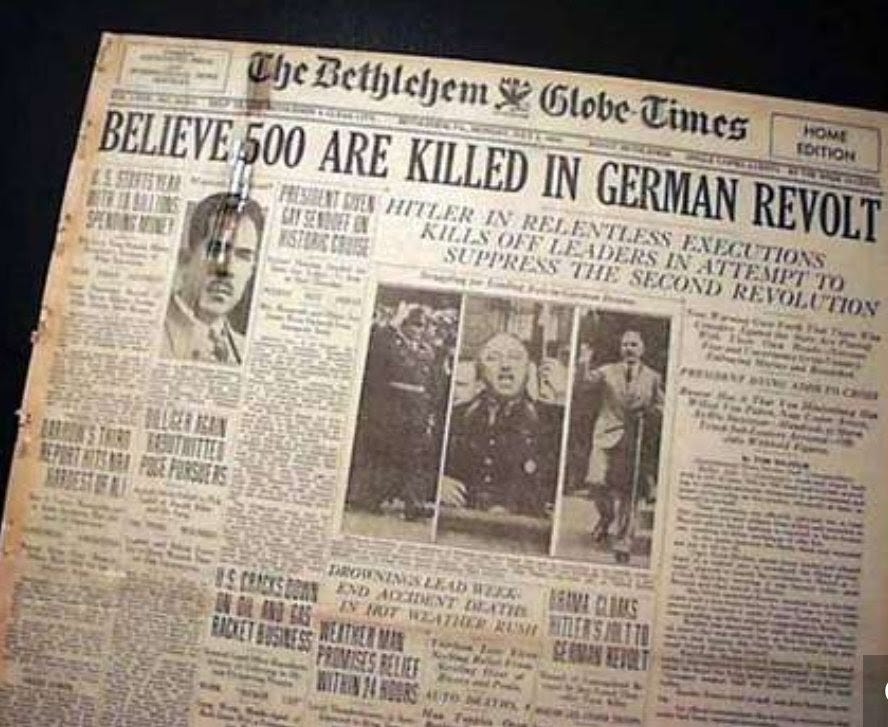
Article announcing the SA purge.
Following these events, Gregor's brother, Otto Strasser, chose to go into exile. Alfred Rosenberg adds more context in his Memoirs:
“During the Röhm-Putsch Strasser and Schleicher were killed. We all thought they had been involved in some way, but the police remained silent. The Führer made arrangements for the financial security of Strasser's widow, an extremely pleasant woman. In the Second World War both of Strasser's sons fell as officers at the front. This is the sort of tragedy that is inevitable in the course of a revolution. Whenever I think of Strasser as he was in those days, I see before my eyes his tall figure and his light, kind eyes. I remember his generosity, and, occasionally, also that apparent uncertainty which eventually led him to his doom. As the Führer told me later, he had intended to make Strasser his Secretary of the Interior. In that case, many things might have taken a different turn.”
— Alfred Rosenberg, Memoirs
In Volume 1 of Der Grosse Wendig: Richtigstellungen zur Zeitgeschichte, the section titled "Lügen über den 30. Juni 1934" supports the assertions made by Rosenberg. Historian David Irving similarly reflects this viewpoint in his book The War Path.
“Much had in fact happened that unsettled Hitler. Göring had wantonly liquidated Gregor Strasser, Hitler’s rival, and there had been a rash of killings in Bavaria... Hitler’s adjutant Brückner later described in private papers how Hitler vented his annoyance on Himmler when the Reichsführer SS appeared at the chancellery with a final list of the victims eighty-two all told. In later months, Viktor Lutze told anybody who would listen that the Führer had originally listed only seven men; he had offered Röhm suicide, and when Röhm declined this ‘offer’ Hitler had him shot too. Hitler’s seven had become seventeen, and then eighty-two.”
— David Irving, The War Path
The available evidence suggests that Adolf Hitler only authorized the execution of seven fellow Nazis during the "Night of the Long Knives." He was unaware of the extent of the killings until later, at which point he expressed irritation at the excessive actions. Hitler took responsibility for the events, ordered an investigation into those responsible for the excesses, and ensured that they were punished. He also provided state pensions to the families of those who died unnecessarily, including Gregor Strasser's wife and sons, as mentioned in Alfred Rosenberg's memoirs.
In Peter Stachura's biography of Gregor Strasser, titled Gregor Strasser and The Rise of Nazism, it is mentioned that Gregor had meetings with Hitler in late 1933 and early 1934, discussing the possibility of him joining the new government. This is supported by Rosenberg's memoirs. It was Heinrich Himmler and Hermann Göring who compiled the death lists, as they viewed Gregor as a threat to their own power within the party. Gregor was considered for significant roles within the Nazi party, including Minister of Economics, Minister of Labor, or Minister for the Interior. The idea that Gregor was executed simply for his socialist views is challenged by the real motives behind his death, which were largely influenced by the internal power dynamics between Göring and Himmler, coupled with Gregor’s outspoken criticism of both figures within the Nazi party. Otto Strasser’s memoir Hitler and I lends credence to these factors, despite some inconsistencies with his other accounts. Additionally, the survival and promotion of Robert Ley, a notably leftist member of the Nazi party, to the head of the German Labor Front, as well as the immunity of other socialist-inclined members like Joseph Goebbels or Gottfried Feder, further disputes the assertion that Gregor was targeted solely for his socialist ideology.
It is important to clarify that Strasserism is often mistakenly labeled as a form of National Bolshevism. While Otto Strasser did have connections with Karl Otto Paetel, the leader of the German National Bolshevik party through Ernst Jünger, Paetel did not hold a favorable view of Otto's ideology. Both Paetel and Otto opposed Hitler and fascism, but Paetel criticized Otto for promoting a form of Feudal Socialism, considering him to be anti-scientific and foolish in his beliefs.
Paetel argued in The National Bolshevik Manifesto of 1933:
“All the Problems Strasser has with Marx, would be solved by Reading Marx.”
— Karl Otto Paetel, The National Bolshevik Manifesto
It is worth noting that Paetel, held extreme views, such as pagan supremacism. Paetel was critical of Hitler, whom he insulted as a "political Catholic," implying that Hitler's religious beliefs influenced his political actions. Additionally, Paetel derogatorily referred to Otto Strasser as a "Jew worshiper.”
Paetel went on to say this:
“They must free themselves from the shackles of Christianity which stunts their heroism and makes them susceptible to enslavement by Rome."
— Karl Otto Paetel, The National Bolshevik manifesto
It's crucial to recognize that Otto's beliefs did not align with fundamental Marxist tenets like Dialectical Materialism or internationalism. His divergence from Marxist ideology drew criticism from Karl Otto Paetel, a materialist who considered nationalism an instrumental step towards internationalism. Despite some level of association between Otto and Paetel, the latter rebuked Otto for his support of a German confederation, contending that Hitler's idea of a centralized German Federalist State was a more fitting concept. Paetel's critique carries weight, especially as he was an ardent critic of Hitlerism. He also disapproved of Otto's radical agrarian emphasis, which he feared would cripple German industry. As a proponent of Marxist economic principles, Paetel viewed this as harmful to national interests and favored continued industrial growth. Otto sought alliances with figures of the Conservative Revolution, including Ernst Jünger, as well as with Kurt Hiller, a Jewish communist and proponent of gay rights, and National Bolshevik theorists like Karl Otto Paetel and Ernst Niekisch. Nevertheless, their collective endeavors to counter Hitler did not succeed.
In his work Germany Tomorrow, Otto Strasser criticized both Hitler and Stalin as "totalitarian." He viewed them as cut from the same cloth, arguing that the 1939 Soviet-German Non-Aggression Pact openly demonstrated the close relationship between the two systems. Otto characterized Hitler as launching a war against Europe in concert with Stalin. When discussing his own economic ideas, Otto also criticized both Fascists and Communists for excessively strengthening the state's control over the economy and infringing upon individual rights.
“Fascists and communists are the first to exalt the state, the first to repress economic and personal independence, the first to exalt the excesses of power, the success of organization, decree, planning, and - last but not least - the police.”
— Otto Strasser, Germany Tomorrow
Otto Strasser engaged in collaboration with Communist and Jewish groups through his Black Front organization from 1930 to 1934, during a period when they sought to divide the NSDAP. In early 1931, the Black Front attempted to align with the Communist group Antifaschistische Aktion, commonly known as Antifa. While the Antifascists considered the Nazi party as one of the fascist parties, they also aimed to appeal to Strasserists by utilizing nationalist slogans. It is worth noting that Otto collaborated with the British Secret Intelligence Service, also known as MI6, indicating his involvement as a traitor.
Sefton Delmer, an expert in British black propaganda during World War II and the creator of the black radio station "Gustav Siegfried eins," mentioned in his autobiography Trail Sinister that one of his inspirations was a secret black propaganda radio transmitter operated by Otto Strasser in Czechoslovakia. The radio engineer Rudolf Formis, who had to flee Germany after being exposed as a saboteur, operated this radio station. This station disseminated grossly fabricated falsehoods about Hitler and others. It should be noted that many of the unsubstantiated claims regarding sexual perversion among prominent National Socialists originate from Otto Strasser. Otto's black radio transmitter received financial support from Jewish individuals and operated under the protection of the Czechoslovakian government. Otto Strasser even relayed a completely unfounded claim to the OSS (Office of Strategic Services) that Hitler had subjected Geli Raubal to humiliating acts. However, there is no evidence to support this allegation.
The Jew Dr. Kurt Hiller, who got to know Otto Strasser during Strasser’s long stay in Czechoslovakia, writes:
”Since 1930, first in Germany and then in exile, he [Strasser] waged an unfailing and brave fight against the werewolf [Hitler] in Germany.”
— Kurt Hiller quoted in Towards a Fourth Reich? The History of National Bolshevism In Germany by Klemens von Klemperer
According to the book Men Against Hitler by Fritz Max Cahen, a Jewish individual, he claims to have regularly met with Otto Strasser during his fight against National Socialist Germany, where he played a leading role in the "German" resistance. It is also worth noting that Otto Strasser had contacts with the Jewish interior minister of France at the beginning of the war. Even more interesting is that the periodical of World Jewry in 28th August, 1936 carried the following report from its Prague correspondent:
“The well-known rival of Herr Hitler, Otto Strasser has published an appeal to the German Jewish emigrants to join the newly-formed organization of German Jews headed by Herr Rossheim. In his opinion, the solution to the problem of the Jews in Germany lies in the direction of assimilation.”
— World Jewry in 28th August, 1936
Historian Henry Ashby Turner has pointed out that a significant aspect of Hitler's socialism was his fervent belief in antisemitism. However, Otto Strasser held strong criticisms of the Jewish Question and biological racism. Otto proposed two options for Jews: either they could become a national minority with their own autonomous region, which also applied to other races, or they could fully assimilate into Germany, renouncing their religion and adopting Christianity. This stands in stark contrast to Hitler's views, as Hitler sought to deport Jews from Germany.
Otto Strasser viewed Jews as he would any other race, believing that consistent cultural interaction would lead to conflicts. In other words, Strasser believed that eliminating cultural differences would resolve internal conflicts. On the other hand, Hitlerism posits that as long as a society remains multicultural, chaos will ensue because, in Hitler's perspective, culture is linked to race and therefore considered the same. In fact, in 1928, Otto Strasser proclaimed, "Anti-semitism is dead. Long live the idea of the people!" In 1938, Otto Strasser relocated to Switzerland and subsequently to France. The British ambassador in Berlin, in a letter to the British Foreign Secretary on the 18th July 1939, said:
“So many people, such as Otto Strasser and others of this world are seeking with intense pertinacity to drive us to war with Germany.”
— Sir Neville Henderson, July 18, 1939
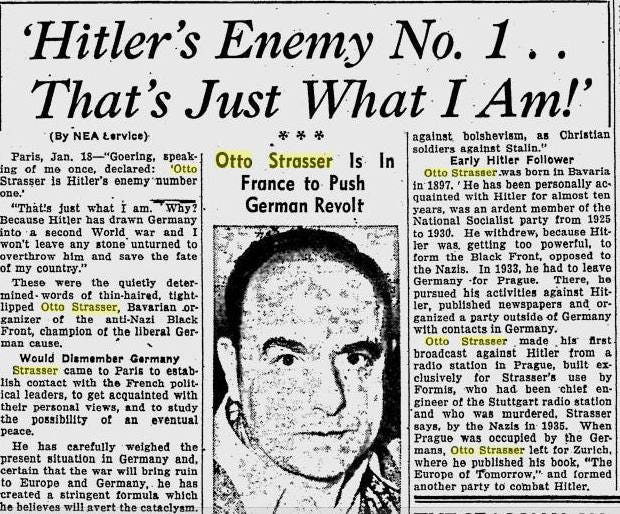
"Otto Strasser... champion of the liberal German cause”
According to W.J. West in The Truth Betrayed, there were strong links between Otto Strasser and the British authorities, specifically through Sir Robert Vansittart, the Permanent Head of the Foreign Office and later Chief Diplomatic Advisor to the Government. Vansittart recommended Otto Strasser and Hermann Rauschning to the Foreign Secretary in October 1939. Another defector, responsible for a book filled with lies titled Hitler Speaks, exposed by Swiss historian Wolfgang Haenel.
After the failed bomb plot at the Burgerbraukeller in November 1939, which aimed to kill Hitler and was believed to have been masterminded by the British Secret Service through Otto Strasser, Vansittart turned against Otto, implying that his reputation was tied to the plot. Material from Otto Strasser was used in the book Der Führer, which was attributed to Konrad Heiden and played a role in formulating the indictment at the Nuremberg Trials. Otto's material was also utilized by Dr. William C. Langer in his book The Mind of Adolf Hitler, a piece of wartime propaganda assigned by the American OSS, now the CIA. Otto Strasser fled from Austria to Czechoslovakia, Switzerland, France, and eventually Canada. During his time outside of Germany, he gave lectures and speeches against the regime and attempted to organize the remaining members of his Black Front organization. Otto also made a direct attack on the NSDAP headquarters in Nuremberg, but the plot was discovered and the attacker, Helmut Hirsch, a German Jew, was executed. Nazi agents made several attempts to capture Otto, but he always managed to escape.
He collaborated with both the Austrian and Czechoslovakian governments, but was eventually pressured to leave due to the influence of the NSDAP and the imminent German invasion. Otto then resided in Canada, where he collaborated with the British government, wrote for the New Statesman, and authored his biography Hitler and I and his book Germany Tomorrow. In 1940-1941, Otto Strasser briefly captured global attention, emerging as a potential figurehead for a reimagined post-war West Germany. Hollywood took notice, with Warner Bros securing rights to produce a film about his life. Strasser sought to spark a revolt against Hitler by covertly distributing his two books in Germany. However, in 1943, Canada banned him from publishing political works due to his ideological ties and prior connections to the Nazi movement, leaving him resentful. His fleeting fame soon vanished entirely.
Following World War II, Otto Strasser received an invitation to join the German Democratic Republic (DDR), East Germany’s Communist regime, but he declined. Unlike other ex-Nazis, such as Bruno Fricke and Otto Ernst Remer, who embraced the DDR as a chance to reframe and resurrect National Socialism through collaboration with the Soviet Union, Strasser found the idea of aligning with former Hitlerites within the DDR’s government abhorrent. He also viewed participation in a Soviet-controlled regime as futile.

Otto being invited to the DDR
Upon his return to West Germany, Otto Strasser established the German Social Union, a political party that struggled to gain support and ultimately collapsed in 1962. He also became involved with the European Social Movement and the National European party, organizations promoting a unified European state and encompassing various nationalist and fascist groups, including Oswald Mosley’s Union Movement, Jeune Europe, the Italian Social Movement, and the Socialist Reich party. Within these circles, Strasser debated foreign policy, often adopting a pro-Soviet perspective and clashing with members over issues like the Holocaust. He maintained ties with Jean Francis Thirart, whose ideas later influenced Alexander Dugin. Throughout his later years, Strasser worked to justify his beliefs while distancing himself from Hitler’s National Socialism. Some of his ideas gained traction in nationalist circles, such as The Other Russia, but only after his death. Strasser died of natural causes in March 1974, outliving many NSDAP leaders and rivals but leaving a less significant legacy within the movement.
Conclusions
From my perspective, if Strasserism had gained traction, it’s unlikely that Hitler’s version of National Socialism would have reached the same heights of dominance. Otto Strasser’s unique ideology could have splintered the support base essential for Hitler’s rise, making it tough for Otto to grip the nation the way Hitler did. Throughout his political career, Otto was a constant irritant to the Nazi elite, often seen as a troublemaker. National Socialism is more intricate than the straightforward blend of socialism and nationalism that Strasserism appears to propose. It’s deeply rooted in the concept of the Volksgemeinschaft, or National Community, which holds that racial unity both demands and validates sweeping social change, reinforced by the Führerprinzip, or leadership principle.
While National Socialism does push for regulating private property to align with the nation’s goals and foster fairer distribution, it doesn’t go so far as to insist on total nationalization as the sole route to social justice and rejects the unchecked inequalities of liberal capitalism. The portrayal of Hitler as a die-hard defender of private property or a capitalist is a distortion, often spread through ignorance or intentional misrepresentation. Hitler always put the state’s aims first. Even Richard Wolff, a Marxist economist of Jewish descent, with his take on socialism, could place Hitler within the wider scope of socialist thought.

Professor Richard Wolff explaining socialism
Even more fascinating is that these various quotes from The Vampire Economy by the communist economist Günter Reimann show the reality for big business under the Nazis.
“I must confess that I think as most German businessmen do who today fear National Socialism as much as they did Communism in 1932. But there is a distinction. In 1932, the fear of Communism was a phantom; today National Socialism is a terrible reality. Business friends of mine are convinced that it will be the turn of the ‘white Jews' (which means us, Aryan businessmen) after the Jews have been expropriated… The difference between this and the Russian system is much less than you think, despite the fact that we are still independent businessmen.”
“You have no idea how far state control goes and how much power the Nazi representatives have over our work. . . In this respect they certainly differ from the former Social-Democratic officials. These Nazi radicals think of nothing except ‘distributing the wealth.’ Some businessmen have even started studying Marxist theories, so that they will have a better understanding of the present economic system.”
“You cannot imagine how taxation has increased. Yet everyone is afraid to complain about it. The new State loans are nothing but confiscation of private property, because no one believes that the Government will ever make repayment, not even pay interest after the first few years.”
“The old type of capitalist who adheres to the traditional concepts of property rights is doomed to failure under Fascism.”
— Günter Reimann, The Vampire Economy
The idea that Strasserism was the sole representative of left-wing socialist ideas within the Nazi Party doesn’t hold up. Figures like Rudolf Jung, Robert Ley, Gottfried Feder, and Joseph Goebbels, who leaned socialist, stayed loyal to Hitler and played major roles in shaping Nazi policies. In my view, modern Strasserists are off-base when they claim Hitler sold out to big business and abandoned his original supporters. The real question isn’t whether Hitler got funding from industrialists or other sources, but whether those funds shifted his core beliefs and principles. A close look at the historical record shows Hitler held firm to his goals and kept tight control over his movement, no matter who was bankrolling him.
There’s no solid evidence that Hitler was ever swayed by financial deals. He called the shots in the political arena, regardless of what his backers might have wanted. On the other hand, Otto Strasser took money from bourgeois sources and courted foreign governments to oppose Hitler. He was neck-deep in plots to kill Hitler, collaborated with Jews and communists, downplayed race and antisemitism, testified at the Nuremberg Trials, which led to Nazi leaders’ executions, and spread falsehoods about Hitler during and after the war. A 2023 University of Vermont thesis by James Francis Hughes II exposes how much Strasser exaggerated and fabricated his accounts of talks with Hitler. The thesis notes that historians often call Strasser’s accounts “unreliable,” as they don’t line up with other personal memoirs from those who knew Hitler, and Hughes cautions that Strasser’s claims clash with the broader historical record.
“one must be wary of accepting Otto Strasser’s biased and possibly fabricated retelling of his former boss-turned-nemesis’ spoken words”.
— James Francis Hughes II, Otto Strasser, The Nazi Party and The Politics of Opposition
From what I’ve pieced together, Hitler envisioned transforming Germany into a revitalized socialist republic post-war, complete with a senate and parliament. His plan included a system for electing a successor who would hold absolute authority, mirroring his own role. For those curious to dig deeper, sources like Hitler’s Table Talk and Hitler: Memoirs of a Confidant shed light on this. Historian Roger Griffin, argued that the Strasser brothers had contrasting stances on their commitment to the NSDAP.
“Gregor Strasser remained faithful to Nazism while his brother Otto was its bitter critic.”
— Roger Griffin, The Nature of Fascism
From my perspective, a close examination shows that Gregor Strasser was a steadfast supporter of National Socialism and loyal to Hitler, which makes it morally questionable for Hitler’s followers to revel in his death. Otto Strasser, on the other hand, was undeniably a traitor. While Strasserism is often lumped under National Socialism because of its roots and its blend of nationalism and socialism, the two were fundamentally different. The notion that Gregor was aligned with Otto largely stems from a fabricated story, one Otto himself pushed and which the uninformed still cling to. This tale conjures up a mythical leftist faction within the NSDAP that could have changed history’s trajectory and sidestepped its worst atrocities, almost like a Nazi version of Trotskyism. Otto was so caught up in his own story that he ignored its impact on others. Even years after the war, he kept insisting Gregor was fully on board with him, despite their obvious differences. Otto even tried to exploit Gregor’s ashes for political gain, defying the explicit wishes of Gregor’s widow, who begged that her husband’s memory not be used for political stunts.
Digging deeper, it’s clear Otto Strasser’s accounts are riddled with lies and self-serving exaggerations meant to inflate his own importance and paint himself and Gregor as united foes of Hitler’s regime. The reality is messier: Gregor’s attitude toward Hitler was more conflicted, and by 1930, he was leaning toward the moderate-conservative side of National Socialism. The idea of a unified “Strasser brothers” or a solid “Strasser wing” is pure fiction. Peter Stachura’s book on Gregor Strasser, lays out a clear-eyed view, portraying Otto as an opportunist who stirred up trouble and whose ideology was shallow. Gregor, by contrast, comes across as more principled and a dedicated Nazi party member, though not especially tied to leftist ideas.
Later in his political career, Gregor even showed openness to working with conservative figures, including Hitler. Like me, Stachura concludes there was no meaningful “Strasser bloc” in the Nazi movement, and Otto made up claims about Gregor’s loyalty after his own expulsion. Gregor’s actual support for Otto was minimal at best, and Otto’s infamy mostly comes from his connection to Gregor and his knack for causing a ruckus. One might wonder if Otto’s false claims about Gregor contributed to his brother’s downfall, though that’s just speculation. The sad reality is that Gregor Strasser’s legacy has been muddied by Otto’s lies. He’s either unfairly vilified by some Hitlerites out of ignorance or wrongly lionized by Otto’s “Strasserites”. Gregor’s loyalty to Hitler held firm until the end, as his resignation letter makes clear, reaffirming his commitment to National Socialism.


