

Ugo Spirito’s Proprietary Corporatism
by Zoltanous
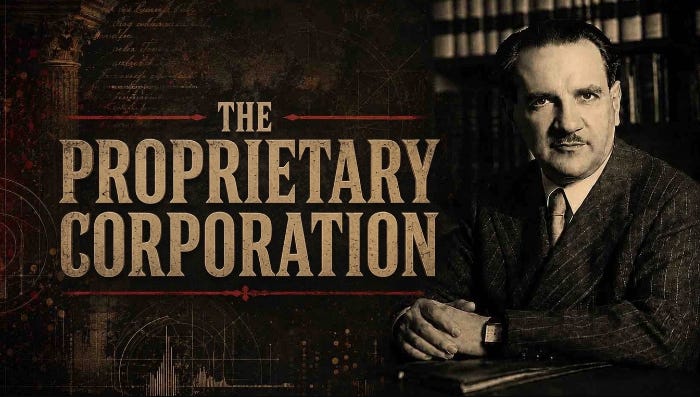
Ugo Spirito (9 September 1896 – 28 April 1979) was born in Arezzo into an Italy still grappling with the legacies of unification and the dislocations of rapid but uneven industrialization. After completing degrees in law im 1918 and letters and philosophy in 1920 at the University of Rome, the latter with a thesis on Italian pragmatism discussed under Giovanni Gentile, Spirito initially showed sympathies for positivism and scientific method. He underwent a profound intellectual conversion to Gentile’s actualism. Actualism held that reality is not a static collection of objects or fixed categories but pure spiritual act and becoming. In this framework, the individual and the state were not opposites but two moments of the same living process: the individual attained full reality only within the state, while the state achieved concrete existence only through the organized activity of individuals. This philosophical conviction became the fixed center of everything Spirito would later write about economics, law, and politics.
Spirito joined the National Fascist party in 1922, signed the Manifesto degli intellettuali fascisti in 1925, and collaborated on the Enciclopedia Italiana. In 1927, together with Arnaldo Volpicelli, he founded the journal Nuovi Studi di diritto, economia e politica (1927–1935). In its pages the two men developed what Spirito called “attualismo costruttore” — a Constructive Actualism that rejected any rigid separation between philosophical reflection and practical institutional work. Theory and practice were to be understood as moments of the same act. The identity of individual and state was not a metaphysical postulate to be contemplated from afar; it was a task to be realized in concrete economic and juridical forms.
Spirito pursued an academic career, teaching at the regime’s school of corporative studies in Pisa (where he worked closely with Giuseppe Bottai from around 1931) before later moving to Messina. Throughout the 1920s and early 1930s he published steadily and took part in official debates on how Fascism should organize economic life. His major early works included La critica dell’economia liberale im 1930, which dismantled what he saw as the philosophical fictions of classical economics — above all the abstraction of homo economicus — and I fondamenti dell’economia corporativa, which set out the positive principles of a corporative system in which economic phenomena possessed an inherent “statehood.”
By the early 1930s the Great Depression had starkly exposed the weaknesses of liberal individualism on a world scale. Markets had become a single vast interconnected system; finance exercised power far beyond its traditional bounds. Many serious observers believed the old liberal state — conceived as a neutral referee among private interests, could no longer master the forces it had unleashed. Spirito believed Fascism possessed both the philosophical resources and the political will to create something genuinely new.
The existing model of Fascist corporatism rested on the syndical and corporative laws of 1926 (drafted by Alfredo Rocco) and the Carta del Lavoro (Charter of Labor) of 1927. These created a hierarchical system of vertically organized syndicates and corporations grouping employers and workers by economic sector, topped by the state through the Ministry of Corporations and the National Council of Corporations. Private property and private initiative were affirmed but declared a social function exercised under state direction. Article VII of the Charter emphasized that the organization of the enterprise was responsible for the direction of production before the state, and that technicians, employees, and workers should be regarded as active and intelligent collaborators, generating a reciprocal sum of duties and rights. The state acted primarily as arbiter and ultimate director rather than as transformer of ownership. Joint-stock companies and shareholder control remained intact; capital and management retained directive power within the new corporative structures. The goal was national coordination, the replacement of class struggle by collaboration, and the mobilization of production for autarky and national strength. Leading theorists such as Bottai stressed the moral and political integration of economic forces into the state community without abolishing the distinction between capital and labor or transferring ownership to producers.
Spirito argued that this system, for all its rhetoric, still left the fundamental structures of capitalist property relations largely untouched. He observed that under the existing system private and public, individual and State had got entangled without really merging and ended up by widening the gap between them. The decisive moment came in May 1932. Between the fifth and eighth of that month the Second National Conference of Syndical and Corporative Studies convened in Ferrara. Spirito delivered his major report, Individuo e Stato nell’economia corporativa [Individual and State in the Corporative Economy]. He proposed transforming the classic joint-stock company into what he named the corporazione proprietaria, the proprietary corporation.
In the new entity, ownership would pass from absentee shareholders to the people actually engaged in productive work — the “corporati,” comprising both manual workers and managerial/technical staff, organized through the corporative system and integrated into the National Council of Corporations. Capital would lose its power of command and become merely a passive right to a share of profits. Decision-making authority would rest with those engaged in production, structured according to function and hierarchical responsibility. The corporation itself would acquire the character of a public-law institution — an organ of the state rather than a purely private association.
Spirito described the effect on property with deliberate sharpness. The reform would deliver the mortal blow to the liberal conception of property. In the same report he continued with these words:
“In this affirmation, which is the foundation of the new science of economics, lies also the entire political, moral, and religious meaning of the Fascist revolution.”
“The corporate State, of which all citizens are officials, in the full development of their activities, no longer public or private […] but always and unequivocally public and private, in an indissoluble unity that excludes every need.”
— Ugo Spirito, Individuo e Stato nell’economia corporativa
He elaborated the institutional logic further:
“(…) the logical solution appears to be that of the ‘proprietary corporation’ and the corporati as shareholders of the corporation. It is a solution that, at least on paper, resolves the antinomies (…) unites capital and labor, eliminates the dualistic system, fuses the company with the corporation and finally allows an effective identification of individual economic life with that of the state.”
— Ugo Spirito, Individuo e Stato nell’economia corporativa
In Capitalismo e corporativismo he specified the participatory structure, stating that workers and managers would become owners of the corporation for the part due to them in accordance with the particular hierarchical ranks. The corporation, Spirito insisted, was an organ that grafts itself into the state organism through the National Council of Corporations and represented the same reality of the corporation seen in the national system. It would stand as an intermediate body realizing, in concrete economic form, the actualist identity of individual and state. In envisioning how that would emerge, Spirito offered a striking analogy.
“Let us imagine a type of perfect society, for example a family in which the spiritual unity of the members is realized to the maximum, or a community in which the good of all is understood as the maximum good of each one. In such a type of social organism one cannot speak of property: by hypothesis everything is of everyone.”
— Ugo Spirito, Capitalismo e Corporativismo
This vision reached its fullest expression in Spirito’s characterization of the system as a whole.
“This is the essence of corporatism, the hierarchical communism that denies the leveling state and, at the same time, the anarchic individual, that denies bureaucratic management by bureaucratizing the entire nation, that is, by making every citizen a civil servant, and denies private management by recognizing each individual as having a public value and function. Wills are combined into a single will, ends into a single end, and the whole of social life is rationalized: the economic world, in particular, can move towards a unitary organization and make possible this programmatic economy, with which alone it is possible to overcome the chaotic nature of traditional liberalism.”
— Ugo Spirito, Capitalismo e Corporativismo
Spirito believed this change would finally resolve contradictions liberal economics had never solved. In modern joint-stock companies, ownership had already separated from control; professional administrators stood between capital and labor and often mediated both without fully belonging to either; shareholders collected returns without knowledge or direction of operations; workers remained wage earners with no material stake in results. The proprietary corporation, in contrast, was intended to transform the enterprise into a unified productive body in which these external separations would be reabsorbed into the internal structure of the firm itself. Entry into economic life would no longer be defined primarily by an exchange between worker and employer, but by incorporation into a legally constituted productive unit whose internal organization determined one’s functional position and share in output. The capitalist would cease to exist as an external rentier, while the worker would acquire a direct and formally recognized interest in the performance of the enterprise, not through individual ownership in the liberal sense, but through participation in its internally mediated distributive mechanism. The separation that had turned the enterprise into a field of permanent conflict would, in theory, be overcome through this redefinition of ownership, labor, and control as aspects of a single corporate structure.
The response at the conference and in the wider regime was swift and largely hostile. Many heard the proposal as a form of disguised collectivism. The idea that capital should lose directive power inside the firm struck conservative corporatists as a step not merely beyond but outside corporatism itself. Giuseppe Bottai, who had previously encouraged innovative thinking, maintained personal relations with Spirito, and directed the corporative studies school in Pisa — distanced himself from the more radical conclusions. At the close of the Ferrara conference Bottai spoke with unusual directness:
“I want, openly and loyally, man to man, to disapprove of Spirito’s report. Not because I consider it, as they say, dangerous; but because I judge it wrong, scientifically, in its conclusions, which do not mark a step forward in corporatism, but a step outside of corporatism.”
— Giuseppe Bottai, closing speech at the Second National Conference of Syndical and Corporative Studies, Ferrara, 7 May 1932
Bottai went on to argue that the thesis of the corporazione proprietaria was not a step forward but a step outside of corporatism, because it abolished the principle of property, destroyed private initiative, and submerged the categories in an undifferentiated organ. The official synthesis of the conference rejected the reporter’s position, concluding that it did not advance corporatism but departed from it. Spirito was accused of pushing the regime toward Bolshevism or collectivism. Mussolini reportedly offered a more positive public comment in Il Popolo d’Italia, suggesting that Spirito overcame the opposed positions of liberal and socialist economics and that his theses on the identity of individual and state did not merit the scandalized reactions of those who failed to understand philosophical reasoning. Nevertheless, the institutional proposal itself was not adopted.
Spirito faced immediate professional consequences. For a period he was asked to step back from teaching responsibilities connected with the corporative school in Pisa. He later took up a post at the University of Messina (having won the chair in December 1933 and transferring in 1935). His most ambitious institutional proposal never received legislative or administrative realization during the ventennio. Spirito did not retract the underlying principles. He continued to publish and defend the philosophical case for a thorough transformation of property relations. In the introduction to Capitalismo e corporativismo in 1933, he appeared to moderate the presentation somewhat, suggesting that the specific conception of the proprietary corporation could be left aside or might even seem surpassed, because the fundamental cornerstones — the identification of individual and state, programmatic economy, and participation in management, had by then been widely recognized. He nevertheless maintained the deeper philosophical commitment.
In later decades Spirito returned to the Ferrara episode in his memoirs with unusual directness. Reflecting on the intellectual path that had led him there, he wrote:
“Fascism and corporatism I saw with the faith of a revolutionary oriented toward a conception of a communist character which had its culminating point in the proposal of the proprietary corporation at the congress of Ferrara in ’32. My communism was the communism of actualism. It is clear that my communism was the communism of actualism. From Bottai I expected an explicit collaboration in this direction, albeit within the limits of an extremely difficult political situation, dominated not only by the two capitalist forces but above all by liberal and conservative culture, by Croce and Einaudi.”
— Ugo Spirito, Memorie di un incosciente
The passage is revealing, Spirito was not equating Fascism with communism in any party or doctrinal sense. He was acknowledging that the revolutionary drive he had experienced inside Fascist corporatism shared certain structural aims with communist critiques of capitalism, above all the desire to overcome the separation between those who owned the means of production and those who worked them, and to bring private economic power under collective national direction. He located the clearest institutional expression of that drive in the proprietary corporation. Spirito also reflected on the deeper historical roots of the Fascist project itself.
“The immediate origins of fascism are to be found in the confluence of the two living forces of the first decades of this century: socialism and nationalism. Socialism became fascism when, through nationalism, it freed itself from its anti-historical abstractionism, and reaffirmed those spiritual values that were able to translate a still mythological and nebulous truth into concrete form. But we must not forget that, if nationalism gave birth to socialism, it is socialism, then, that gave birth to nationalism, according to that fusion of terms, which reappears today after a decade in German national socialism, a direct offspring of our fascism.”
— Ugo Spirito, essays in Nuovi Studi di Diritto, Economia e Politica
After the mid-1930s Spirito’s public role became more circumspect. He continued to write, gradually developing what he called problematicism (problematicismo) — an open, investigative stance that questioned closed systems and emphasized the unfinished character of historical reality (most clearly articulated in La vita come ricerca, 1937). He lived long enough to see the collapse of the regime and to reflect on its achievements and failures from a distance. In his memoirs he treated the proprietary corporation not as a youthful error but as the logical culmination of a coherent philosophical and political project. He believed that Fascism could and should have gone further in transforming the economic order. The fact that it did not, he suggested, revealed the limits of the regime’s actual social base and political will rather than any flaw in the underlying idea.
Elements of Spirito’s vision later influenced attempts at enterprise socialization during the Italian Social Republic (RSI). The Verona manifesto and the Legislative Decree of 12 February 1944 (No. 375) on the socialization of enterprises established management boards with representation from managers, technicians, and workers and promoted state and corporate involvement aimed at transcending labor-management divisions. While Spirito himself did not join the RSI and was later tried (and acquitted) for Fascist apology, the 1944 measures drew on earlier radical currents, including his emphasis on worker participation and the fusion of capital and labor.
The debate at Ferrara remains one of the clearest expressions of the current inside Fascist economic thought. It shows that corporatism was never a single settled doctrine. It encompassed technocratic planners, conservative hierarchs, syndicalists, and Soviet apologists who believed that true corporatism required a fundamental reordering of property itself. Spirito’s proposal tested the outer boundary of what could be imagined and what could be tolerated within the existing structures of power. In comparative perspective across other radical interpretations of the corporate state, Spirito’s proprietary corporation stands as one of the most thoroughgoing efforts to derive concrete institutional consequences from the rejection of liberal property relations and the drive toward organic national economic unity. Otto Wagener’s early Nazi proposals for Werksgemeinschaft (company unions) and occupational integration under national leadership shared the aim of transcending class antagonism through coordinated organs serving the Volksgemeinschaft, yet preserved the employer’s directive authority and stopped short of transferring ownership or stripping capital of command. William Dudley Pelley’s vision of a Christian Commonwealth similarly sought to submerge all private enterprises and banking into a unified national corporation in which loyal citizens would function as shareholders under state-directed “Christian economics,” thereby dissolving the public-private distinction into a single ideological-economic whole, though Pelley anchored this in explicit occult theocratic premises rather than Actual Idealist philosophy. Spirito’s model took corporatist ideas to the furthest by converting the corporation itself into a public-law institution owned and directed by the corporati (producers encompassing manual workers and managerial/technical staff), rendering capital a passive claim and realizing in living economic form the Actualist identity of individual and state. The regime ultimately chose a more cautious gradualist path that preserved elements of private ownership and managerial authority. Spirito’s vision was rejected not because it lacked internal coherence but because it demanded changes that the regime were unwilling to accept.
What gives the story continuing interest is the seriousness with which Spirito attempted to derive concrete institutional consequences from his philosophical premises. He refused to treat corporatism as a merely technical adjustment or a rhetorical device for class collaboration. For him it was a philosophical and political project that required changing who actually controlled production and on what terms. The proprietary corporation was his answer to the question of how to move from the abstract identity of individual and state to a living reorganization of factories, ownership, and decision-making power.
The historical record shows that the regime was not prepared to follow him that far. Yet the questions he raised, about the social character of property, the proper scope of state direction in a modern economy, and the possibility of aligning individual initiative with national purpose, did not vanish with the end of Fascism. They reappear in different forms whenever societies confront the tension between concentrated economic power and claims of collective or national interest. Spirito’s attempt to resolve those tensions through the resources of idealism and Fascist institutional imagination stands as one of the most coherent and uncompromising efforts of its era. Whether one regards his solution as visionary or utopian, the intellectual energy he devoted to it, and the clarity with which he later assessed both its promise and its political fate, remain worthy of serious attention. The proprietary corporation was, for him, not an eccentric aside but the logical outcome of a consistent commitment. Its rejection by the regime it was meant to serve reveals as much about the limits of Fascist corporatism as the proposal itself reveals about the radical possibilities some of its thinkers were willing to entertain.


