Shattuck and The Devil Try To Stop Quaker Persecution in New England

by
19 comments

Quaker persecution began in Massachusetts in July 1656 as soon as the first two Quakers sailed into Boston Harbor. Mary Fisher and Ann Austin arrived on the Swallow, a ship from Barbados, with a trunk full of Quaker writings.

quaker-persecution-granger

Puritan magistrates had them strip searched in public for signs of witchcraft, jailed them, deprived them of food, confiscated their belongings and put them back on the Swallow when it sailed away eight weeks later.

To the Puritans’ horror, eight more Quakers arrived in Boston shortly after Fisher and Austin. The General Court passed an edict that imposed a heavy fine on any ship’s captain who brought Quakers into Boston. The eight Quakers were beaten and jailed, and the captain who brought them had to take them back to England.

The Massachusetts Bay Colony then banned Quakers — in 1656, 1657, 1658, 1659 and 1660 — and sent letters to the other New England colonies suggesting they do the same. Connecticut followed suit in 1656; Rhode Island refused.

The colonies got away with Quaker persecution until the restoration of the English monarchy. Then, Charles II tried to stop the Puritans from persecuting Quakers – or other heretics such as Catholics or Lutherans. And at that point Quaker persecution was more than an exercise in religious intolerance; it was about maintaining political independence from the Crown.

New England Way

sewall

Samuel Sewall

The Puritans had endured much to establish the New England Way, a system based on the power and independence of the congregation. The church was sovereign; the state subordinate to the church.

To create their moral community – their ‘city on a hill’ – the Puritans had left their homes, sailed across the Atlantic and confronted the terrors of the wilderness.

The Quakers who continued to arrive in the mid-1600s were anything but gentle peaceniks. They deliberately disrupted the Puritan community. When the self-righteous Quakers came to town they yelled in the streets, banged pots and pans, shouted during church services and stripped off their clothes.

Samuel Sewall in his diary recorded one such disturbance:

In Sermon time there came in a female Quaker, in a Canvas Frock, her face as black as ink, led by two other Quakers, and two others followed. It occasioned the greatest and most amazing uproar that I ever saw.

Burning Quakers

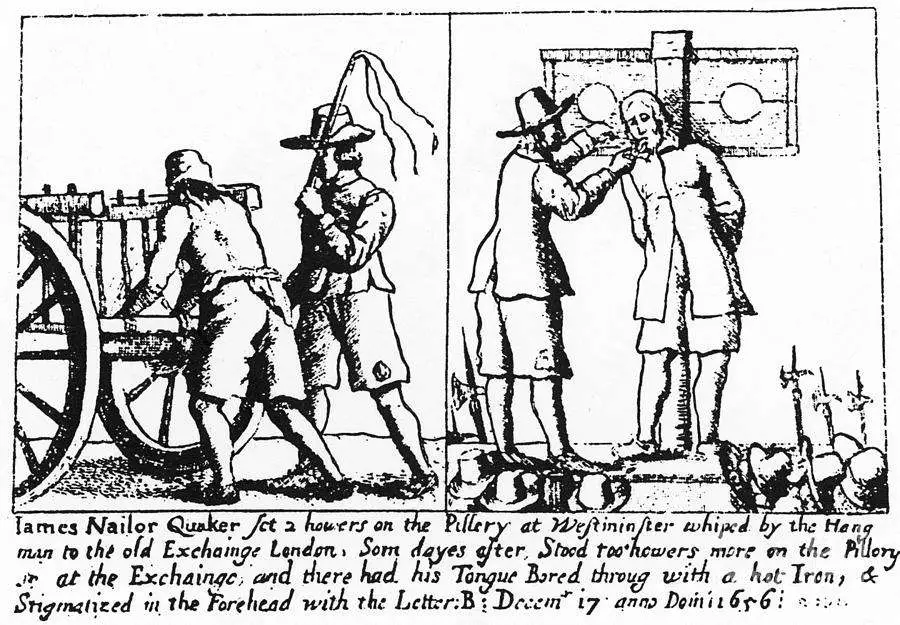
The Puritans responded by cruelly punishing Quakers. They whipped them, branded them, cut off their ears, bored holes through their tongues and hanged them.

Rev. John Norton, a leading Boston minister, cried, “I would carry fire in one hand and faggots in the other, to burn all the Quakers in the world.”

That didn’t stop the Quakers.

The punishment for a Quaker to set foot in Massachusetts in 1660 was death by hanging. Quaker Mary Dyer chose to die to expose the cruelty of the Puritan theocracy

The Quakers even exasperated Roger Williams, that paragon of tolerance. Though the other colonies threatened Providence Plantation with a trade embargo because it tolerated Quakers, the Quakers treated Williams disrespectfully. Wrote one historian,

Williams was taken aback by his Quaker opponents’ boisterous behavior and abandonment of common courtesy during the debates. He vehemently objected to their habit of interrupting his arguments, shouting him down, attempting to humiliate him personally with name-calling and ridicule, misrepresenting his convictions, and displaying a noted lack of truthfulness in their own arguments.

Stopping the Quaker Persecution

Charles II

Charles II ordered an end to Quaker persecution.

In 1660, the English monarchy was restored. Quakers went for help to King Charles II, a Catholic sympathizer. He had no liking for the Puritans, who had executed his father and taken refuge in New England.

A Quaker named Burroughs was said to have told the monarch, “There is a vein of blood opened in your dominions which, if not stopped, will overcome all.

”I will stop that vein,” Charles supposedly replied.

Then in 1662, the king sent a letter to Massachusetts ordering him to stop the Quaker persecution.

According to the king’s missive, the colony should send Quakers accused of crimes – unharmed – to England for trial. A Quaker named Shattuck, who the Puritans had sent back to England, then brought the letter to Gov. John Endicott. Word spread that “Shattuck and the devil had come.”

Endicott said he would obey the king’s command. But only gradually did Massachusetts Puritans lessen their persecution of Quakers.


This story about Quaker persecution was updated in 2022.
"This page includes affiliate links. If you buy something through them, we get a commission at no extra cost to you. These earnings support our work

19 comments

Elizabeth Buffum Chace, Conductor on the Underground Railroad - New England Historical Society December 13, 2015 - 8:14 am

[…] Her ancestor Daniel Gould came from England and settled in Newport in 1637. He became a member of the Society of Friends and married the daughter of John Coggeshall, the first president of the Aquidneck Colony who was also a Quaker. […]

Lady Deborah Moody - A Dangerous Woman Comes to New England - New England Historical Society January 5, 2016 - 10:39 am

[…] where she attended some of the more exotic religious services of the day among the Baptists and Quakers. Lady Moody became an Anabaptist — a school of thought that held that people should not be […]

Geraldine Farrar, the Women Who Put the Fight Into Carmen - New England Historical Society January 29, 2016 - 9:00 am

[…] Mass. Her father was Major League Baseball player Sidney Farrar, an infielder for the Philadelphia Quakers and Philadelphia […]

Benedict Arnold and the Rhode Island Quakers, Ranters and Heretics - New England Historical Society May 18, 2016 - 8:13 am

[…] Massachusetts would continue persecuting Quakers, even executing some such as Mary Dyer,  until 1660 when the monarchy returned to England and the king ordered Massachusetts to stop. […]

Benedict Arnold and the Rhode Island Quakers, Ranters and Heretics | MassCentral, Worcester May 23, 2016 - 6:46 pm

[…] Massachusetts would continue persecuting Quakers, even executing some such as Mary Dyer,  until 1660 when the monarchy returned to England and the king ordered Massachusetts to stop. […]

6 Stops On The New England Underground Railroad | MassCentral, Springfield July 31, 2016 - 8:01 am

[…] One of the Johnson properties was a residence, the other a Quaker meetinghouse. […]

6 Religious Revival Camps - New England Historical Society August 6, 2016 - 6:46 am

[…] Presbyterians and Baptists, even a Quaker ran the religious revival camps. It was the Methodists, though, who brought the camp meeting east […]

A Brief History of the Boston Brahmin - New England Historical Society November 21, 2016 - 11:07 am

[…] Crowninshields, Forbes, Hunnewells, Lodges, Lowells, Parkmans, Perkins, Russells, Saltonstalls, Shattucks, Shaws and […]

6 Stops on the Underground Railroad - New England Historical Society August 26, 2017 - 7:12 am

[…] Quakers Nathan and Mary Johnson harbored Frederick Douglass in 1838 at their home in New Bedford, Mass. The couple were free blacks who married in 1819 and became part of New Bedford’s robust African-American community. […]

Another Look at Hetty Green, The Witch of Wall Street - New England Historical Society December 17, 2017 - 8:26 am

[…] who was astute enough to get out of whaling before the industry collapsed. Edward Robinson, a Quaker, also taught her the value of plain […]

The Stone-Throwing Devil of New Castle, N.H. - New England Historical Society December 31, 2017 - 10:04 am

[…] the summer of 1682, a stone-throwing devil persecuted a Quaker tavern owner named George Walton in what is now New Castle, […]

Sarah Kemble Knight Rides the Boston Post Road. Alone. In 1704. - New England Historical Society March 3, 2018 - 8:21 am

[…] woman held forth for so long that Knight feared she was a Quaker, then a minority much reviled by the Massachusetts […]

Fidelia Bridges, The Lonely Painter Who Found Joy in Nature - New England Historical Society March 22, 2018 - 10:03 am

[…] from a long illness. Then, to support herself, she got a job as a mother’s helper to a successful Quaker merchant, William Augustus Brown. Brown moved his family to Brooklyn, N.Y., and Eliza, Elizabeth […]

Lightfoot and Thunderbolt - The Last New England Highwaymen - New England Historical Society March 27, 2018 - 6:31 am

[…] and Lightfoot’s stock in trade was disguise, posing as Quakers, beggars and physicians. They also altered their ages and features. But the hunt for them was so […]

Thomas Maule, the Quaker Who Criticized the Salem Witch Trials – and Got Away With It - New England Historical Society May 10, 2018 - 8:40 am

[…] Like many Quakers of the era, Thomas Maule spoke out against the Puritans for their cruelty and intolerance.  He received 10 stripes of the whip for saying Salem John Higginson, ‘preached lies and instructing in the doctrine of devils.’ […]

Maria Mitchell Discovers Her Very Own Comet - New England Historical Society August 9, 2018 - 2:42 pm

[…] had 9 brothers and sisters, and all the children were given a quality education. They were Quakers, and intellectual equality was a tenet of the Quaker […]

Rowland Macy, the Grandfather of Black Friday - New England Historical Society November 11, 2018 - 6:00 pm

[…] Hussey Macy was born in Nantucket on Aug. 30, 1822, the fourth of six children in a seafaring Quaker family.  At 15 he shipped out aboard the whale ship Emily Morgan and spent four years at sea. He […]

Rhode Island’s Nathanael Greene – the Limping Quaker Who Won the Revolution - New England Historical Society April 10, 2019 - 6:54 am

[…] battles set up the British for their final defeat at Yorktown. Nathanael Greene, the limping Quaker, returned to a hero’s welcome in Rhode Island. He didn’t stay long, however. The South Carolina […]

The Curse of Humphrey Atherton - New England Historical Society July 11, 2019 - 8:21 am

[…] least one of his victims, Mary Dyer, has gone down in history as a courageous woman whose stand against religious intolerance cost her […]

Comments are closed.

A Brief History of the Frisbee

If you think it looks like a pie plate, you'd be correct

by
4 comments

Decades before the plastic Frisbee was invented, New England resonated with the shouts of “Frisbee” warning of an oncoming tin pie plate thrown through the air.

The baked-good containers distributed by the Frisbie Pie Company eventually inspired marketers at Wham-O to brand a plastic flying disc the ‘Frisbee.’

And for a brief time in the late 1950s, Frisbee flying discs and Frisbie pie tins flew off shelves simultaneously (but not in the same stores).

Connecticut Frisbee

frisbee pieWilliam Russell Frisbie founded the company in 1871 in Bridgeport, Conn. His family had long been established in New England. Ancestor Edward Frisbie was an original settler of the Town of Branford in New Haven Colony in 1645.

William Russell Frisbie grew up in Branford, where his father had run a successful gristmill. He moved to Bridgeport to manage a new branch of the Olds Baking Co. of New Haven. Soon he bought the branch and renamed it after himself.

Frisbie died in 1903 and his son Joseph took over the company. He expanded the number of routes from six to 250, opening shops in Hartford, Providence and Poughkeepsie, N.Y. By 1956 the Frisbie Pie Company made 80,000 pies a day.

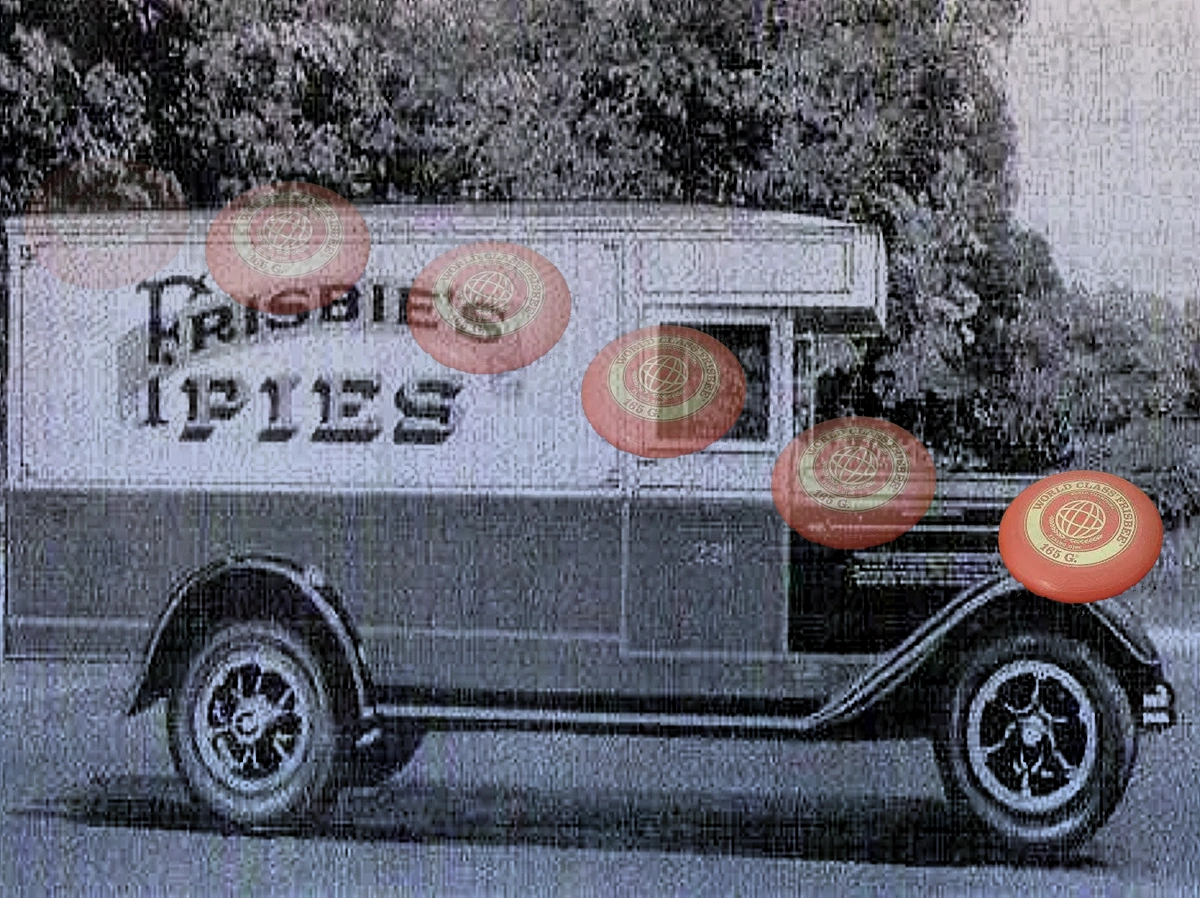
Frisbie pie truck from the 1920s

The pies were sold with the tins, which had a 10-cent deposit. According to lore, Frisbie sold pies to Yale, where students started throwing the pie tins upside down on the New Haven Green in the 1920s. The sport spread to other New England college campuses. Students called it “Frisbee-ing.”

Another story has local schoolchildren and factory workers tossing the pie plates around – or maybe cookie tin lids — and yelling “Frisbee” to avoid hitting others.

After Joseph Frisbie died, his widow, Marian Rose Frisbie, along with plant manager Joseph Vaughn, carried on until 1958. The Bridgeport factory, now a parking lot, shut down in 1959, and a Worcester, Mass., company called Table Talk bought the rest of the Frisbie pie company.

California Frisbee

Frisbee 19Enter two World War II veterans, Army Air Force pilots named Walter ‘Fred’ Morrison and Warren Franscioni. As a kid in Utah, Morrison had tossed around metal discs such as pie tins and paint can lids. Before the war, he and his wife bought cake pans for 5 cents and sold them on California beaches for 25 cents.

By 1946, Morrison and Franscioni decided to make a flying disc from lightweight postwar plastic. In Franscioni’s California basement, they shaped plastic sheets over a heater into a flying disc and called it the Whirlo Way.

In 1947, word spread that the Air Force had discovered the remains of a flying saucer near Roswell, N.M. Morrison and Franscioni renamed their toy the Flyin’ Saucer and created a new version with harder plastic.

It didn’t sell.

The two men then made a deal with Al Capp to use L’il Abner to help sell the Flyin’ Saucer. Somehow they overstepped their bounds and Capp sued, bringing to an end the Pipco partnership.

Pluto Platter

Franscioni returned to the Air Force and Morrison got a job as a Los Angeles building inspector. He continued tinkering with the design of his flying disc. In 1955 he came up with the Pluto Platter Flying Saucer and sold it by mail.

One day he finally got his lucky break in a Los Angeles parking lot. He was showing off the Pluto Platter when a representative from Hula Hoop maker Wham-O spotted him. The representative told  the company’s owners, Dick Knerr and Spud Melin. In 1956, they bought the rights from Morrison, making him a wealthy man.

Between 1949 and 1959, at least six companies were making and selling flying plastic discs. On a business trip to the East Coast, Knerr realized the fad was catching on at college campuses like Yale, Harvard, Northeastern and Dartmouth. No matter what a company named its plastic disc, the students called it a Frisbie.

Knerr decided to join them rather than try to beat them. Wham-O renamed the toy the Frisbee in 1958 — the same year the Frisbie Pie Company closed its doors. Since then, more than 100 million Frisbees have been sold.

This story was updated in 2023. The Frisbee commercial was filmed sometime in the late 1970s along the Charles River in Boston. Ultimate Frisbee players By Devon Hollahan from Tucson, USA – IMG_3399.JPG, CC BY-SA 2.0, https://commons.wikimedia.org/w/index.php?curid=3744946.

"This page includes affiliate links. If you buy something through them, we get a commission at no extra cost to you. These earnings support our work

4 comments

Catch of the Day – Weekend Edition – October 3-4, 2015 | Cape Ann Planet October 3, 2015 - 6:07 am

[…] History of the Frisbee Revealed […]

Douglas Cote October 8, 2015 - 7:09 pm

Interesting. Want to mention another Frisbee…that of the old general store in Kittery Point, ME. I just discovered they closed in 2010, but was once the oldest continually operating family market in the country…opened in 1828. It’s unfortunate that it had to close, although it has a new life as another market today. Would love to see a story on this some time….more info: http://www.seacoastonline.com/article/20100820/NEWS/8200390

Thanks,
Doug

Small Bells of Connecticut: One Town Made Sounds That Rang in Millions of Ears - New England Historical Society September 15, 2017 - 7:42 am

[…] Brothers is also the last surviving bell maker in Connecticut. The state that produced the Frisbee, the lollipop, the can opener, the box clock and the Mickey Mouse watch also once made nearly every […]

The Sweet New England History of the Frisbee - The History Gen September 1, 2019 - 4:28 am

[…] The Sweet New England History of the Frisbee – http://www.newenglandhis… […]

Comments are closed.

In the Gilded Age, Marriages Began in NY and Ended in RI, America’s Divorce Capital

by
4 comments

In the late 1800s and early 1900s, if your wife or husband told you they wanted to spend a few winter months in Newport, you should probably call your lawyer. Back in those days, the small Rhode Island city was America’s divorce capital.


In 1883, Grace Turnbull wanted to be shed of her loutish husband Henry, who had caused a stir at New York’s Union Club. In 1920, Julia French Garaghty, wife of “Handsome Jack” – her father’s one-time chauffeur – was rethinking her decision to elope years earlier. J.B. Potter was fed up with the antics of his actress wife Cora Urquhart Potter in 1900. And in 1894, Alva Vanderbilt sought to bring her 20-year marriage to a philandering husband to a close.

All went to Rhode Island, but they are just a smattering of the people who ended their marriages in the Ocean State.

R.I. Divorce Capital

Consuelo Vanderbilt (1902)

Consuelo Vanderbilt (1902), one of many who headed for the divorce capital

Grace Turnbull charged that Henry didn’t provide her adequate support. The press, though, suspected no one thought Trumbull capable of supporting Grace’s appetites from the start. Grace had landed Henry, of Baltimore, as a second husband, her first having left her a fortune.

Henry made a name for himself in 1882 for challenging yachtsman J.F. Loubat to a duel. He wanted to settle the question of whether Loubat exhibited bad manners at the Union Club. The club expelled Loubat, a decision he failed to reverse in court. The press hinted that the dispute actually stemmed from Grace’s friendship with Loubat.

Regardless of the outcome, Turnbull had lost his wife’s confidence. So she decamped for Newport in 1883.

Different Castes

Julia Garaghty’s divorce case created far less of a sensation than her elopement in 1911 with “Handsome Jack.” Julia, the daughter of one of America’s richest bankers, Amos Tuck French, ran off with a lowly chauffeur. Critics said the marriage wouldn’t last. And despite a 10-year run, the critics were right. Julia returned to Newport to put an end to the marriage.

“Handsome Jack,” meanwhile, offered a cautionary tale to newspaper reporters about the perils of marrying into wealth: “Here in America we are supposed to be democratic and with no social distinctions. It is supposed to be a free country, with the laborer having as much authority and right as the employer.

“But when it comes to marriage there is no better way to describe the reasons for my domestic difficulty (my first marriage) than to say that my wife and I were of different castes.”

Art More Than Life

When financier James Brown Potter, of Brown Bros., married Louisiana belle Mary Cora Urquhart he assumed he got the perfect society wife. He didn’t count on her love of the stage, where she began performing as Cora Urquhart Brown-Potter.

Upon learning that Cora planned an extended theatrical run in England, he wrote his wife: “I demand it be cancelled.”

That didn’t go so well, as her letters made plain: “Dear Jim: You know I am going to do as I want. Your family has never treated me right. Your father told me I was an obstacle to your advancement.”

Further, she wrote, “Your mother insulted me before I was married. Brown Brothers are nothing to me. Their name I do not care for. Henry, your uncle, is all fuss and feathers. My art I love better than life. I cannot settle down to a narrow life like your family…We are not now living in Dark Ages when wives were slaves.”

The marriage had effectively ended, with Cora continuing on the stage and J.P. taking up temporary residence in Rhode Island to rid himself of her.

As for William K. and Alva Vanderbilt, the granddaddy of all society divorces, they chose Rhode Island to put in place an arduously negotiated separation.  Alva convinced a judge of William K.’s infidelity. Alva got millions and William  K. got his freedom.

Why the Divorce Capital?

These couples and countless others didn’t choose Rhode Island to get a divorce because of the scenery. Rhode Island had a reputation for having some of the laxest attitudes toward divorce in America.

South Dakota, Illinois and Rhode Island all had minimal residency requirements. And Rhode Island would allow divorce for a variety of reasons, including simple abandonment.

Other states such as New York required infidelity or cruelty as the cause. They also required charges to be proven in open court. Further, some states barred divorcees deemed at fault from remarrying.

In addition, New Yorkers could hope to face much less publicity by divorcing in the small state of Rhode Island.

The divorce capital of Rhode Island did not go unnoticed. The Saint Paul Daily Globe in 1887 ran a newspaper editorial reflecting the views of many:

“Newport, the famous watering place, has a new mission beside entertaining wealthy summer idlers. It seems that the laws of Rhode Island are particularly lax with reference to the granting of divorces, and in this fact mismatched couples find their opportunity. It is only necessary for either party to go to Newport for a short length of time, bring suit, and the divorce is granted on the most trivial grounds.

“Thus far the members of New York swelldom, who have found their matrimonial chains galling, have chiefly taken advantage of the ease with which divorces can be obtained in Newport…Matrimony should not be regarded as a thing to be put on and off like an old glove, and the laws of the country should make it impossible to consider it in that light. Newport’s new mission is one that does her no credit.”

Awkward

Battles played out in the Rhode Island Legislature to toughen the requirements for divorce, but the divorce industry found a way to still thrive. Humorists enjoyed the scenarios that cropped up, noting that society hostesses faced complicated seating arrangements since they needed to separate ex-spouses. And one writer gleefully told of attending a tennis match at the Newport Casino that ended in great embarrassment: A  former married couple, both now with new spouses, found they were seated next to each other.

But it wasn’t just the wealthy who headed to the Rhode Island divorce capital. In New York, law firms sprouted that specialized in the Rhode Island divorce. One spouse would hire a firm and sign an attestation that he or she had established residency in Rhode Island. New York would forward the matter to Rhode Island for processing.

These “divorce mills” occasionally grew controversial. In 1925, police arrested 25 people for fraudulently processing out-of-state divorces, with the aid of a magistrate.

Haddock v. Haddock

Meanwhile, the critics had persuaded the Supreme Court to further muddy the waters because they couldn’t reform the divorce laws state-by-state. In the 1906 case of Haddock v. Haddock, the court declared that simply because one state declared a couple divorced did not mean they had actually divorced. The state where they married had to agree to the divorce, as well.

The ruling was a lawyer’s dream. It opened endless possibilities to complicate the issue, creating the real possibility for a person to be married in one state, divorced in another and guilty of bigamy in another, if remarried.

This state of confusion would exist until the court again addressed the question in 1942. By then, however, Rhode Island was losing its status as the divorce capital.

In 1927, Nevada finally got into the game, dropping residency requirements to six months for divorcees. Nevada again in 1930 dropped the requirement to three weeks.

This story about New England’s divorce capital was updated in 2026.

"This page includes affiliate links. If you buy something through them, we get a commission at no extra cost to you. These earnings support our work

4 comments

 The Great Connecticut Polygamy Crisis of 1903 - New England Historical Society December 28, 2015 - 8:01 am

[…] case I may mention. There is a family on the line between Connecticut and Rhode Island in which I found a man with two women, one having a family of children, the oldest of whom, a girl […]

Rhode Island’s Sprague-Conkling Affair (or the 1879 Episode at Narragansett) - New England Historical Society January 20, 2016 - 3:51 pm

[…] in her divorce suit, blistered her husband. She charged Sprague with numerous incidents of adultery, cruelty and […]

Equity, Maine Meets the New England Divorce Reform League - New England Historical Society April 23, 2019 - 6:24 am

[…] elsewhere were still permissive. States around the country — Indiana, Illinois, South Dakota, Rhode Island — had a long history of taking turns becoming divorce mills, allowing out-of-staters to come, […]

The Hypnotized Bride of 1908 - Madelon Kenmore Looker Coburn Le Compte - New England Historical Society August 14, 2019 - 8:11 am

[…] If you liked this article, you might enjoy In the Gilded Age, Marriages Began in NY and Ended in RI, America’s Divorce Capital. […]

Comments are closed.

Subscribe To Our Newsletter

Join our mailing list to receive the latest artciles from the New England Historical Society

Thanks for Signing Up!

Subscribe To Our Newsletter

Join Now and Get The Latest Articles. 

It's Free!

You have Successfully Subscribed!