

NYT Claps Back: The AMA 'Contradicts' Its 'Own Statements' About Youth Gender Surgery
After the American Medical Association's board chair claimed the AMA never said it opposed such surgeries, The New York Times has released the organization's full Feb. 4 statement to the contrary.


The American Medical Association has sought to walk back the assertion it made last month that the organization was generally opposed to minors receiving gender-transition surgeries. In service of this about-face, the AMA’s board chair on Thursday claimed that The New York Times in particular had misstated the organization’s position on the matter in its reporting.
However, The New York Times on Friday published the full statement that the AMA provided to the paper’s reporters in February. The statement supported the veracity of its reporting on the AMA’s position on youth gender surgeries.
The AMA has offered no evidence to back up its claims that it was misquoted on the matter and that it has consistently supported youth gender surgeries.
The slow-simmering imbroglio began on February 3, when the American Society of Plastic Surgeons released a policy statement, long in the coming, in which the medical society advised its members against performing gender-transition surgeries on patients younger than age 19. The evidence base was too weak and the potential consequences too great, the ASPS concluded.
The statement came just days after a young woman in New York state received a $2 million jury award after suing her plastic surgeon and psychologist for malpractice over the gender-transition surgery she received at age 16. I covered the trial for The Free Press:

Later on February 3, The National Review ran a story in which it quoted the AMA’s response to the ASPS’s position:
The AMA said in a statement to National Review that because “the evidence for gender-affirming surgical intervention in minors is insufficient for us to make a definitive statement . . . the AMA agrees with ASPS that surgical interventions in minors should be generally deferred to adulthood.”
The AMA supports “evidence-based treatment,” including other types of gender-affirming care for minors, the organization added.
The next day, The New York Times ran its own story, “Doctors’ Group Endorses Restrictions on Gender-Related Surgery for Minors,” in which it stated:
The American Medical Association said in its own announcement that it continued to support treatment for minors seeking gender-related care. But given the sparse research on the risks and benefits of surgical procedures, it concurred with the plastic surgeons.
“In the absence of clear evidence, the A.M.A. agrees with A.S.P.S. that surgical interventions in minors should be generally deferred to adulthood,” the statement said.
On February 10, STAT News ran a story on the subject, “Did the AMA change its position on surgery for transgender minors?” It cited the AMA’s position as such:
[T]he American Medical Association told some media organizations last week that “surgical interventions in minors should be generally deferred to adulthood.”
…
“The AMA supports evidence-based treatment, including gender-affirming care,” reads the comment, which was not published on its site or attributed to any of the group’s leaders. But it goes on to call the evidence for surgery on minors “insufficient” and says that, “in the absence of clear evidence, the AMA agrees with ASPS that surgical interventions in minors should be generally deferred to adulthood.”
On February 24, Jesse Singal published an editorial in the Times entitled “Medical Associations Trusted Belief Over Science on Youth Gender Care.” He wrote:
[T]he American Medical Association — which has long approved of such procedures — announced that “in the absence of clear evidence, the A.M.A. agrees with A.S.P.S. that surgical interventions in minors should be generally deferred to adulthood.”
Mr. Singal stated in his editorial that the A.M.A. would not grant him an interview.
Finally, on March 16, the Times ran an article, “In Tense Meeting, Mehmet Oz Pressed Medical Societies on Trans Care for Teens,” that referred back to its reporting from the previous month:
The American Medical Association has since announced a shift in its position, hedging its guidance on surgery for minors: “In the absence of clear evidence, the AMA agrees with ASPS that surgical interventions in minors should be generally deferred to adulthood,” the group said last month.
The A.M.A. did not mention nonsurgical interventions, saying only that the organization “supports evidence-based treatment, including gender-affirming care.”
An about-face, and an accusation absent evidence
In a startling turn of events, the AMA on Thursday published a “Board Newsletter” stating that, contrary to multiple news reports, “AMA policy on gender-affirming care is unchanged.”
The statement continued: “Our recent response to questions about ASPS’s position statement was intended to preserve—not diminish—access to gender-affirming care, and to clarify and reinforce what our policy has long reflected and standards of care. The AMA supports gender-affirming care as medically necessary per our policy.”
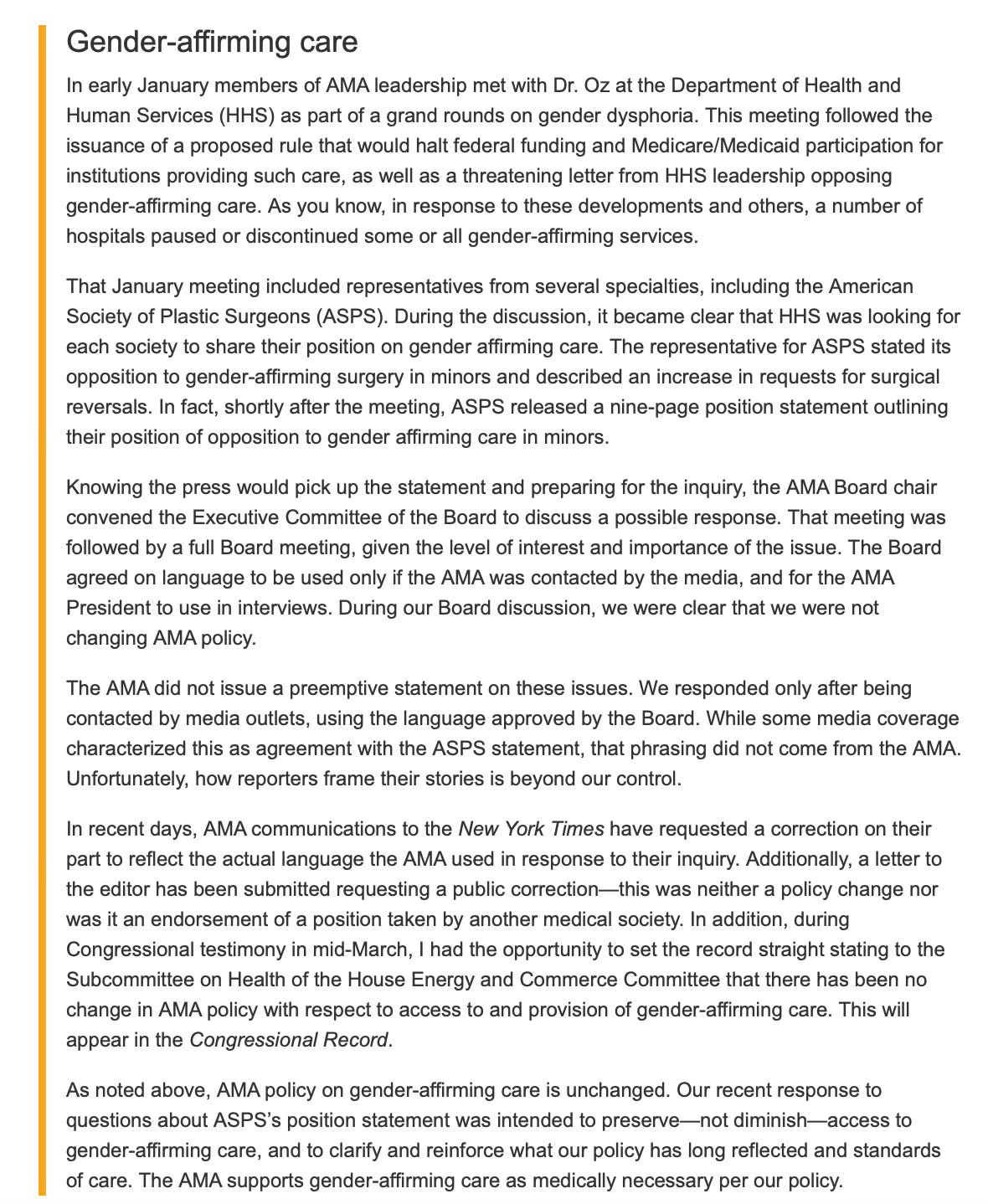
Nowhere in the AMA’s new statement did it put into plain language that, in fact, the organization did support minors’ access to gender-transition surgeries in particular. It just relied on the more general language of supporting “gender-affirming care”—a term that can encompass puberty blockers, cross-sex hormones and surgeries, as well as other non-medical interventions, such as honoring a new name or pronouns.
The AMA stated that its leadership had been aware since January that the ASPS was apparently preparing to declare publicly its opposition to gender-transition surgery. So its board chair convened the organization’s executive committee to discuss and prepare a potential response. Their plan was to only provide that response if they were contacted by media outlets asking for a reaction to the ASPS’s public position.
News outlets, the AMA asserted, had in turn misquoted the organization when they reported that the organization sided with the ASPS in opposition to minors receiving gender surgeries. “While some media coverage characterized this as agreement with the ASPS statement,” the board newsletter stated, “that phrasing did not come from the AMA. Unfortunately, how reporters frame their stories is beyond our control.”
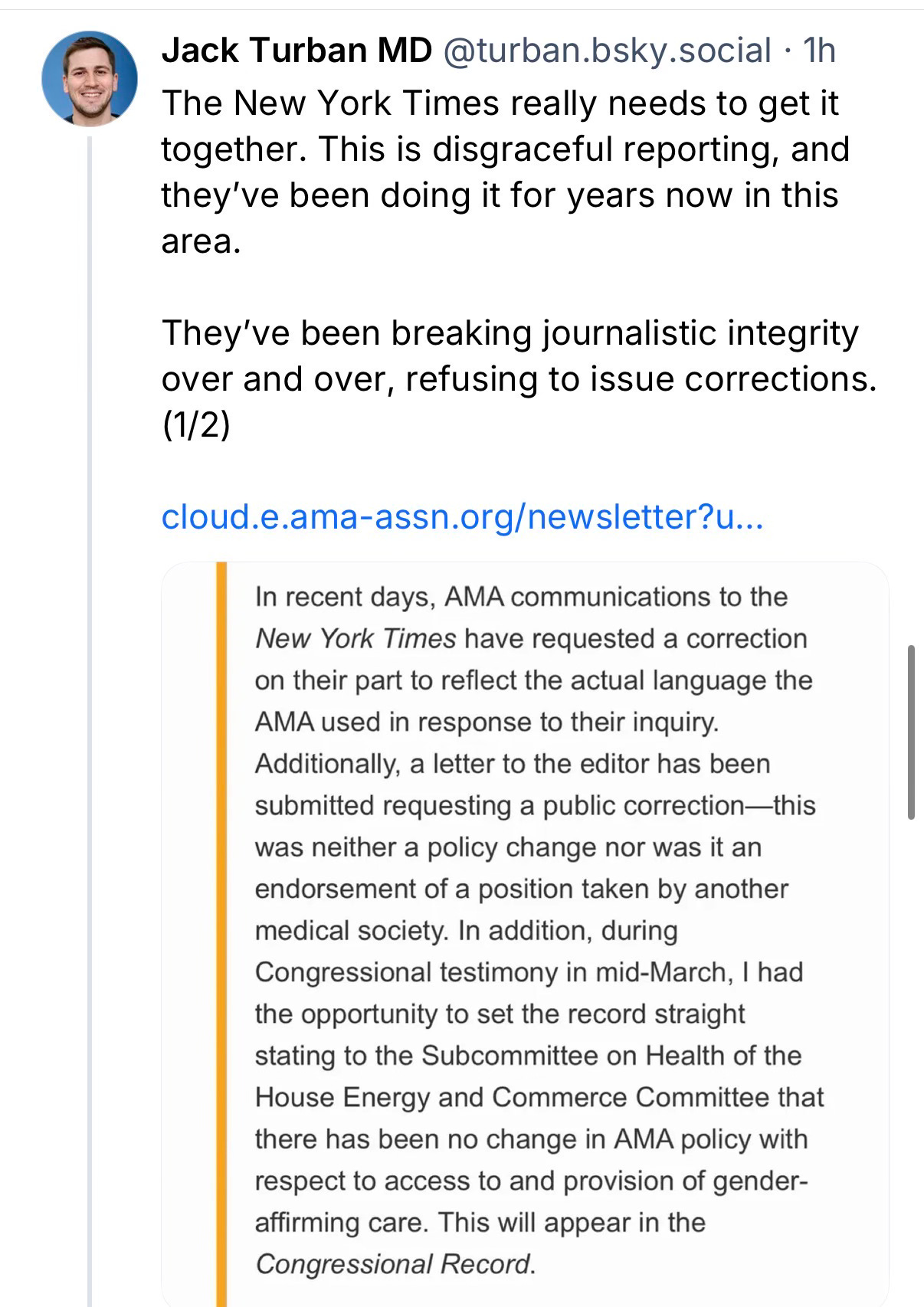
The AMA faulted the Times in particular, asserting: “In recent days, AMA communications to the New York Times have requested a correction on their part to reflect the actual language the AMA used in response to their inquiry. Additionally, a letter to the editor has been submitted requesting a public correction—this was neither a policy change nor was it an endorsement of a position taken by another medical society.”
All this raises the question: If The New York Times so glaringly misstated the AMA’s position on youth gender surgeries on February 4, 10 and 24 and March 16, why would the organization wait until March 26—over seven weeks after the original article—to object?
I contacted Mr. Singal for comment. He referred me the statement he made on X on Thursday. He said: “I spoke with a press person at the AMA to try to set up an interview as I was working on my column, which references the NYT piece at issue. He said he’d try to find someone. Then total silence and no response to a followup email. AMA had every opportunity to dispel confusion.”


I contacted the Times communications team for comment. They ultimately referred me to a statement they published Friday afternoon. In includes the full, original statement that Joshua Zembik, the AMA’s chief communications officer, provided in February. It read:
Our colleagues at ASPS concluded that the evidence supporting gender-related surgery in minors is insufficient and of low certainty. The American Medical Association respects the expertise and dedication of surgeons who care for patients every day. The AMA supports evidence-based treatment, including gender-affirming care. Currently, the evidence for gender-affirming surgical intervention in minors is insufficient for us to make a definitive statement. In the absence of clear evidence, the AMA agrees with ASPS that surgical interventions in minors should be generally deferred to adulthood.
This text precisely matches what The National Review, STAT and The New York Times all reported. This refutes the AMA’s claims that it was misquoted and makes evident that it did indeed publicly state its opposition to minors receiving gender surgeries.
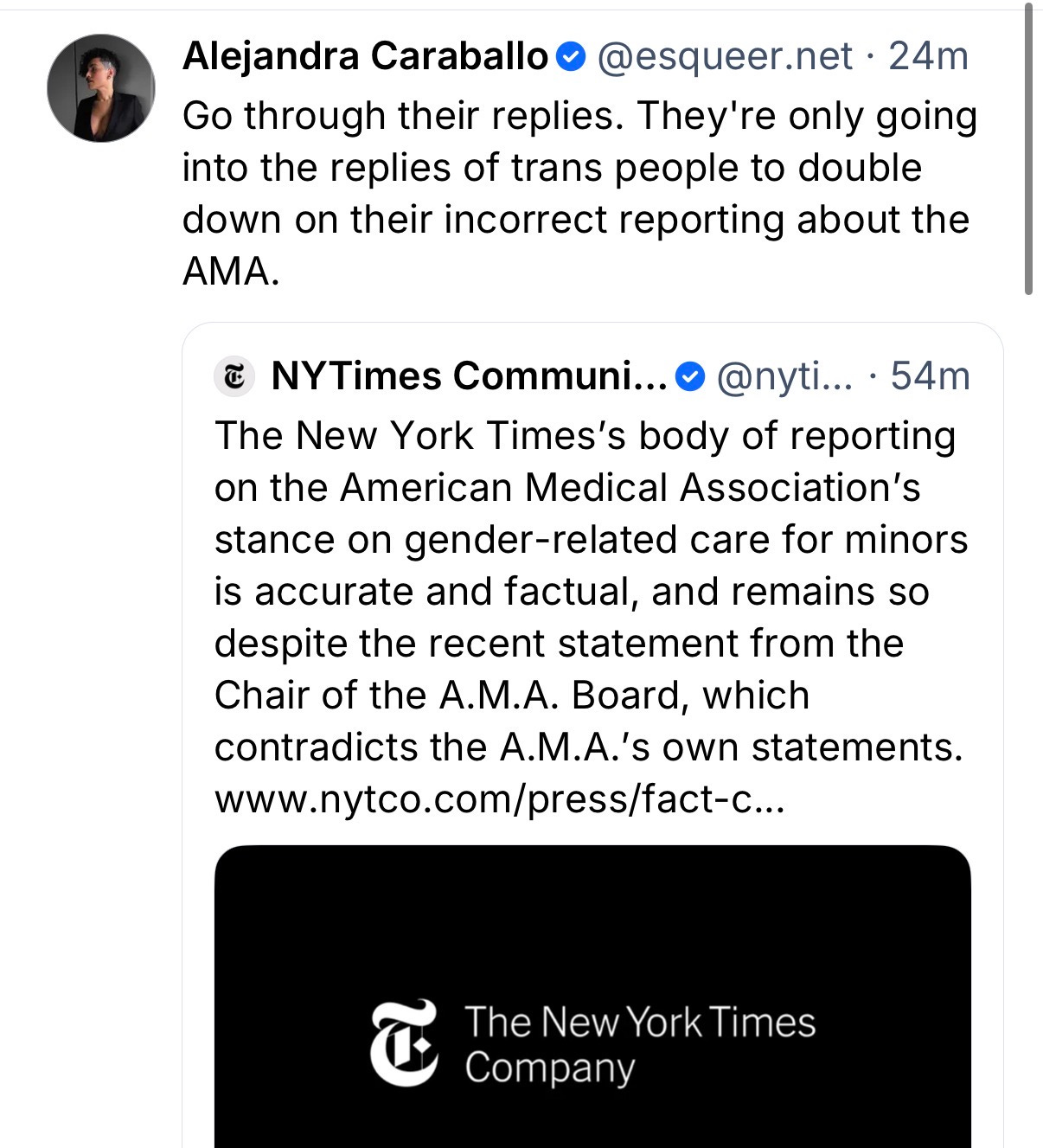
The Times defended its reporting, stating that the paper “has received no requests to correct, clarify or update our articles from the A.M.A. After the board chair’s comments, Times reporters also confirmed with the A.M.A. spokesperson that the statements reflected in our previous reporting remain accurate in reflecting the association’s stated positions. The board chair’s claims are not based in fact, and are in contradiction to both the association’s own statements provided to The Times.”
I contacted Mr. Zembik multiple times, including to ask for his response to the Times’ statement. He did not reply to my emails.
On March 27, Erin Reed ran a credulous article in her Substack that failed to ask why the AMA waited so long to correct supposedly erroneous quotes regarding its position on youth gender surgeries.

On Bluesky, transgender advocates, who routinely demonize the Times on the left-wing social-media site, reveled in what they assumed was the paper’s folly. This included Harvard Law School clinical instructor and transgender activist Alejandra Caraballo, who asserted: “The NYT purposefully mischaracterized the position of the AMA to make it seem like they changed policy.”
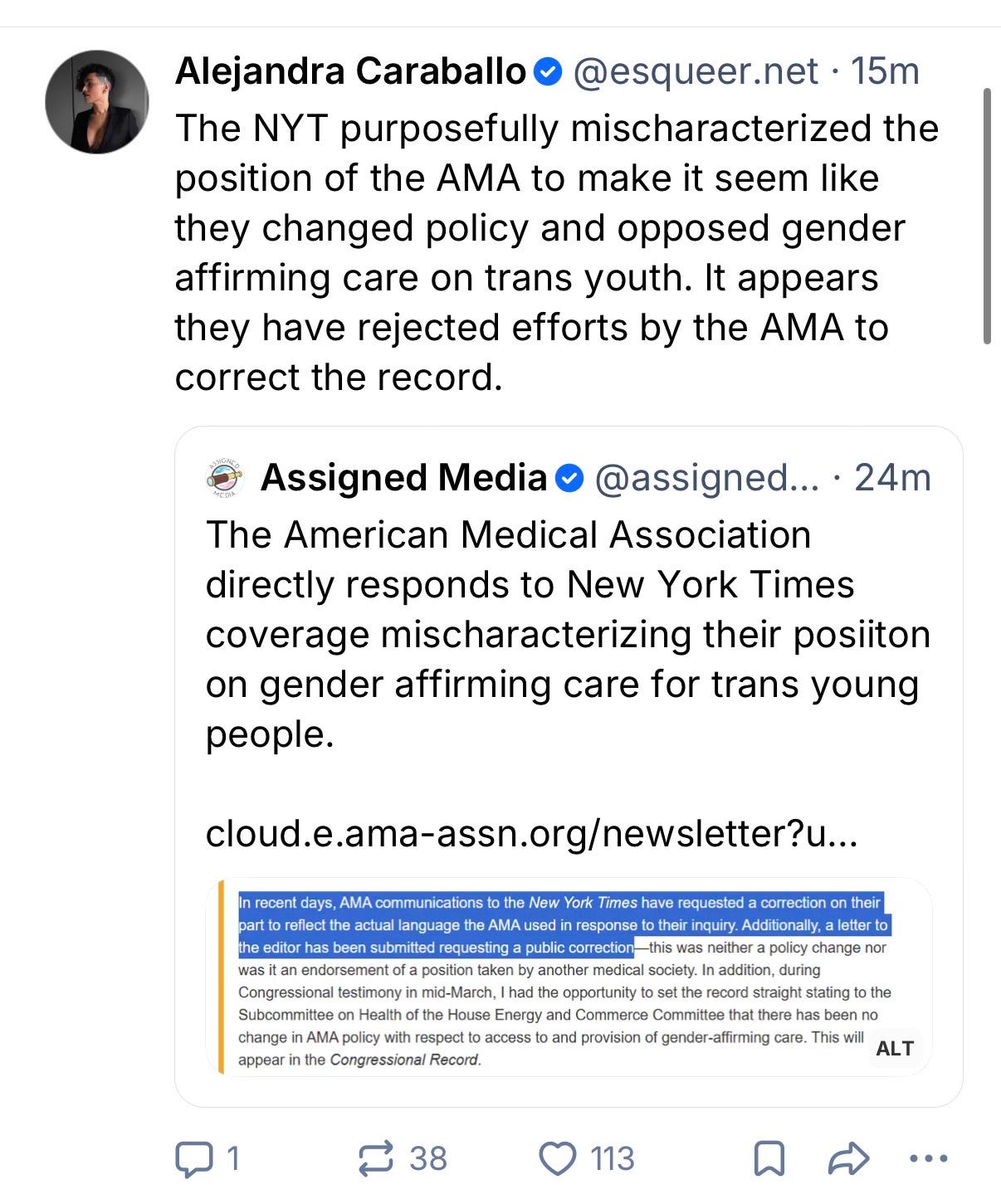
Ms. Caraballo, who wields a powerful influence on social media, was centrally responsible for a storm of misinformation about Britain’s Cass Review, which was published in 2024.

Dr. Jack Turban, a child psychiatrist at the University of California, San Francisco and prominent advocate of gender-transition interventions for minors, stated: “The New York Times really needs to get it together. This is disgraceful reporting.”

After the Times published its defense of its reporting on Friday afternoon, Ms. Caraballo doubled down, claiming absent evidence that it was the Times that was doubling down.


I get that this whole topic is filled with uncertainty, but I don't understand what the AMA is trying to achieve. The organization is not walking back its previous statement; it's denying it ever made such a statement. There's something Trumpian about unshamefacedly denying you said something everyone heard you say, and that was well reported for a month and a half before you actually started to deny it.
As with Trump, there is a core of true believers who will accept anything they need to accept in order to keep the dream alive, and maybe THAT'S what is behind the AMA's thinking.
I’m starting to understand the cause of this eye twitch I’ve developed circa 2015.