
Exclusive: AMA Documents Expose Internal Schism and Uproar Over Its Youth-Gender-Surgery Position
This follow-up to my investigation in The Free Press details the fallout within the American Medical Association after it declared that gender surgeries should generally be delayed until adulthood.

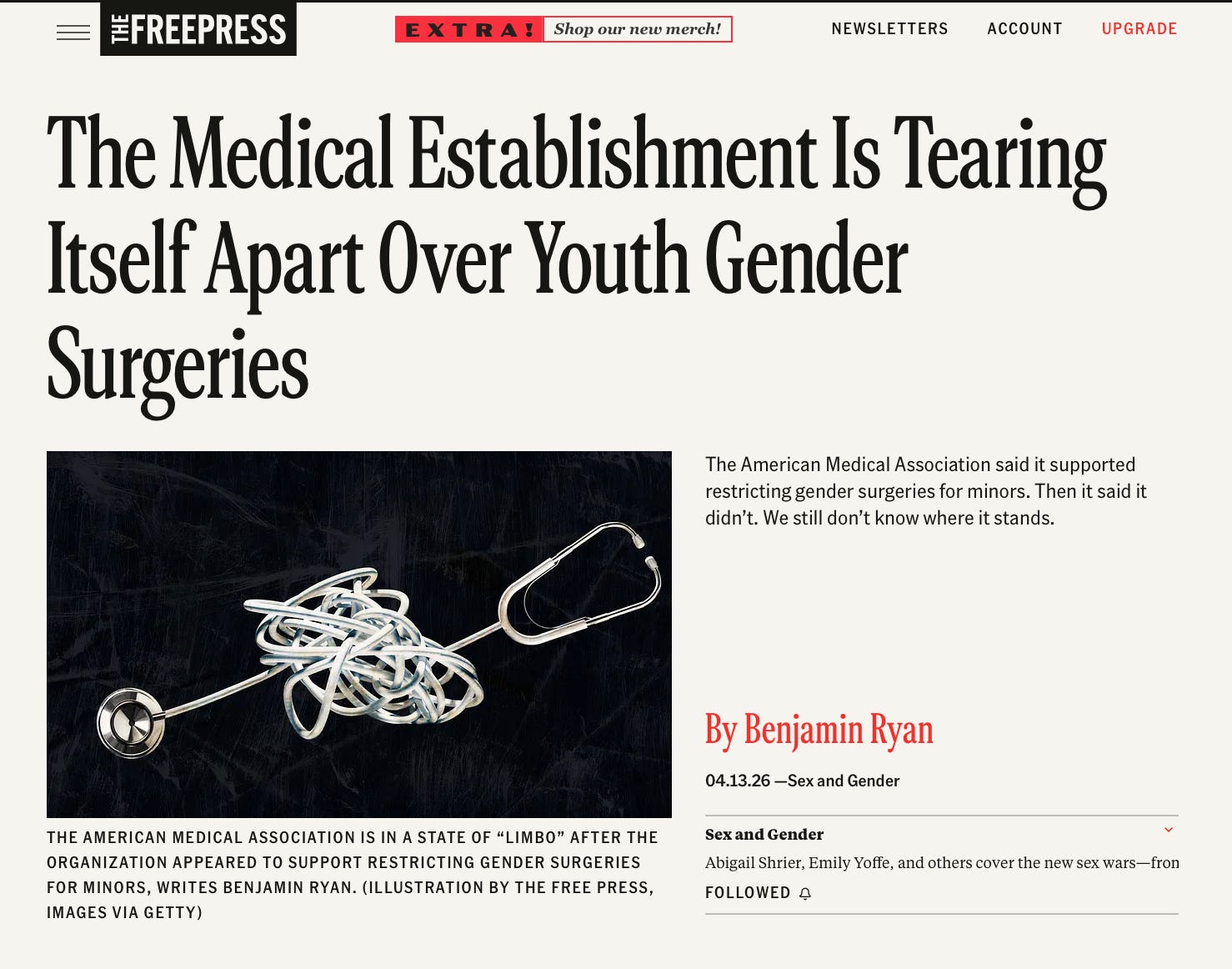
I published an article in The Free Press yesterday that peels the lid off the American Medical Association and reveals what that led the organization’s board president to claim, without evidence, that the The New York Times had misquoted its statement endorsing limits on youth gender surgeries. I revealed that the AMA’s CEO contradicted the board president in an employee town hall, asserting that the board had signed off on the statement (while deferring any responsibility for it). This new Substack serves as a complement and appendix to my Free Press article, which I encourage you to read. It includes a lot of extra details about the surrounding politics that appear to have given rise to the imbroglio at the AMA.
This Substack is free to read. At the end of it, behind the paywall, I will provide for you the two key pieces of internal documentation on which I based my reporting for The Free Press:
The official transcript from a February 10 AMA town hall at which the CEO, Dr. John Whyte, and the director of communications, Josh Zembik, each addressed the media’s reporting of the AMA’s position on youth gender surgeries.
Comprehensive records from the message board of the AMA’s LGBTQ+ affinity group, on which numerous members expressed their upset that the AMA had gone against policy by at least generally advising against gender surgeries for minors.
I previously wrote about this story in a Substack that diagrammed how all the media outlets that quoted the AMA on the matter published some portion of the five-sentence statement from Mr. Zembik that the Times asserted in a March 27 statement that it received from the communications director in February.

The AMA Faces Political Peril
All of the drama started after the American Society of Plastic Surgeons on February 3 announced in a policy statement that it was recommending its members not provide gender-transition surgeries to patients under age 19. This prompted the AMA to tell The National Review and The New York Times, among other outlets, that it agreed with the ASPS and that such surgeries should “generally” be deferred to adulthood.
The resulting internal chaos at the AMA comes at a politically perilous time for the medical behemoth. Lawmakers in Washington have threatened to unravel the AMA’s monopoly over medical billing codes that generate well over $100 million in annual royalties for the organization. Multiple individuals who have held top positions at AMA expressed concern to me that Dr. Whyte, who became CEO last year, seems keen on appeasing President Trump by aligning with the administration’s conservative overhaul of major institutions. Trump has been vocal about his disdain for pediatric gender medicine, and gender clinics at multiple major children’s hospitals have closed after the administration has threatened to cut off access to federal funding.
The AMA did not respond to multiple requests for comment.
In January, the Centers for Medicare and Medicaid Services director Dr. Mehmet Oz held what the Times reported was a “tense meeting” with the leaders of top medical associations to discuss the field of pediatric gender medicine. In attendance were Dr. Aizuss and Dr. Whyte. Two of the AMA leaders I spoke with told me that Dr. Oz has previously spoken of his and Dr. Whyte’s long-standing relationship. I contacted the U.S. Department of Health and Human Services, which confirmed the relationship. At the January meeting, ASPS leadership made evident that they were preparing to publicly oppose gender surgeries for minors.
The AMA board then set to work drafting a response should media outlets ask them about the ASPS’s position, according to the March 26 board newsletter penned by Aizuss in which he accused the Times of misquoting the organization.
On February 3, the ASPS published its policy statement opposing youth gender surgeries. In its coverage of the development, the Times ran a statement from the AMA: “In the absence of clear evidence, the AMA agrees with ASPS that surgical interventions in minors should be generally deferred to adulthood.” The National Review, and multiple other publications, published parts of the broader AMA statement.
According to two of the AMA leaders I spoke with, board members were immediately upset that the statement given to the Times did not reflect the statement the board had crafted. In particular, the board did not intend to say that it sided with the ASPS. It’s not clear what the exact wording of the intended statement actually was.
This set off a period of confusion and debate among AMA membership over whether the news outlets had misquoted Mr. Zembik.
The day the Times story ran, Dr. Andrew Norton, a pediatrician at the University of Wisconsin, wrote on the LGBTQ+ group’s message board that “it appears whoever spoke” to the press about the AMA’s position on youth gender surgeries “did not follow policy.” He referenced a 2024 AMA policy document that stated that “medical and surgical treatments for gender dysphoria” are “medically necessary” and that made no suggestion of age limitations.
Some of the group’s members expressed concern that politics had been broadly guiding AMA decision-making, and conveyed a wider loss of trust in the organization’s leadership.
Dr. Frank Dowling, a psychiatrist at Stony Brook School of Medicine expressed suspicion that at “least some in the AMA are working” on “an agenda and against our clear policies.”
“The fact that section leaders do not have answers, have no paper trail on this announcement, and we have no policy or report to back it,” Dr. Scott Chaiet, an otolaryngologist at the University of Wisconsin-Madison, wrote, “is very telling of our organization today.”
Dr. Kavita Arora, an OB/GYN at the UNC School of Medicine, voiced concerns about the AMA’s apparent political leanings. “Over the past several months, I have become increasingly uneasy about a number of significant decisions that appear to have been made at the management level rather than originating from, or bering directly directed by” the board, she said. She lamented “the reduction of state-level advocacy on women’s health, the scaling back of DEI initiatives, the discontinuation of the AMA Journal of Ethics, and most recently, decisions related to pediatric gender-affirming care.”
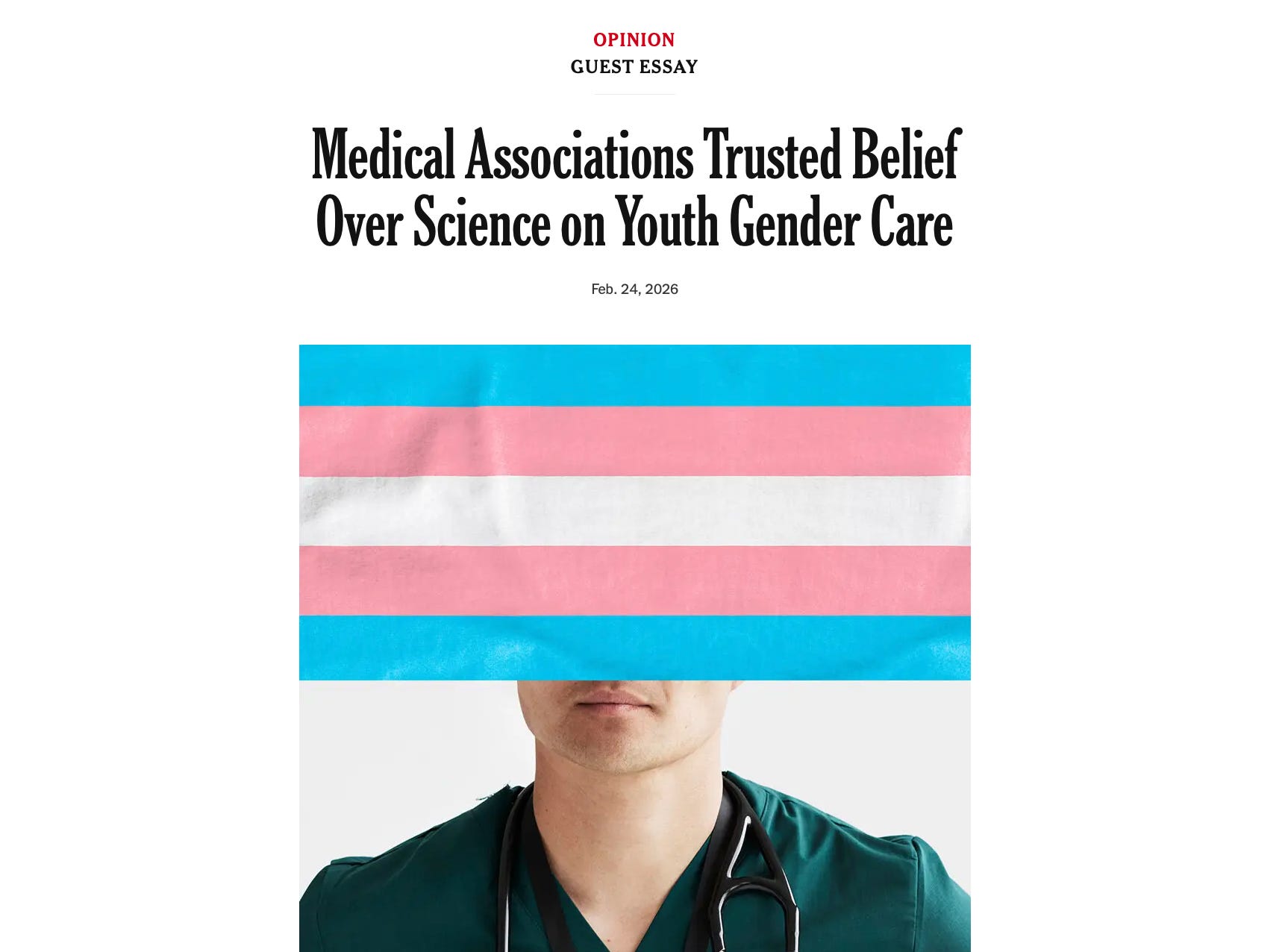
According to comments on the message board and my conversations with AMA leaders, the board initially decided not to seek a correction to the February 4 Times article, believing doing so would only feed the news cycle and worsen the public-relations fiasco. Better to do nothing, they thought, and hope the story would die down. It did not. The Times referred to the statement in an editorial by Jesse Singal, “Medical Associations Trusted Belief Over Science on Youth Gender Care,” on February 24 and again in the March 16 article on the Oz meeting.
The board’s inaction infuriated Dr. Frances Grimstad, a gynecologist at Boston Children’s Hospital, who gained notoriety in 2022 for a widely circulated video, since deleted, of her enthusiastically promoting gender-transition hysterectomies. (Amid uproar over the video, Boston Children’s asserted that it did not provide such surgeries to minors. The hospital also treats young adults.) On February 11, she wrote on the message board: “Choosing to be silent is the board being complicit in allowing the statement to stand as AMA’s voice, suggesting they support it, which is a smack in the face.”
Dr. Grimstad went on to say that “the policies and procedures that typically safeguard an org from being at the ideological whim of one person are being ignored, similar to our federal admin.” She asked if the organization was “just becoming the trumpian AMA,” guided by “rogue leadership?”

I wrote for The Free Press:
To complicate matters further, a video The Free Press reviewed from a February 10 AMA town hall showed the organization’s CEO, Dr. John Whyte, insisting that the board had, in fact, signed off on the published statement about youth gender surgeries.
At the gathering, which was limited to AMA employees, Whyte said that the AMA had publicly sided with the ASPS on youth gender surgery because this “was a position that the board of trustees voted on.” He continued: “Consistent with what the board felt was existing policy is that it generally should be delayed until adulthood.” He deferred responsibility, saying, “I’m not a member of the board.” The AMA did not reply to multiple requests for comment.
Mr. Zembik did not challenge Whyte’s characterization during the town hall. But he did say at the gathering that the statement “wasn’t a position change. This was a clarification in case we were asked.”
And yet there is no evident documentation of the AMA having ever issued a public statement regarding age limits for gender surgeries.
I wrote for The Free Press:
On March 26, nearly two months after the original Times article ran, the AMA’s board chair, Dr. David Aizuss, published a newsletter in which he declared that the newspaper had published an incorrect statement whose “phrasing did not come from the AMA.”
“During our Board discussion, we were clear that we were not changing AMA policy,” he wrote. Aizuss said the AMA had written to The New York Times and “requested a correction on their part to reflect the actual language the AMA used.”
But the following day, the Times communications department defended its reporting in a press release, which included the full five-sentence remark that AMA’s communication’s director, Josh Zembik, provided the paper. The Times also wrote that it “received no requests to correct, clarify or update our articles from the A.M.A.”
After reading the Times’ statement, Dr. Paula Amato, an OB/GYN at Oregon Health & Science University, who is part of the LGBTQ+ group, told me: “The AMA statement is inconsistent with current AMA policy.”
I wrote for The Free Press:
Once it appeared clear that The New York Times had, indeed, not misquoted the AMA spokesperson, members of the LGBTQ+ group trained their ire on the AMA’s leadership.
Dr. Sophia Spadafore, an emergency medicine attending physician at Mount Sinai in New York, wrote on the LGBTQ+ message board, “That fact that our board may have been lied to about such a huge issue (whether the misstatement was intentional or not I don’t know) needs to have real consequences.”
I wrote for The Free Press:
On March 29, Aizuss wrote on the group’s message board that he had addressed the matter “with senior management” and would be discussing it further at the April board meeting. He said that “there continues to be a discrepancy between what the New York Times states they were told and what our communications people say they said.” He added: “If our spokesperson said that the AMA agrees with the ASPS, that was a clear error and was not authorized by the board. He unfortunately does not recall if he used those words.”
Dr. Aizuss said that the “board gave very specific guidance” to the communications team. He made it evident that he believed that the AMA spokesperson had conveyed the statement to the Times verbally and had no recording of the conversation.
And yet a representative for the Times told me that the statement from Mr. Zembik came in over email. The author of the National Review piece, Haley Strack, also told me that she received the statement from the AMA in writing. A journalist at another publication, who asked for anonymity because they were not cleared to speak on the matter, said they received the full statement from Mr. Zembik digitally; I reviewed a copy of the message from Mr. Zembik.
Dr. Grimstad pointed the finger squarely at the AMA, on March 29 writing on the message board: “In this moment where the credibility of American medicine is being questioned at every turn, for the AMA to add to the national distrust by suggesting NYT has no editorial standards and, when facts come to light, it was the AMA that was the source of misinformation…a massive deal.”
Fact checking a misleading article in The Advocate
(Feel free to scroll past this if you just want to look at the source materials, including the AMA town hall transcript and the detailed records from the LGBTQ+ group’s message board.)
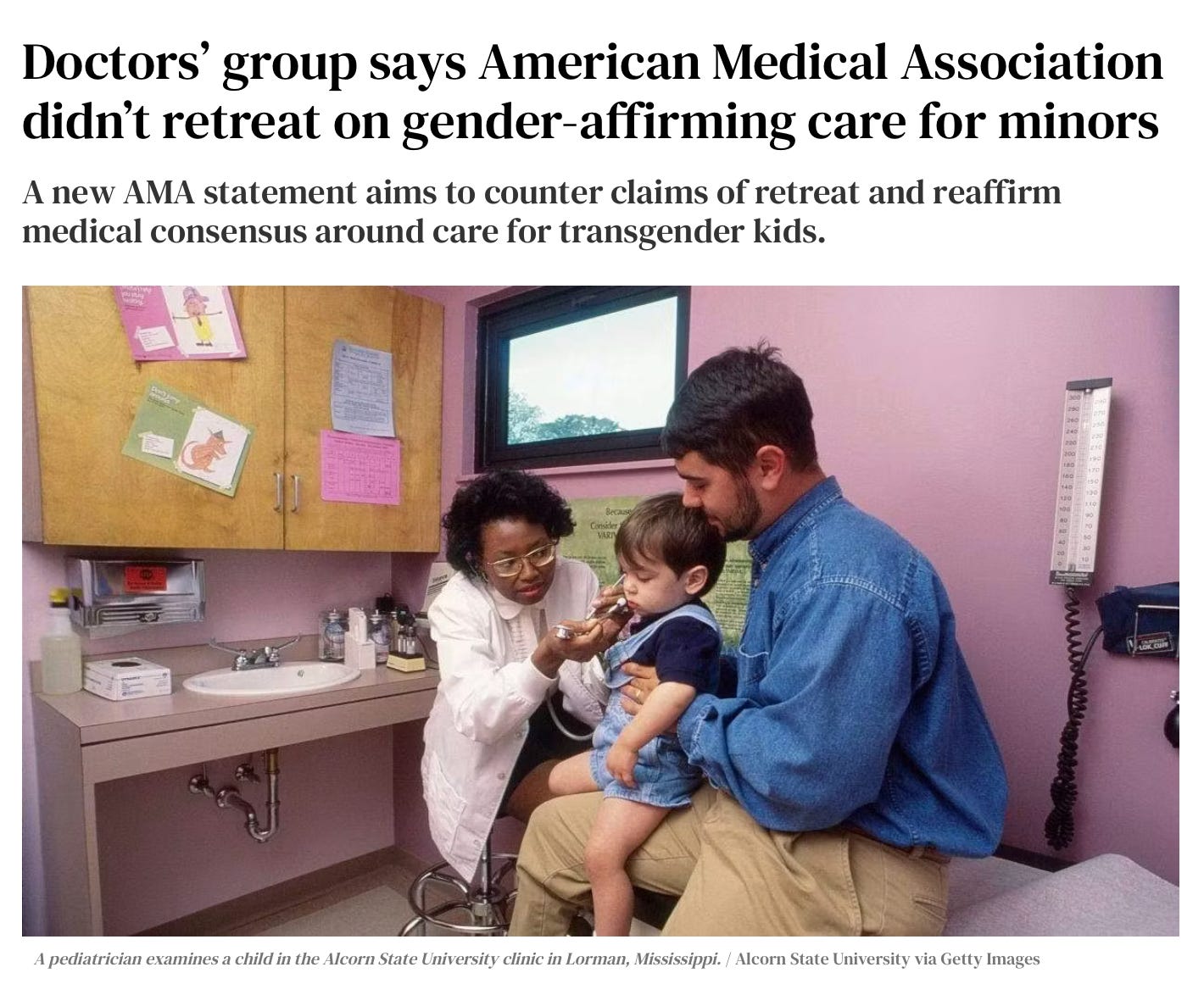
One member of the AMA’s LGBTQ+ group is Alex Sheldon, executive director of GLMA: Health Professionals Advancing LGBTQ+ Equality. Sheldon, who uses gender-neutral pronouns, gave an interview to The Advocate for an article that ran April 1: “Doctors’ group says American Medical Association didn’t retreat on gender-affirming care for minors.”
The article sought to do two things that it never acknowledged are in direct conflict with one another:
Deny that the AMA released a statement about youth gender surgery that ran contrary to what the board prepared for the press
And yet credulously insist that the organization had not, in fact, publicly changed its policy on the matter in the statement Mr. Zembik provided.
Both of these things cannot be true at the same time. For starters, as I have made clear, there is no evidence that the AMA had ever taken a stance on age limits for gender surgeries. And the statement Mr. Zembik provided did agree with the ASPS on generally deferring surgeries until adulthood. Furthermore, multiple AMA members have made evident that the statement published by the Times did represent a change in policy.
The Advocate stated the following regarding what the Times had reported about the AMA’s stance on youth gender surgeries:
In an interview with The Advocate, Alex Sheldon…said the controversy reflects misinterpretation rather than any substantive shift in medical guidance.
“We knew right away that any shift in policy that was being reported was a grave exaggeration,” Sheldon said, pointing to GLMA’s role within the AMA’s House of Delegates, where it has a voting seat and direct visibility into policymaking.
…
Sheldon argued that the nuance was lost in translation and then amplified.
“In this case, the New York Times relied on a quote that was itself sourced from another outlet,” they said, describing an “echo effect” that distorted the AMA’s underlying policy framework.
Being a member of the AMA’s LGBTQ+ group, Sheldon had access to its message board, where he was an active participant (as you can see in the screenshots below). There, the group had emotionally-charged, in-depth discussions about how the gender-surgery-related statement that the press reported was not what the board had prepared and represented a change in poicy. And yet, despite recent developments that were discussed on the message board, Sheldon still tried to pin the blame on the Times.
It is always possible that Sheldon did not check the message board to see Dr. Aizuss post on March 29 the very strong suggestion that the Times was not at fault, that the problem was internal. And then there was Dr. Grimstad making abundantly clear that the AMA was the culprit.
Dr. Aizuss’ complete quote on the message board was:
“I’ve had a number of calls yesterday with senior management regarding the statements to the New York Times. I will be discussing this further with the Board at our April meeting. At this point, there continues to be a discrepancy between what the New York Times states they were told and what our communications people say they said. Unfortunately, there is no tape recording to my knowledge, and it is difficult to verify exactly what was stated by our spokespeople compared to what the New York Times says they were told. Regardless, there will be further discussion of this entire matter. As you can imagine, I am deeply disappointed by the information that was provided to me. the board gave very specific guidance to enterprise communications, and specifically what was to be utilized in responding to press inquiries, as I have said to all the groups that I met with it now appears that there may have been some deviation.
“If he use [sic] those words, it was just in regards to the fact that we stated gender, affirming surgery in minors should be generally deferred to adulthood, which is similar to what was stated by the ASPS. However we do not agree under any circumstances with the ASPS 9 page statement. If our spokesperson said that the AMA agrees with the ASPS, that was a clear error and was not authorized by the board. He unfortunately does not recall if he use those words.
“As I noted, I will continue to follow up with senior management, both our CEO and Josh are out for the next week. I will be in Chicago the following week for meetings some of which will be addressing this issue as well as the following week for the board meeting.”
Sheldon claimed to be providing The Advocate with a “clarification” on the matter. (Incidentally, this is the same word that Mr. Zembik used to characterize what he told the press when addressing the issue at the town hall. That word also showed up in reporting by NPR on February 8 and STAT News on February 10. Coincidence?) And yet Sheldon was, knowingly or not, clouding over the internal confusion and upset at the AMA over how Mr. Zembik gave the Times a statement that did indeed represent a major change in policy.
All this raises the question of why Sheldon felt the need to make these claims to The Advocate at this particular moment in time. And did the AMA put Sheldon up to it, or did Sheldon go rogue?
The internal AMA documents I obtained:
Just below are screenshots from the official transcript of the February 10 AMA town hall, which was limited to AMA employees and took place one week after the ASPS released its policy document on youth gender surgeries and the AMA provided its response to that document to media outlets.
