
How Did Jesus Become Palestinian?
On the multiple sources of our modern culture

“On the same day, I went to the late martyr, Abu Jihad, and said to him, “You are now being put up on the cross [By Israel].”—This was in the idiom that we used.— But he didn’t believe me, and a month later, he was assassinated.”
These are the words of Mohammed Dahlan, the Palestinian politician and former leader of Fatah in Gaza, in a recent interview on an Arab Gulf television network. Dahlan’s use of Christian symbolism did not initially capture my attention. This is common practice among Palestinian intellectuals and politicians. Having read widely in Palestinian political and literary writing, I had grown so accustomed to such Christian imagery that it had become invisible to me—part of the furniture of the discourse. What caught my attention this time was his clarification—the fact that he rightfully felt the need to explain his use of the Christian symbol for his presumably Muslim audience.
This tells us something. The language of crucifixion is internal to the Palestinian political class, natural enough that Dahlan calls it “the idiom that we used,” yet foreign enough to ordinary Muslim Arabic speakers that it cannot be left unexplained. It is not, then, Islamic. Nor is it simply Christian. It is a secularized post-Christian political vocabulary, so thoroughly internalized by the Palestinian intelligentsia that it has become private language. Understanding the origins of this vocabulary—how a first-century crucifixion became “the idiom that we used” among twentieth-century Muslim revolutionaries—may help illuminate the entangled intellectual sources of the Palestinian movement itself.
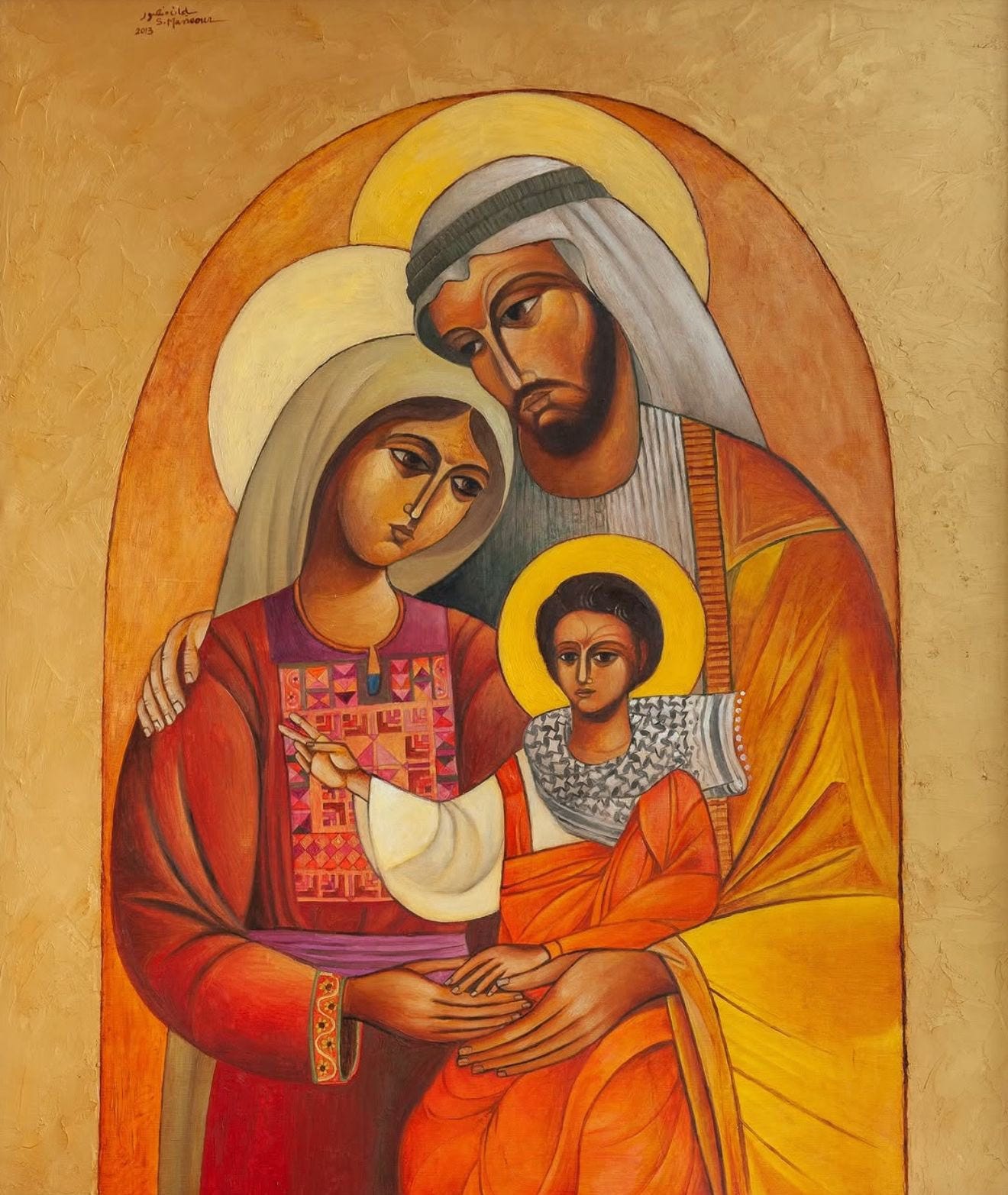
For several decades, the figure of a Palestinian Jesus has served as a central metaphor in international Palestinian advocacy: Palestine as oppressed, exiled, occupied, wounded—Palestine as Christ. Christian visual motifs and iconography have been adapted, infused with Palestinian symbols, to construct a tableau of Palestinian victimhood against Israeli villainy. Christmas in particular has become a season of conflict over the symbol. Every year, pro-Palestinian and pro-Israeli activists wage what might be called “Jesus wars”—battles over who owns the Nativity, who can claim Bethlehem, who gets to dress the Holy Family. This past Christmas, the Palestinian Authority’s official account posted an image of Jesus in a keffiyeh, Mary and Joseph as Palestinian peasants. The provocation is annual, predictable, and effective.
The standard explanation is propaganda. The symbol is viewed as an instrumentalist ploy designed to exploit Western Christian sympathies—a calculated manipulation with no deeper significance. This explanation is not wrong, but it is inadequate. If the Palestinian Jesus were merely a propaganda tool aimed outward, at Western audiences, it would not explain Dahlan’s usage. He was not speaking to Western Christians. He was speaking Arabic, to Arabs, about internal Fatah affairs. The crucifixion—an event Islam explicitly denies ever took place—has become so natural to Palestinian political discourse that Dahlan calls it “the idiom that we used.” A symbol with no standing in Islamic theology, drawn from the one episode in Jesus’s life that Muslims consider a fabrication, has become the private language of a Muslim revolutionary movement. This is beyond propaganda. Something else has happened. The symbol has been internalized from a source that is neither Islamic nor Christian in any straightforward sense, but rather a secularized post-Christian political vocabulary whose origins lie elsewhere entirely.
“This is blessed Christmas, the birthday of our Lord Jesus Christ, the first Palestinian and the first Shahid (Islamic Martyr).” ––Tawfiq Tirawi, senior Palestinian leader and Fatah Central Committee on his Facebook page, Dec. 24, 2019
Indeed, instrumentalism plays a role, but it is both simplistic and unwise to consider the phenomenon purely in terms of strategic communication. The celebration of Jesus as a Palestinian, or a proto-Palestinian, figure is not the work of a single line of thought or a single ideology. The Palestinian Jesus is a composite figure, the outcome of the coalescence of the three main ideological components of Palestinianism around the symbol of Jesus: revolutionary radicalism, Palestinian romantic national myth-making, and Islam. These three have coalesced around the symbol of Jesus, each contributing a different layer of meaning, each drawing on different sources. The result is a figure that is overdetermined—a symbol that means several things at once, to different audiences, for different reasons.
Of the three components, the Islamic is most frequently cited as the source of Jesus’s Palestinian identity. This is understandable. Muslims do claim Jesus as a prophet, and it seems natural to assume that Palestinian Muslims are simply asserting their own religious tradition. But this assumption is mistaken. The Islamic contribution to the Palestinian Jesus is, paradoxically, the most recent and the weakest of the three. The symbol’s core does not derive from Islamic theology. It derives from a secularized post-Christian radicalism transmitted to the Middle East through quite specific channels, and from a romantic nationalist project that predates the Islamist turn in Palestinian politics by several decades.

