







One of the things I love most about Central Park is its history.
It was created back in 1914 by Schenectady Mayor George Lunn and General Electric scientist Charles Steinmetz, two individuals I admire greatly. The idea was for the city to have a nice place for its citizens - many of them poor immigrants looking for work at GE and the American Locomotive Company - to escape the trials and tribulations of urban life in the early 20th century.
For much of its 115 years now, Central Park has been a wonderful oasis for both children and adults, offering a swimming hole, playground, woods with walking trails, softball and baseball fields, a rose garden and tennis courts.
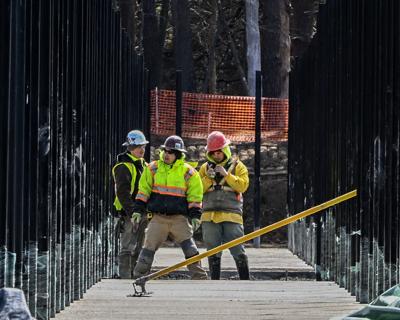
This column is about the tennis courts. It’s a wonderful facility that helped Schenectady and Central Park get on the international tennis map. And I could go on and on about some of the changes that I don’t like, such as the removal of the layered three-tier court layout that helped give the place a special look. With its two short stone walls attached to a grassy area, it was no concrete jungle. It may still look great when it’s done in a few weeks, but it will be flat, with no grass between courts. It just won’t be like it was.
I also had a friend who wished to have some of his ashes buried at the facility on what had been a nice grassy area with two small shrubs. His family acted on that wish when he died in 2012, but that grassy area and the shrubs are gone. There’s nothing left there but concrete, or whatever the actual surface of a tennis court is made up of these days.
But I understand that time marches on and things change. And it’s nice that the United States Tennis Association has contributed financially to the work being done. While I don’t play much tennis these days due to arthritis in my hand, I find myself driving by the courts just to check up on them, refresh a few old memories, and to see who’s playing. And the courts, from most of the people I talked too, did need some work.
So, despite my minor misgivings, the Central Park tennis courts will continue to be a wonderful place to play the game we love, and 18 brand new courts is something we can all be happy about.
But there is a problem. City officials are hoping to begin charging for court time. There will be a meeting at City Hall tomorrow (Tuesday) night at 7 to break the news to the public, and to introduce a brand new system to secure that court time and pay for it, courtesy of the USTA.
It’s called SmartAccess, and according to AI it is a “system that allows facilities to manage reservations, process payments and control gate locks.”
So, yes, you’re going to have to go on line and reserve a court. The idea of grabbing your cell phone as you walk up to the facility to make sure you can access your court brought an audible groan to a number of people I spoke to. The idea of heading to the courts and maybe picking up a match when you get there will likely become history. And there’s no hitting wall to test your groundstrokes, and people aren’t going to pay a fee to hit against a wall.
Officials from the Schenectady Tennis Association I talked to aren’t very happy. I also spoke to four long-time Central Park regulars and they’re also not very happy with the new system.
And just how much is it going to cost? Most of the people I know can afford it, but the annoyance of it may turn some people away.
And what about those who can’t afford it. What about the young boy or girl who leave their own neighborhood park to find better competition at Central Park. In my four-plus decades of “hanging out” at Central Park I know a handful of people, some kids and some adults, who did exactly that in an effort to get better at the sport. In the future are those newcomers to the game going to make Central Park their primary destination to hit tennis balls? And for me, part of the enjoyment that comes with playing tennis for nearly 50 years is seeing other people pick up the sport and become passionate about it. Hopefully, the changes that are coming to Central Park won’t be too onerous. I’m looking forward to Tuesday night’s get-together to see what more we learn, and what, if anything, we might be able to do about it.
Preservation awards
The Schenectady Heritage Foundation will hold its annual awards ceremony Thursday at 4 p.m. in the City Hall Rotunda.
There are eight buildings slated to earn some recognition, including the 1913 pump station in Riverside Park, the 1904 apartment building on the corner of State Street and Washington Avenue, and the Elmer Garden Apartments, once home to the Elmer Avenue Middle School.
Seneca Chief heads home
The Seneca Chief, which sailed through the Mohawk Valley and Schenectady last October to help commemorate the 200th anniversary of the Erie Canal, will soon be leaving its winter home in Waterford and returning to the Buffalo Maritime Center.
The replica canal boat will be leaving Waterford the morning of June 6 and will arrive later in the day in Schenectady at Mohawk Harbor where the boat and it’s crew will spend the night.
If you miss it’s first stop, you’ll be able to catch it in Amsterdam on June 7. The Seneca Chief will arrive back in Buffalo on June 27.
Realty Plot tour
The General Electric Realty Plot tour returns on June 20 next month with a new twist. “A Neighborhood That Changed the World,” its new moniker, will consist of the usual house tour but also offer a story or two told by the home owners; that is actors playing the home owners that lived in those houses back in the early 20th century.
House tours begin at 11 a.m. that day. Tickets are $20 for anyone 12 and above. For more information, contact the Whitney Bookstore or visit the GE Realty Plot website.


