
A Hardcore Reading of the MSS Report: The Old Order Is Dead, Comprehensive Stalemate Has Arrived
CICIR Publication of May 13: China's Top Leadership on the Structure of the World

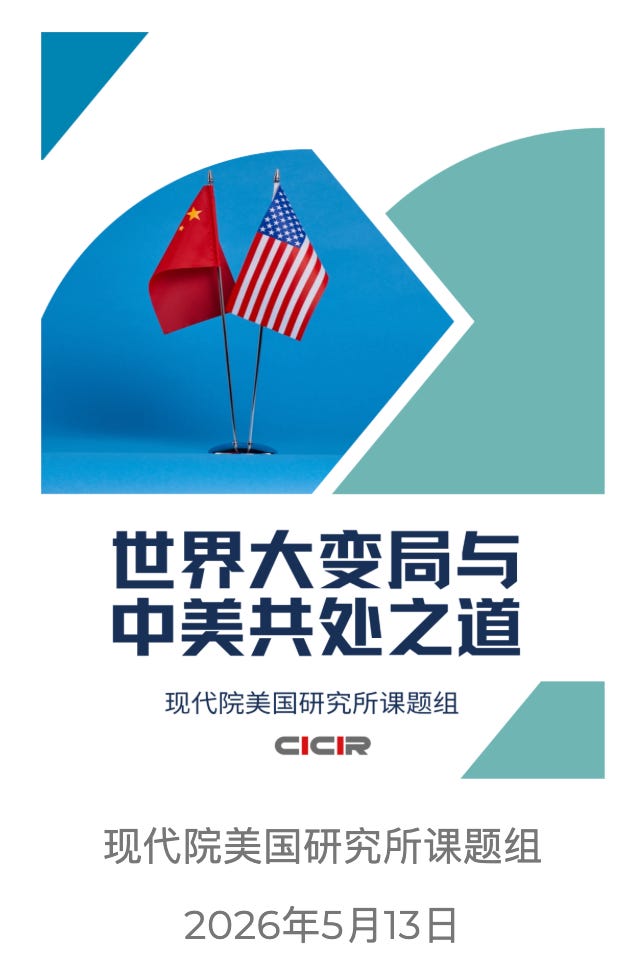
On May 13, the China Institutes of Contemporary International Relations (CICIR) publicly released The Great Global Transformation and the Path to U.S.–China Coexistence. CICIR is the research institute of China’s Ministry of State Security (MSS). The document was then published on chinadiplomacy.org.cn, jointly operated by the Ministry of Foreign Affairs’ affiliated China Institute of International Studies (CIIS). Arnaud Bertrand has accurately flagged the weight of the source in his Substack — this is about as close as one gets to sitting in on a Politburo briefing.
Western media read the document as “the worst is over.”
That is a misreading. The heaviest content of the document is not the diplomatic phrasing in its conclusion. It is the hard judgments wrapped inside the diplomatic language of Sections I and II. The document is built on three layers of structural assessment, each closer to the actual viewpoint of China’s top leadership than any ordinary think-tank analysis. This piece unpacks them one layer at a time.
Layer One: The Old Order Is Dead — That Is the Document’s First Sentence
The document opens with this line: “The so-called liberal international order that sustained the post-Cold War system has already collapsed.”
That sentence carrying MSS-affiliated authorship is far heavier than the same sentence from an academic paper, a think-tank report, or a media commentary. MSS does not write academic essays. MSS does not run thought experiments. A conclusion delivered in a public MSS document is China’s top intelligence apparatus stating its current positioning on world structure.
The second sentence cuts deeper. The document cites the American foreign policy scholar Richard Haass as support — but MSS selected the sharpest of all Haass’s arguments: one of the key reasons for the decline of the liberal international order is that “the United States, the principal creator and guardian of that order, has itself begun to depart from the system it built.”
Notice MSS’s precision in word choice. MSS did not say “America has changed.” MSS did not say “America is in decline.” The language that appears in this MSS public document is — America is departing from the system it built. This is a very precise diagnosis: the death of the old order is not being inflicted by external force. It is being dismantled by the order’s own creator.
ChinArb’s long-time readers should immediately recognize this logic — the genuine threat to a system comes from internal defection from its own rules, not from external challengers. System A (the financial-military-legal infrastructure of the old order) is being taken apart by its own core node. This judgment is closer to the truth of the matter than any “China threat” theory, any “American decline” theory. It also carries more weight than any diplomatic phrasing — because it comes out of MSS’s mouth, which amounts to a semi-official endorsement of the diagnosis.
The third nail is the historical pattern. From the document: “Recent major transitions of international order have all been completed after great wars — the Versailles-Washington system after WWI, the Yalta system after WWII.”
Translated into framework language: MSS publicly acknowledges that we are inside a great-war-scale window of order transition.
The Versailles-Washington system was a product of WWI. The Yalta system was a product of WWII. By placing these two historical analogies in Section I, MSS is anchoring a coordinate in a public document: the magnitude of the current order transition is on par with Versailles and Yalta. This is not a policy statement. It is a structural positioning.
ChinArb’s WWIII pentalogy published its first essay on April 12 — roughly one month ahead of this CICIR document. Two independent observation sources converged within one month on the same structural judgment: this is not a localized crisis but a WWIII-scale order transition. The shorter the gap, the stronger the signal — this is not speculation, this is the same underlying reality being identified through two different lenses. CICIR put it down in the official language of an MSS think tank. ChinArb put it down a month earlier in the language of a framework. Both language versions point to the same thing.
The remaining nails in Layer One —
The real weight of the crisis list. From the document: the Russia-Ukraine conflict spills over, Middle East warfare persists, the Strait of Hormuz situation “shapes global market expectations across energy, shipping, chemicals, and food,” and security risks “spread continuously through supply chains, financial markets, and social expectations.”
Notice that MSS quietly completed a categorical switch on the principal contradiction of the world here. Traditional geopolitical-conflict thinking — state versus state, bloc versus bloc, territory versus territory — is no longer in MSS’s core vocabulary. The MSS list is not a list of countries. It is a list of impact channels: straits, supply chains, financial markets, social expectations. The dominant form of conflict in the world, in MSS’s official language, has now been defined as supply chain conflict.
This nail is heavier than the opening line about the old order’s collapse. Because it acknowledges: the specific mode of the old order’s death is being dragged down by a new type of conflict it cannot comprehend. Traditional geopolitical thinking is no longer sufficient to understand modern warfare — this is not ChinArb commenting from the outside. This is the default premise in an MSS document. Hormuz being named as the chokepoint that “shapes global energy, shipping, chemicals, and food” — four global domains — is effectively declaring: the battlefield of modern war is not on borders, it is on supply chain nodes. Anyone still using 20th-century geopolitical thinking to analyze this is already using the wrong tool to look at the wrong thing.
The System C nail. MSS makes a rare citation of New York Times columnist Thomas Friedman — that “the emerging risks from asymmetric cyber threats brought by agentic AI systems are the common enemy of China and the United States.” MSS choosing the term “common enemy” is not rhetoric. In MSS’s language system, “common enemy” carries strict classification — the Soviet Union was once the common enemy of China and the United States, terrorism was once the common enemy of China and the United States. Now, AI joins that list.
ChinArb readers should immediately see the weight of this. ChinArb has consistently argued: there are not two supply-chain systems in the 21st century, but three — System C: the Silicon Valley stack of compute + protocol + distributed energy, with representative companies Tesla, SpaceX, Anduril, Palantir, Boring Company, Neuralink. C’s core characteristic is using Bits to reorganize Atoms, fundamentally incompatible with A’s logic of abstracting Atoms into Paper (financialization).
What MSS is doing in this document is — at the level of diplomatic language, acknowledging for the first time that System C exists as an independent force. “AI is the common enemy of China and the United States” translates into framework language as: neither A nor B can tame C alone. C’s destructive force belongs neither to A’s toolkit (financial-military-legal sanctions) nor to B’s toolkit (capacity-supply chain-market access). It requires A and B to act jointly. This is MSS publicly recognizing that C constitutes a third pole outside the A-B bilateral game.
This nail is not a minor item on the crisis list. This is the first semi-official articulation of the three-system framework in Chinese official language.
Layer Two: Comprehensive Strategic Stalemate Is the Official Chinese Version of Hostile Symbiosis
The core phrase in Section II of the document — “U.S.-China rivalry has moved from the preliminary strategic stalemate of Trump’s first term into a new phase of comprehensive strategic stalemate.”
“Comprehensive strategic stalemate.” This is the first appearance of this term in the public language of a Chinese state-linked think tank.
To understand what “comprehensive strategic stalemate” means, you need a framework. Put simply: this is the official Chinese version of Hostile Symbiosis — the stable structure where symbiosis and antagonism are simultaneously true. ChinArb readers should recognize the structure.
But to see how MSS uses three sets of concrete data to nail down this structure, the document’s original passages need to be opened one by one.

