
abadonian/iStock via Getty Images
Co-authored by Kody's Dividends
While much of the world is focused on commodity prices, specifically oil price volatility, there is an entire sector in the United States that often trades along with commodity prices but is not directly exposed to them. Those would be midstream partnerships and midstream corporations. These companies overwhelmingly operate a toll bridge-style system with their pipelines, where companies pay for the movement through the pipeline regardless of what the price of the commodity is that's traveling through it. Some of them have a take-or-pay contract where they are committed to a minimum volume that they have to pay for. Whether they use it is up to them. The money is still required to be paid to the toll bridge owner.
Pipelines are extremely hard to not only get approved to be built but also to be replaced. This means that those companies that have miles upon miles of pipeline are owners of critical infrastructure that's necessary for the continuation of the economy on a day-to-day scale, but also the growth of that economy. Pipelines are now getting interest from various counterparties who are involved in data center production because these data centers require massive amounts of power to operate, and if you have a cluster of data centers together, the demand on the power grid can be enormous. Utilities are building out their ability to handle the demand and scale of various projects, but some of them are deciding to source power on their own. This usually entails a localized power generation facility tied to a contracted supply of natural gas.
Today's focus not only owns miles of pipelines but is also getting interest from data centers.
Let's dive in!
A Winner Of The Data Center Boom
ONEOK Q1 2026 Earnings Presentation
As we outlined in February, ONEOK's (OKE) network of 60,000 miles of NGL gathering and crude oil transportation pipelines, as well as storage assets, is vital to the U.S. economy. At the time, we also thought that ONEOK’s business was well-balanced.
Following the company’s first-quarter results shared last month, our views were arguably validated. ONEOK’s total revenue climbed 19.6% higher over the year-ago period to $9.62 billion in the quarter. Double-digit percentage growth in NGL raw feed throughput volumes and refined products volumes shipped (+15% and +12%, respectively) contributed to these results for the quarter. A 5% increase in natural gas volumes processed chipped in as well. Volume growth in the Permian Basin was made possible by the completion of its 150 million cubic feet per day natural gas processing plant relocation during the quarter.
Top-line synergies from the EnLink Midstream and Medallion acquisitions also played a role in the growth in the first quarter. Favorable price differentials between the Waha Hub and Katy, Texas markets were yet another contributor.
ONEOK’s adjusted EBITDA also rose 12.5% year-over-year to $2.00 billion for the first quarter.
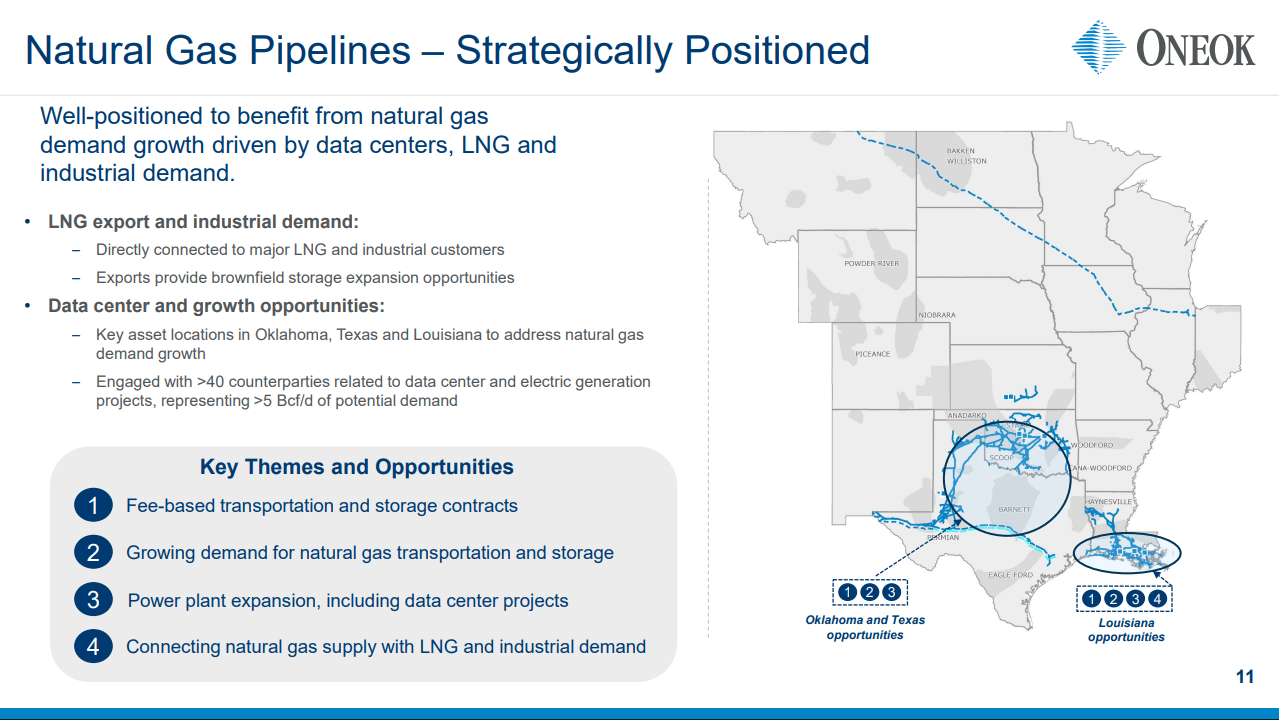
Moving forward, the company’s growth opportunities are multifaceted. In his opening remarks during the Q1 2026 Earnings Call, Chief Commercial Officer Sheridan Swords noted that ONEOK continues to see significant interest from data center-related opportunities in Oklahoma and Texas. The company is engaged with over 40 counterparties, making up more than 5 billion cubic feet per day of potential demand. At the time of the earnings call, ONEOK was in advanced discussions with several counterparties.
What’s more, the company is directly connected to major LNG and industrial customers. This is another growth avenue for ONEOK.
Financially, the company remains on track to reach its leverage target (3.5x) right around the end of 2026. This should provide further support to ONEOK’s BBB S&P credit rating with a stable outlook. Coupled with the bulk of its larger capex being completed by the middle of 2027, that is expected to free up cash flow for additional dividend growth and potential share buybacks.
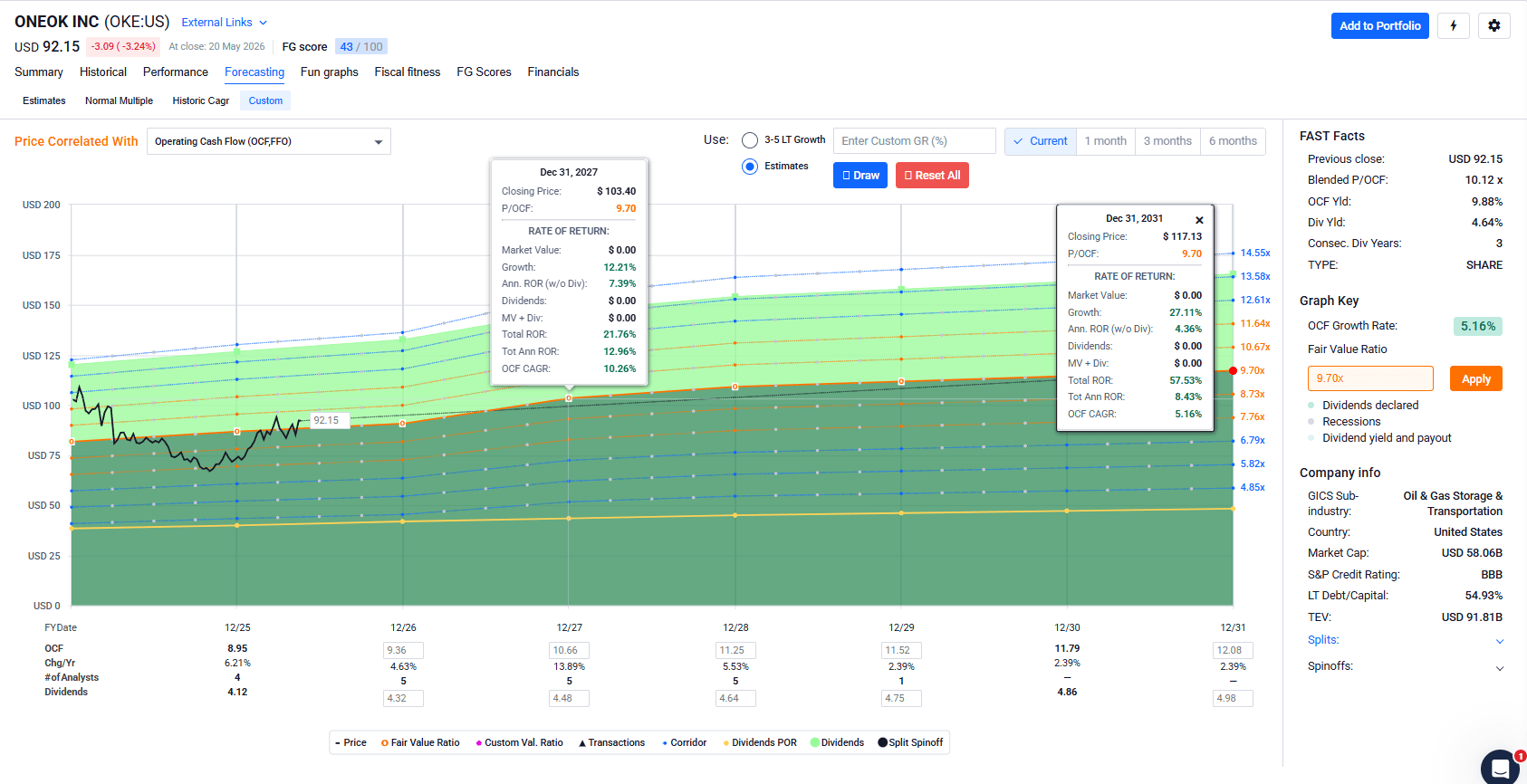
This is why the FAST Graphs analyst consensus is for operating cash flow per share to grow by over 6% annually through 2028, off a 2025 base of $8.95. ONEOK’s nearly 5% dividend yield is well-covered, with the EPS payout ratio slated to be in the mid-70% range in 2026. That’s why we think that 4% or 5% annual dividend growth can persist for the foreseeable future (for a Chowder number of 9 or 10).
FAST Graphs, FactSet
At the current $92 share price, the stock is priced at a forward 12-month P/OCF ratio of 8.37. That’s moderately under the 10-year average P/OCF ratio of 9.7, per FAST Graphs.
Overall, we believe that the 10-year average P/OCF ratio remains a reasonable expectation for ONEOK’s fair value. This is because the midstream giant’s 6%+ annual OCF per share growth consensus matches the 10-year CAGR of 6.5% (with ONEOK’s growth catalysts, the case could also be made that the forecast for 1.5% growth in 2028 is selling it short).
If ONEOK meets growth projections and reverts to fair value, it could log a 21% upside through December 2027. By the end of 2031, ONEOK could produce 8%+ annual total returns.
Relevant risks to the midstream operator include volume risk and attempted cyberbreaches.
The vast majority of ONEOK’s adjusted EBITDA (90%) is fee-based, which insulates it from direct commodity price risk. However, the real risk is the possibility of WTI crude oil falling and staying in the $60s or lower for a prolonged period. That could force cuts to growth capex for producers, which would impact ONEOK’s volume growth.
Another risk to the company is that its importance to the U.S. economy makes it a prime target for hackers. Amid the conflict with Iran, this is particularly worth noting. If Iranian-affiliated actors successfully breach ONEOK’s IT networks, that could disrupt its operations and cost it through litigation and regulatory penalties as well.
Conclusion
ONEOK is a reliable generator of returns over the long run. Its critical infrastructure and management focus on long-term success position it to reward shareholders without the drama and noise of other opportunities in the market.
Investors who are looking for an excellent midstream opportunity but do not want to have to deal with the K-1 tax form at tax time can tremendously benefit from investing in this midstream corporation. It allows you to collect strong, qualified dividend income while simultaneously enjoying exposure to a sector that benefits from regular economic activity without needing the excitement of consumers or the focus of government for it to continue to succeed.
As a dividend investor who is focused on total returns and growing dividends, I love owning companies that operate a toll bridge-style business. ONEOK is an example of a company that can be just that for you.


