

Controversial Pediatric Gender Panel Draws Trans-Activist Push for Cancellation
Trans-activist Substacker Erin Reed has prompted an uproar over a panel of skeptics of pediatric gender medicine slated for Sunday at the Pediatric Academic Societies meeting in Boston.

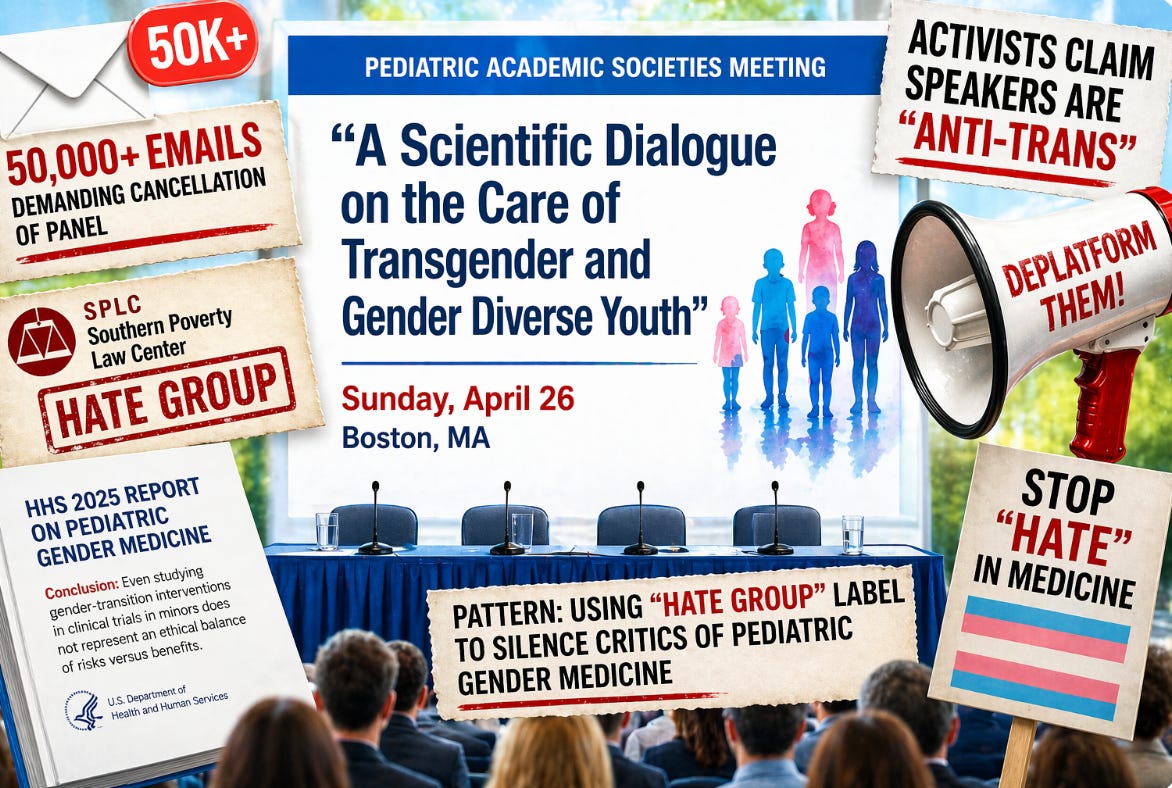
Note: After the April 26, 2026, panel, I obtained some video of protests and disruptions as well as audio of the moderator introducing the panel. I dropped those at the end of this article. I also updated the article to show a response from the Pediatric Endocrine Society on April 27.
Transgender activists and their allies are in an uproar over an upcoming medical-conference panel concerning pediatric gender medicine that features skeptics of this field whom activists accuse of being anti-trans.
Since the prominent trans-activist Substacker Erin Reed published an article about the panel on Tuesday, conference organizers have at least supposedly been inundated with tens of thousands of emails demanding it cancel the panel, in particular due to the panelists’ connections to a small nonprofit known as the Society for Evidence Based Gender Medicine, or SEGM.
This burgeoning deplatforming campaign raises questions about the place that the free exercise of scientific ideas has within a medical field as peerlessly politicized as pediatric gender medicine. As transgender activists seek to shut down what they argue are toxic fringe positions akin to climate-change deniers, a relatively small but determined collection of scientific and medical experts have remained committed to publicly scrutinizing this field and defending themselves against what they say are baseless accusations that their perspectives are rooted in bigotry and animus.


The panel has drawn further ire of activists because one of the panelists was a coauthor of the 2025 Health and Human Services report that the Trump administration commissioned on pediatric gender medicine. The mammoth report concluded that even studying gender-transition interventions in clinical trials in minors is in critical tension with well-established medical-ethics principles.

SEGM, which has a small staff and a network of loosely affiliated clinicians and researchers, has quietly become a major influence in recent years in the fierce debate across the Western world over the quality of the evidence base backing the use of puberty blockers, cross-sex hormones and gender-transition surgeries to treat gender dysphoria in minors. The nonprofit conducts and commissions reviews of the related evidence, which have cast doubt on the ethics of providing these medical interventions to vulnerable youth who cannot consent on their own behalf.
The Southern Poverty Law Center, which this week was indicted by the Department of Justice over its past practice of paying informants in the organizations it scrutinizes, in 2024 branded SEGM a hate group. Supporters of SEGM have criticized the sprawling report on which the SPLC based their designation as shoddy and for having relied on tenuous, guilt-by-association inferences to unjustly malign an academic collective that relies on rigorous evidence-based-medicine standards to justly scrutinize pediatric gender medicine.
Leor Sapir, who studies pediatric gender medicine at the Manhattan Institute, in a direct message to me reflected on the activist campaign to cancel the upcoming panel, saying: “Citing ‘hate’ as a reason to de-platform the speakers is a lazy and transparently self-serving excuse to prevent physicians from hearing from experts with legitimate concerns about this area of medicine.” Dr. Sapir, who was a coauthor of the HHS report, referenced the fact that the SPLC report about SEGM was written in part by activists, as he continued: “This is especially true considering that the ‘hate’ label was manufactured by the same activists, precisely for this purpose. If gender medicine activists are so confident that the scientific evidence supports their position, they should have no difficulty making their case within the context of scientific debate.”
Trans activists such as Ms. Reed, however, routinely accuse Dr. Sapir of being an anti-trans activist who, they assert, leveraged his own biases when crafting the HHS report in service of undermining pediatric gender medicine. The Trump administration has indeed leveraged the report as justification for its policies attacking this field.
In response to such criticisms, Dr. Sapir asserted, “I’ve never called for suppression of discussion or debate on this topic.” He said that on the contrary, he had encouraged debate and “tried to organize debates” with his detractors, but with no success.
The panel
The panel in question is slated for Sunday morning at the Pediatric Academic Societies, or PAS, meeting in Boston. Its four panelists include widely published academics, researchers and clinicians who between them have experience in providing gender-transition treatment to children, in plastic surgery, and in bioethics. All of them have ties to SEGM, including having presented at the organization’s conferences.
The fierce blowback to the panel, a campaign that as of Friday afternoon had not produced the results activists have sought—the panel is still on the conference schedule—follows what has become well-worn pattern in which such activists will point to the SPLC hate group designation and leverage SEGM’s ties with other academic or medical groups in an effort to deplatform critiques of pediatric gender medicine.
Last year, evidence-based medicine experts at McMaster University in Ontario published the first three papers in a planned series of systematic literature reviews, commissioned by SEGM, regarding pediatric gender medicine. Like all such reviews published to date, the papers found the evidence wanting. After a protracted activist outcry, some of the coauthors of these papers, including Dr. Gordon Guyatt, considered the godfather of the field of evidence-based medicine, issued a statement criticizing the use of their work to support bans of these medical practices. They also sought to remove their names as coauthors of future pending papers from the commission, putting their publication in limbo.

In October, Ms. Reed published on her Substack an article revealing that Washington State University had accredited a series of videos of presentations from SEGM’s 2023 conference in New York City (which I attended). Like Sunday’s PAS panel, health care providers could use these presentations to obtain continuing medical education, or CME, credits to maintain their licensure. With Ms. Reed’s eager prodding, the article prompted a swift public outcry that led the Accreditation Council for Continuing Medical Education, or ACCME, to launch an investigation into WSU’s accreditation of the videos. WSU was in turn compelled to withdraw the accreditation pending the investigation.

Ms. Reed, who has over 132,000 Substack subscribers, has become an increasingly influential force in the raging political battle over the care of children with gender-related distress. This despite the fact that her reporting is often laden with factual errors, in particular where science and medicine are concerned. She also frequently employs baseless claims in an effort to smear people she perceives as political adversaries. Her carelessness as a reporter and brazen disregard for hewing to factual reporting speak to a looming problem within independent media in the Substack age: Free-agent writers are accountable only to their paid subscribers and are thus at risk of audience capture. Ms. Reed currently ranks number 22 in annual revenue from Substack on the politics roster, just behind Andrew Sullivan. (For the record, I rank number 56 on the science list.)

In her article about Sunday’s PAS panel, which was penned by her staffer, S. Baum, Ms. Reed cited an anonymous source who complained that the four panelists would provide a “one-sided perspective that is not based on medical society guidelines or in the preponderance of the scientific evidence” about pediatric gender medicine.
On Wednesday, January Littlejohn, an activist who calls herself a “mom fighting to protect children and families from the harms of gender ideology” posted an “IMMEDIATE CALL TO ACTION” on X to push back against trans-activists’ efforts to get the panel canceled. Ms. Littlejohn published the email address of the PAS program chair, Dr. Daniel Rauch. “Respectfully urge him to keep this panel on the program,” Ms. Littlejohn urged. “Medicine depends on open inquiry, rigorous debate, & the honest examination of evidence—particularly when children’s health is at stake.”
In response, Ms. Reed posted screenshots of Ms. Littlejohn’s remarks on X to her 265,500 Bluesky followers, deriding the panelists as “pseudoscience pushers.” Ms. Reed also provided to her followers Dr. Rauch’s email address.


Dr. Rauch did not return a request for comment.
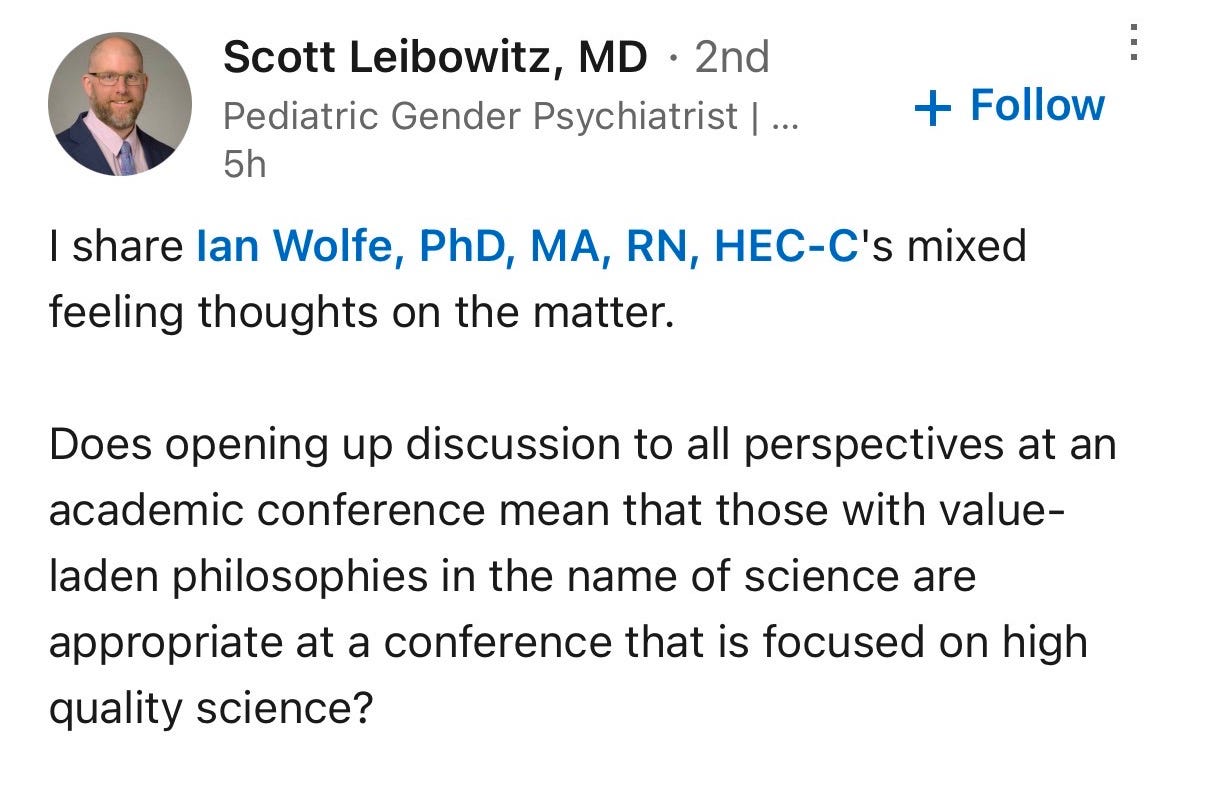
Lively debate about the panel emerged on LinkedIn, including remarks from Dr. Scott Leibowitz, a child and adolescent psychiatrist and board member at the World Professional Association for Transgender Health, or WPATH. Dr. Leibowitz expressed “mixed” thoughts on the matter. “Does opening up discussion to all perspectives at an academic conference mean that those with value-laden philosophies in the name of science are appropriate at a conference that is focused on high quality science?” he said.

Dr. Leibowitz formerly ran the gender clinic at Nationwide Children’s Hospital in Columbus, Ohio. In 2025, he gave a talk at the American Psychiatric Association’s conference that provided a remarkably nuanced take on pediatric gender-transition treatment. He went so far as to acknowledge social influences as potential drivers of youth adopting a transgender identity.
The conference paired Dr. Leibowitz’s speech with a separate slate of presentations from three skeptics of pediatric gender medicine, all of whom have ties to SEGM.
Both presentations were closed to the public. But I obtained videos of them and published them on my Substack:


Dr. Leibowitz did not return a request for comment.
A campaign against the panel
In the wake of Ms. Reed’s article on the pediatrics panel, the progressive organizing nonprofit Action Network sponsored a letter-writing campaign to urge the panel’s cancelation. As of Friday afternoon, this had apparently prompted over 60,000 letters (a figure that is impossible to confirm and potentially driven by bots, mind you).
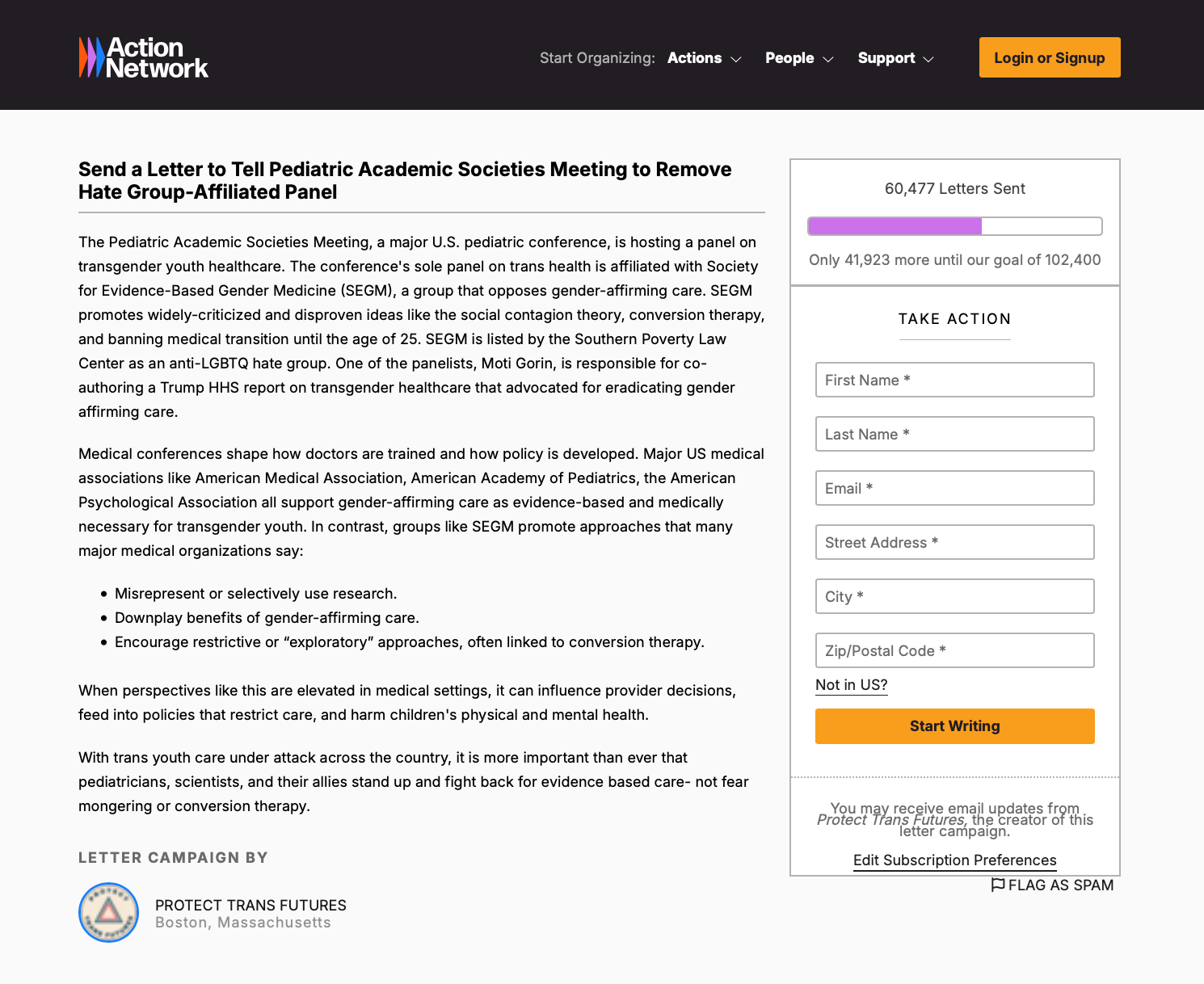
“When perspectives like this are elevated in medical settings, it can influence provider decisions, feed into policies that restrict care, and harm children’s physical and mental health,” the letter stated. “With trans youth care under attack across the country, it is more important than ever that pediatricians, scientists, and their allies stand up and fight back for evidence based care- not fear mongering or conversion therapy.”
The letter further stated that the “conference’s sole panel on trans health is affiliated with” SEGM, a group that it asserted “opposes gender-affirming care. SEGM promotes widely-criticized and disproven ideas like the social contagion theory, conversion therapy, and banning medical transition until the age of 25.”
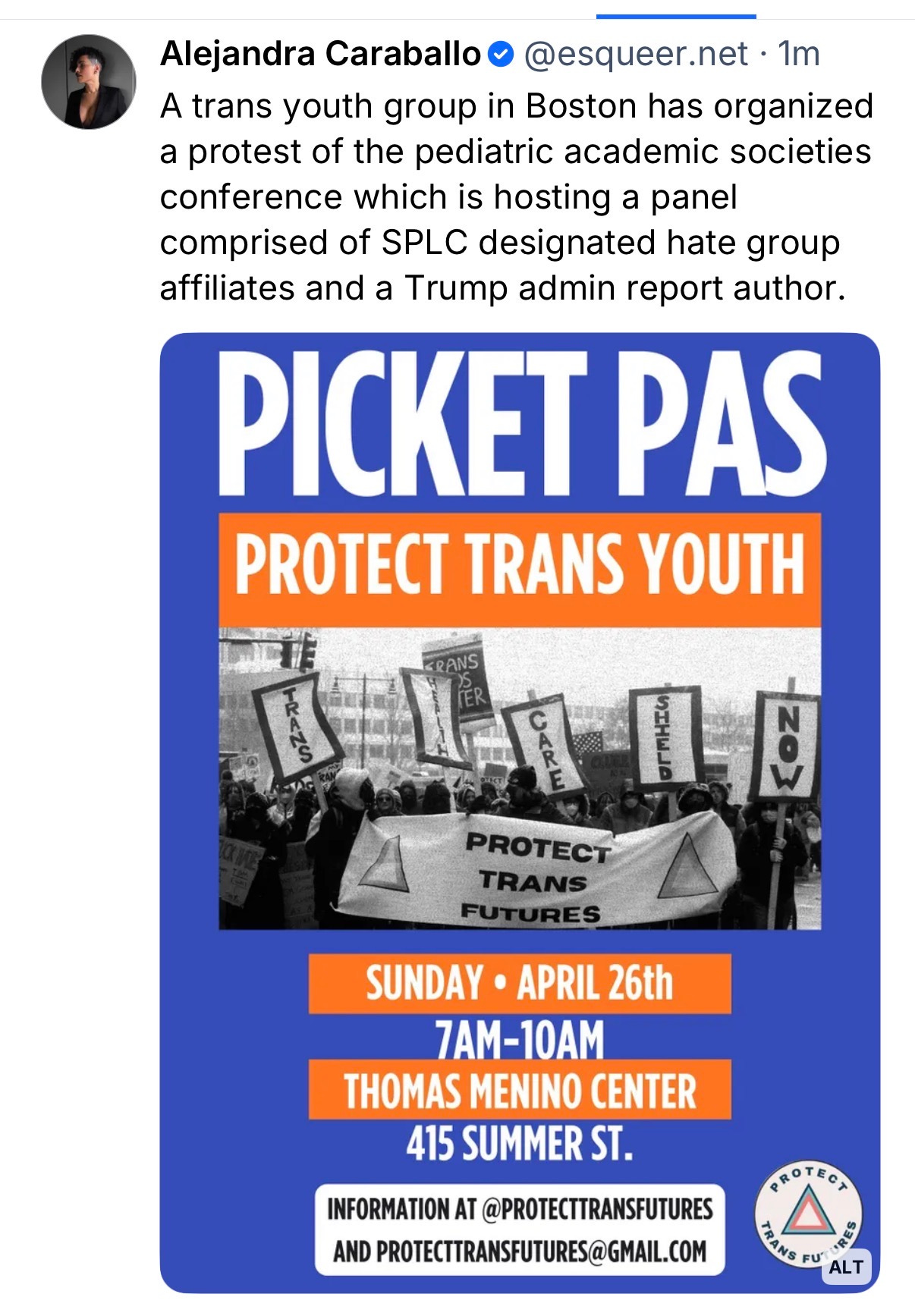
Alejandra Caraballo, a prominent transgender activist and clinical instructor at Harvard Law School, was among those who on social media pushed the campaign, which was created by a Boston-based group called Protect Trans Futures.


Evgenia Abbruzzese, who is SEGM’s cofounder and was another coauthor of the HHS report, responded to the Take Action campaign’s letter in a text message to me. “Every part of the statement is false,” she said. “SEGM has been a target of a disinformation campaign by the Southern Poverty Law Center, with the intention to shut down scientific inquiry into the evidence base in pediatric gender medicine. Unfortunately, some people continue to uncritically repeat SPLC’s false claims. Some do so unwittingly while others perhaps are knowingly attempting to shut down difficult but necessary conversations that need to take place about evidence based medicine and gender care for minors.”
Ms. Abburzzese emphasized that no one on the panel is a member of SEGM, nor are they presenting on behalf of the nonprofit. SEGM, she said, “has indeed been subjected to a breathtaking level of reputational assault through a coordinated and well-financed campaign, which culminated in the despicable ‘hate group’ label assigned to SEGM by SPLC.” She dismissed this designation as based on “baseless allegations.”
“In line with our mission to advance evidence-based medicine in the field of youth gender medicine,” Ms. Abbruzzese said, “SEGM has become an important hub for in-depth discussions and debates about the evidentiary and ethical dilemmas in this highly contested field.”
Ms. Caraballo further promoted on Bluesky a planned picketing of the conference:
After I emailed Ms. Caraballo seeking comment, she responded by asserting that my email to her was “harassment.” She noted that she had previously instructed me not to email her. (I emailed an article of mine to her in an email blast earlier this month.) Ms. Caraballo, who has a law degree from Brooklyn Law School, threatened that if I continued to email her she would “seek a harassment prevention order.”
The panelists
Entitled, “A Scientific Dialogue on the Care of Transgender and Gender Diverse Youth,” the PAS panel is, per the conference roster, slated to “provide a scholarly review of the current evidence informing clinical approaches to care” of transgender “youth, showing the dynamic way research and pediatric practice can evolve.”
Marshalling the panel is Moti Gorin, an associate professor and bioethicist at Colorado State University, who also coauthored the HHS report. He declined to comment for this article.
Dr. Gorin has published various papers exploring the ethics of what supporters of pediatric gender medicine call gender-affirming care, including one that critiques the ethics of placing a heavy emphasis on minors’ autonomy in consenting to such medical interventions.

The most prominent panelist is Dr. Riittakerttu Kaltiala, who is a professor of adolescent psychiatry at Tampere University in Finland. In 2011, Dr. Kaltiala was tasked with founding one of Finland’s two youth gender clinics. During the ensuing years, she has since reported, she observed that her young patients were generally not faring well on cross-sex hormones. So she set out to document her findings. Aided by Finland’s comprehensive nationalized health data, she has published a roster of papers that have cast doubt on pediatric gender medicine.

This includes a 2024 paper that found there was no independent, statistically significant association between providing cross-sex hormones to youths attending gender clinics and the rate of suicide death among them. Earlier this month, Dr. Kaltiala’s team made waves with a paper that found that after starting cross-sex hormones, such youths experienced a surge in their use of specialist psychiatric care, which in Finland is generally reserved for more severe mental health conditions.

After the paper was subjected to harsh criticisms by, among others, Ms. Reed and the prominent Substacker known as Gideon M-K: Health Nerd, I corresponded with Dr. Kaltiala, who provided detailed responses:

Trans advocates have accused Dr. Kaltiala of running a cruel and borderline abusive practice. I spoke with her about those accusations in 2024, which she derided as “rubbish”:

“Silencing science will eventually harm the patients,” Dr. Kaltiala on Friday told me in an emailed statement. “I think that American pediatricians need to have an opportunity to hear all research evidence so that they can make their conclusions in a balanced way.” She added: “My published research points towards a more cautious approach in this field, and in Europe such caution is increasingly applied. Medical science has to constantly accumulate research evidence and re-evaluate practices in light of what research findings suggest.”
Panelist Anna Hutchinson is a clinical psychologist. She was a staffer at the Gender Identity Development Service, or GIDS, which was the British National Health Services’ only pediatric gender clinic until it was shuttered in 2024 in the wake of the publication of the NHS-commissioned Cass Review. Dr. Hutchinson ultimately became alarmed by what she saw at GIDS’s reckless practices in caring for gender-distressed youths and went public with her concerns. She is featured prominently in Time to Think, British investigative journalist Hannah Barnes’ vivid account of GIDS’s downfall.
In a WhatsApp message, Dr. Hutchinson told me that her planned 15-minute talk at Sunday’s panel “is incapsulated” by a quote from Cass Review, which reads: “Although some think the clinical approach should be based on a social justice model, the NHS works in an evidence-based way. Whilst navigating a way through the surrounding ‘culture wars’, the Review has been acutely and increasingly aware of the need for evidence to support its thinking.”
In her Substack, Ms. Reed accused Dr. Hutchinson of promoting practices “widely considered to be conversion therapy.”
In 2025, Dr. Hutchinson published a journal article detailing what she called “Cass informed psychotherapy for gender distressed youths.” In the paper, Dr. Hutchinson acknowledged and explicitly cautioned that some therapeutic approaches could indeed resemble conversion therapy. This included, she wrote, therapy that might “unintentionally act as covert forms of conversion therapy, especially if they pathologize or consistently discourage gender transition with no good reason.” She advocated that psychotherapists strike a balance between such egregiously restrictive therapy and care that was insufficiently exploratory. Referring to what is known as the gender-affirming method, psychotherapy with gender-distressed youth, she wrote, should “facilitate open exploration without imposing predetermined outcomes whether from an affirmative or non-affirmative stance.”
Panelist Dr. Steven Monante is a plastic surgeon in private practice in Virginia who was a coauthor of the three McMaster systematic reviews, which included the first-ever such review examining gender-transition mastectomies for young people. Dr. Montante has publicly expressed his concerns about the wisdom of providing these surgeries even to young adults as old as 24.

Dr. Montante was on a task force tapped by the American Society of Plastic Surgeons to examine the science regarding such surgeries for adolescents. In February, the ASPS board issued a statement recommending its members not provide such surgeries to patients under age 19. This came as a surprise to the task force members, some of whom protested not being kept in the loop on the matter. Dr. Montante, however, supported the statement and also previously sought to distance himself from his colleagues at McMaster in the wake of their public apologia over their review papers.


In an interview, Dr. Montante expressed his dismay over the campaign to deplatform the PAS panel. “It’s the Pediatric Academic Society,” he said. “If this isn’t the forum to have these discussions about evidence with people who have done their due diligence, then I don’t know where else the discussion should be had.” In response to the panel’s detractors, he said: “I would ask them to just listen to what we have to say, let us present the evidence that we have. And let’s have a discussion about it.”
Dr. Montante said Dr. Gorin had reported being in contact with Dr. Rauch, but could not elaborate further.
Dr. Montante sought to correct Ms. Reed’s claim in her Substack that he is among those who, in her article’s words, “want to ban some, if not all, kinds of medical gender-transition care until age 25.” He said that he did not support legislative bans, rather he favored voluntary guidelines from medical authorities recommending against gender surgeries until patients are cognitively developed enough to “make an informed decision” about such a surgery.
“If this isn’t the forum to have these discussions about evidence with people who have done their due diligence, then I don’t know where else the discussion should be had.” —Dr. Steven Montante
Erica Anderson, a psychologist and former head of WPATH’s U.S. branch, USPATH, shared with me the email she sent on Wednesday to Dr. Rauch urging him to keep the panel on the schedule. Dr. Anderson, who is transgender, wrote him that she knew the panelists “personally and can attest that they are devoted to evidence based care and compassion toward gender distressed youth.” She added: “Please do not be distracted by noisy distractions of those making unfounded claims about the speakers and the topic. Without question you are brave as a conference to hold this high level free exchange on this important topic.”
Dr. Anderson has become one of pediatric gender medicine’s most prominent and vocal dissidents. She frequently serves an expert witness in court cases in which she casts doubt on the safety and wisdom of common practices in this field. This included testifying in the nation’s first malpractice lawsuit waged by a detransitioner to go to trial: the Fox Varian case, which I covered in White Plains, New York, for The Free Press and which concluded in a $2 million jury award for Ms. Varian.
In an email to me, Dr. Anderson derided those who have protested the PAS panel as a “middle school trans activist flash mob.”
“Such illiberal efforts to censure important dialogue on trans youth medicine issues are seen for what they are: biased, ‘woke’ and misguided attempts to cancel viewpoints some don’t like,” Dr. Anderson said. “Such efforts are doomed to fail.”
“The truth will win out,” she added. “It must.”
I obtained video of protests outside the panel and of one disruption of the panel, as well as audio of the moderator introducing the Sunday morning panel, which had 106 people in attendance.
Here are protests outside the conference hall, including a marching band:
These protest signs went up the day before outside the hall:
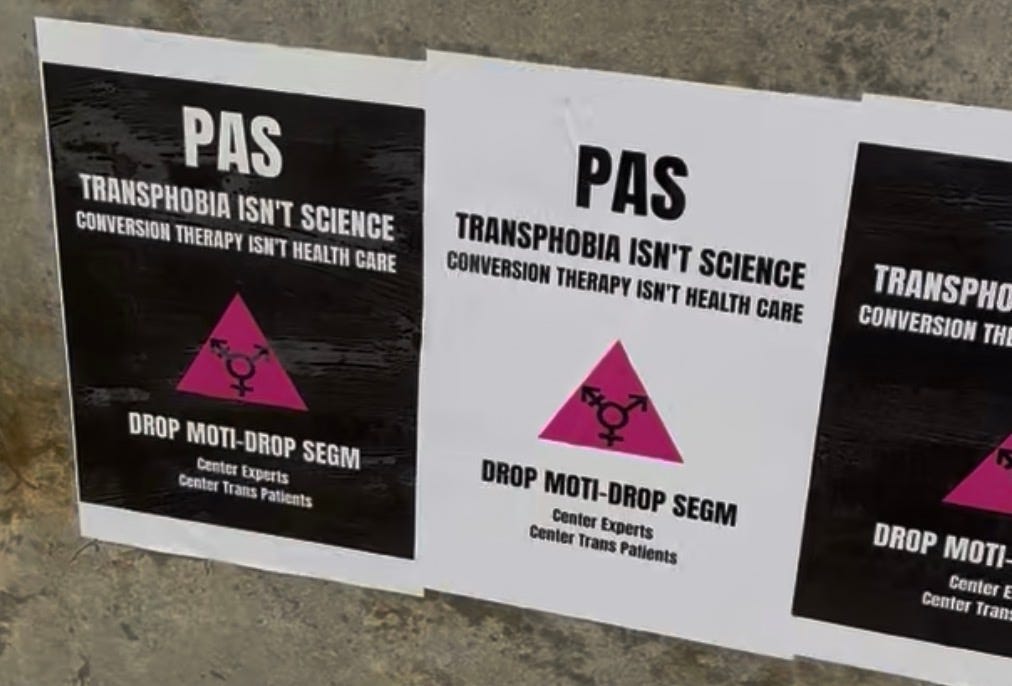
One attendee of the panel described the security as “laughable,” including their failure to prevent one protester from lunging in the direction of Dr. Hutchinson while she was speaking. The audience, this attendee said, was unruly and poorly managed. Apparently, some of them had subverted security requirements to have a lanyard and a name badge.
Here is four minutes of Dr. Rauch introducing the panel:
Kale Edmiston, a neuroscientist by training and a coauthor of one of the chapters of WPATH’s Standards of Care, disrupted the panel. This first video doesn’t show Dr. Edmiston actually having the exchange with the panelists, but you can hear the audio:
Here you can actually see Dr. Edmiston:
A disrupter was dragged from the room:
Kale Edmiston is known for having falsely claimed to be a coauthor of WPATH’s adolescent trans-care guidelines in 2023. He falsely claimed Jesse Singal had misinterpreted a sentence that he falsely claimed to have written. Dr. Scott Leibowitz, who actually coauthored that guidelines chapter, publicly confirmed Edmiston was lying.
See Mr. Singal’s jaw-dropping play-by-play of the affair, which included a barrage of smug reporters such as Marisa Kabas (who has made false claims about me in her writing), then of MSNBC, falling for Mr. Edmiston’s claims and asserting that they confirmed that Mr. Singal was a bad actor.

During Mr. Edmiston’s disruption of the pediatrics panel, he falsely claimed that the assertion that WPATH leaders did not put the removal of age limits from their trans-care guidelines through their process of reaching internal consensus was a conspiracy theory. I spelled out in this Substack why the evidence supports the notion that the guidelines authors did not in fact put this change through that process:
Also, below are some people in Erin Reed’s Substack chat feed who were strategizing prior to the conference about whether it was better to disrupt, attend quietly, or boycott the panel. You may recall the name of Long Island, NY, psychiatrist Dr. Frank Dowling from my reporting at the imbroglio over the American Medical Association’s general opposition to youth gender surgeries. Dr. Dowling was especially vocal in the AMA’s LGBTQ+ affinity group’s message board on the matter.


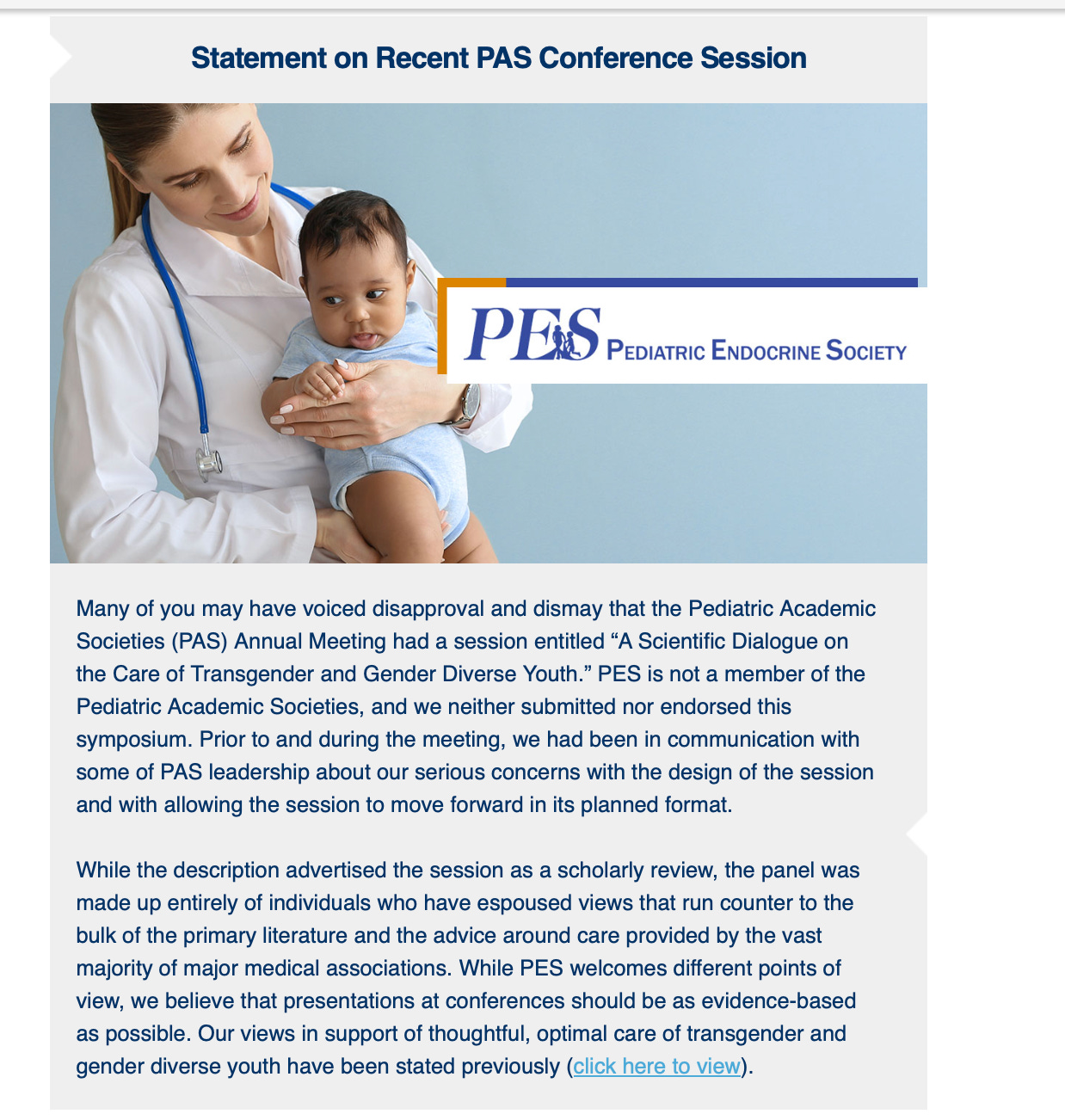
The Pediatric Endocrine Society took a stand against the panel and sent this missive to their members on Monday:
“Many of you may have voiced disapproval and dismay that the Pediatric Academic Societies (PAS) Annual Meeting had a session entitled ‘A Scientific Dialogue on the Care of Transgender and Gender Diverse Youth.’ PES is not a member of the Pediatric Academic Societies, and we neither submitted nor endorsed this symposium. Prior to and during the meeting, we had been in communication with some of PAS leadership about our serious concerns with the design of the session and with allowing the session to move forward in its planned format.
“While the description advertised the session as a scholarly review, the panel was made up entirely of individuals who have espoused views that run counter to the bulk of the primary literature and the advice around care provided by the vast majority of major medical associations. While PES welcomes different points of view, we believe that presentations at conferences should be as evidence-based as possible. Our views in support of thoughtful, optimal care of transgender and gender diverse youth have been stated previously.”
I am an independent journalist, specializing in science and health care coverage. I contribute to The New York Times, The Guardian, NBC News, The Free Press and The New York Sun. I have also written for the Washington Post, The Atlantic and The Nation, among many others. Follow me on Twitter: @benryanwriter and Bluesky: @benryanwriter.bsky.social. Visit my website: benryan.net


Ok this is big. As a retired academic pediatrician, Pediatric Academic Societies is a research meeting unlike the American Academy of Pediatrics which supposedly represents practitioners. The fact that a panel consisting of SEGM members is even set to speak at PAS represents a huge change in the right direction because when I last attended it was already undergoing disgusting institutional capture on this issue. Some people found their brains again. Obviously the activists know that the more daylight on this issue the more people will understand how deep the medical scandal is.
If you are afraid of a panel discussion, your ideas/ideology are on shaky ground. If the facts and evidence were supportive of your position a panel discussion would be welcomed. Clearly this is not the case given the outrage and attempt to prevent discussion that are commonplace with gender affirming care advocates.