1


Fernand Léger's (1881–1955) Tubist art style: Despite suffering a mustard gas attack while serving France in WWI, he expressed an optimistic view of modernism through his syntactic proto-Pop Art style, developed during the Cubist experimentation era.


1
100% Upvoted
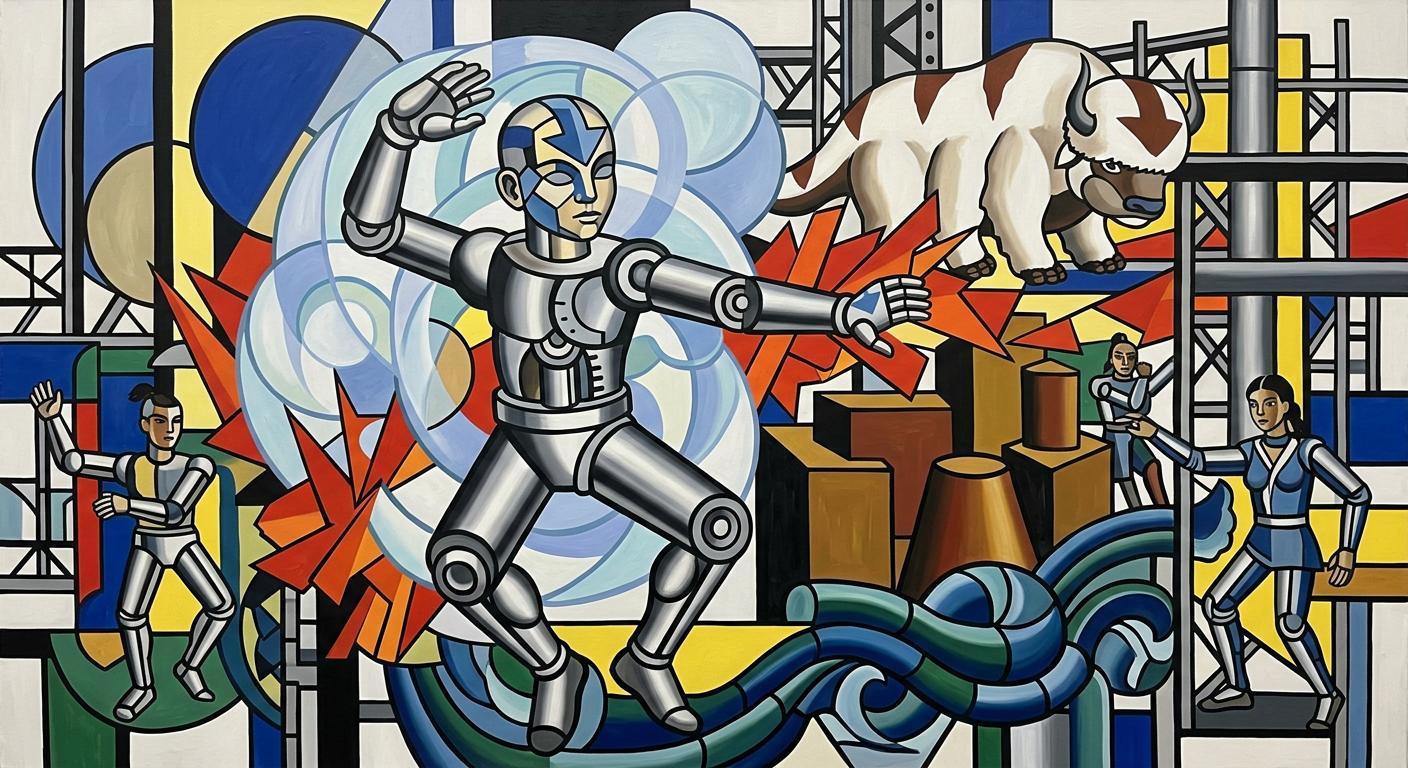
{The Legend of Avatar (Nickelodeon series)} abstracted in Fernand Léger's (1881–1955) signature "musically autonomous" Cubism, without text or lettering: {
Fernand Léger's artistic achievement represents a singular trajectory within twentieth-century modernism—transforming Cubism from an analytical apparatus for perceptual investigation into a celebratory visual language of industrial modernity. His mature style, codified through the principle of Contraste de formes (Contrast of Forms), employed architectonic volumes, mechanical rhythms, and autonomous color as symbolic equivalents rather than descriptive tools. This created what Léger termed "Pictorial Realism": paintings that functioned as physical objects embodying the modern experience rather than mere windows representing it. This approach decisively separated Léger from the analytical fragmentation of Pablo Picasso (1881–1973) and Georges Braque (1882–1963), positioning his oeuvre as a crucial antecedent to the graphic clarity of the International Typographic Style and the democratic visual semantics of Pop Art.
Joseph Fernand Henri Léger was born February 4, 1881, in Argentan, Normandy, into a cattle-raising family whose practical expectations initially pointed him toward architecture. Between 1897 and 1899, he apprenticed locally before working with an architect in Caen. There, he acquired foundational competencies in structural clarity, spatial organization, and geometric precision that would profoundly inflect his later painterly vocabulary.
Relocating to Paris in 1900, Léger supported himself as an architectural draftsman and photographic retoucher. These dual professions cultivated sensibilities that became the hallmarks of his mature idiom: graphic precision inherited from technical drawing, and an awareness of mechanical image manipulation derived from photography. Following military service with the 2nd Engineer Regiment (1902–1903) and a subsequent rejection from the École des Beaux-Arts, he enrolled at the School of Decorative Arts while auditing classes at the Beaux-Arts and the Académie Julian. Though he later dismissed these years of traditional tutelage as "empty and useless," his concurrent drawing lessons at M. Corbin's studio—alongside decorators André Mare (1885–1932) and Henri Viel—crucially embedded him within decorative arts traditions. Here, he learned to conceptualize color as an autonomous, ornamental element rather than a naturalistic descriptor.
This early immersion into the decorative arts planted the seed for a lifelong interest in environmental design, culminating later in his landmark 1912 collaboration with Mare on La Maison Cubiste (The Cubist House), a provocative architectural and interior design installation at the Salon d'Automne. While Mare designed the interior of the "Salon Bourgeois," Léger provided paintings—such as Le Passage à niveau (1912)—to rhythmically activate the walls. This environmental installation instilled an enduring awareness of how paintings function theatrically within spatial contexts. Conceptually, this total-room integration paralleled the immersive Makartstil environments of Austrian painter Hans Makart (1840–1884). However, whereas Makart catered to the opulent, static performative viewing culture of Vienna's Ringstraße era (c. 1860s–1880s), Léger reconceptualized the painting as a kinetic object designed to complement the dynamic, fluid movements of modern machine-age architecture.
Even before reaching these spatial innovations, however, Léger had to traverse the prevailing currents of traditional painting. He only began painting seriously around 1906, emerging from a Parisian milieu saturated with Post-Impressionism and the recent shock of Fauvism. His early work fused Paul Cézanne's (1839–1906) geometric reduction of nature with the radical chromatic autonomy championed by Henri Matisse (1869–1954). Surviving works from this period—such as Le Jardin de ma mère (1905) and Gamins au soleil (1907)—reveal bold flattened volumes, controlled yet vibrant palettes, and the atmospheric staging typical of late Impressionism.
However, his encounter with Cézanne's retrospective at the October 1907 Salon d'Automne proved to be an ideological catalyst. Cézanne's dictum to treat nature via the cylinder, sphere, and cone provided the conceptual scaffolding Léger needed to permanently shift from impressionist atmospherics to solid, volumetric construction. In 1909, coinciding with his entry into Cubist experimentation, Léger deliberately destroyed virtually all of his Impressionist works—a gesture of self-erasure marking his total rejection of perceptual transcription in favor of architectonic synthesis.
In 1909, Léger rented a studio at La Ruche, the legendary 15th arrondissement artists' residence, immersing himself in an international avant-garde milieu. There, he connected with sculptors Alexander Archipenko (1887–1964), Henri Laurens (1885–1954), and Jacques Lipchitz (1891–1973); painters Robert Delaunay (1885–1941), Chaïm Soutine (1893–1943), and Marc Chagall (1887–1985); and writers Guillaume Apollinaire (1880–1918), Max Jacob (1876–1944), Maurice Raynal (1884–1954), and Blaise Cendrars (1887–1961). This proximity to sculptural practice reinforced Léger’s emphasis on volume and the 'construction' of form, informing the distinctive treatment of subjects in his later 'Tubist' idiom. Critically, he also encountered the self-taught painter Henri Rousseau (1844–1910), whose bold frontal compositions, firm contours, and naïve clarity exerted a lasting influence on Léger's pictorial construction.
Positioned at the epicenter of Parisian modernism, Léger entered the Cubist movement just as it transitioned from the private experiments of Picasso and Braque into a collective, public enterprise. Yet, his landmark Nus dans la forêt (1909–10) announced a vastly different syntax. Rather than decomposing observed motifs into multi-perspectival, fragmented slivers, Léger reduced figures to architectonic, woodblock-like volumes—interlocking cylinders, truncated cones, and faceted rectangular solids. His architectural background dictated a departure from academic norms: while traditional observational painting starts with gestural underdrawing, Léger’s work originated in bold, angular, shaded outlines (cernes). In this approach, boundaries function as an ambiguous locus of interaction between foreground and background rather than a means of separation; this alignment with the Cubist 'fourth dimension' and the prismatic deconstruction of light as an irradiating force allowed him to conceptualize legibility through decorative balance, establishing the structural 'blueprint' for his later architectonic volumes. The composition utilized a cohesive palette that offered immediate legibility from a distance, yet close inspection revealed deliberate spatial contradictions, such as dislocated joints and machine-like fittings. This dual readability forged a distinct path: while Analytical Cubism dissected subjects to reveal the process of perception, Léger imposed geometric order to create symbolic representation. In doing so, he developed what might be termed a 'musical narrative abstraction,' driven by an industrial syntax rather than analytical deconstruction.
Exhibiting Nus dans la forêt alongside Jean Metzinger (1883–1956), Albert Gleizes (1881–1953), Henri Le Fauconnier (1881–1945), and Robert Delaunay at the 1911 Salon des Indépendants in a deliberately grouped presentation, Léger was mockingly dubbed a "tubist" by critic Louis Vauxcelles (1870–1943). Léger embraced the moniker, formalizing this volumetric idiom in works like La Couseuse (1910) and Le Passage à niveau (1912). The latter, commissioned for André Mare and Raymond Duchamp-Villon's (1876–1918) Maison Cubiste at the 1912 Salon d'Automne, showcased Léger's ability to translate Cubist fragmentation into decorative architectural contexts. This concurrently connected him to the Duchamp circle and the Puteaux Group (Section d'Or), which included Jacques Villon (1875–1963), Marcel Duchamp (1887–1968), and Francis Picabia (1879–1953).
Between 1912 and 1914, Léger’s conceptual framework solidified. Through his Contraste de formes series (1913) and lectures at the Académie Vassilieff, he codified his theory of "Pictorial Realism," rooted in the "Law of Plastic Contrasts." He abandoned mimetic subject matter, realizing "plastic power" through systematic ruptures: substituting flat planes for tubular cylinders, clashing primary colors bounded by heavy black outlines, and rejecting consistent light sources in favor of chaotic, kinetic energy echoing Futurist dynamism. For Léger, "realism" was not nature’s imitation, but the reality of the picture plane itself. Consequently, while Analytical Cubism pursued the abstraction of perception, Léger’s canvases generalized forms into an abstraction of symbolism—turning visual mechanics into monuments of the industrial age.
The Stairway (1913) exemplified this pre-war synthesis: figures sculpted from metallic cylinders recalling pistons and gears, infused with bold color and structured mechanical rhythms rather than Analytical Cubism's fractured muted tones. The staircase itself became a metaphor for movement, progress, and modernity's dizzying acceleration. While still employing Cubist principles, Léger's forms were solid, weighty, and rhythmic. By 1913, when he participated in the landmark Armory Show in America and signed with dealer Daniel-Henry Kahnweiler (1884–1979), critics frequently compared his production to the Futurism of F. T. Marinetti (1876–1944). However, Léger's research lacked Futurism's anarchist political dimension, approaching acceleration strictly through aesthetic, geometric experimentation rather than ideological manifestos.
Léger’s vision was permanently altered by his service at the Argonne front during World War I. Trench warfare and the lethal ubiquity of war machines informed his early mechanized works, such as Le Soldat à la Pipe (1916). However, following a near-fatal mustard gas attack at Verdun, the celebratory tone of mechanization turned haunting. During his convalescence, he painted La partie de cartes (1917), where humans are reduced to dehumanized, armored automatons.
This trauma ushered in Léger’s dedicated "mechanical period." Returning to Paris, he channeled post-war energy into pieces like Les Disques dans la ville (1918). Informed by the pure geometry of De Stijl (such as Piet Mondrian, 1872–1944), the color theory of the Delaunays (Sonia Delaunay, 1885–1979, and Robert), and the syncopation of Jazz, Léger orchestrated concentric circular and rectangular geometries into a rhythmic visual language. By reducing everyday objects into ordered systems of stacked, high-contrast "voluminoids," he created a mechanical choreography that mirrored factory production and urban tempos while maintaining a cohesive level of immediate object recognition for narrative legibility.
In the 1920s, after befriending architect Le Corbusier (1887–1965), Léger aligned with Europe’s "return to order." He pivoted toward functionalist aesthetics, producing paysages animés (1921) that combined legible humanist subjects with resolutely modern geometric environments. Drawing deep parallels to Henri Matisse’s (1869–1954) elevation of flat, large-scale spatial harmonies over academic shading, Léger explicitly returned to his early architectural instincts—conceptualizing art for monumental, public viewing environments. Pushing his practice outward, he embraced experimental film (Ballet mécanique, 1924), theater design, massive muralism, and tapestry. Rejecting interwar existential despair, his mature works elevated ordinary laborers and modern leisure, insisting on art’s social responsibility and celebrating the democratic, collective potential of technological progress.
Ultimately, Fernand Léger cultivated a distinctly unique branch of modernism. Where Picasso and Braque deconstructed intimate reality through muted, faceted lenses, Léger constructed a machine-oriented abstraction that symbolized a rushing, optimistic modernity. His overarching conceptual legacy relies on several core theoretical innovations:
Through this structural autonomy and abstraction of symbolism, Fernand Léger transformed Cubism. He unshackled it from the realm of private perceptual analysis, refashioning it into an exuberant, democratic visual syntax explicitly designed to chronicle, inhabit, and celebrate the vibrant kineticism of the 20th century.
}