
Nagano Miso
Shinshu miso accounts for 50 percent of Japan's total miso production. Why has miso-making thrived in Shinshu, as Nagano Prefecture is also called? It's not just a question of the right climate. It took people to make it happen.
The story of Shinshu miso: How Nagano became Japan’s premier miso-making region
Silk mills start mass-producing their own miso
In the Meiji period (1868-1912), Nagano Prefecture became a major producer of raw silk, which drove Japan's modernization. The silk mills where raw silk was extracted from cocoons were staffed by female laborers. They were hard workers, and miso soup was served with every meal they were fed to keep them going. Each mill made its own miso.
Soybeans were boiled using heat from the boilers, transferred to shallow wooden tubs, and mashed by feet shod in straw snow boots. Then, with the assistance of the female workers, the resulting paste was formed into balls. The balls were suspended in the cocoon storehouse and, a month later, placed in large barrels. After being left to age for three years, the miso was ready to eat.

1926 Horikawa-gumi menu: The bill of fare of a silk mill in the village of Kawagishi (now part of the city of Okaya)
Photo courtesy of Okaya Silk Museum
Shinshu miso breaks into the Tokyo market after the 1923 earthquake
Miso tends to be produced locally, and that once held true also of Tokyo, the country's biggest consumer market. While the city procured soy sauce and sake from the provinces, miso was made locally. But then came the Great Kanto Earthquake of 1923, which inflicted serious damage on 60 percent of Tokyo's miso producers. The order went out to other regions of the country to ship their miso to Tokyo.
This enabled many of Nagano's miso producers to gain a foothold in the Tokyo market. People then started talking about how Nagano miso tasted excellent compared with that from elsewhere, and slowly but steadily it made a name for itself.

Miso being shipped circa 1937-38, after the Great Kanto Earthquake
Photo reproduced from Takeya miso hyakunen-shi (100 years of Takeya Miso)
From making silk to making miso
By around 1930, more and more of Nagano's silk mills had fallen on hard times due to the Depression. Many silk producers therefore decided to switch industries and enter the miso business instead. During the transition, they received manufacturing and sales advice from incumbent producers. And so Nagano established itself as a center of miso production, helped along by the reputation that Nagano miso had gained in Tokyo since the Great Kanto Earthquake.
Then the Pacific War broke out, and production slumped. But the industry never stopped evolving. It produced powdered miso to feed the troops. And the postwar boom was just around the corner.
A quantum leap made possible by joint marketing
In the postwar years, miso producers suffered from a shortage of funding and raw ingredients. They also struggled to find buyers. In response, Nagano's miso producers banded together to form the Nagano Prefectural Federation of Miso Manufacturers Associations . The Hachijuni Bank gave the Federation its full financial backing. The Federation used the resulting funds to purchase ingredients in bulk, then distributed them to individual miso producers.
It also sold their miso en bloc to customers in Tokyo and other areas of the country. In addition, the prefecture enacted the Miso Inspection Ordinance. Now only conforming products could be shipped under the name “Shinshu miso.” The region and the industry came together to turn Nagano into Japan's largest miso producer

The traditional technique of forming miso balls
Mashed soybeans are formed into balls. The balls are stored for a set period; then koji and salt are mixed in, and the balls are left to age. Miso made this way possesses its own distinctive flavor.

Photo courtesy of Shioya Jozo Co., Ltd.
How Miso Is Made
Photos courtesy of Takeya Miso Co., Ltd.

【1】Making the koji (Wash, soak, steam, cool, inoculate with spores, produce and remove koji)
Koji mold is grown on steamed rice.
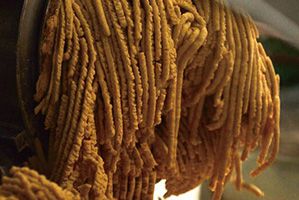
【2】Preparing the soybeans (Sort, wash, soak, steam or boil, cool, mash)
Soybeans are steamed or boiled and mashed.

【3】Mixing
Table salt is added to the rice koji and mashed soybeans, and everything is mixed together.

【4】Fermentation
The mixture is allowed to ferment and age, typically for six months to a year.

【5】Kneading
During fermentation and aging, the fermentation process is reactivated by kneading the miso in the barrel into an even paste.

【6】Packaging
The miso is packed in containers.
● Thanks to the following for interviews and photos
Okaya Silk Museum
Shioya Jozo Co., Ltd.
Takeya Miso Co., Ltd.
● Bibliography
The Shinshu miso no rekishi Editorial Committee, Shinshu miso no rekishi (A history of Shinshu miso) (1966)
Website of the Nagano Prefectural Federation of Miso Manufacturers Cooperatives
Takeya Miso Co., Ltd., Takeya miso hyakunen-shi (100 years of Takeya Miso) (1972)
Nagano Miso