1


Louis Wain’s (1860–1939) Edwardian anthropomorphic cat art style. It is a rigorous observational study of felines, an enduring emotional tribute to his late wife, and a playful satire that mirrors Victorian society through feline mischief.


1
100% Upvoted
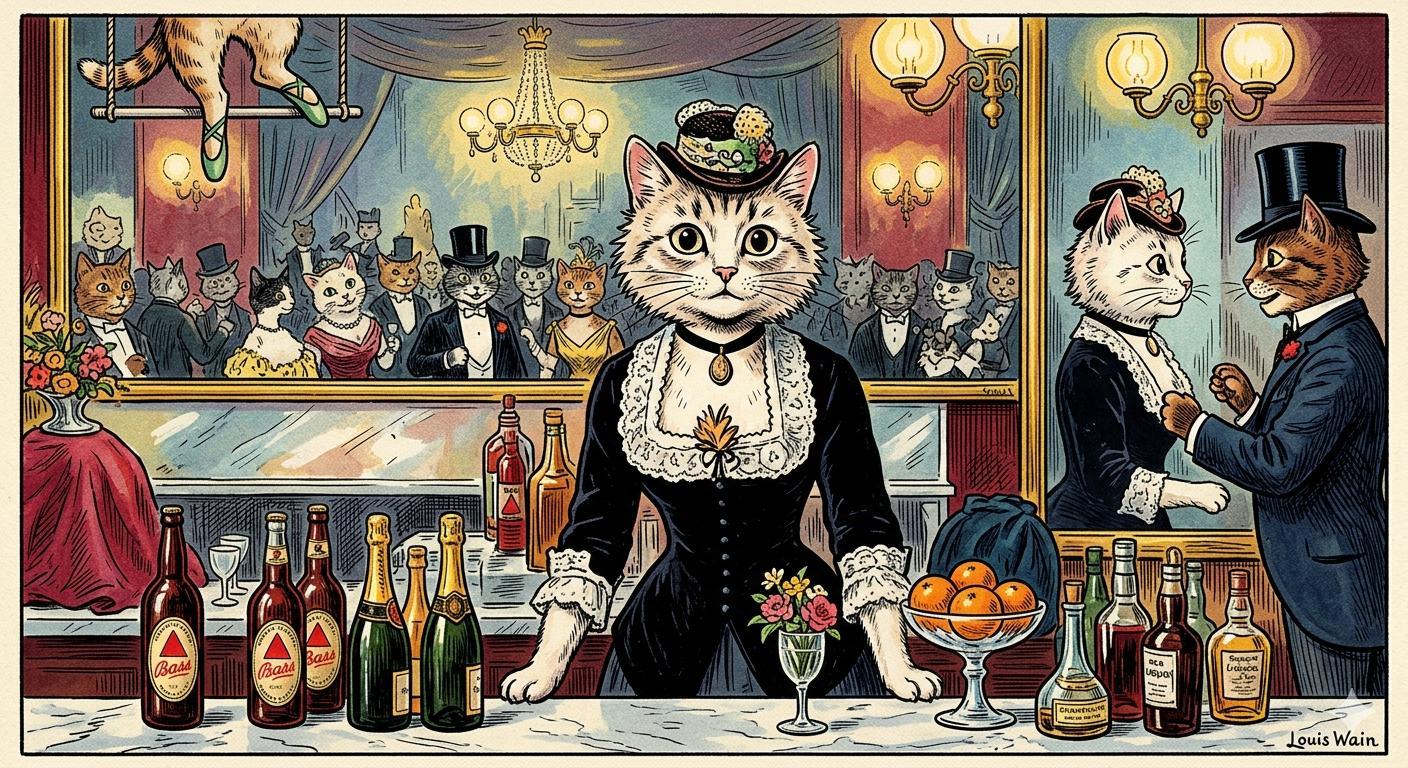
Create an illustration of {Alice in Wonderland: The Mad Hatter’s Tea Party} strictly in the classic Edwardian peak of Louis Wain’s (1860–1939) signature anthropomorphic cat art style. The image must feature expressive, delightfully clothed, bipedal felines engaged in whimsical narrative human scenarios, utilizing energetic linework, saturated colors, and wide-eyed neotenic charm.
Style strictly based on the Edwardian narrative charm detailed below (expressly excluding the abstract, fractal, or psychedelic aesthetics of his late period): {
I. Early Foundations and the Decorative Scaffolding (1860–1883)
Louis William Wain’s visual sensibilities were fundamentally shaped by his domestic environment. Born on August 5, 1860, Wain was raised in a household steeped in textile design. His father, William Matthew Wain (1825–1880), was a traveler for a textile firm, and his mother, Julie Félicie Boiteux (1834–1910), designed church embroideries and carpets. This early immersion in intricate, repeating patterns, combined with the broader influence of William Morris (1834–1896) and the Arts and Crafts Movement, ingrained in Wain an innate sense of rhythmic decorative composition. These textile roots planted the seeds for the highly structured, fractal geometries that would eventually dominate his late-career work.
Equally important to his visual training was his eccentric breadth of personal interests. To channel his restless mental energy, Wain developed a lifelong habit of directing his intense focus outward. He pursued an eclectic range of youthful hobbies with the commitment, vigour, and certainty of a prophet—whether boxing, improvising on the piano, dancing, experimenting with chemistry, composing an opera, or drafting mechanical inventions. This rich repository of lived experiences provided the narrative scaffolding for his art, directly paralleling the exceptionally varied, dynamically human lives of his later anthropomorphic cats. Crucially, he applied this same hyper-focused attention to the acute observation of animal behavior, a practice that directly informed his ability to convincingly anthropomorphize his feline subjects.
Wain formalized his education at the West London School of Art. Entering London’s artistic circles, he absorbed the prevailing late-Victorian visual culture, characterized by a robust appetite for narrative illustration and ornamental design. He was deeply influenced by prominent contemporaries like Herbert Railton (1857–1910), known for meticulous architectural renderings, and Linley Sambourne (1844–1910), a Punch cartoonist celebrated for his densely detailed, satirical compositions. These interactions refined Wain's approach to descriptive detail and expressive characterization, launching his professional career in 1881 with the Illustrated Sporting and Dramatic News.
II. Emotional Catalyst and Proto-Anthropomorphism (1884–1889)
Wain’s trajectory shifted exclusively to his lifelong feline motif following his marriage in 1884 to Emily Richardson, his sisters’ governess. Emily championed his art and introduced him to "Peter," a black-and-white kitten who served as his earliest muse. Wain’s illustrations became an escapist comfort in an alienating Victorian society that judged his cross-class marriage. During this period, he produced intensive, highly realistic watercolor studies of Peter, demonstrating a level of observational rigor and anatomical mastery that paralleled the academic draftsmen of his era.
Wain was an acutely observant draughtsman capable of drawing ambidextrously and with astonishing speed. Yet, as art historian Chris Beetles observes, his sheer technical fluency stood in stark contrast to his struggles as an effective social communicator. For Wain, drawing was a highly focused, sometimes confrontational alternative to speech—a visual way of pleading with the world: “But don’t you see?!” The public debut of this singular focus occurred in 1886 with "A Kittens' Christmas Party" in the Illustrated London News. This piece depicted 150 cats in a state of proto-anthropomorphism: engaged in human scenarios, yet anatomically realistic, positioned on all fours, and lacking exaggerated facial expressions. When Emily died of breast cancer in 1887, Wain retreated entirely into his art, cementing the cat as his primary emotional vocabulary and a lifelong tribute to their partnership.
As his work evolved into the 1890s and the Edwardian era, the endearing aesthetic of Wain’s fully anthropomorphic cats emerged not as the byproduct of a restricted artistic range, but as a deliberate, calculated faux-naïf (false naive) stylization. Having already proven his capacity for exacting documentary realism, Wain consciously subverted strict academic draftsmanship in favor of expressive, formal simplification. He employed exaggerated neotenic (childlike) physiognomies—oversized heads, enlarged, highly emotive eyes, and shortened limbs—while frequently flattening the pictorial space and bypassing rigid linear perspective. By intentionally stripping away cold academic verisimilitude, Wain achieved an unmediated, nostalgic innocence. This strategic stylistic restraint allowed his illustrations to project a profound emotional warmth and an inviting storybook charm. In an increasingly complex, industrialized society, Wain’s deliberate naivete functioned as a visually disarming sanctuary, inviting the viewer into a non-threatening, ludic world of uncorrupted childhood wonder. Crucially, this core characteristic—especially the wide, unwavering neotenic yet sharp gaze—served as the permanent anchor of his oeuvre, staying intact even as the surrounding forms historically dissolved into the blazing fractal abstractions of his late institutionalized period.
III. The Victorian Lexicon and Stylistic Diversification (1890–1899)
Throughout the 1890s, Wain’s style evolved into an endearing, highly theatrical anthropomorphism, echoing the whimsical visual charm of the dimensional books published by Ernest Nister (1841–1906), such as The Children's Tableaux (ca. 1895). Wain's cats began to walk upright, don contemporary fashions, and mimic human emotive expressions, while crucially retaining their distinctly sharp, penetrating feline gaze. His work exhibited a ludic quality akin to Walt Disney’s later Silly Symphonies, inviting imaginative role-play. He adapted the slightly satirical anthropomorphism of John Tenniel’s (1820–1914) Alice's Adventures in Wonderland (1865) while applying a subtle, genuinely idealistic social dynamism reminiscent of Randolph Caldecott’s (1846–1886) storybooks.
Wain's mastery of Tenniel's sculptural pen-and-ink chiaroscuro and evocative, textural cross-hatching was already evident in his earlier illustrations for Kari's (Caroline Hughes) Madame Tabby’s Establishment (1886). He soon leveraged this dense, atmospheric technique for darker, more psychologically laden works; following his wife's passing, he published "A Cat's Nightmare" (1890), channeling his grief and memories of his own childhood night terrors into a macabre scene of a feline haunted by spectral owls. By the end of the decade, in works like Pussies and Puppies (c. 1899), Wain further showcased his narrative range, adapting his whimsical anthropomorphic cats into more theatrically tense, dynamic scenes alongside anthropomorphic dogs.
Crucially, this decade established Wain’s technical versatility, providing the formal foundations he would later use to construct his abstract works. In Dreams by French Firesides (1890), he explored colorless pen-and-ink styles akin to linocuts, deploying the flattened decorative figures of Walter Crane (1845–1915), alongside bold tonal depth, meticulous line-work, and ornate Victorian cartouches. Conversely, his work in The Monkey that Would Not Kill (1898) showcased his striking capacity for anatomically precise, documentary realism.
IV. Edwardian Saturation and Underlying Fracture (1900–1914)
From the turn of the century until the First World War, the "Louis Wain cat" became a ubiquitous cultural phenomenon. Wain contributed to over 100 children’s books, and his illustrations saturated magazines and postcards. Works like Ping-Pong (1901), Fun and Frolic (1902), and Three Little Kittens Painting Book (1902) drew upon the vivid chromolithographic palettes of Edwardian commercial ephemera, such as biscuit tins and confectionery packaging. Through sets like Theatrical Cats (1902), he masterfully integrated comic visual idioms with an exaggerated gestural comedy that recalled early silent film. On the covers of Louis Wain's Annual (published 1901–1921), his felines charmingly parodied the visual culture of the era—ranging from the painterly gravitas of formal portraiture to theatrical stage plays and commercial advertising cartoons. While his anthropomorphic scenes sometimes shared the domesticated romanticism of Beatrix Potter’s (1866–1943) Peter Rabbit tales, Wain's illustrations were distinctly more frenetic, characterized by highly energetic linework and intensely saturated colors. Inspired by the 1910 Japan–British Exhibition, he also parodied popular Japanese ukiyo-e bijin-ga (beautiful women) motifs. In these works, Wain effectively married his own graphic energy with the fluid linework and narrative compositional qualities characteristic of master printmakers like Utagawa Kunisada (1786–1865) and Kitagawa Utamaro (1753–1806).
Despite his staggering prolificacy and popularity, Wain’s naive business acumen—most notably his habit of selling his work outright without retaining copyrights—combined with his personal generosity to leave him in chronic poverty. A 1907 trip to New York to draw comic strips (Cats About Town) for Hearst newspapers ended in financial disappointment and critical sniping. Returning to England, his financial anxieties compounded. Yet, artistically, he continued to experiment. Around 1914, he designed a sculptural series of ceramic "Cubist Cats" (often associated with Futurism) for Max Emanuel & Co., showcasing how his strong foundational drawing skills enabled him to distill and adapt animal forms into the avant-garde aesthetic of early-20th-century modernism. Similarly, in The Cat Scouts (c. 1911), Wain depicted anthropomorphic cats in lively cartoon scenes, their energetic, wide-eyed gazes anticipating the stylized, psychological intensity of his later institutionalized artworks. These late-Edwardian illustrations and objects perfectly bridge his early narrative charm with the radical abstraction that would ultimately redefine his legacy. Tragically, following a head injury sustained in a 1914 omnibus accident, Wain's previously mild demeanor fractured, giving way to suspicion, erratic mood swings, and escalating mental health challenges.
V. [Historical Postscript] Institutionalization and the Unmasking of the Feline Spirit (1924–1939)
In 1924, escalating mental health challenges led to Wain’s commitment to a pauper ward at Springfield Mental Hospital. When his presence was discovered there a year later, his plight sparked public intervention from prominent admirers, including H.G. Wells and Prime Minister Ramsay MacDonald. Wain was subsequently transferred to better facilities, ultimately spending his final fifteen years in peace at Napsbury Hospital. Surrounded by gardens and a colony of resident cats, his erratic moods subsided, and he drew prolifically until his death on July 4, 1939.
It was during these institutionalized years that Wain’s art underwent a profound conceptual shift—a distillation rather than a departure. Stripped of the commercial mandate to produce cheerful Edwardian social satire, Wain effectively burned away the charming, bourgeois costumes of his earlier work. His subsequent "psychedelic" cats were not a break from his past; rather, they unmasked the strong, foundational personalities that had always animated his endearing characters. Wain had always been an acute observer of feline temperament—their mischievousness, stubborn independence, and psychological intensity. No longer obscured by waistcoats, monocles, or tea-party settings, these powerful traits were finally laid bare. This newfound, uninhibited vibrancy extended beyond his subjects; Wain also produced vivid, richly colored, idealized landscapes whose pulsating energy mirrored the intense psychological presence of his anthropomorphic cats.
Wain conceptualized this inner vitality through a radically abstract vision, fusing the rhythmic textile patterns of his youth with his idiosyncratic belief that cats were highly sensitive conductors of electricity. During this final phase, he reimagined his subjects as radiating, fractal networks of fiery energy. Yet, at the center of these kaleidoscopic conflagrations, the cat’s unwavering, playful presence is magnified into a quasi‑deific figure. The animal’s imperious, piercing stare—unfazed by the surrounding decorative maelstrom—affirms that its distinct identity remains intact. By separating the cat’s electrifying spirit from its cute, physical facade, Wain elevated his companions from objects of narrative charm to transcendent, deified icons.
VI. Legacy and Conceptual Conclusion Louis Wain’s overarching aesthetic journey—from Victorian storyteller to a pioneer of outsider abstraction—parallels his internal departure from societal conventionality. His later abstract works, once reductively dismissed merely as symptoms of schizophrenia, are now recognized as a deliberate fusion of whimsy, technical mastery, and profound psychological depth. Resonating deeply with mid-20th-century psychedelia and outsider art, Wain’s illustrations stand as a genuine, energetic artistic expression. Through the vehicle of the cat, and by adapting contemporary charms such as comical gestures and romanticized motifs—later echoed in mid‑20th‑century aesthetics—Wain managed to focus his frantic mind, channel his hyperactive energy, process his childhood textile heritage, immortalize his love for his wife, and counterbalance his difficulty with verbal communication. In doing so, he left an enduring legacy of popular affection for cats and of humorous, meme‑like imagery that playfully critiqued society, while advancing radical artistic innovation.
}
FINAL IMAGE INSTRUCTION: Ensure the output strictly reflects the narrative, faux-naïf Edwardian anthropomorphism detailed in Sections II–IV (cats wearing clothes, engaging in human activities, with a warm, storybook aesthetic). Explicitly NEGATE and avoid any fractal, psychedelic, kaleidoscopic, or radically abstract aesthetics described in Section V.