
Folate Is Much More Than Methylation
Here's why men specifically need to optimize their folate status

Folate Is Not Just a Methylation Vitamin
Most people think folate is a methylation vitamin.
They associate it with:
MTHFR mutations
Homocysteine
B12
And the typical solution is simple.
Take methylfolate.
Problem solved.
But this model is incomplete.
Folate doesn’t just support methylation.
Folate sits upstream of some of the most important systems in the body:
nitric oxide
neurotransmitters
DNA repair
mitochondrial stability
antioxidant defenses
In other words:
Folate determines how well the body handles stress.
When folate levels drop, the effects appear across multiple systems at once.
Mood.
Blood flow.
Energy production.
Cellular repair.
And for men specifically, one of the earliest systems affected is vascular function.
Folate Controls Blood Flow
Erections are fundamentally a vascular event.
Nitric oxide (NO) signals the smooth muscle in penile arteries to relax, allowing blood to fill the corpus cavernosum.
Anything that interferes with nitric oxide signaling can impair erectile function.
Folate plays a central role in maintaining this system.
The folate cycle helps regenerate tetrahydrobiopterin (BH4).
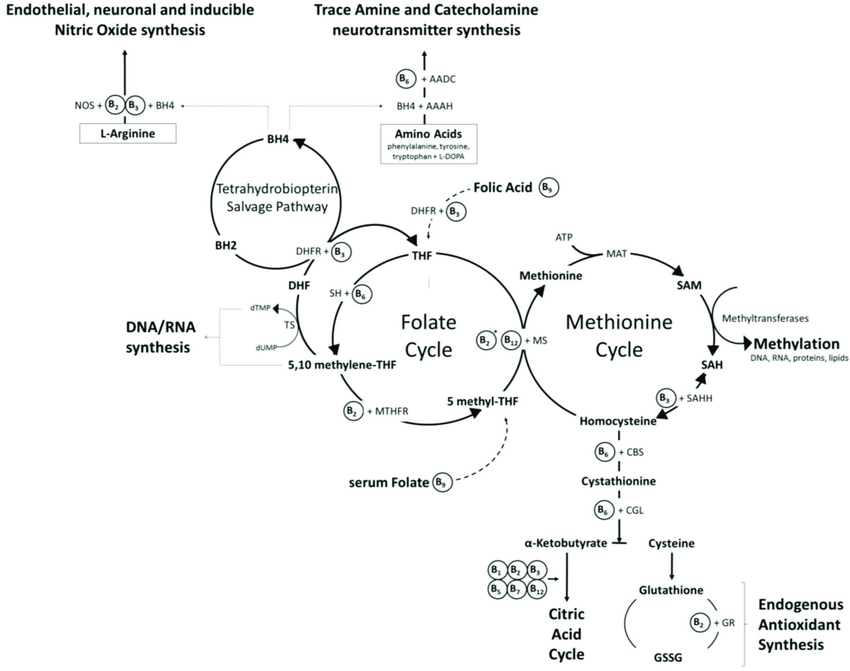
BH4 is an essential cofactor for several enzymes:
tyrosine hydroxylase → dopamine
tryptophan hydroxylase → serotonin
nitric oxide synthase → nitric oxide
Without sufficient BH4, nitric oxide synthase (eNOS) becomes unstable.
Instead of producing nitric oxide, the enzyme begins producing superoxide, a reactive oxygen species.
This process is called eNOS uncoupling.
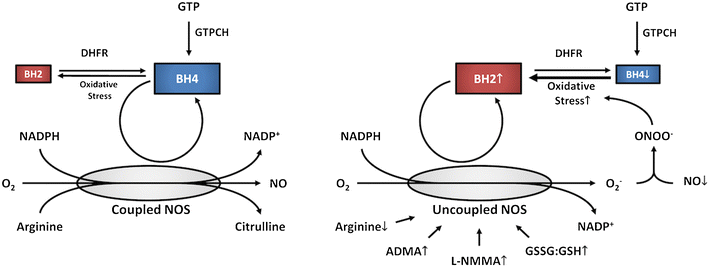
Once uncoupled, the enzyme that should produce nitric oxide instead produces superoxide, a free radical. And then to make things worse, the superoxide then binds to the little nitric oxide that is left and creates a highly toxic radical called peroxynitrite.
And peroxynitrite is ~100 to 1,000 times more reactive (harmful) than superoxide. Meaning, it’s highly destructive.
As a result, blood vessels become less responsive.
Nitric oxide signaling drops.
Blood flow becomes impaired.
This is one of the reasons folate deficiency is associated with erectile dysfunction.
Low Folate and Erectile Dysfunction
Several studies have shown that men with erectile dysfunction have significantly lower folate levels.
In one study examining arteriogenic erectile dysfunction:
Average folate levels in ED patients were:
8.08 ± 2.64 ng/mL
Healthy controls had significantly higher folate levels:
10.78 ± 2.87 ng/mL
…not even a huge difference.
This suggests that folate levels below roughly 10 ng/mL may be associated with poorer vascular function. Other studies suggest that 12ng/ml should actually be the cutoff point for folate.
Other research shows that men with severe ED tend to have even lower folate levels compared to those with milder symptoms.
Interestingly, folate deficiency can impair erectile function even when homocysteine levels are normal.
This means the benefit of folate is not limited to lowering homocysteine.
Folate also directly supports nitric oxide production and endothelial function.
Folate Does More Than Lower Homocysteine
Homocysteine is often used as a marker of folate status.
But focusing only on homocysteine misses several important mechanisms.
One active folate form, 5-methyltetrahydrofolate (5-MTHF), has additional effects inside blood vessels.
First, it helps regenerate BH4.
Second, it acts as an antioxidant.
5-MTHF can directly scavenge reactive oxygen species (ROS) such as superoxide.
It also helps protect BH4 from destruction by peroxynitrite (ONOO⁻).
This matters because peroxynitrite rapidly oxidizes BH4.
Once BH4 is destroyed, eNOS becomes uncoupled and oxidative stress increases.
By preserving BH4, folate helps keep nitric oxide synthase in its coupled, nitric-oxide-producing state.
There is also evidence that 5-MTHF may bind directly to the pterin site of eNOS, further supporting nitric oxide production.
So folate protects blood flow in multiple ways:
lowering homocysteine
preserving BH4
preventing eNOS uncoupling
scavenging oxidative stress
That is why folate status correlates with endothelial health.
Folate Also Supports Neurotransmitters
The same BH4 pathway that controls nitric oxide also affects neurotransmitter synthesis.
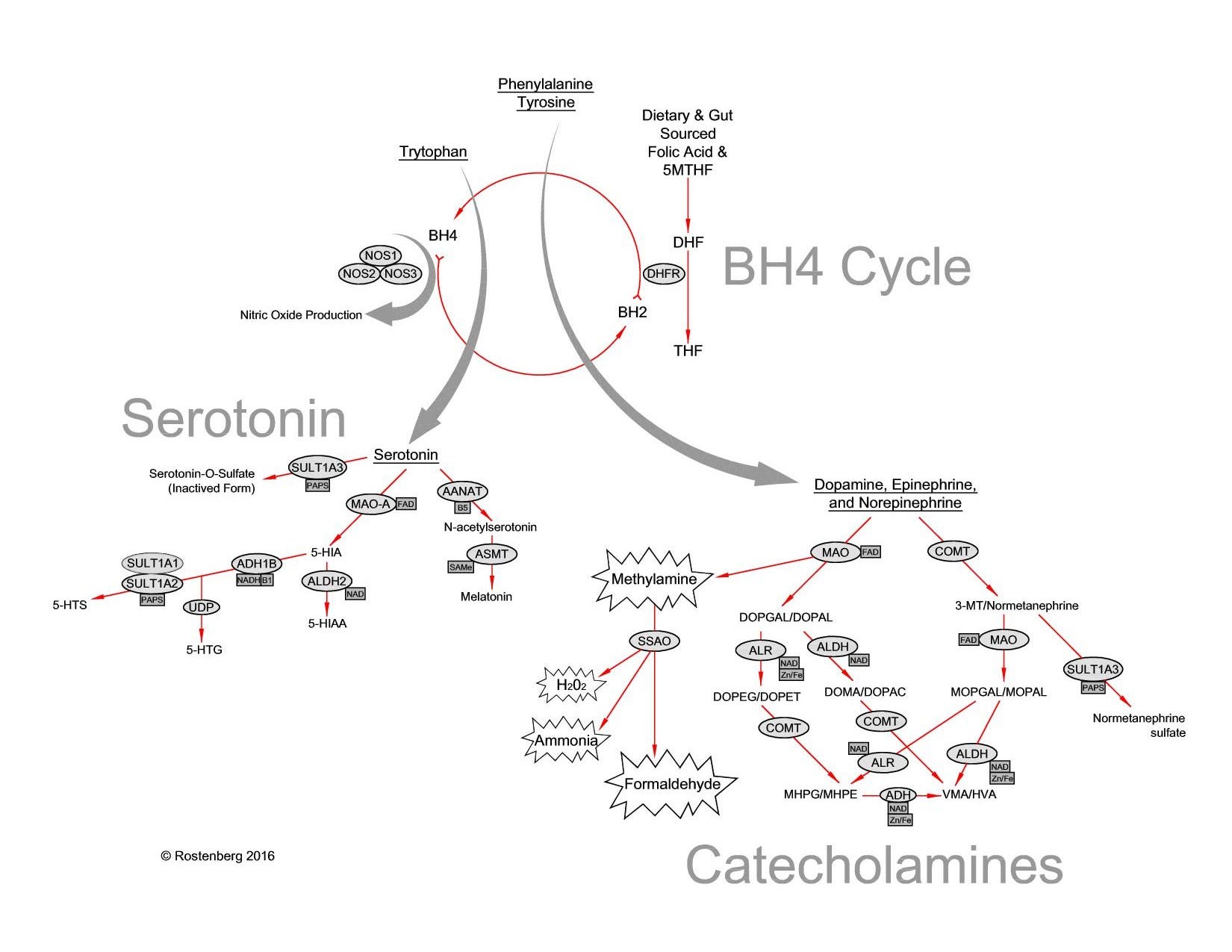
BH4 is required for the enzymes that produce:
dopamine
serotonin
norepinephrine
If folate levels drop, BH4 availability can decline.
When BH4 drops, neurotransmitter synthesis slows.
This can contribute to symptoms such as:
low motivation
depressed mood
reduced stress tolerance
struggling to focus or find joy or reward in things
Human research consistently finds that low folate or elevated homocysteine is associated with increased risk of depression and poorer response to antidepressants.
Supplementation with active folate forms such as L-methylfolate is sometimes used as an adjunct therapy in treatment-resistant depression for this reason. However, the effective dose is very high (15mg daily) and the additional boost is only about 10-20% on average.
Folate Is Also an Antioxidant
Another overlooked property of folate is its role in redox balance.
5-MTHF can directly neutralize reactive oxygen species.
Laboratory experiments show that 5-MTHF scavenges superoxide with measurable reaction kinetics, meaning it actively reduces oxidative stress inside cells.
This antioxidant activity is particularly important in the vascular system.
In conditions where BH4 is partially depleted, 5-MTHF can reduce superoxide production and restore nitric oxide output.
This effectively shifts the vascular environment from oxidative stress toward normal nitric oxide signaling.
In hypercholesterolemic patients, 5-MTHF supplementation has been shown to completely restore the vasodilatory effect of nitric oxide. Meaning, you can have adequate NO available, but your vascular doesn’t respond to it. Restoring folate levels can help normalize the vasculature response to NO.
When Folate Deficiency Begins
Folate deficiency is often blamed on poor diet, or the lack of broccoli intake.

But in many cases, the problem begins earlier in digestion.
Folate is absorbed primarily in the proximal small intestine through specialized transporters such as the proton-coupled folate transporter (PCFT).
Before absorption, dietary folate polyglutamates must first be converted to monoglutamate forms by the enzyme glutamate carboxypeptidase II (GCPII) on the intestinal brush border.
Anything that interferes with digestion in this region can impair folate absorption.
One common factor is Helicobacter pylori infection (as well as low stomach acid).
H. pylori infects more than half of the world’s population and colonizes the stomach and upper small intestine.
The bacterium disrupts normal stomach acid secretion.
Adequate stomach acid is required for proper digestion and nutrient absorption.
When acid production drops, absorption of several nutrients declines, including:
folate
vitamin B12
zinc
magnesium
iron
vitamin C
This combination can create a nutrient-deficient, inflammatory environment.
Interestingly, men with erectile dysfunction have roughly double the levels of H. pylori antibodies compared to men without ED, suggesting that infection may contribute to vascular dysfunction.
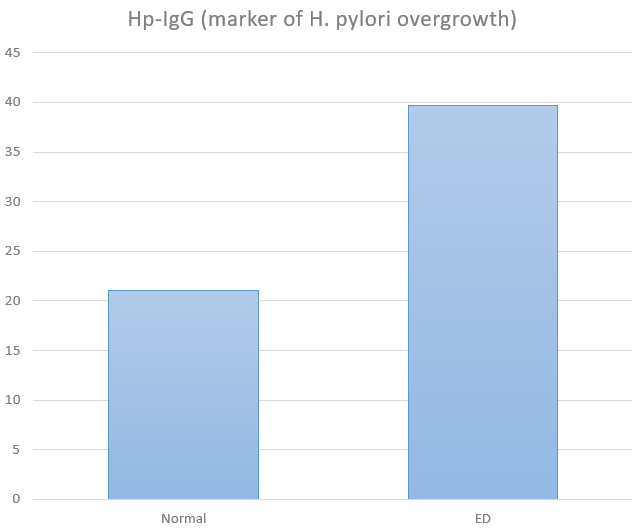
The cascade can look like this:
H. pylori infection → reduced stomach acid → poorer nutrient absorption → lower folate and B12 → impaired nitric oxide signaling → endothelial dysfunction → erectile problems.
In this situation, increasing folate intake alone may not fully solve the problem because the underlying issue is absorption.
Folate and Stress Resilience
Folate also plays an important role in how cells respond to stress.
Chronic stress and elevated cortisol increase the body’s demand for folate and other B vitamins.
Laboratory studies show that folate deficiency makes lymphocytes (a type of white blood cell part of the immune system) significantly more vulnerable to cortisol-induced chromosomal damage and telomere shortening.
In other words, adequate folate helps protect DNA during periods of stress.
This doesn’t mean folate directly lowers cortisol.
Instead, it helps cells maintain stability under stress exposure.
Folate Is a Capacity Nutrient
Looking at these pathways together reveals a larger pattern.
Folate supports:
nitric oxide signaling
neurotransmitter synthesis
DNA protection and repair
antioxidant defenses
endothelial health
All of these systems determine how well the body maintains function under stress.
When folate levels fall, these systems begin to degrade simultaneously.
Blood flow becomes less efficient.
Neurotransmitter synthesis slows.
Oxidative stress increases.
Repair capacity drops.
That’s why folate deficiency rarely appears as just a laboratory abnormality.
It often feels like reduced biological capacity.
Lower resilience.
Lower stress tolerance.
Poorer vascular performance.
Up next
Understanding why folate matters is only the first step.
The next question is just as important:
Which form of folate (or food) should you actually use?
Folic acid, methylfolate, and folinic acid all enter the folate cycle differently.
Some forms can overload specific pathways.
Others support the entire folate pool more gently.
In the next section we’ll cover:
the best supplemental forms of folate
why methylfolate can sometimes backfire
why folinic acid may be a better option for many people
the best food sources of folate
how to proper test your folate status (not just a serum folate test)
symptoms that may indicate folate deficiency
Let’s jump in!
