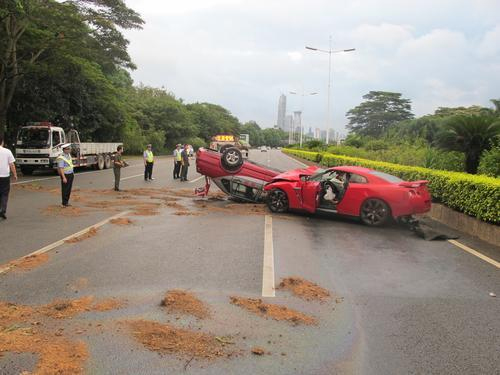
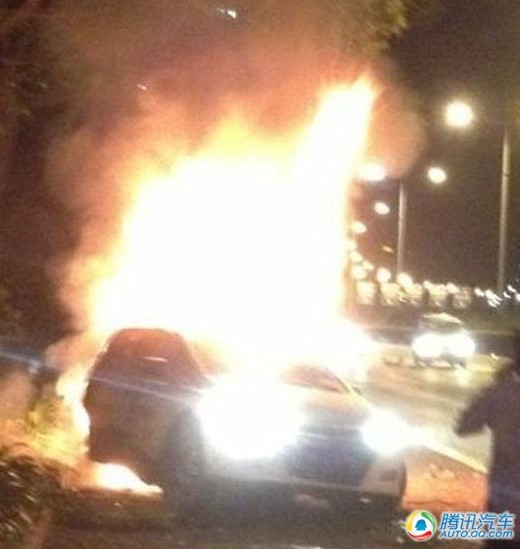
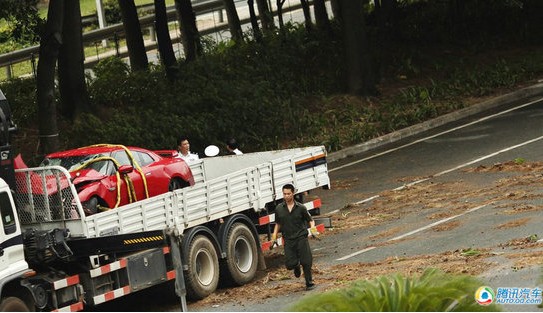
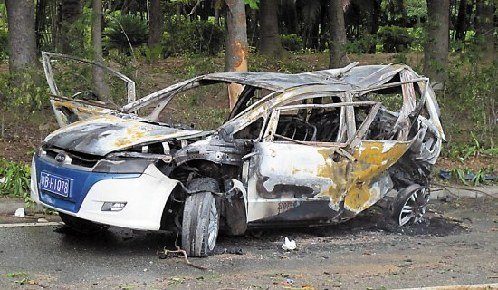
A horrible accident in the city of Shenzhen in Guangdong Province on the early morning of May 26. A Nissan GT-R crashed with two taxi’s, one patrol-powered Volkswagen Santana and one electric BYD e6. The BYD e6 bursted into flames, killing two female passengers and the driver. The driver and passenger of the Santana were slightly wounded and were taken to a hospital.
The driver and passenger of the Nissan GT-R fled the scene but later turned themselves in, both were drunk and involved in a drag race with a BMW when the accident happened. Why the e6 burned like it did is yet very uncertain, police is investigating what exactly happened. Still, investors are extremely worried about implications for BYD’s electric vehicle sales and sent stock down with almost 9% this Monday morning. The stock has since recovered but was still down 2.53% when the Chinese stock market closed 20 minutes ago.
The GT-R and Santana taxi. Witnesses at the scene said the speed of the Nissan was at least 180km/h.
The front of the e6 seems largely intact. Most damage is in the middle and at the back. The battery pack of the e6 is located in the belly pan of the vehicle; half under the floor of the driver’s seat and half under the area where the passenger’s feet would be. This is indeed the area where the flames seem to have started. How the GT-R exactly hit the e6 is not clear. The GT-R came to a stop after it hit the Sanatana so it likely hit the e6 first.
Pic of the fire seems to confirm the flames started in the middle. No flames up front and the head lights are still working. So much however for our amateur research based on not too clear pictures. Let’s hope Shenzhen police finds the real reason for the fire as quickly as possible.
According to a Reuters report citing Germany’s Handelsblatt newspaper, the European Union and China have begun negotiations over electric vehicle pricing that could potentially replace the EU’s current tariffs. This development comes as Donald Trump’s targeted approach to tariffs has inadvertently strengthened Chinese automotive presence in European markets while limiting their U.S. exposure.
EU spokesman confirmed Thursday that Trade Commissioner Maros Sefcovic has held talks with Chinese Commerce Minister Wang Wentao within the past 24 hours. Both sides have agreed to explore the feasibility of establishing a price floor for Chinese electric vehicles entering European markets.
China’s Commerce Ministry also confirmed in Beijing that relevant negotiations would “begin immediately.”
Commissioner Sefcovic has previously emphasized that any price floor arrangement must be equivalent to current tariff measures regarding effectiveness and verifiability. Since October 2023, the EU has been imposing tariffs of up to 45.3% on Chinese electric vehicles, prompting retaliatory measures from China that have particularly affected French cognac exports from brands such as Hennessy and Rémy Martin.
The timing of these negotiations appears significantly influenced by Donald Trump’s latest trade maneuvers. The former and potentially future U.S. president recently announced a three-month suspension of “reciprocal tariffs” against all countries except China, specifically signaling further tax increases on Chinese goods.
This targeted approach to Chinese imports has created an interesting dynamic in global automotive trade. With Chinese automakers facing prohibitively high barriers to the U.S. market, they have intensified their focus on European expansion, where, despite EU tariffs, they’ve managed to gain a growing market share.
Industry analysts note that Chinese auto exports to the United States represent a small fraction of their global export volume. European markets are becoming increasingly important for brands like BYD, SAIC, Geely, and others. The tariff environment created by Trump’s policies has effectively redirected Chinese automotive export strategies toward Europe rather than America.
“What we’re seeing is a classic case of trade diversion,” said an international trade expert who requested anonymity. “As the U.S. market becomes effectively closed to Chinese vehicles through punitive tariffs, manufacturers are doubling down on other markets where barriers are still manageable.”
The EU’s willingness to discuss alternatives to its current tariff regime suggests that European officials recognize the growing importance of finding a sustainable framework for trade with China, particularly as Trump’s policies create broader global trade tensions.
For Chinese automakers, the potential establishment of a price floor rather than percentage-based tariffs could provide more predictability for their European operations. This could allow them to adjust their business models accordingly while building market presence in what has become their most crucial export region outside of Asia.
The unintended consequence of Trump’s aggressive stance toward China appears to be strengthening Sino-European trade dialogue when the transatlantic relationship faces its own challenges.
At CES 2024 (Consumer Electronic Show) in Las Vegas, WeRide launched its autonomous minibus, WeRide Robobus, providing the exclusive on-site Level 4 autonomous driving minibus demo ride on site.
In 2020, WeRide partnered with Yutong Group to produce Robobuses, with Yutong investing 200 million USD. WeRide focuses on development, while Yutong handles production. The autonomous bus is known as Yutong Xiaoyu 2.0 in China. Yutong received the 2021 Red Dot Award for Xiaoyu 2.0’s design.
WeRide Robobus employs a fully autonomous design, integrating WeRide’s proprietary software and hardware solutions. Outfitted with lidar, high-definition cameras, blind-spot lidar, and millimeter-wave radar, the minibus achieves a comprehensive 360-degree awareness of its surroundings, featuring a 200-meter range obstacle detection capability.
Despite its compact size (5500/2050/2650 mm), the minibus accommodates up to ten passengers. Powered by a single 120 kW electric motor, it has a top speed restricted to 40 km/h and an NEDC range of 300 km. It can accurately recognise lane markings, traffic lights, signs, pedestrians, and other vehicles, facilitating seamless navigation through intricate urban traffic scenarios.
Robobus made its mark in Beijing, Guangzhou, Wuxi, Abu Dhabi, Singapore, and now in Las Vegas at CES 2024. CES visitors have the opportunity to experience the Robobus’ autonomous driving firsthand.
WeRide, founded in 2017, is one of the leaders in Level 4 autonomous driving technology. Headquartered in Guangzhou, WeRide operates R&D centers in China and San Jose, USA. Focused on autonomous driving, the company has conducted research, testing, and operations in over 26 cities globally. With over 25 million kilometers of autonomous driving mileage and nearly 1,500 days of operation, WeRide provides solutions for autonomous taxis, minibuses, freight vehicles, sanitation vehicles, and advanced intelligent driving. WeRide has partnerships with Renault-Nissian-Mitsubishi Alliance, Yutong Group, GAC Group, BOSCH, etc.
Adrian, an Electrical and Computer Engineering graduate with a love for cars, brings expertise and enthusiasm to every test at CarNewsChina. He also enjoys audio, photography, and staying active.