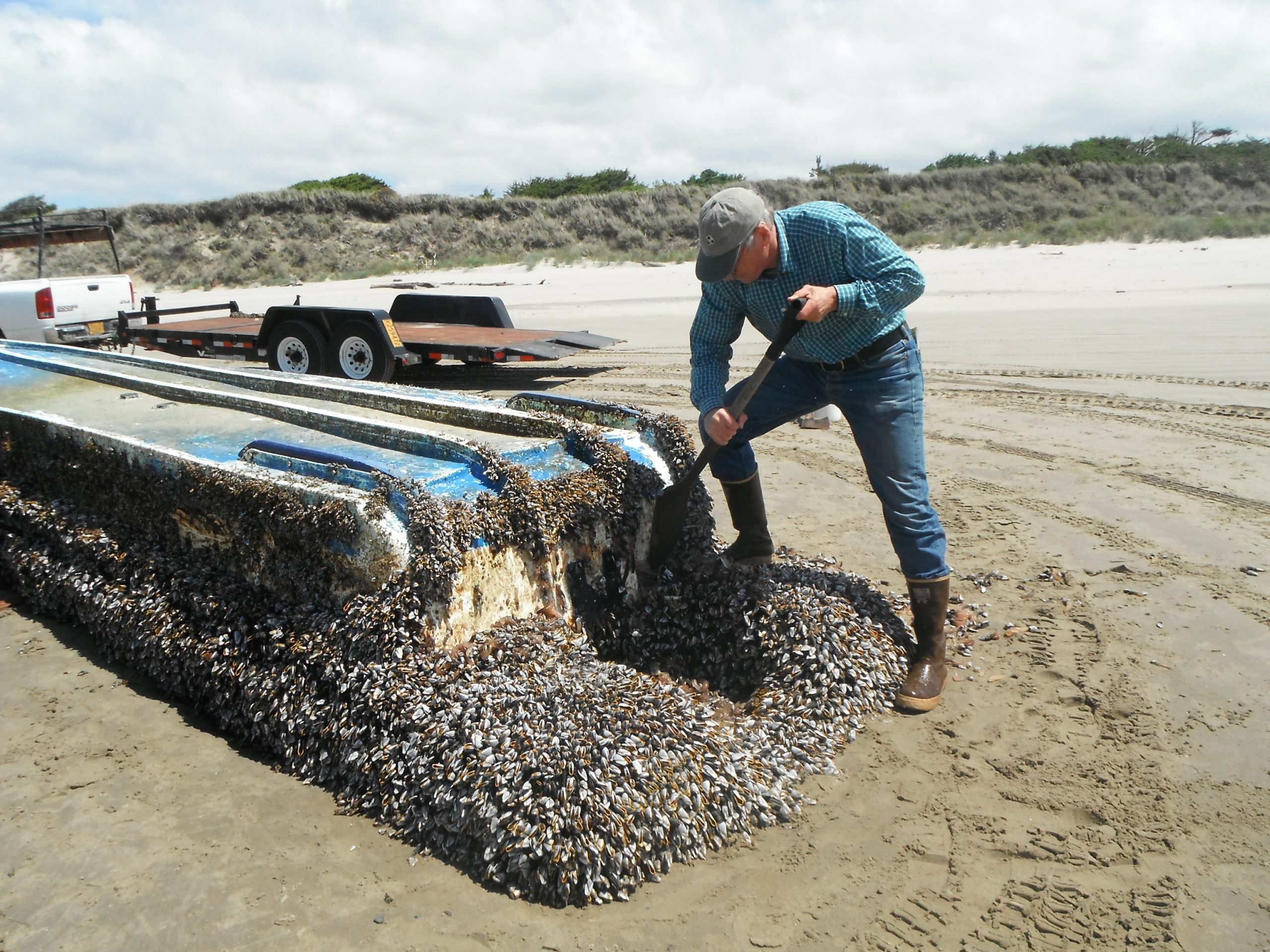
Well after the massive 2011 tsunami that swept across the Japanese coast, reminders of the event started appearing on the US-side of the Pacific. Various forms of debris, ranging from small hunks of plastic up to entire boats, made appearances on the US West Coast. Now, a team of researchers has found that the floating debris carried hundreds of potentially invasive species across the vast ocean with it, including a couple of species of fish.
While large tsunamis have occurred frequently, even in historic times, there’s no indication of anything like this before. The difference, according to the researchers, is humanity’s ability to make materials that can remain afloat in the open ocean for years.
It may seem a bit surprising that marine species couldn’t just introduce themselves, given that they already live in the ocean. But coastal habitats are very distinct from those of the open ocean, and many species couldn’t survive an ocean crossing on their own even if currents were favorable. While there are coastal environments across the Pacific Rim, they occur at very different latitudes, meaning the temperature conditions and nutrient availability can provide barriers to any species that might migrate around the edges of the open ocean.
The clearest indication that the Pacific poses a major barrier is the fact that similar environments, like the coasts of Japan and the Pacific Northwest, have distinct species.
But that barrier broke down a bit in the wake of the 2011 tsunami. The ocean carried off all sorts of floating debris, from small objects like buoys and wooden beams to entire docks and boats. Since 2012, a group of biologists has been monitoring the debris, tracking the organisms it carries. All told, they found 289 species. Most of these were invertebrates, like mollusks, worms, and crustaceans. But there were at least two species of fish that hitched a ride (one floating inside a flooded portion of a ship hull). And as of late last year, new debris was still arriving—including new boats, although the frequency was going down. “It is surprising that living species from Japan continue to arrive after nearly six years at sea,” the authors write, “four or more years longer than previous documented instances of the survival of coastal species rafting in the ocean.”


 Loading comments...

