


Age-related sex differences in explicit measures of empathy do not predict brain responses across childhood and adolescence
- PMID: 23245217
- PMCID: PMC6987715
- DOI: 10.1016/j.dcn.2012.08.001
Age-related sex differences in explicit measures of empathy do not predict brain responses across childhood and adolescence
Abstract
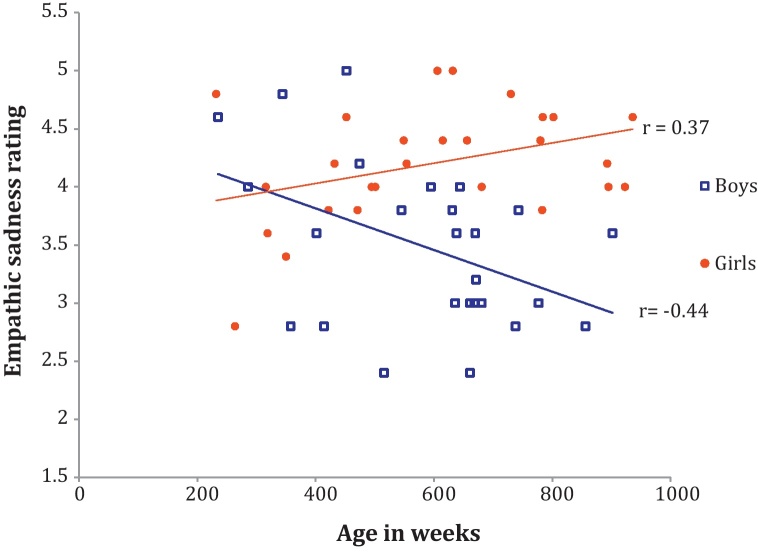
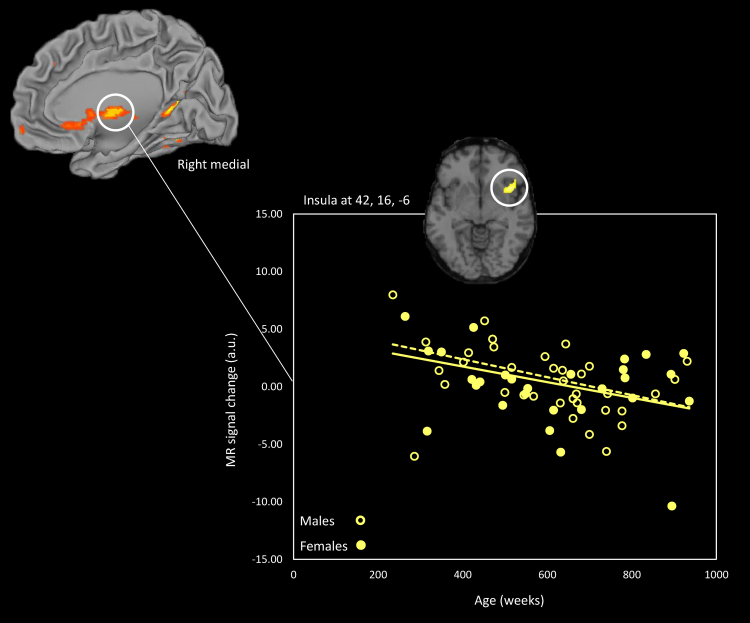
Behavioral research indicates that human females are more empathic than males, a disparity that widens from childhood to adulthood. Nevertheless, the extent to which such sex differences are an artifact of self-report indices is unclear. The present study compared age-related sex differences in both self-report and neurophysiological measures of empathic arousal, a primary building block of empathy. Participants included sixty-five 4-17-year-old children (mean 11.5±3.5 years) who completed the Bryant Empathy Scale, and were scanned while viewing animated clips depicting people being hurt. Female participants scored higher than males on self-reported dispositional empathy, a difference that increased with age. In contrast, no sex-related differential changes were detected in hemodynamic responses or in pupil dilation, with no interaction between sex and age. Results suggest a dissociation between explicit ratings and neurophysiological measures of empathic arousal. Past observed sex differences in empathy may reflect females' greater willingness to report empathic experiences. Findings are also discussed in terms of discrepancies in the methods used to assess affective responding and how they relate to the multi-faceted construct of empathy.
Copyright © 2012 Elsevier Ltd. All rights reserved.
Figures
Similar articles
-
Development of neural correlates of empathy from childhood to early adulthood: an fMRI study in boys and adult men.J Neural Transm (Vienna). 2010 Jun;117(6):781-91. doi: 10.1007/s00702-010-0404-9. Epub 2010 Apr 22. J Neural Transm (Vienna). 2010. PMID: 20411397
-
Sex-based differences in affective and cognitive empathy following severe traumatic brain injury.Neuropsychology. 2018 Jul;32(5):554-563. doi: 10.1037/neu0000462. Neuropsychology. 2018. PMID: 29952609
-
An EEG/ERP investigation of the development of empathy in early and middle childhood.Dev Cogn Neurosci. 2014 Oct;10:160-9. doi: 10.1016/j.dcn.2014.08.012. Epub 2014 Sep 6. Dev Cogn Neurosci. 2014. PMID: 25261920 Free PMC article.
-
Gender differences in empathic responses to others' economic payoffs: an event-related potentials study.Exp Brain Res. 2019 May;237(5):1347-1359. doi: 10.1007/s00221-019-05518-x. Epub 2019 Mar 15. Exp Brain Res. 2019. PMID: 30877343
-
Empathy: gender effects in brain and behavior.Neurosci Biobehav Rev. 2014 Oct;46 Pt 4(Pt 4):604-27. doi: 10.1016/j.neubiorev.2014.09.001. Epub 2014 Sep 16. Neurosci Biobehav Rev. 2014. PMID: 25236781 Free PMC article. Review.
Cited by
-
Psychometric Properties of Questionnaire of Cognitive and Affective Empathy (QCAE): Reliability and Factor Analysis Study in Turkish Sample.Noro Psikiyatr Ars. 2021 Aug 26;58(3):228-233. doi: 10.29399/npa.27248. eCollection 2021. Noro Psikiyatr Ars. 2021. PMID: 34526847 Free PMC article.
-
Social skills moderate the time-varying association between aggression and peer rejection among children with and without ADHD.Aggress Behav. 2021 Nov;47(6):659-671. doi: 10.1002/ab.21991. Epub 2021 Aug 23. Aggress Behav. 2021. PMID: 34426990 Free PMC article.
-
Emotional Self-Regulation in Primary Education: A Heart Rate-Variability Biofeedback Intervention Programme.Int J Environ Res Public Health. 2022 Apr 30;19(9):5475. doi: 10.3390/ijerph19095475. Int J Environ Res Public Health. 2022. PMID: 35564869 Free PMC article.
-
She more than he: gender bias supports the empathic nature of yawn contagion in Homo sapiens.R Soc Open Sci. 2016 Feb 3;3(2):150459. doi: 10.1098/rsos.150459. eCollection 2016 Feb. R Soc Open Sci. 2016. PMID: 26998318 Free PMC article.
-
Psychometric properties of the chinese version of the value-based stigma inventory (VASI): a translation and validation study.BMC Psychiatry. 2024 Aug 7;24(1):550. doi: 10.1186/s12888-024-05998-4. BMC Psychiatry. 2024. PMID: 39112959 Free PMC article.
References
-
- Akitsuki Y., Decety J. Social context and perceived agency modulate brain activity in the neural circuits underpinning empathy for pain: an event-related fMRI study. NeuroImage. 2009;47:722–734. - PubMed
-
- Andersen, S., Ertac, S., Gneezy, U., Liszt, J.A., Maximiano, S., 2012. Gender, competitiveness and socialization at a young age: evidence from a matrilineal and a patriarchal society. Review of Economics and Statistics, Epub ahead of print.
-
- Bandstra N.F., Chambers C.T., McGrath P.J., Moore C. The behavioural expression of empathy to others’ pain versus others’ sadness in young children. Pain. 2011;152:1074–1182. - PubMed
-
- Baron-Cohen S., Wheelright S., Hill J., Raste Y., Plumb I. The Reading the Mind in the Eyes Test revised version: a study with normal adults and adults with Asperger syndrome or high-functioning autism. Journal of Child Psychology and Psychiatry. 2001;42:241–251. - PubMed
-
- Baron-Cohen S., Wheelwright S. The empathy quotient: an investigation of adults with Asperger syndrome or high functioning autism, and normal sex differences. Journal of Autism and Developmental Disorders. 2004;34:163–175. - PubMed
Publication types
MeSH terms
LinkOut - more resources
Full Text Sources
Other Literature Sources
Miscellaneous
