


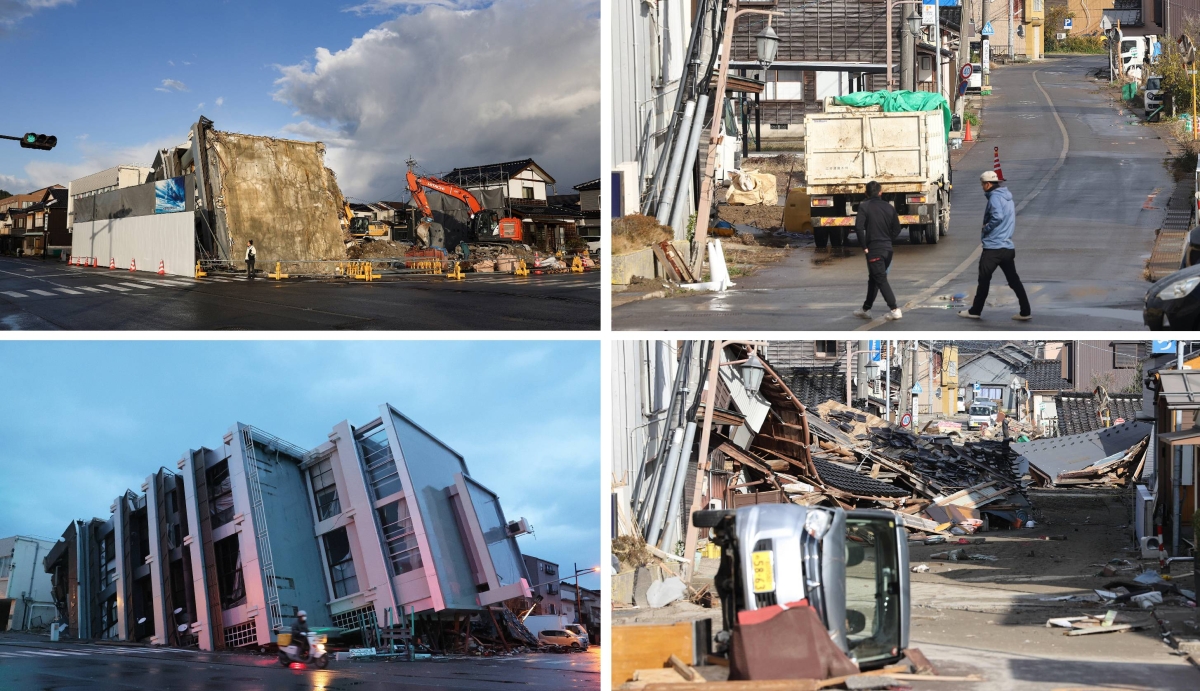

Layers of ashen-brown mud cake the roadside, driftwood lies heaped in mangled mounds, and homes knocked down by landslides rest in eerie silence as the occasional truck roars past — scars left by torrential rain in September that battered the community of Machinomachi, a district in the northern corner of the city of Wajima.
Taking the wheel of his minivan, Tsukasa Kurosawa drives through the bleak scene, explaining the work he and his team of disaster relief experts and volunteers have been engaged in since the ferocious downpours flooded rivers and triggered mudslides — dealing yet another blow to residents still struggling to rebuild their lives after a violent earthquake rocked the region on Jan. 1, 2024.
A year after a magnitude 7.6 temblor resulted in a death toll that’s expected to surpass 500, reconstruction on the Noto Peninsula in Ishikawa Prefecture remains a prolonged and complex ordeal.
“An old lady living here was killed by a landslide,” Kurosawa says, waving toward a house half-buried under debris. “It’s a sad story.”
Reports say the woman, in her 80s, was living with her son’s family and arranging to relocate to a temporary housing facility as their home was partially damaged by the New Year’s Day quake. On the day of the heavy rain, she stayed home while the rest of the family were at the shelter as part of their moving preparations. She was one of the 16 people killed during the deluge.
“We’re clearing out the mud and rubble using heavy machinery while organizing volunteers to do the more intricate, hands-on waste removal at homes and areas where contractors hired by local governments aren’t authorized to operate,” says Kurosawa, a senior adviser for The Nippon Foundation disaster response team and organizer of the technical disaster volunteer network DRT-JAPAN.
“There just aren’t enough workers to get the job done, and that’s why Ishikawa Prefecture has been saying they need more volunteers.”

The region's mountainous terrain has made it difficult to transport necessary materials and labor, while battered roads, utilities and structures have required extensive rebuilding amid limited resources, causing both emotional and social strain on an aging, shrinking population — many of whom have been displaced.
Noto’s story is a tragic case where the double whammy of a massive earthquake and vicious rainstorm was compounded by its geographical isolation and graying demographics, raising broader questions about how a nation so prone to disasters can face future calamities.
“Of course, global warming is having an impact, and disasters are happening more often and becoming more severe. People also say that an earthquake along the Nankai Trough could happen soon,” says Kurosawa, referring to a major seismic zone off the archipelago’s Pacific coast where tectonic activity poses a risk for powerful megathrust earthquakes and tsunamis.
“And if it really happens, there’s a real sense of crisis — especially with the possibility of a major earthquake right under Tokyo," continues Kurosawa, who has been involved in disaster relief work since the Great Hanshin Earthquake in 1995 and has been active in Noto since Jan. 3, 2024.
“When I see what’s happening in the Noto Peninsula, I can’t help but wonder: Are we really going to be okay?"
Perseverance
Sandwiched between the Machino River and its tributary, the Suzuya River, the Motoya Supermarket is the only one of its kind in Machinomachi. Founded in 1946, the store has served as a central hub of the community and continued to operate without taking a single day off after the Jan. 1 earthquake, despite the widespread blackouts and destruction the neighborhood suffered.
That streak of resilience ended with the rainstorm, however.
Kazutomo Motoya, the owner and president of the supermarket, documented the sudden rise in water levels and the subsequent inundation of his shop on video.
At around 10 a.m. on Sept. 21, he had his employees move products toward the rear of the store to avoid damage from the floodwater seeping in.

Things escalated quickly.
Ten minutes later, he evacuated to the roof of the supermarket as water kept rising. From his vantage point, he saw his mobile sales truck, used to deliver goods to rural neighborhoods, being carried away by the muddy current. By 10:17 a.m., the first floor of the supermarket was submerged.
When the water subsided in the early afternoon, Motoya went downstairs to examine his shop. A video clip he took shows a large tree rammed through the glass doors of the supermarket. All the items in the store, along with the shelves, had been swept to the back in muddy, chaotic piles.
It was as if a tsunami had crashed over the property.
To make matters worse, Machinomachi was temporarily isolated as mudslides swamped the roads leading into the district.
It was only on Dec. 5 that traffic resumed on a portion of National Route 249 — a major artery that runs along the coast of the peninsula and the most direct route connecting Wajima’s city center to Machinomachi. A 2.8-kilometer section had been blocked due to landslides.
“It’s been painful since we’ve kept our supermarket open every day since the earthquake,” Motoya says at his store in late November while preparing to reopen. “Everything, including our safe, was swept away.”

Most of the mud and debris had been cleared by then, thanks to the efforts of construction workers and volunteers, and his shop had begun stocking its shelves again. He also decided to open up 500 square meters of space inside his supermarket so tents can be pitched for volunteers and visitors to sleep in.
On Nov. 30, Motoya Supermarket officially reopened. The event was marked by a ceremony attended by around 50 local residents and the press.
After a moment of silence to honor those who perished in the earthquake and flooding, an ornamental sphere decoration cracked open, unfurling a banner that read: “Revival!! Machino's Rocky, Motoya Supermarket.”
It was a reference to Rocky Balboa and the iconic movie character’s message of perseverance.
“It’s a miracle, isn't it? To think that such a store was restored in just two months,” Motoya told reporters afterward.
“It would have been impossible with just my own efforts. ... From here on, I want to work with all the residents to rebuild this town, making it a fun and meaningful process."
Slow progress
While many affected communities have begun regaining a sense of normalcy, some parts of the Noto Peninsula remain in relative isolation due to extremely bad road conditions.
About 6 km north of Motoya Supermarket, along Route 249, is the coastal district of Mauramachi in the city of Suzu. The Jan. 1 earthquake triggered landslides on both the northeastern and southwestern sides of the road, temporarily cutting the area off.
While access to Wajima was restored shortly after the quake, the Hosaka Tunnel, which leads northeast toward Suzu, along with four other damaged sections of the highway connecting Wajima to Suzu, remained blocked until recently.
With a panoramic view of the Sea of Japan, a restaurant remodeled from an old kominka (traditional Japanese house) and a hotel stand by the coast. Both were forced to suspend their operations due to damage from the temblor, and the Sept. 21 downpour dealt them a further setback, as flooding and landslides overwhelmed the buildings.

On an overcast afternoon in late November, Jotaro Wada, the owner of the restaurant and inn, was seen donning a helmet, rubber boots and an orange jacket in front of what remained of his properties.
Following the quake, his family evacuated to a temporary housing facility in the city of Kanazawa while Wada, a professionally trained chef, returned to Suzu.
Living out of an evacuation center in the local elementary and junior high school, he and three other restaurant owners launched a bento (lunchbox) delivery service, and on Sept. 5, opened a temporary restaurant at a rest area in Suzu they called Suzunari Shokudo.
“While my home, restaurant and hotel were damaged to varying extents by the quake, the impact of the rain was immense,” Wada says. “There’s a small river running nearby that burst its banks while the cliff behind our restaurant and hotel collapsed.”
Wada now lives in a sharehouse near Suzunari Shokudo, and occasionally checks in on his properties in Mauramachi, which his family has owned for half a century.
Considering the severity of the damage to the structures, he plans on having them demolished eventually. He hopes to relocate his business to somewhere safer in Suzu, having factored in how disaster-prone the current location has been.
“There are also road conditions to consider. We are residents of Suzu, but since we are located on the far end of the city, there are many services that we can't access that others in Suzu are able to,” he says.
“The recovery is slow, and we’ve been without water for a long time. I think everyone in Mauramachi feels like they have been left behind."
The treacherous road conditions, one of the main hurdles hampering reconstruction, are improving, albeit slowly.

On Dec. 13, the land ministry’s Noto Reconstruction Office announced that sections of Route 249 between Wajima’s Monzencho district and Suzu would have their access gradually restored, and the entire route reopened to traffic on Friday.
“There are still some tough spots, and the road conditions aren't great in certain areas, but there are definitely more places you can get through now,” says Toshihide Tani, the technical director of the reconstruction office based in the city of Nanao.
When asked how long it would take to see transportation routes fully restored, Tani could not give a precise estimate.
“I can’t say whether it will take one or two years,” he says. “There are places where the roads are completely gone and others where they have collapsed.”
Business as usual
Some 100 km south of Wajima, Kanazawa is a different world entirely.
Throngs of tourists disembark at the prefectural capital’s shinkansen station and marvel at Tsuzumimon (drum gate) outside the exit before venturing on to the numerous historical attractions the elegant castle town has to offer.
Traces of a pandemic-induced tourist-drought are nonexistent here — in fact, Kanazawa found a spot on National Geographic’s Best of the World 2025 list, promising increased inbound footfall.
The stark contrast with the situation in Noto is perhaps what makes the realities on the peninsula all the more heartbreaking.
Ishikawa Gov. Hiroshi Hase said during a press conference on Dec. 26 that public-funded demolitions of houses damaged by the earthquake reached a total of 13,547 as of Dec. 22. That’s still only around 40% of the expected number of demolitions.
Meanwhile, Hase said the construction of 6,882 emergency temporary housing units was completed on Dec. 23, nearly a year after the quake. As for the 286 additional housing units needed following the September deluge, he said they would be completed by the end of March at the latest.

“Despite the slow progress, infrastructure is gradually returning,” says Tatsuto Aoki, an associate professor at Kanazawa University and an expert on regional disaster prevention.
That said, winter is a concern, he adds. Bulldozers cannot operate effectively on uneven roads, and certain areas have broken guardrails, raising safety concerns about the snow removal process.
“Last winter, everyone evacuated, but this year, people have gradually returned. If snow removal proves difficult, some areas may become isolated during the winter. There are fears about fuel supplies being cut off as well,” he says.
In the longer term, lack of employment would see younger workers leave the disaster-affected regions for urban areas, Aoki says, raising the question surrounding the sustainability of depopulated villages inhabited largely by elderly residents.
Tourism is perhaps an answer. Prime Minister Shigeru Ishiba has said the government is considering measures to stimulate travel demand in the region.
“I myself plan to spend the New Year’s holiday season at Wakura Onsen,” Aoki says, referring to a well-known hot spring resort in the Noto Peninsula city of Nanao.
Aoki points out that Noto has become a pioneering example of managing lifelines on a peninsula during a disaster that other regions with similar geographical conditions can learn from.
"Given Japan’s aging population, Noto’s experience with disaster response in these vulnerable areas could offer valuable lessons for the rest of the country," he says.


With your current subscription plan you can comment on stories. However, before writing your first comment, please create a display name in the Profile section of your subscriber account page.