Edition
delhi14°C
TOI logo
tap to unmute
Pause
Play
Play
Play
Unmute
00:08 / 03:43
Fullscreen
Skip
Now Playing
R.I.P. Manmohan Singh: A Legacy of Economic Reforms & Nuclear Deal | WATCH

Panama Canal power play: Donald Trump pushes back against China’s rising role

US President-elect Donald Trump has raised concerns about China's expanding influence in the Panama Canal region, criticizing high fees and suggesting a return to US control. Panama's President José Raúl Mulino emphasized Panama's sovereignty. China's investments in Panama’s ports and infrastructure further highlight the strategic US-China rivalry over this critical global trade artery.
Read More
Panama Canal power play: Donald Trump pushes back against China’s rising role
File photo: President Jimmy Carter views the Panama Canal at the Miraflores Locks in Canal Zone on June 17, 1978.
The Panama Canal, a key artery for global trade, has emerged as a focal point of geopolitical tension as US President-elect Donald Trump raises alarms about China’s expanding influence in the region.
Driving the news
  • Trump has recently made headlines with provocative statements regarding Panama, Canada, and Greenland.
  • In relation to Panama, Trump has criticized the fees charged by the country for ships passing through the Panama Canal, describing them as "ridiculous, highly unfair." He threatened to demand that the canal be returned to US control if Panama does not reduce these fees, reviving a nationalist rhetoric about reclaiming a "vital national asset" that the US once controlled until 1999. This stance has been met with firm rebuttal from Panama's President José Raúl Mulino, who emphasized Panama's sovereignty and control over the canal.
  • Concerning Canada, Trump has engaged in what appears to be trolling by suggesting that Canada could become the 51st US state, referring to its Prime Minister Justin Trudeau as "Governor" and linking this proposal to his threats of imposing tariffs on Canadian goods.
  • Meanwhile, Trump's interest in Greenland has been reignited, echoing his earlier attempts during his first term to purchase the island from Denmark for national security reasons. He has stated that the US "feels that the ownership and control of Greenland is an absolute necessity," which was met with a clear rejection from Greenland's Prime Minister Mute Egede, who declared, "Greenland is ours. We are not for sale."

Merry Christmas to all, including to the wonderful soldiers of China, who are lovingly, but illegally, operating the Panama Canal (where we lost 38,000 people in building 110 years ago), always making certain that the United States puts in Billions of Dollars in “repair” money, but will have absolutely nothing to say about “anything.”
US President-elect Donald Trump

Why it matters
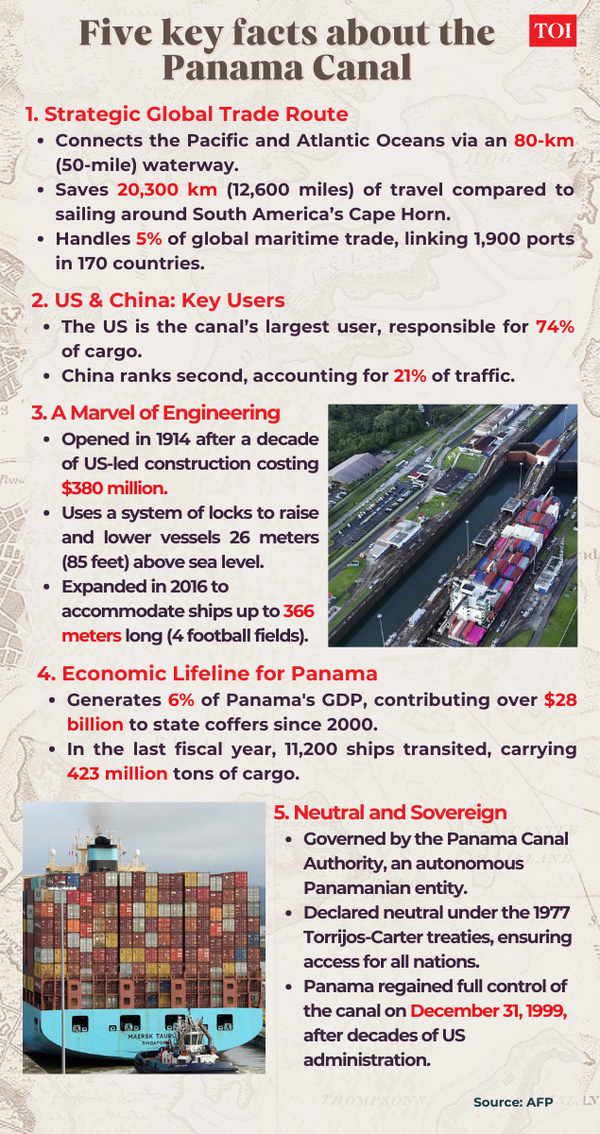
  • The Panama Canal, a critical artery of global trade, has become a focal point in the strategic rivalry between the United States and China. Carrying nearly 6% of global commerce and 57.5% of US-Asia container traffic, the canal remains vital for economic and geopolitical stability. However, China’s growing economic footprint in Panama’s ports and infrastructure has raised concerns in Washington over Beijing’s influence in this pivotal chokepoint.
  • The Panama Canal’s significance goes beyond its logistical value in global trade. It has become a flashpoint in the broader struggle for influence between the world’s two largest economies:
  • Economic importance: Over 70% of the canal’s traffic involves goods originating in or destined for US markets, underscoring its critical role in maintaining US supply chains and consumer goods flow.
  • For China, Panama serves as a strategic entry point into Latin America, a region where Beijing has steadily increased its investments.
  • Geopolitical stakes: The canal’s neutrality is guaranteed under the US-Panama Neutrality Treaty, which ensures equal access to all nations. However, growing Chinese influence raises questions about the potential erosion of this principle.
  • The US has signaled concerns that Chinese investments in canal-adjacent infrastructure could enable Beijing to monitor or potentially disrupt operations in the event of a geopolitical conflict.
  • Global trade balance: Any disruption to the canal’s operations would ripple across global supply chains, affecting the movement of goods, especially between Asia and the US East Coast.

Zoom in: Chinese influence
  • China’s growing presence in Panama is multifaceted, blending economic investments with strategic positioning.
  • Since Panama shifted its diplomatic allegiance from Taiwan to Beijing in 2017, Chinese investments in the region have surged. Panama became the first Latin American country to sign onto China’s Belt and Road Initiative (BRI), a global infrastructure development strategy aimed at extending China’s geopolitical influence
  • Ports and infrastructure: Hutchison Ports PPC: This Hong Kong-based company operates ports at both ends of the canal, Balboa (Pacific side) and Cristobal (Atlantic side), giving China a significant role in the region’s logistics.
  • Panama-Colón Container Port: A $900 million project on Margarita Island, funded by the China-based Landbridge Group, adds a deep-water port for megaships, boosting China’s logistical reach in the Western Hemisphere.
  • Strategic projects: The Fourth Bridge: China Communications Construction Company (CCCC) was awarded a $1.4 billion contract to build a fourth bridge over the canal. Though delayed, the project reflects Beijing’s ongoing interest in cementing its role in Panama’s infrastructure.
  • Energy facilities: Investments such as the $900 million natural gas-fired power plant by Shanghai Gorgeous Group have expanded China’s influence beyond logistics.
.
The big picture
The growing tension over the Panama Canal underscores the broader struggle for influence between Washington and Beijing:
US concerns: The Biden administration has expressed unease over the extent of Chinese involvement in Panama. US ambassador Mari Carmen Aponte noted that the canal must remain neutral, emphasizing, “We do not want to put Panama in a position where it must choose between the United States and China.”

Recent US military statements highlight fears that Chinese-controlled infrastructure near the canal could be used for surveillance or other security threats.

Trump’s recent comments may reflect a newly muscular interpretation of his America First policy amid rising alarm about what the commander of US forces in the region this year called China’s significant presence on America’s “20-yard line.” At the same time, the incoming administration may see Latin America as an easier place to exert foreign policy pressure — or at least the image of toughness — than some other parts of the world.

An article in the Washington Post

Panama pushes back: Panamanian officials have firmly rejected Trump’s assertions. President José Raúl Mulino emphasized that the canal is fully sovereign and operates under the principles of the 1977 Torrijos-Carter Treaties, which transferred control of the canal from the United States to Panama. The treaties also guarantee the canal’s neutrality and nondiscriminatory access for all nations.

Every square meter of the Panama canal and the surrounding area belongs to Panama and will continue belonging so.

Panamanian President Jose Raul Mulino

Chinese officials have also dismissed Trump’s claims. Mao Ning, a spokesperson for China’s Foreign Ministry, stated that “China will, as always, respect Panama’s sovereignty over the canal and recognize the canal as a permanently neutral international waterway.”
Regional implications
As a strategic hub for global trade, Panama’s decisions will resonate across Latin America. Countries like Colombia and Costa Rica closely watch these developments, as they seek to navigate their own economic ties with China and the US.
What’s next
  • Several developments will shape the future of the Panama Canal’s role in global geopolitics:
  • US re-engagement:Washington may ramp up efforts to counterbalance Chinese influence by offering infrastructure investments, trade agreements, or defense cooperation with Panama.
  • Beijing is also likely to double down on its economic diplomacy, presenting itself as a reliable partner for Panama’s development while downplaying security concerns.
  • Chinese firms could push for additional concessions in logistics, energy, and infrastructure to consolidate their presence.
  • Panama’s strategic calculus:
  • Panama’s government will need to balance its relationships carefully, ensuring that it maintains autonomy over the canal while leveraging investments from both the US and China.
  • Decisions like the Port of Cristobal renewal and the future of the Fourth Bridge project will be critical tests of Panama’s ability to navigate these pressures.
Bottom line
The Panama Canal is more than a waterway; it is a strategic battleground in the escalating competition between the US and China. While Panama asserts its sovereignty, the geopolitical currents around the canal show no signs of calming. The country’s decisions in the coming years will shape the dynamics of global trade and influence the broader balance of power in Latin America.
(With inputs from agencies)
author
About the Author
TOI World Desk

At TOI World Desk, our dedicated team of seasoned journalists and passionate writers tirelessly sifts through the vast tapestry of global events to bring you the latest news and diverse perspectives round the clock. With an unwavering commitment to accuracy, depth, and timeliness, we strive to keep you informed about the ever-evolving world, delivering a nuanced understanding of international affairs to our readers. Join us on a journey across continents as we unravel the stories that shape our interconnected world.

Start a Conversation
Post comment
End of Article
FOLLOW US ON SOCIAL MEDIA
GoogleFacebookTwitterInstagramKOO APPYOUTUBE
Up Next

Print smarter, work faster: Unlock efficiency with HP Laser Jet Tank MFP 2606sdw printers

Print smarter, work faster: Unlock efficiency with HP Laser Jet Tank MFP 2606sdw printers
In our always on-the-go world, every second counts, and the right tools can make all the difference in your productivity. Imagine juggling multiple deadlines, with your printer keeping up effortlessly—no delays, no paper jams, just crisp, high-quality prints. That’s where HP LaserJet Tank MFP 2606sdw comes in, a game-changer in the future of work. Designed for small businesses and home offices, it’s one of the top mono laser printers on the market, delivering blazing-fast speeds, low cost per page, and unwavering reliability. Whether you’re running a busy print shop, managing a home business, or tackling school projects, the printer ensures you stay on track without the worry of downtime.
Speed that aligns with your ambitions
image1

Businesses value simplicity and convenience in their printing solutions, preferring printers that are easy to set up, operate, and maintain, allowing them to focus on core business activities. Time is money, especially for businesses. The HP LaserJet Tank MFP 2606sdw is designed to keep pace with your fast-moving environment, delivering high-speed printing without sacrificing quality. Its self-reloading toner feature lets you quickly reload in under 15 seconds—no technician required—ensuring you’re back to work in no time. Whether you're handling a last-minute print job or managing high-volume tasks, this printer is the ideal solution for SMBs and busy households that can't afford any interruptions.
Business deserves unmatched quality
The HP LaserJet Tank MFP 2606sdw is a laser printer with up to 5,000 pre-filled pages of Original HP Toner and a cost per page as low as 30 paisa—that’s exceptional cost efficiency for businesses. Thanks to HP’s LaserJet technology, you get sharp prints that make every page look professional—whether it’s an invoice, brochure, or even a marketing campaign.
Smarter printing made simple
With its seamless integration with mobile devices, printing documents, invitations, or even school projects has never been easier. The HP Smart app lets you print, scan, and troubleshoot directly from your mobile device, with no complicated setups. Just tap to print, and you’re good to go.For jobbers running print shops, parents managing school assignments, or professionals working from home—imagine a printer that effortlessly keeps up with your busy day. That’s HP LaserJet Tank MFP 2606sdw
Sustainability meets savings
The printer is designed with the planet in mind. With HP Auto On/Off Technology, you’ll save energy and reduce your electricity bills while printing in lightning speed. The printer’s speedy 22 ppm print rate ensures high-quality prints, while automatic duplex printing saves paper Plus, the 40-sheet Automatic Document Feeder (ADF) simplifies scanning and copying, making your workflow even smoother.
A printer that works as hard as you do
Whether you’re managing a government office, running a private firm, or organizing a home office, the HP LaserJet Tank MFP 2606sdw Printer Range is designed to keep pace with your demands. With its unbeatable combination of speed, reliability, and quality, it’s the ultimate tool for those who refuse to compromise.
To experience effortless printing, bring the HP LaserJet Tank MFP 2606sdw today to your space and see your productivity rise to the next level!
Disclaimer: The article has been produced on behalf of HP by the Times Internet's Spotlight team.
End of Article
FOLLOW US ON SOCIAL MEDIA
GoogleFacebookTwitterInstagramKOO APPYOUTUBE
Up Next

Musk, Ramaswamy discuss US talent shortage as Sriram Krishnan’s immigration views spark row: ‘America-first means ...’

Musk, Ramaswamy discuss US talent shortage as Sriram Krishnan’s immigration views spark row: ‘America-first means ...’
Elon Musk and Vivek Ramaswamy (File photo)
Amid recent controversy surrounding Indian-American entrepreneur Sriram Krishnan, who has faced scrutiny over his views on immigration and high-skilled worker visas, Vivek Ramaswamy responded to Elon Musk’s statement on the US talent shortage and its potential impact on America’s global competitiveness.
Musk, who recently highlighted the scarcity of skilled engineering talent in Silicon Valley, posted, "It comes down to this: do you want America to WIN or do you want America to LOSE? If you force the world’s best talent to play for the other side, America will LOSE. End of story."

Ramaswamy, the entrepreneur and political figure, quickly responded, "America-First means we want America to WIN. Playing for second place doesn’t cut it." His reply was seen as a pointed comment on the ongoing debate surrounding immigration policy and the need for top-tier talent in the US.

Musk’s original post had focused on what he sees as a critical shortage of engineering talent in the US, particularly in fields like AI and semiconductors. “The number of people who are super talented engineers AND super motivated in the USA is far too low,” Musk explained. He went on to liken the situation to a pro sports team, stating, “If you want your TEAM to win the championship, you need to recruit top talent wherever they may be. That enables the whole TEAM to win."

This conversation was sparked by a post on X that discussed the significant gap in engineering talent, particularly within the US semiconductor industry. The post noted that the US semiconductor industry alone needs over 160,000 engineers by 2032 due to $250 billion in new investments. Demand for AI experts has also surged, with Musk calling the talent shortage "the craziest" ever. The post further highlighted the struggles of STEM programs to produce enough graduates, which threatens innovation and global competitiveness.
In response, Musk emphasized the importance of expanding STEM education, streamlining high-skilled immigration, and reskilling workers to address the growing talent gap.
author
About the Author
TOI World Desk

At TOI World Desk, our dedicated team of seasoned journalists and passionate writers tirelessly sifts through the vast tapestry of global events to bring you the latest news and diverse perspectives round the clock. With an unwavering commitment to accuracy, depth, and timeliness, we strive to keep you informed about the ever-evolving world, delivering a nuanced understanding of international affairs to our readers. Join us on a journey across continents as we unravel the stories that shape our interconnected world.

End of Article
FOLLOW US ON SOCIAL MEDIA
GoogleFacebookTwitterInstagramKOO APPYOUTUBE
Up Next

Sriram Krishnan Outrage: Indian-Americans are the wealthiest minorities in the US

Sriram Krishnan Outrage: Indian-Americans are the wealthiest minorities in the US
Amid the ongoing controversy surrounding Indian-American entrepreneur Sriram Krishnan’s appointment as Senior Policy Advisor on Artificial Intelligence in President-elect Donald Trump’s administration, a viral dataset has reignited discussions on the success of minority groups in the US.
The data comes as a response to accusations from some users who claim that Indian immigrants, like Krishnan, are "exploiting" the US labor market.
The dataset, which has also been shared by Elon Musk, reveals the economic success of several minority communities, with Indian Americans leading the pack. Their median household income of $126,705 is nearly double that of White Americans, who earn $69,823.


The dataset, sourced from the American Community Survey, highlights the economic contributions of immigrant groups in the US Taiwanese Americans and Filipino Americans follow Indian Americans with median household incomes of $102,405 and $100,273, respectively. Indonesian Americans ($93,501), Pakistani Americans ($87,509), and Iranian Americans ($87,288) also out-earn White Americans. This underscores the significant role immigrant communities play in driving economic growth, particularly in high-skilled sectors like technology and medicine.

This data comes amid a wave of criticism directed at Krishnan by far-right groups, particularly from activist Laura Loomer. Loomer voiced concerns about Krishnan’s appointment, claiming it runs counter to Trump’s “America First” agenda, especially in light of Krishnan’s past advocacy for removing country-specific caps on green cards. “How will we control immigration and promote America First innovation when Trump appoints someone who wants to REMOVE all restrictions on green card caps?” Loomer questioned on X, sparking anti-Indian and anti-immigrant rhetoric online.
In response to these attacks, Krishnan has garnered support from industry leaders like Musk and Sacks. Musk refuted the criticisms, dismissing them as a result of the “fixed pie” fallacy, saying, “There is essentially infinite potential for job and company creation.”
Sacks, who will work with Krishnan on AI policy, emphasized that Krishnan supports a merit-based immigration system and aims to shorten wait times for green cards, particularly for Indian nationals.
The controversy has also reignited debates around the H-1B visa program and the country-specific caps that create significant backlogs for countries like India. In 2023, Indian nationals accounted for 72% of H-1B visa approvals, highlighting their central role in the US high-skilled workforce. However, these country caps limit their access to permanent residency, with some facing wait times of over a decade for green cards.
Congressman Ro Khanna has also defended Krishnan, pointing out the hypocrisy in attacking Indian immigrants while ignoring the foreign-born backgrounds of figures like Musk and Nvidia’s Jensen Huang.
author
About the Author
TOI World Desk

At TOI World Desk, our dedicated team of seasoned journalists and passionate writers tirelessly sifts through the vast tapestry of global events to bring you the latest news and diverse perspectives round the clock. With an unwavering commitment to accuracy, depth, and timeliness, we strive to keep you informed about the ever-evolving world, delivering a nuanced understanding of international affairs to our readers. Join us on a journey across continents as we unravel the stories that shape our interconnected world.

End of Article
FOLLOW US ON SOCIAL MEDIA
GoogleFacebookTwitterInstagramKOO APPYOUTUBE