


Posted Mon, June 4th, 2018 1:36 pm
Opinion analysis: Court rules (narrowly) for baker in same-sex-wedding-cake case
[NOTE: This post was published at 12:04 p.m. We will updating it with additional analysis shortly.]
The Supreme Court ruled today in favor of Jack Phillips, a Colorado baker who refused to make a custom cake for a same-sex couple because he believed that doing so would violate his religious beliefs. This was one of the most anticipated decisions of the term, and it was relatively narrow: Although Phillips prevailed today, the opinion by Justice Anthony Kennedy rested largely on the majority’s conclusion that the Colorado administrative agency that ruled against Phillips treated him unfairly by being too hostile to his sincere religious beliefs. The court seemed to leave open the possibility that a different outcome could result in a future case, and it did not rule at all one of the central arguments in the case – whether compelling Phillips to bake a cake for a same-sex couple would violate his right to freedom of speech.
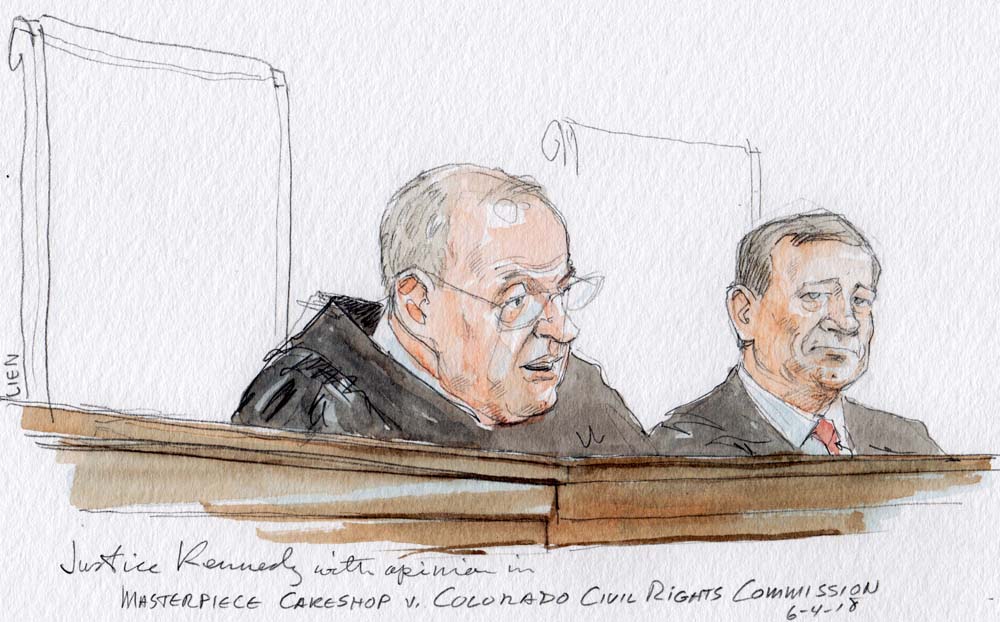
Justice Kennedy announces opinion in Masterpiece Cakeshop (Art Lien)
The dispute that led to today’s ruling began back in 2012, when Charlie Craig and David Mullins went to Masterpiece Cakeshop, a bakery outside Denver, to order a cake to celebrate their upcoming wedding. But Jack Phillips, the owner of the bakery and a devout Christian, refused the couple’s request because he is not willing to design custom cakes that conflict with his religious beliefs. A Colorado civil-rights agency ruled that Phillips had violated the state’s antidiscrimination laws and told him that, if he wanted to make cakes for opposite-sex weddings, he would have to do the same for same-sex weddings. After a Colorado court upheld that ruling, Phillips went to the U.S. Supreme Court last year.
Almost six months to the day after the oral argument, the justices today handed Phillips a victory, even if not necessarily the ruling that he and his supporters had hoped for. Kennedy, the author of some of the court’s most important gay-rights rulings, began by explaining that the case involved a conflict between two important principles: on the one hand, the state’s power “to protect the rights and dignity of gay persons who are, or wish to be, married but who face discrimination when they seek goods or services”; and, on the other, the First Amendment rights to freedom of speech and the free exercise of religion.
As a general rule, Kennedy explained, the Supreme Court’s cases make clear that Phillips’ right to freely exercise his religion is not absolute, and can be limited by neutral laws that apply to everyone. But the critical question of when Phillips’ right to exercise his religion can be limited had to be determined, Kennedy emphasized, in a proceeding that was not tainted by hostility to religion.
Here, Kennedy observed, the “neutral and respectful consideration to which Phillips was entitled was compromised” by comments by members of the Colorado Civil Rights Commission. One commissioner, Kennedy pointed out, “even went so far as to compare Phillips’ invocation of his sincerely held religious beliefs to defenses of slavery and the Holocaust.” Moreover, Kennedy added, the commission’s treatment of Phillips’ religious objections was at odds with its rulings in the cases of bakers who refused to create cakes “with images that conveyed disapproval of same-sex marriage.” Therefore, Kennedy concluded, the commission’s order – which, among other things, required Phillips to sell same-sex couples wedding cakes or anything else that he would sell to opposite-sex couples and mandated remedial training and compliance reports – “must be set aside.”
The majority left open, however, the possibility that a future case could come out differently, particularly if the decisionmaker in the case considered religious objections neutrally and fairly. “The outcome of cases like this in other circumstances,” the majority closed, “must await further elaboration in the courts, all in the context of recognizing that these disputes must be resolved with tolerance, without undue disrespect to sincere religious beliefs, and without subjecting gay persons to indignities when they seek goods and services in an open market.”
Justice Ruth Bader Ginsburg dissented from the court’s ruling, in an opinion joined only by Justice Sonia Sotomayor. Ginsburg stressed that there “is much in the Court’s opinion with which I agree,” but she “strongly” disagreed with the idea that the same-sex couple “should lose this case.” In particular, she argued, neither the commissioners’ statements about religion nor the commission’s disparate treatment of other bakers who refused to make cakes disapproving of same-sex marriage justified a ruling in favor of Phillips.
This post was originally published at Howe on the Court.

Recommended Citation: Amy Howe, Opinion analysis: Court rules (narrowly) for baker in same-sex-wedding-cake case, SCOTUSblog (Jun. 4, 2018, 1:36 PM), http://www.scotusblog.com/2018/06/opinion-analysis-court-rules-narrowly-for-baker-in-same-sex-wedding-cake-case/
 Submit Event


